
──────────
Share this analysis
Send this article to readers who follow biotech, company strategy, and capital-market signals.
PharmaEssentia has moved beyond the question of whether a Taiwan-developed medicine can win another approval. The harder phase begins after approval: whether physicians adopt the product, whether payers support access, whether patients remain on long-term therapy, and whether manufacturing and supply can keep pace with demand.
That is why the company’s approximately US$46 million Puerto Rico plan belongs in the same conversation. According to PharmaEssentia’s announcement, this is a planned investment, with operations expected to begin in 2027 after regulatory approval. It is not an operating commercial supply site today; it is a capacity and cost commitment intended to support the U.S. market and long-term global demand. [7]
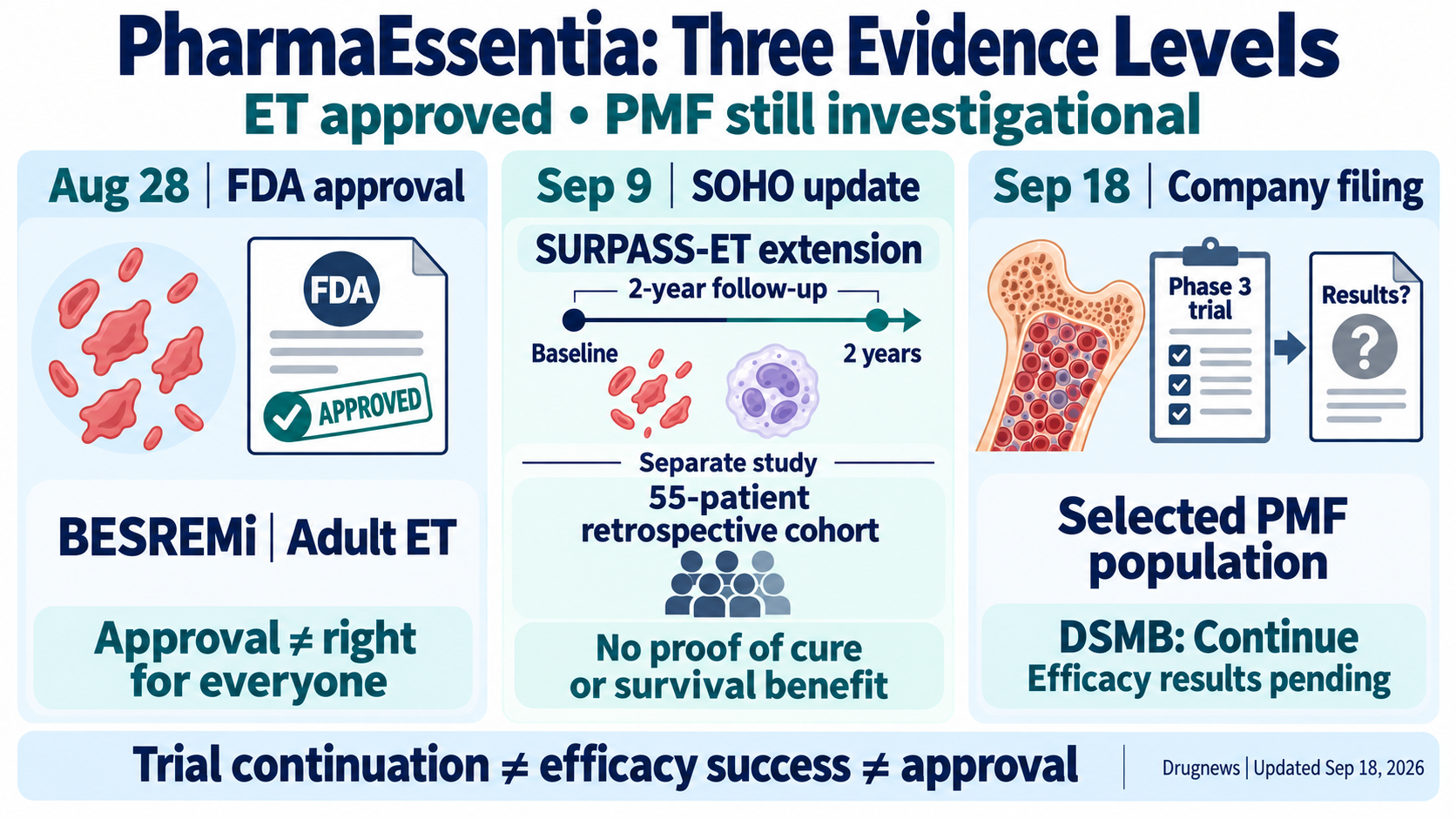
The clinical and commercial picture now has several moving parts. BESREMi has been approved by the FDA for adults with essential thrombocythemia, a blood disease indication; the polycythemia vera market now has a new competitive entrant; and the primary myelofibrosis program still needs formal data. These developments matter, but they belong to different timelines: adoption, competition and clinical-development risk. [1][3][5]
【Figure 1|Three updates, three evidence levels】
【01|ET Approval: Read the Population, Comparator and Endpoint Together】
ET is the clearest part of the story.
The FDA has approved BESREMi for the treatment of adults with essential thrombocythemia. The supporting SURPASS-ET study was an open-label, multicenter, randomized trial enrolling 174 adults with ET who had inadequate response or intolerance to hydroxyurea. It compared BESREMi with anagrelide. [1]
The endpoint is important. The FDA announcement and label describe durable modified European Leukemia Net, or ELN, response at Months 9 and 12. This was not a platelet-only endpoint. It included peripheral blood count remission, improvement or non-progression of splenomegaly, and absence of hemorrhagic or thrombotic events. Patients had to meet the response criteria at both Month 9 and Month 12. The response rate was 37.4% for BESREMi and 3.6% for anagrelide. [1][2]
That result supports approval. It also gives BESREMi a second U.S. MPN indication beyond polycythemia vera. But the number should stay attached to the trial setting. It is not a cure rate. It is not an average success rate across all adults with ET. It is a result in adults with ET who were resistant or intolerant to hydroxyurea, compared with anagrelide, using a composite endpoint.
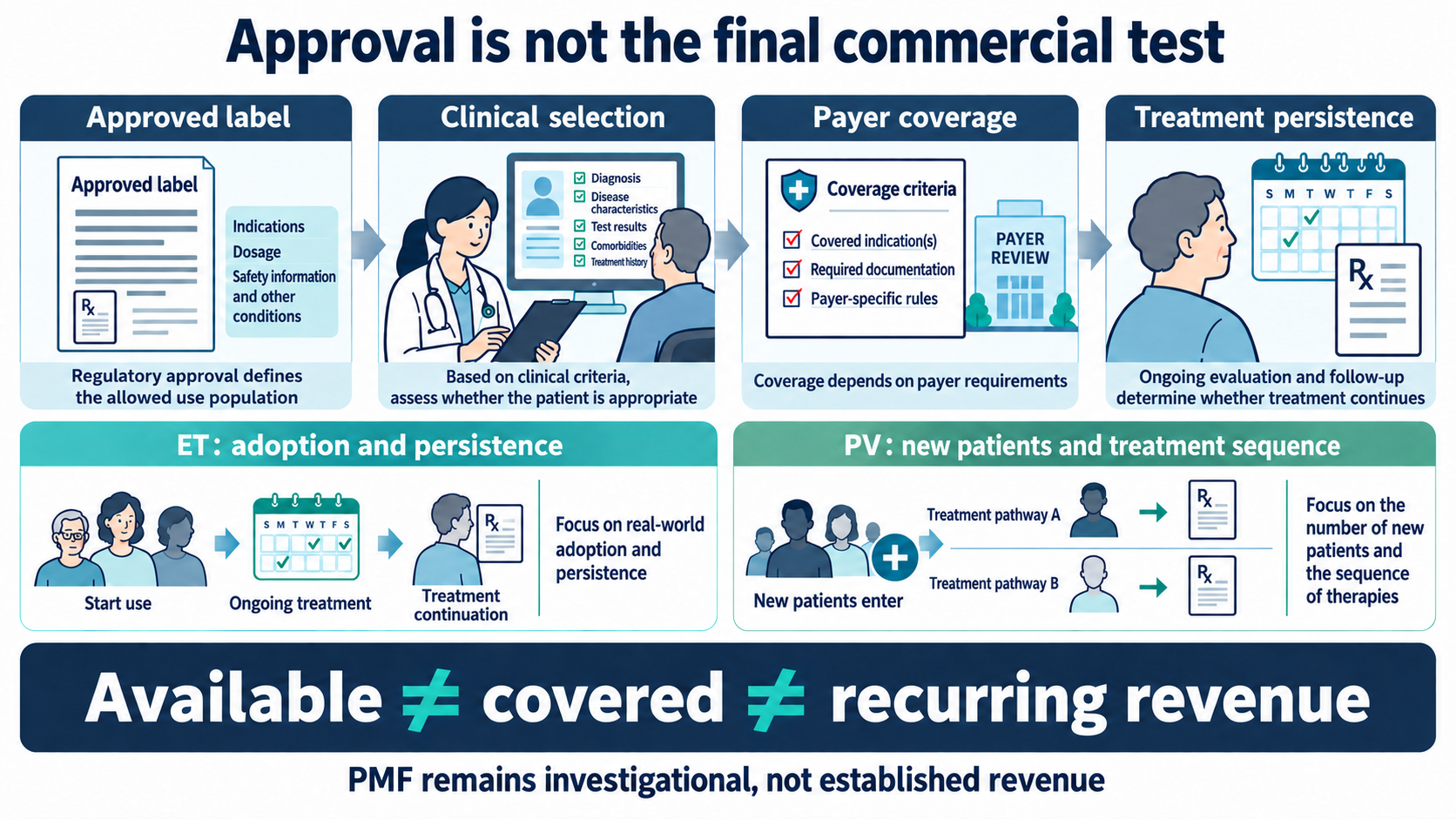
After approval, the practical question shifts. Physicians need to decide which patients fit the label and treatment sequence. Payers need to define access conditions. Patients need to manage long-term subcutaneous dosing, laboratory monitoring and tolerability. The label lists common adverse reactions in ET, including transaminase elevations, anemia, pyrexia, beta-2 microglobulin urine increased, bacterial infection, pruritus and weight decreased. Interferon alfa products also carry serious warnings, including neuropsychiatric, autoimmune, ischemic and infectious risks. [2]
That is the first commercial chain: approval opens the legal treatment pathway; endpoint data supports physician confidence; safety and monitoring shape long-term persistence; reimbursement determines the speed of adoption.
【02|SOHO Data: Filling in the ET Use Pattern】
PharmaEssentia’s September 9 announcement said it would present two ET datasets at the 2026 Society of Hematologic Oncology Annual Meeting. One is two-year data from the Phase 3 SURPASS-ET study and its ongoing extension. The other is a retrospective cohort of 55 ET patients treated with BESREMi in U.S. community oncology settings. [4]
According to the company summary, participants who continued BESREMi in the extension maintained modified ELN response rates as well as platelet and white blood cell control through two years, with continued reduction in JAK2V617F variant allele burden. Patients who transitioned from anagrelide to BESREMi after the 52-week core study showed improved hematologic control and reduced JAK2V617F allele burden relative to prior anagrelide therapy; long-term efficacy and safety analyses remain ongoing. [4]
The commercial relevance is straightforward. ET is a chronic disease. Physicians need more than a one-year endpoint to understand how treatment behaves over time. Durability, monitoring burden, laboratory control and tolerability all influence whether a therapy can become part of routine care.
The 55-patient retrospective real-world cohort adds a different lens. It evaluates how BESREMi is being used in community oncology settings. The company summary states that BESREMi was most commonly initiated after first-line therapy, while first-line use was also observed, predominantly in younger patients. Platelet counts and response rates trended toward optimal levels regardless of prior cytoreductive therapy history. [4]
Retrospective data cannot replace randomized evidence. It can be shaped by patient selection, treatment decisions and record completeness. Still, after approval, real-world data helps answer a different question: which patients are physicians actually selecting, and how is the treatment being introduced outside the trial setting?
【03|PV Competition: Different Mechanisms, Different Questions】
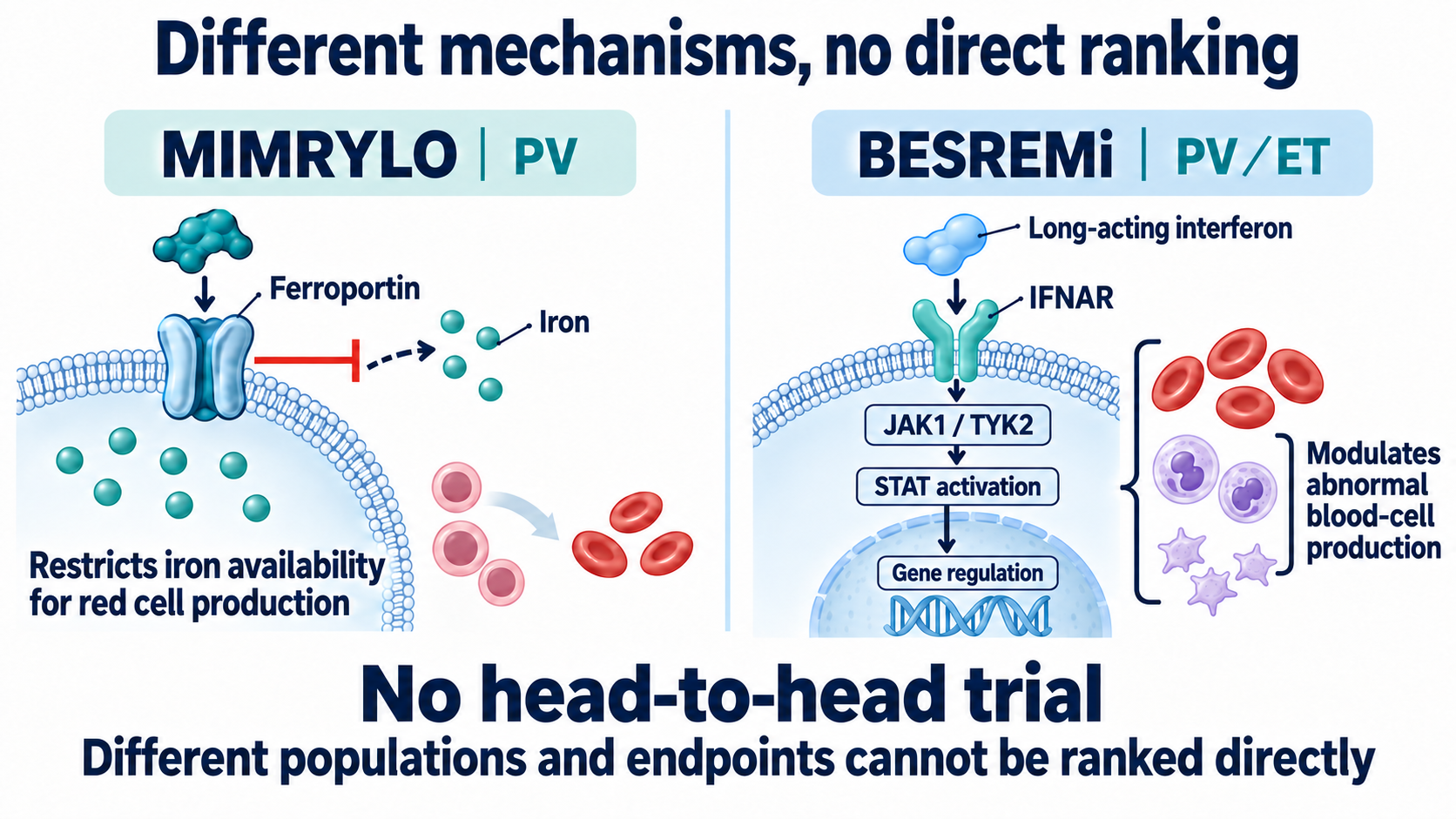
The PV market is also changing. On August 28, 2026, the FDA approved Mimrylo, or rusfertide, for adults with polycythemia vera and erythrocytosis. The FDA described rusfertide as a hepcidin mimetic that limits available iron for red blood cell production. The VERIFY trial enrolled 293 adults with PV who required frequent phlebotomies despite ongoing standard-of-care therapy and randomized them to rusfertide or placebo over 32 weeks. [5]
This matters to PharmaEssentia because BESREMi is already established in PV. But PV, ET and PMF are different clinical settings even though they all fall within the broader MPN landscape. A PV approval should not be used to rank an ET response rate, and it does not answer the PMF question.
The mechanisms also differ. BESREMi is ropeginterferon alfa-2b, a long-acting interferon. The FDA label explains that interferon alfa binds to IFNAR, triggering downstream signaling through JAK1, TYK2 and STAT proteins. STAT translocation into the nucleus influences gene-expression programs. The label also states that the actions involved in the therapeutic effects of interferon alfa in PV and ET are not fully elucidated. [2]
Figure 2 should therefore be read as a simplified mechanism boundary. Mimrylo works through iron regulation. BESREMi works through interferon signaling. There is no head-to-head trial between them. For PharmaEssentia, the key PV questions are new patient starts, treatment sequencing, persistence and payer behavior after rusfertide enters the market.
【Figure 2|Different mechanisms do not equal a head-to-head answer】
【04|PMF: Continuation Keeps the Study Alive, but the Result Is Still Ahead】
PMF remains the earlier-stage clinical risk.
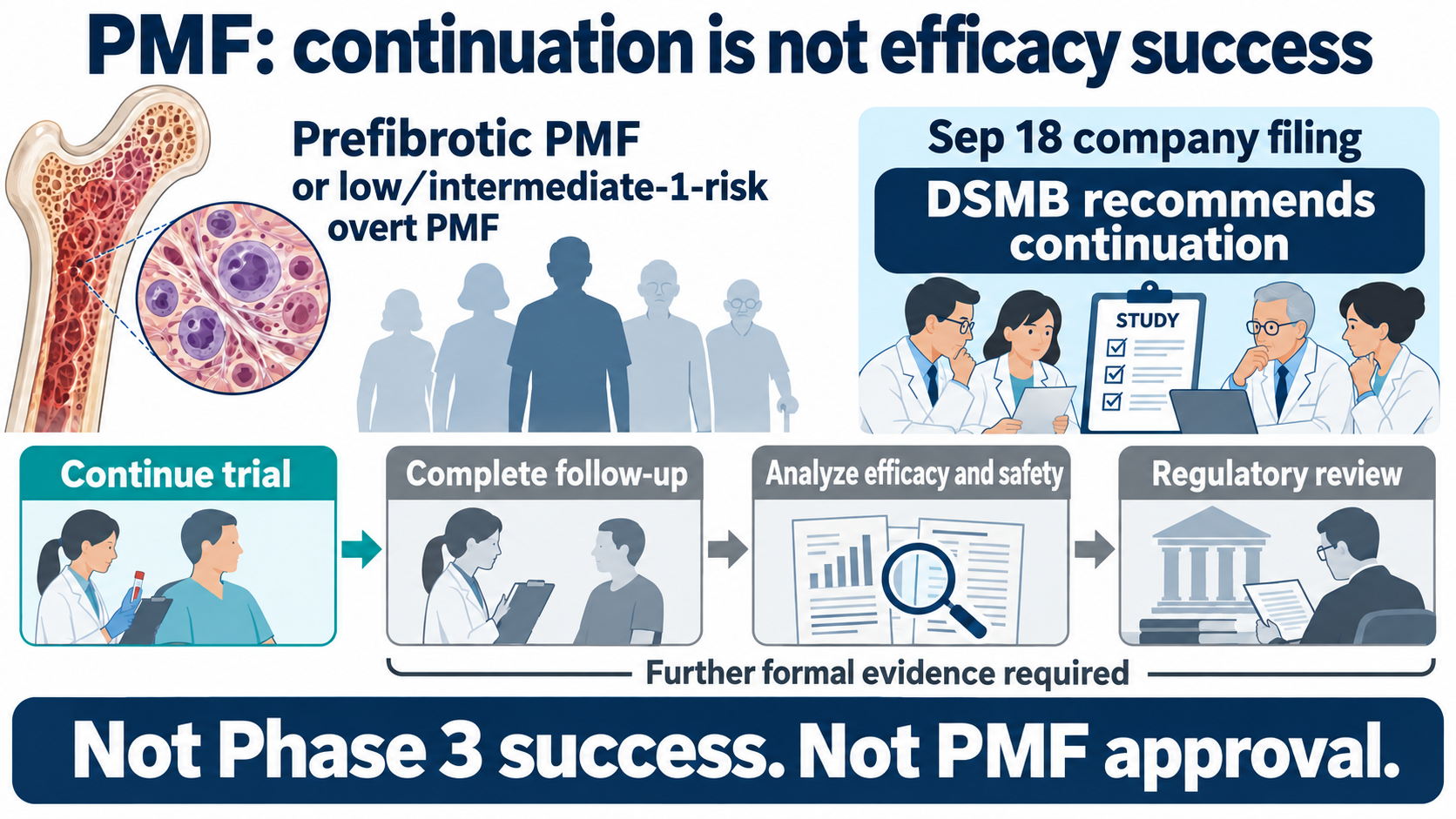
The September 18 disclosure concerns P1101 in early primary myelofibrosis or overt primary myelofibrosis with low or intermediate-1 risk. This is a defined patient population. It is not a broad PMF label, and ET approval does not automatically extend to PMF. [3]
A DSMB recommendation to continue means the study was not stopped after data and safety review. That is meaningful in development. It keeps the PMF path open.
The value, however, still depends on future data. The disclosure does not provide primary efficacy results, effect size, statistical analysis or regulatory filing timing. PMF should therefore be treated as a clinical-development option rather than a confirmed revenue contributor.
Commercially, a positive PMF outcome could expand PharmaEssentia’s MPN franchise beyond PV and ET. If the data are not strong enough, the company remains anchored in its approved indications and existing pipeline. At this stage, the right position is simple: the study continues, but the conclusion has not arrived.
【Figure 3|PMF study progress cannot skip steps】
【05|From Evidence to Revenue: Execution Becomes the Main Question】
PharmaEssentia is no longer only a development-stage story. BESREMi is now a global product requiring manufacturing, market access, medical education and long-term patient management.
Manufacturing matters to the revenue curve. PharmaEssentia’s global manufacturing page states that its Taiwan manufacturing center was built in 2012 as a 43,000-square-foot cGMP facility combining PEG production, API production and automated aseptic filling. It also says the company’s main manufacturing facility at Central Taiwan Science Park in Taichung includes a PEG production plant, a biologic drug substance production plant and an aseptic filling plant. Two drug substance production lines provide capacity to support up to 40,000 patients. The page states that new facilities, expected to be completed by 2026, will expand capacity to serve more than 100,000 patients worldwide, and that efforts are underway to expand U.S. manufacturing components, including fill and finish. [6]
Puerto Rico is another layer. On February 9, 2026, PharmaEssentia announced that its board had approved an approximately US$46 million investment to establish a wholly owned manufacturing subsidiary in Puerto Rico. The company described it as a planned investment to support global manufacturing expansion and as a future manufacturing center for the U.S. market and long-term global demand for BESREMi. The announcement also says the company plans to obtain regulatory approval and commence operations in 2027. This is a planned facility and future capacity, not an operating commercial supply site today. [7]
After ET approval, the commercial cause-and-effect chain becomes more concrete. If physicians adopt BESREMi more broadly in ET, demand first appears through patient starts and prescription coverage. If reimbursement improves, revenue can become more stable. If patients remain on therapy over time, supply reliability and manufacturing cost matter more. Conversely, if payer access is slow, physician selection remains conservative or tolerability limits persistence, revenue may build more slowly than the label alone suggests.
【Figure 4|From evidence to revenue, several gates remain】
【06|Industry Visibility Is Useful, but Commercialization Must Still Be Executed】
The Presidential Office event shows how visible PharmaEssentia has become as a Taiwan-developed drug company operating internationally. The Vice President described the long path from R&D and clinical trials to international regulatory approval, and emphasized the difficulty and uncertainty involved in drug development. [8]
That matters because PharmaEssentia’s model is heavier than a simple licensing story. The company is developing, manufacturing and commercializing its own product across markets, which means clinical development, regulatory work, manufacturing systems, market access, sales infrastructure and post-approval medical support all need to work together. If execution succeeds, the company may retain more product rights and revenue participation than a pure licensing model; if adoption is slower than expected, the same integrated structure can also make fixed costs and operating burden more visible.
For investors following 6446, the next questions are operational. How quickly are ET patients being started in the United States? How do payer conditions evolve? Does rusfertide change PV treatment sequencing? When will the next formal PMF data point arrive? Can the Taiwan and Puerto Rico manufacturing strategy support demand growth without turning capacity expansion into a cost burden?
Those questions will take time to answer. They are also closer to the company’s actual value than a single headline.
【Conclusion|ET Is About Adoption, PV Is About Competition, PMF Is About Results】
PharmaEssentia’s latest updates sit at different maturity levels.
ET is approved; the next task is adoption, access and persistence. SOHO data add follow-up and real-world context, but they remain part of the evidence-building process. PMF continues after DSMB review, but the efficacy result is still ahead.
The company has entered an execution phase. ET needs to become prescriptions and recurring treatment. PV needs to navigate new competition. PMF needs formal data. Manufacturing needs to scale with demand without overburdening the business.
That is a harder story than a single approval headline. It is also the kind of story that shows whether a Taiwan biotech company can move from developing a product to operating a global product franchise.
This article is for biotech industry and research information only and does not constitute individualized medical or investment advice. Treatment decisions should be made by healthcare professionals based on individual circumstances and the latest approved labeling. Research progress does not guarantee regulatory approval or investment returns.
Sources
[1] FDA — Essential thrombocythemia approval announcement https://www.fda.gov/drugs/news-events-human-drugs/fda-approves-treatment-essential-thrombocythemia
[2] FDA — BESREMi prescribing information (revised August 2026) https://www.accessdata.fda.gov/drugsatfda_docs/label/2026/761166s013lbl.pdf
[3] MOPS — PharmaEssentia material information (company 6446; September 18, 2026, 05:36:43) https://mops.twse.com.tw/mops/#/web/t05st01
[4] PharmaEssentia USA — SOHO 2026 announcement (September 9, 2026) https://us.pharmaessentia.com/pharmaessentia-to-present-at-the-society-of-hematologic-oncology-soho-2026-annual-meeting/
[5] FDA — Mimrylo approval announcement (August 28, 2026) https://www.fda.gov/news-events/press-announcements/fda-approves-first-drug-its-kind-polycythemia-vera-rare-blood-disorder
[6] PharmaEssentia — Manufacturing (undated page; ©2026) https://www.pharmaessentia.com/products/manufacturing
[7] PharmaEssentia — Planned Puerto Rico manufacturing facility (February 9, 2026) https://www.pharmaessentia.com/news/pharmaessentia-announces-plans-to-establish-new-us-manufacturing-facility-in-puerto-rico-to-support-global-growth-of-besremi
[8] Taiwan Presidential Office — PharmaEssentia event (September 18, 2026) https://www.president.gov.tw/NEWS/40354
Cite this article
For decks, research notes, or media references, cite Drugnews with the canonical article URL.
Drugnews Editorial Team. "PharmaEssentia After a New Indication Approval: A US$46 Million Plant Plan for Long-Term Supply." Drugnews, Sep 21, 2026. https://drugnews.com.tw/articles/2026-09-21-pharmaessentia-besremi-et-mimrylo-fda-en.html