
You want the number on the scale to fall, not to see more hair coming out when you wash it. Hair loss has been reported during treatment with weight-loss injections. Although it does not happen to everyone, it adds a very tangible cost to losing weight: the medicine may work, but the process also has to be manageable.
Share this analysis
Send this article to readers who follow biotech, company strategy, and capital-market signals.
Weight-loss medicines are often judged by how much weight is lost at the end. Users, however, experience every day from their first injection through maintenance treatment. When hair starts shedding and how the body responds to eating less may not move in step with the scale. That gap is a question product competition has yet to fully answer.
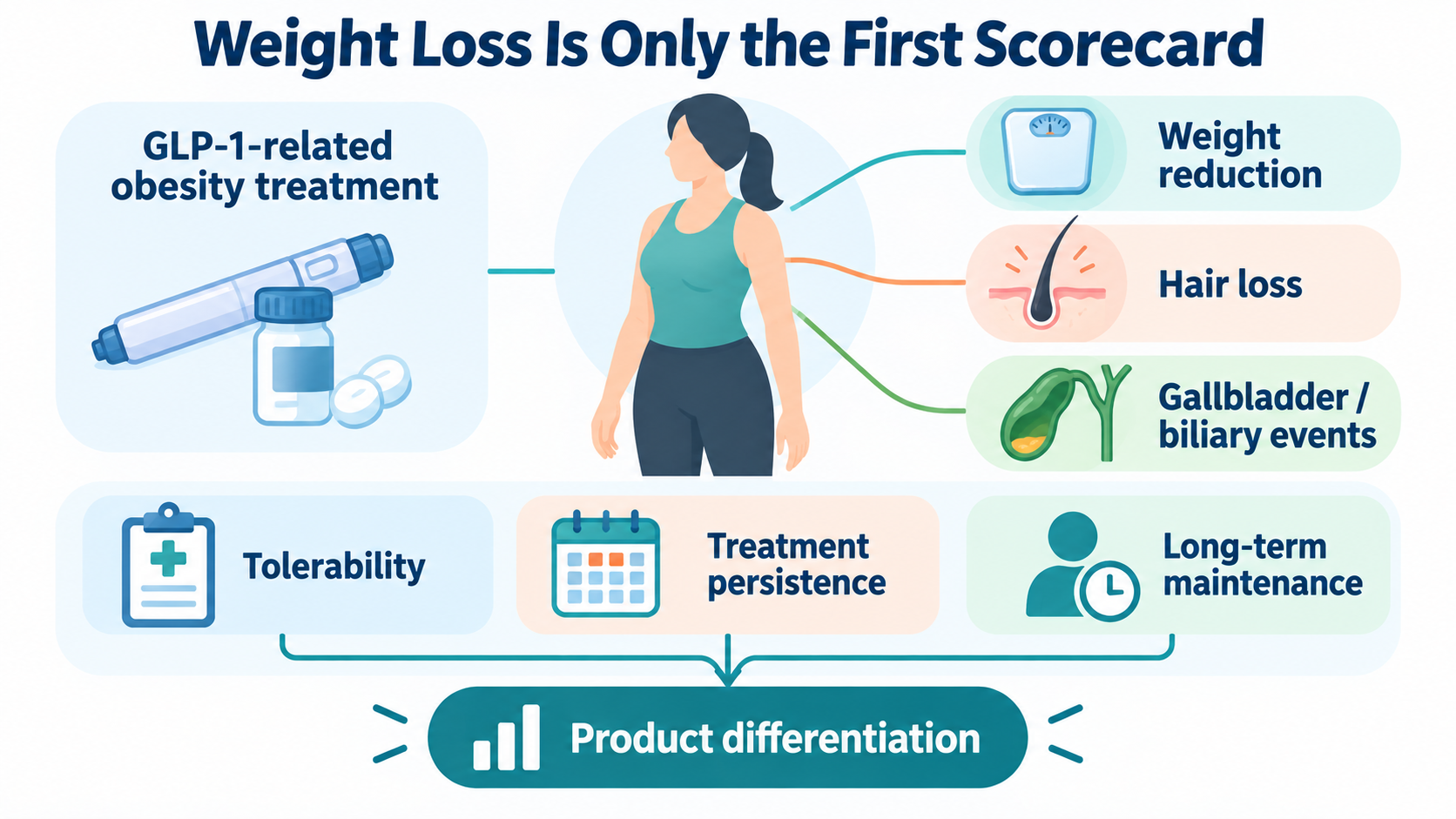
The value of GLP-1-related obesity treatment is not defined by weight reduction alone. Hair loss, gallbladder or biliary events, tolerability and the ability to remain on treatment can all influence long-term use and product differentiation.
Weight Changes First; Hair Follicles May Report Back Months Later
These medicines regulate appetite through incretin-related signals such as GLP-1, or glucagon-like peptide-1. As food intake falls and body weight changes, treatment effects and the body’s adjustments begin to intertwine.
A 2026 meta-analysis of hair loss included nine interventional studies, with 4,114 users of GLP-1-related medicines across the review as a whole. In the subset of data that could be compared with placebo, the pooled relative risk of hair loss was approximately 3.25.
The 4,114 figure is the total number of treated users across the review. The relative risk of 3.25 comes from the placebo-comparison analysis and expresses the relative difference between the groups’ event proportions; it does not mean that one-third of users lose hair.
Why might hair be affected? Hair follicles normally cycle through growth, resting and other phases. After substantial weight loss, severe dieting, illness or surgery, some follicles may enter the resting phase early, with more noticeable diffuse shedding appearing several months later.
A 2024 single-center retrospective study documented weight-loss-associated telogen effluvium and discussed the influence of calorie restriction. Hair follicles are not synced to the scale in real time: changes visible now may relate to food intake and weight changes during an earlier period.
This also explains why asking only whether this week’s injection caused discomfort does not capture the full treatment burden. What people eat after their intake falls, and how long those changes last, need to be understood together over time. Current evidence is insufficient to attribute every episode of hair loss to the same cause, and it has not established that the medicines directly damage hair follicles.
For a product, the issue extends beyond hair volume itself. Patients may already be seeing weight-loss benefits, only to encounter an unexpected burden months later. Addressing the experience of “it works, but I am becoming more hesitant to keep using it” can influence their next choice.
Why Is the Gallbladder Risk More Pronounced in Weight-Loss Treatment?
Gallbladder changes are less visible than hair loss, but the evidence comes from a larger research pool. A 2022 meta-analysis in JAMA Internal Medicine, including 76 randomized trials and 103,371 participants, found a 37% increase in the overall relative risk of gallbladder or biliary disease with GLP-1 receptor agonist treatment.
On an absolute scale, that amounts to approximately 27 additional events per 10,000 patient-years.
This is the average additional event rate across the overall study pool, expressed in terms of follow-up time. It does not mean that 37% of patients will develop disease, nor is it a fixed probability specific to the weight-loss subgroup or to an individual.
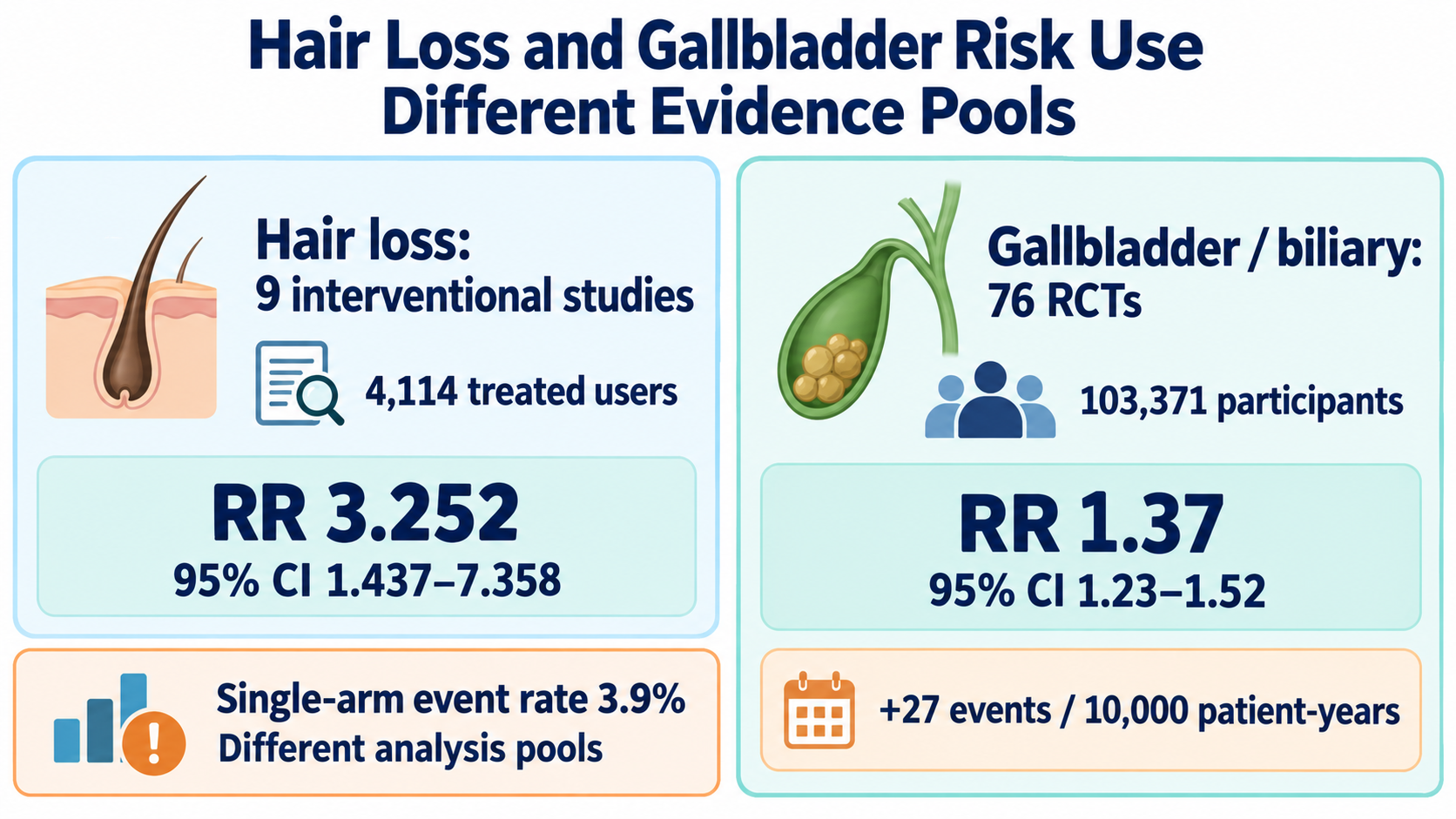
The hair-loss RR of 3.252 and the 3.9% single-arm event rate come from different analytical pools and cannot be reverse-calculated from one another. The gallbladder/biliary meta-analysis reports both RR 1.37 and an absolute increase of about 27 events per 10,000 patient-years, which answer different risk questions.
The difference by treatment purpose warrants a closer look: the relative risk was approximately 2.29 in weight-loss trials and 1.27 in trials for diabetes or other uses, each compared with its own control group. Knowing the drug class alone is therefore not enough; the treatment setting also matters.
The gallbladder stores and releases bile. The U.S. NIDDK explains that prolonged periods without eating or rapid weight loss can cause the liver to release more cholesterol into bile; rapid weight loss can also interfere with normal gallbladder emptying. Changes in bile composition and emptying can increase the likelihood of gallstone formation.
The speed of weight loss is therefore more than a measure of progress. Even if the final amount lost is the same, the body may experience a different process when changes in food intake and weight are concentrated into a shorter period. The scale diligently reports the kilograms, but it does not come with a progress report from the gallbladder.
However, these trials also differed in dose, duration and weight change; they did not separately randomize participants to faster or slower weight loss. The Wegovy label further notes that acute gallbladder disease was more frequent in the treatment group even after accounting for the degree of weight loss. Differences by treatment purpose therefore do not directly establish speed as the cause, and slower weight loss offers no guarantee of safety.
The useful question is whether food intake, weight change and the burden on the body can be managed better while retaining effective weight loss. That is closer to what a product might actually improve than either pursuing the fastest possible decline or assuming that slower is always better.
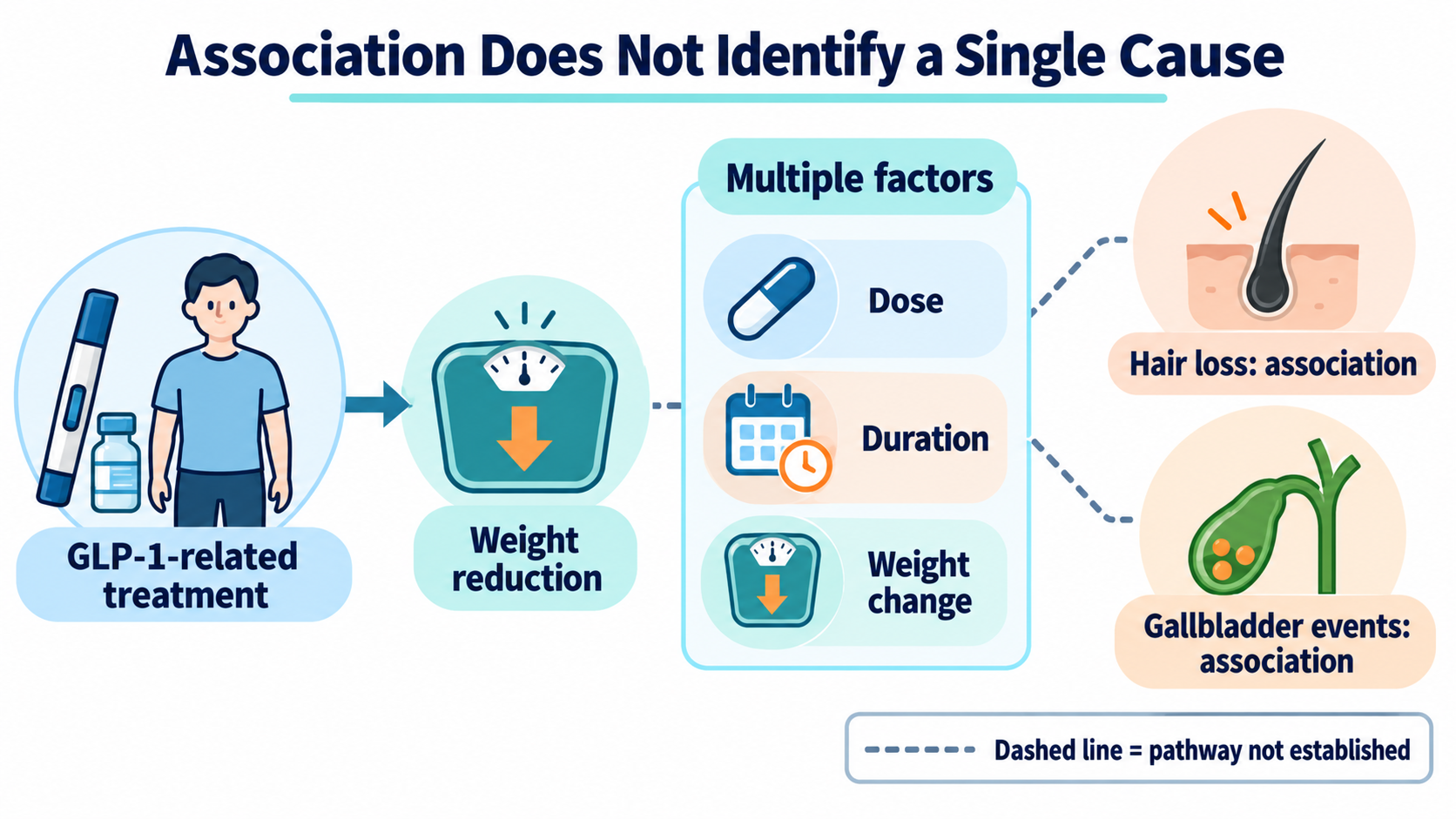
Current evidence supports associations with hair loss and gallbladder or biliary events, but it does not reduce them to a single causal pathway. Indication, dose, duration and weight change overlap, so existing meta-analyses cannot establish that faster weight loss alone explains the risk.
The Next Selling Point Is Not Asking Patients to Put Up with More
Giving the body time to adjust is not an overlooked idea. The U.S. label for Wegovy (semaglutide) already specifies dose escalation for the injection, expressly to reduce gastrointestinal adverse reactions; clinicians may consider delaying escalation when it is not tolerated.
This existing design establishes the competitive starting point: a new product or regimen cannot claim innovation simply by saying “take it slowly.” The escalation recommendation addresses gastrointestinal tolerability; it does not establish prevention of hair loss or gallstones.
The next unmet need is to make the full weight-loss journey more manageable while preserving meaningful efficacy. Concrete reasons to choose a product could center on three areas:
- 🪜 Fewer interruptions during dose escalation: Starting and escalation regimens that allow patients struggling with discomfort to continue effective treatment could provide a reason to choose a product. The goal is a better actual experience, not simply a longer escalation period.
- 💊 Formulation changes must translate into everyday benefits: New release profiles or administration designs are valuable when they reduce discomfort and disruption to daily life, rather than merely making a drug-concentration curve look better.
- ⏱️ Tolerable Treatment Still Needs Timely Results: Even with similar efficacy, taking too long to reach the goal can add waiting, appointments and medication costs, making treatment less appealing. Patients need a worthwhile trade-off, not a weaker medicine repackaged.
A more comfortable start and fewer later episodes of hair loss or gallbladder events are distinct product promises. The former may first ease difficulties during dose escalation; the latter, if demonstrated, could also address the concerns of people already seeing benefits but becoming hesitant because of later burdens. That makes product positioning more precise than a blanket claim of “fewer side effects.”
For drugmakers, demand does not come only from people trying weight-loss treatment for the first time. For users who have benefited but are considering stopping because of discomfort during escalation or later treatment, a regimen that addresses that barrier may be more appealing than a few additional percentage points of weight loss. Reducing those interruptions could sustain prescriptions that would otherwise be lost, allowing differences in treatment experience to translate into revenue.
This opportunity is not limited to new molecules. Dose-escalation regimens and formulations of existing products can also improve. The additional burden a product can address is the source of its added value.
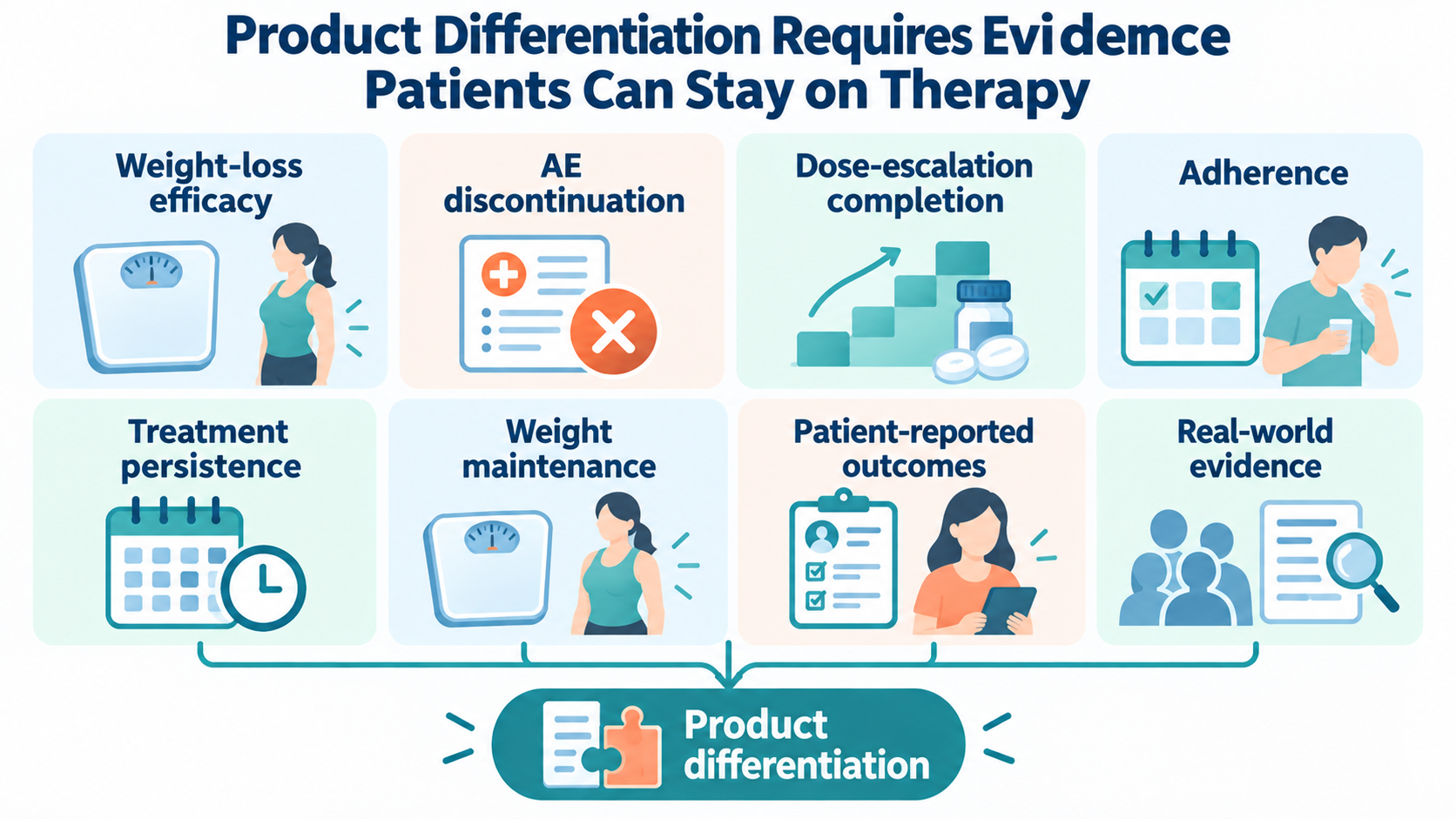
A durable product advantage requires more than mean weight loss. Discontinuation, dose-escalation completion, adherence, persistence, weight maintenance, patient-reported outcomes and real-world evidence are needed to support a claim that patients can remain on therapy more successfully.
Can the next weight-loss medicine give patients fewer moments of “it works, but I no longer want to use it,” without sacrificing worthwhile efficacy? Whoever manages that trade-off better will not have to rely solely on the lowest number on the scale to persuade the market.
This article provides industry information and business analysis and does not constitute individualized medical or investment advice.
Public Research Sources
| Study / information | Supporting points | Journal or official link |
|---|---|---|
| Meta-analysis of GLP-1-related medicines and hair loss (2026) | Nine interventional studies and 4,114 treated users across the review; pooled hair-loss relative risk in placebo comparisons | Journal DOI |
| Kang et al.: Weight-loss-associated telogen effluvium (2024) | Hair-follicle cycles, delayed shedding and the background of calorie restriction | Annals of Dermatology |
| Meta-analysis of GLP-1 receptor agonists and gallbladder/biliary disease (2022) | Overall relative and absolute risks and differences between weight-loss and other indications | JAMA Internal Medicine |
| NIDDK: Dieting & Gallstones | Rapid weight loss, cholesterol in bile and gallbladder emptying | Official information |
| Wegovy U.S. prescribing information | Gastrointestinal-tolerability purpose of injection dose escalation, possible delayed escalation and gallbladder-risk qualifications | Manufacturer’s prescribing information |
Cite this article
For decks, research notes, or media references, cite Drugnews with the canonical article URL.
Drugnews Editorial Team. "Weight-Loss Injections: The Goal Is to Lose Weight, Not Hair." Drugnews, Oct 02, 2026. https://drugnews.com.tw/articles/2026-10-02-glp1-weight-loss-speed-hair-gallbladder-safety-en.html