
On October 7, the 2026 Nobel Prize in Chemistry was announced. Henri B. Kagan and Kenso Soai were awarded for nonlinear effects and autocatalysis in asymmetric organic synthesis.
Share this analysis
Send this article to readers who follow biotech, company strategy, and capital-market signals.
The terminology sounds demanding. The question is wonderfully intuitive: when two sides start almost tied, can a chemical reaction take one side's tiny advantage and make it much larger?
What does that have to do with medicines? Look at your hands. They are remarkably similar and appear as mirror images when their palms face each other. Yet rotating one will not make it perfectly overlap the other. Molecules can behave this way too: the same composition, arranged as mirror images in three dimensions, need not be treated as the same thing inside the body.
This Nobel story takes us from molecules having two “hands” to reactions that favour one of them.
The body reads more than an ingredient list
No amount of rotation turns a left glove into a right glove.
Shrink that picture to the molecular scale and chirality becomes easier to understand. Some molecules cannot be superimposed on their own mirror images. The two mirror-image forms are called enantiomers.
“Left” and “right” are analogies, not actual molecular hands. In a common tetrahedral arrangement, a centre is attached to four different groups. Making its mirror image changes their spatial orientation.
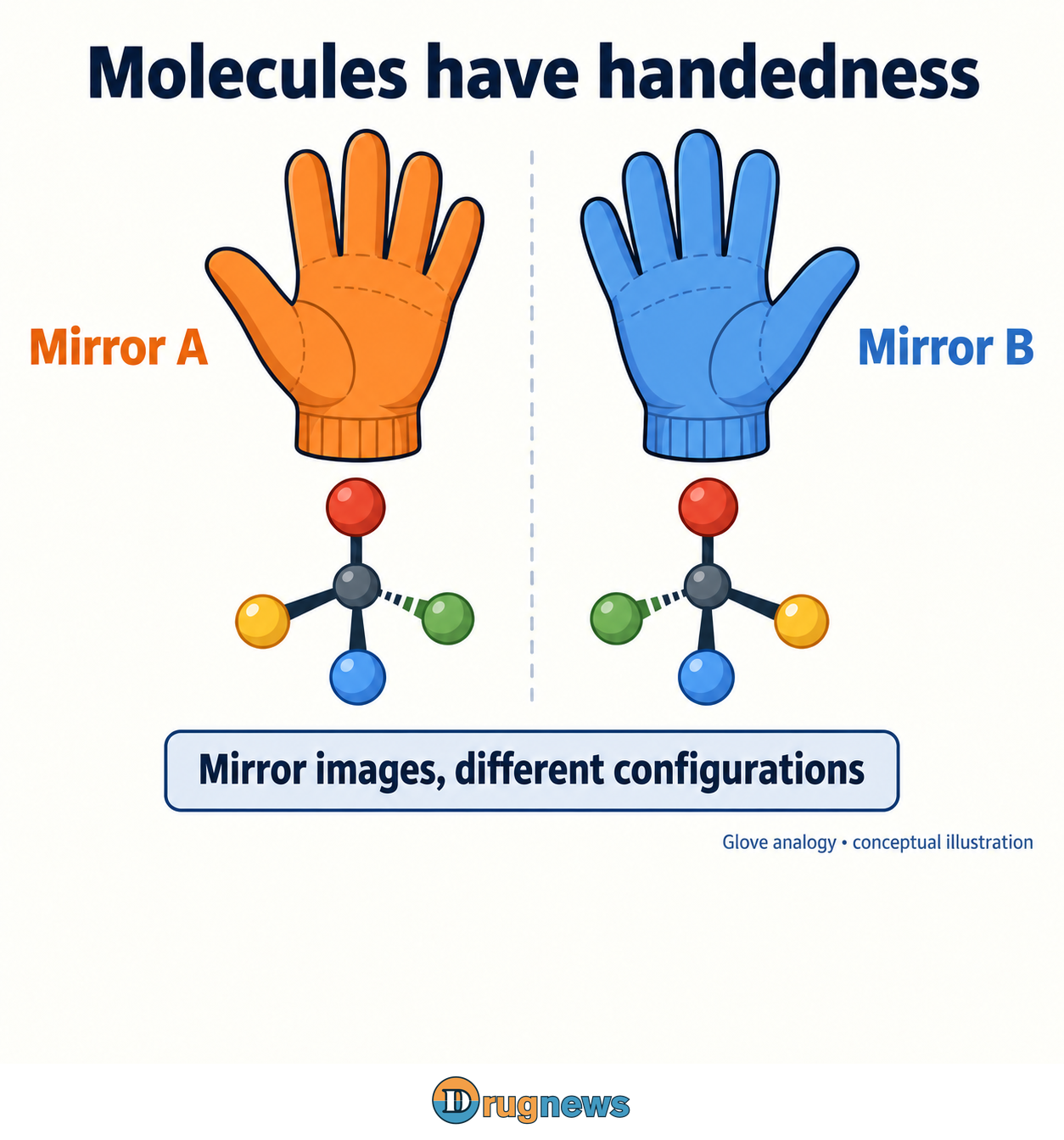
Figure 1 | Glove analogy and mirrored tetrahedral models with four distinct groups; not a particular drug structure.
Proteins in the body have three-dimensional shapes of their own. When a drug encounters one, the match involves not just which atoms are present, but where they point. Imagine reflecting a key with the same pattern of teeth: the way it meets a directional lock may change.
Choosing a configuration and controlling the proportions of the two forms are therefore problems for medicinal chemistry. The consequences depend on the particular molecule and its data; one cannot label every “left hand” good and every “right hand” bad.
That is only the entrance to the story.
If a reaction produces a pair of mirror-image forms, the next challenge is to make more of the desired one. Producing a nearly equal mixture and then separating it turns synthesis and separation into two jobs.
Asymmetric synthesis establishes selectivity during the reaction. The work recognised this year goes further: the chiral bias in the starting material and the bias in the product need not follow a simple proportional relationship.
Understand the percentage before admiring the decimal places
Chemists often describe the bias between enantiomers using ee, or enantiomeric excess.
Take an imaginary mixture. If each mirror-image form accounts for 50%, ee is 0%. If one accounts for 51% and the other 49%, ee is 2%. It is the difference between their proportions, not a statement that the reaction used 2% catalyst.
At the other extreme, 100% of one form and 0% of the other gives 100% ee. A higher ee describes a stronger preference for one member of the pair.
The percentage answers “how far apart are the two proportions?”, not “how much product was made?”. Yield measures the amount of product obtained; ee describes enantiomeric composition. A small amount of product can have a high ee, and a high-yield reaction can still give nearly equal proportions.
That distinction is useful when reading chemistry news. An impressive percentage may refer to selectivity or to quantity. First identify what it measures, then ask which conclusion it changes.
Now comes the counterintuitive question:
If the initial bias is tiny, must the product's bias also be tiny?
It is tempting to picture a reaction as a vote: nearly equal numbers on each side should give a nearly equal result. But a catalytic reaction is a system with its own response. The relationship between input and output has to be measured, not assumed to copy the initial proportions.
Nonlinearity: a reaction need not copy the starting proportions
Kagan and colleagues' 1986 work on asymmetric oxidation and aldol reactions was an important point on this path.
“Nonlinear” means that input and output do not follow a simple proportional relationship. Here, the question concerns the chiral bias of the starting catalytic material and the chiral bias of the product.
Some systems with a positive nonlinear effect can turn a relatively modest input bias into a stronger bias in the product.
Researchers must therefore ask not only how enantiomerically enriched the starting material is, but how the catalytic system responds to it. The same starting proportions cannot simply be assumed to give the same result in different systems or conditions.
This is a valuable shift in scientific thinking: an apparently minor mixture ratio becomes a variable to measure and analyse. The task is not to memorise a purity number, but to establish the input–output relationship.
The curve in the figure is conceptual, not data from the 1986 experiments. It explains the difference between a response that amplifies bias and a proportional response. The performance of a particular reaction still belongs to its own conditions and results.
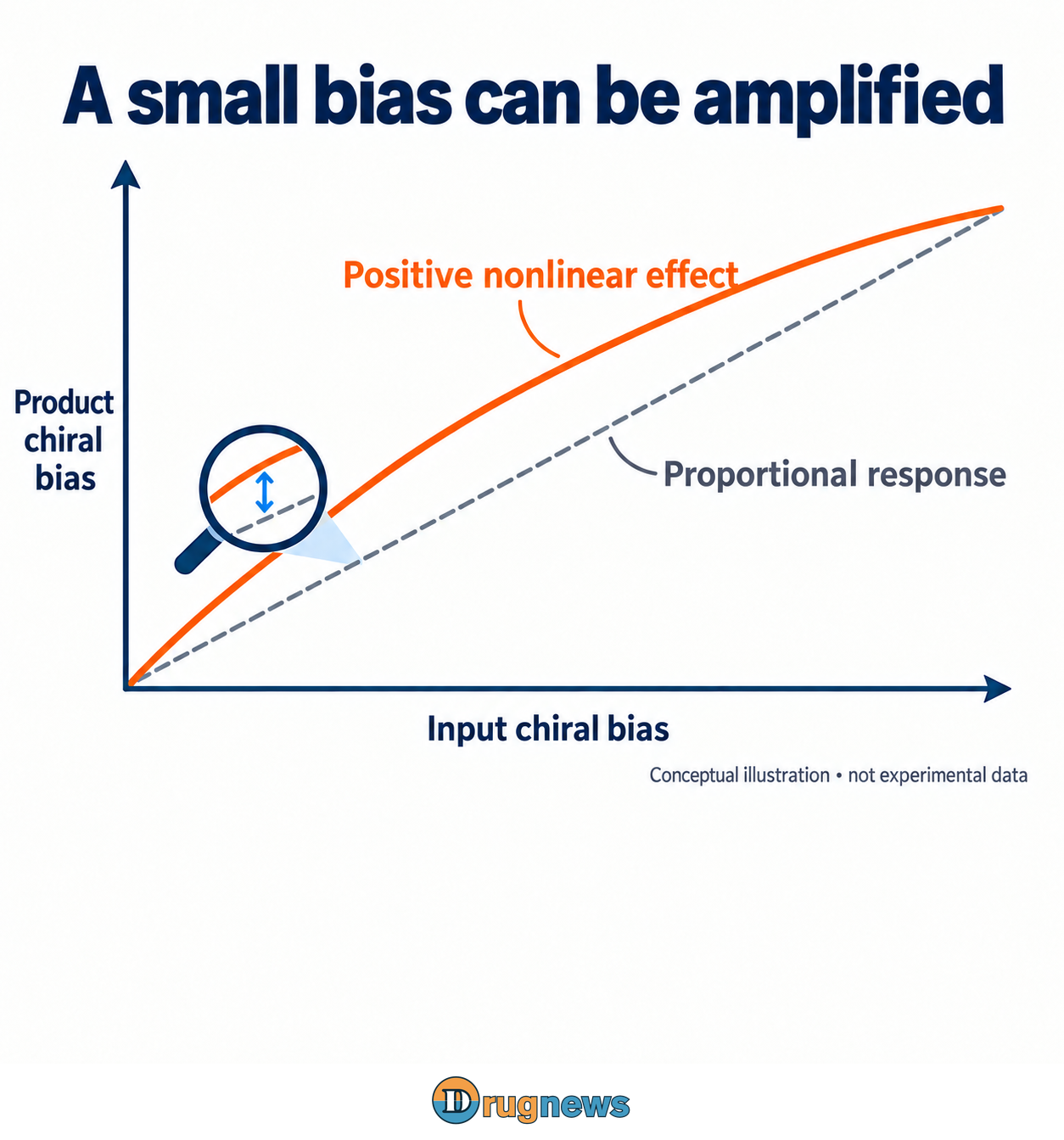
Figure 2 | A conceptual positive nonlinear input–output response, without experimental scales; not the 1986 data.
Why the system responds that way is a further question.
Nonlinearity describes a relationship. Autocatalysis describes how a reaction operates. The two can occur together in particular systems, but a curved line alone does not mean that the product catalyses its own formation.
The product goes back to help form the next batch
In 1995, Soai and colleagues took the problem to another level. Their public abstract described a pyrimidyl alcohol with an initial ee of 2% producing more of the same alcohol through asymmetric autocatalysis, with increased enantiomeric excess.
The work used diisopropylzinc and pyrimidine-5-carbaldehyde. For a general reader, the change in roles matters more than memorising the reactants: the product is not only the endpoint. Within the reaction system, it participates in promoting the formation of more of the same product.
Think of a team whose earlier members help recruit later ones. The process still needs reactants; its members are not conjuring copies of themselves from nothing.
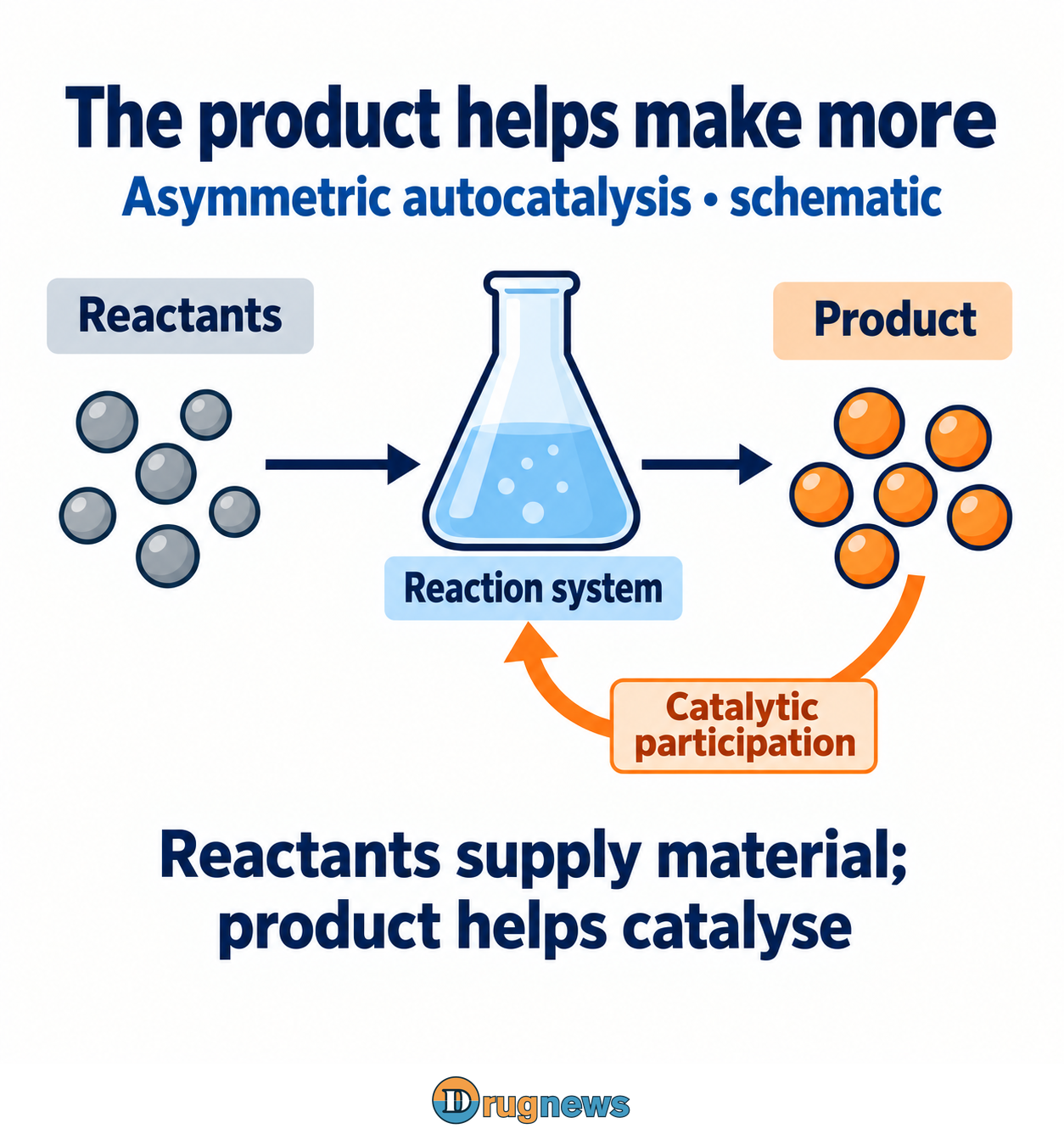
Figure 3 | Reactants form product; product participates in catalysis. Icon counts are not measured quantities or molecular structures.
That feedback can carry a small initial bias forward and amplify it.
Scientists thus obtained a chemical route they could study experimentally: the starting mixture need not be overwhelmingly dominated by one side for the reaction to widen the difference.
The interesting questions concern how the product participates and how the bias changes, not just whether the reaction runs faster. Distinguishing those roles keeps catalysis, chiral selection and amplification from collapsing into one vague “remarkable ability”.
Later experiments on this research path explored even smaller initial biases.
A difference of fifty parts in one hundred million
In 2003, Sato and colleagues reported a striking example.
In a specific asymmetric autocatalytic experiment involving a 2-alkynylpyrimidyl alcohol, a nominal initial bias of about 0.00005% ee led to product with more than 99.5% ee after three reaction rounds.
At first glance, 0.00005% looks like little more than a string of zeros.
Here is a more tangible interpretation. At that nominal ratio, in one hundred million parts of a mirror-image pair, the more abundant side exceeds the other by only fifty parts. This is an arithmetic illustration of the ratio, not a claim that researchers counted one hundred million molecules individually.
A long decimal does not mean that every digit was directly measured by an instrument.
The extremely small starting value was nominal, prepared through mixing and dilution, and below the direct detection capability of the commonly used instruments. How the starting value was obtained is part of understanding the experiment. It is a different layer of information from the highly enriched product reported afterwards.
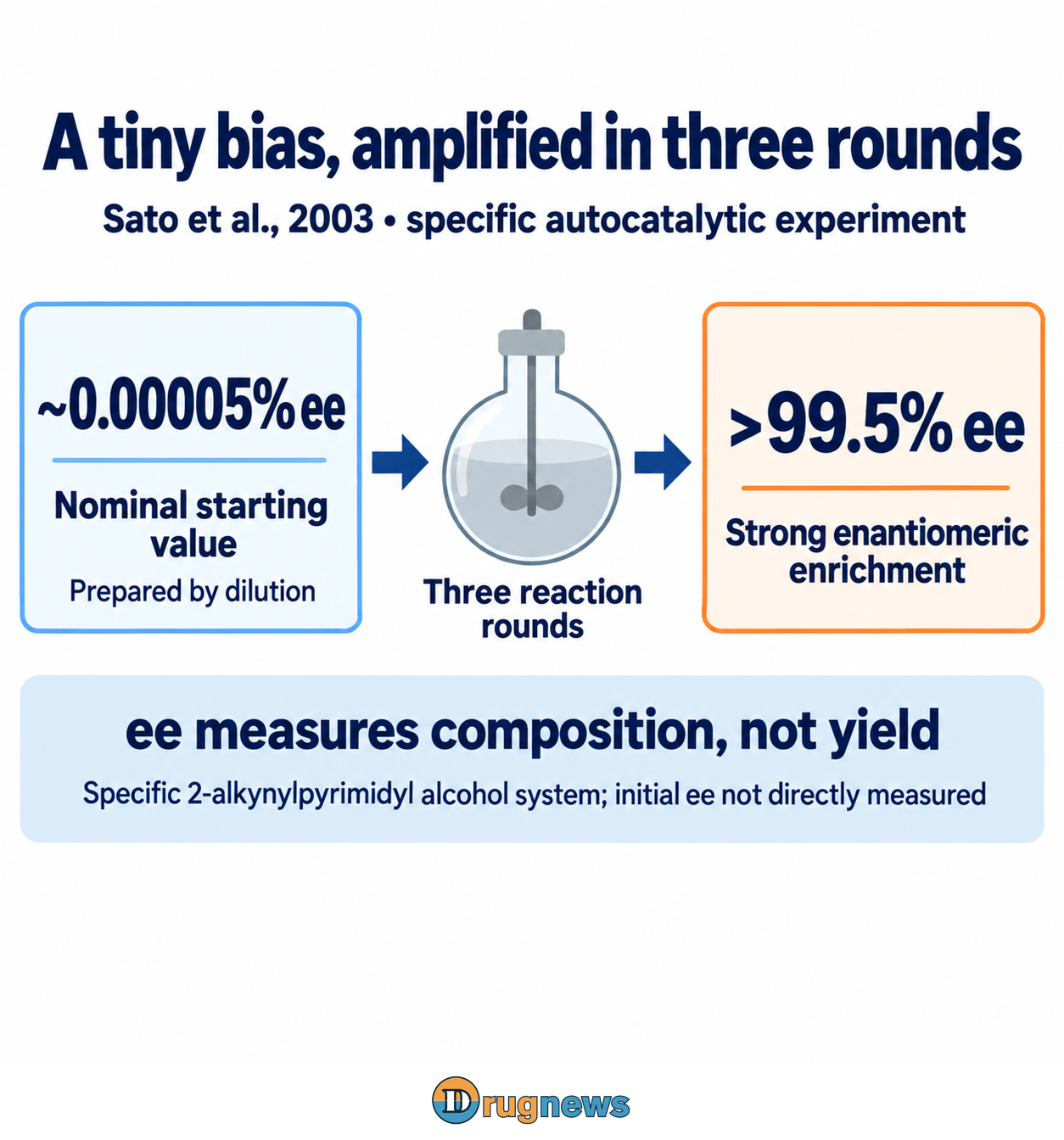
Figure 4 | Sato et al., 2003: nominal initial ~0.00005% ee, then >99.5% ee after three rounds in a specific experiment. Initial ee was prepared by dilution, not directly measured; ee is not yield.
More than 99.5% ee means that the product strongly favoured one of the two enantiomers. It is not 99.5% yield, much less a claim of 99.5% clinical efficacy.
The important result is a demonstrated route for amplification under particular conditions: an extremely small initial bias can become a pronounced final difference.
The question “why are the two sides not exactly equal?” now has an experimental process to examine. Initial bias, the reaction that carries it forward, the number of rounds and the resulting composition can each be considered separately.
A medicine's handedness and life's handedness are connected questions
For medicinal chemistry, configuration and enantiomeric composition are part of identifying a product. If a reaction effectively favours the desired form, the next questions concern the actual process: quantity, selectivity, impurities, reproducibility and performance at the required scale.
Each of those questions has a role distinct from a high ee in one experiment.
When reading news about chiral synthesis, follow the reaction: which mirror-image pair is being discussed? Does the bias develop during the reaction or emerge through later separation? Are yield and ee reported separately?
Then the numbers can answer questions rather than merely create astonishment. Starting with a particular reaction also makes it clearer which chemical capability has advanced, without imagining a universal production method for every medicine.
The mirror-image asymmetry of life's molecules opens a larger question.
These studies provide observable chemical examples of how a small bias can be amplified. Establishing an experimental route and proving which route nature actually followed are different evidence questions.
Why did that very first, tiny bias favour this side rather than the other?
That remains the next question.
Sources and literature Nobel Prize: official 2026 overview https://www.nobelprize.org/all-nobel-prizes-2026/ Kagan and colleagues, 1986: nonlinear effects in asymmetric oxidation and aldol reactions https://pubs.acs.org/doi/10.1021/ja00269a036 Soai and colleagues, 1995: asymmetric autocatalysis https://www.nature.com/articles/378767a0 Sato and colleagues, 2003: amplification of an extremely small initial ee https://onlinelibrary.wiley.com/doi/abs/10.1002/anie.200390105
This article explains published research and does not constitute individualized medical advice.
Cite this article
For decks, research notes, or media references, cite Drugnews with the canonical article URL.
Drugnews Editorial Team. "The 2026 Nobel Prize in Chemistry: do medicines have left and right hands?" Drugnews, Oct 08, 2026. https://drugnews.com.tw/articles/2026-10-08-2026-nobel-chemistry-chiral-amplification-en.html