
In May 2025, the FDA would not even accept ImmunityBio's application. Run a randomized trial against chemotherapy first, it said. In drug development, that usually means three or four more years.
Patrick Soon-Shiong did not run it. On October 14, 2026, he got the approval anyway, 84 days before the FDA's own deadline, with no new trial in between.
The new label lets Anktiva be used in bladder cancer patients whose disease came back after BCG and who have only papillary tumors. The FDA did not ask for new efficacy data. It extrapolated from the results in patients with carcinoma in situ.
Rivals chasing the same patients took a different road. Johnson & Johnson is running a Phase 3 trial for Inlexzo. CG Oncology, after talking with the FDA, pushed its filing to the fourth quarter.
Soon-Shiong has the first move. He read correctly how the FDA thinks after more than a decade of BCG shortages: it would rather be fast than make patients wait again.
01|A refusal letter that turned into an early approval
This is not the first time Soon-Shiong has bet against the rulebook.
He was born in 1952 in Port Elizabeth, South Africa, to Hakka Chinese parents who had fled Guangdong. He studied medicine at the University of the Witwatersrand, then became a transplant surgeon at UCLA, where he performed the university's first whole-pancreas transplant.
His first fortune came from a packaging idea: wrap an old chemotherapy, paclitaxel, in albumin. The result was Abraxane.
In 2008 he sold APP Pharmaceuticals to Fresenius for $4.6 billion. In 2010, Celgene bought Abraxis BioScience in a deal valued at $2.9 billion. In 2018 he paid nearly $500 million in cash for the Los Angeles Times.
ImmunityBio is his third big bet.
In 2021 he merged NantKwest with ImmunityBio. The lead asset was an IL-15 superagonist that became Anktiva. In April 2024 it won its first label: BCG-unresponsive non-muscle invasive bladder cancer with carcinoma in situ.
The next step was papillary-only disease. In January 2025, the FDA advised ImmunityBio to submit a supplemental application. In May, it sent a refuse-to-file letter instead.
The agency that invited the filing turned around four months later and would not even open it. For a company burning cash every quarter, that is the kind of letter that ends a growth story. A randomized trial in bladder cancer means recruiting hundreds of patients, waiting for recurrences and paying for all of it while the clock runs.
The company that was supposed to go back and start a trial went back to negotiate. In January 2026, ImmunityBio said it had worked out a resubmission path that would not require "the initiation or design of any new clinical trials." The stock jumped more than 17% on the news.
What it brought back was long-term follow-up in 80 papillary patients: 58.2% disease-free at 12 months, 96% disease-specific survival at 36 months, and 81.8% still with their bladder at 36 months.
Soon-Shiong said those survival rates were "higher than those reported for other investigational therapies."
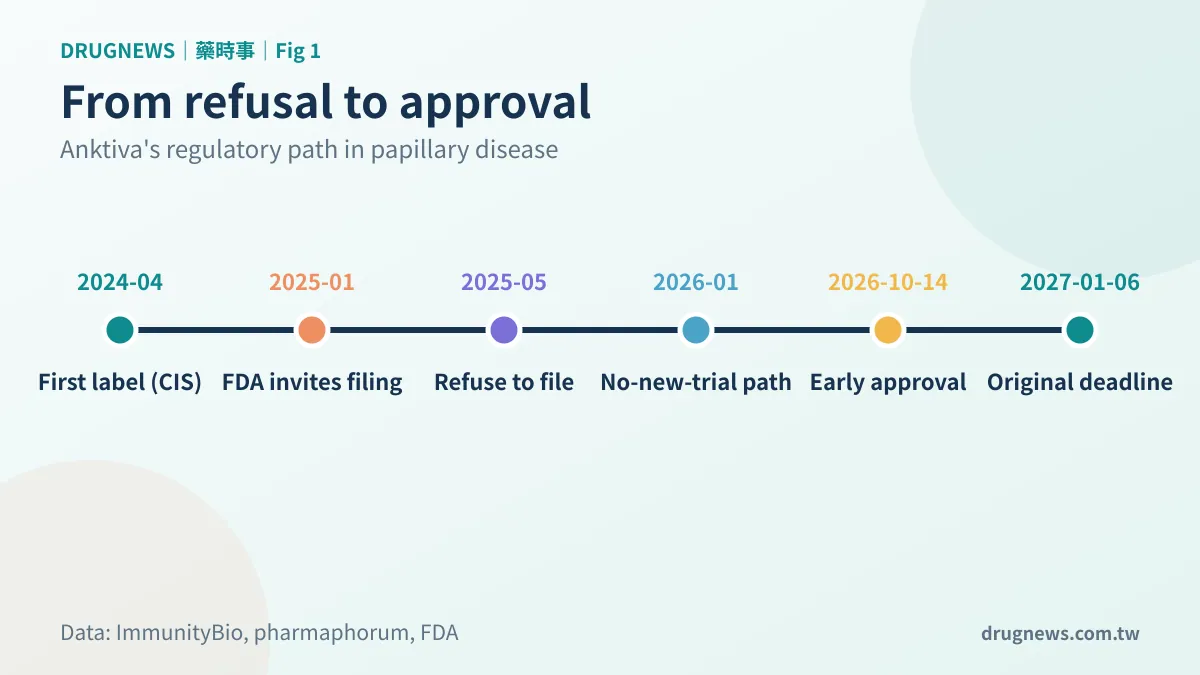
Figure 1|The FDA went from demanding a new trial to accepting extrapolation in 17 months
He did not bet on new data. He bet that a regulator would change its mind.
02|Anktiva does not kill cancer cells; it wakes up the killers
Why does a new bladder cancer drug have to travel with a tuberculosis vaccine?
Non-muscle invasive bladder cancer grows on the inner lining of the bladder and has not yet pushed into the muscle. The standard treatment is to pour BCG straight into the bladder so the immune system attacks the lining.
When BCG fails, the next step is often removing the whole bladder.
That is the human stake in this fight. Radical cystectomy means removing the bladder and building a new way for urine to leave the body. Patients who have already failed BCG are often weighing that surgery against one more round of bladder-sparing treatment. Every drug in this story is selling the same promise: keep the bladder longer.
Anktiva works like an amplifier. It mimics IL-15 and goes into the bladder alongside BCG, waking and expanding natural killer cells and T cells so they go after the tumor. BCG lights the fire; Anktiva fans it.
The rivals strike at different points. J&J's Inlexzo is a small device placed in the bladder that releases the chemotherapy gemcitabine over weeks, with no BCG needed. CG Oncology's cretostimogene is an oncolytic virus that gets inside cancer cells, copies itself and bursts them, also without BCG.
UroGen's Zusduri is a mitomycin gel aimed at a different group: recurrent low-grade, intermediate-risk bladder cancer.
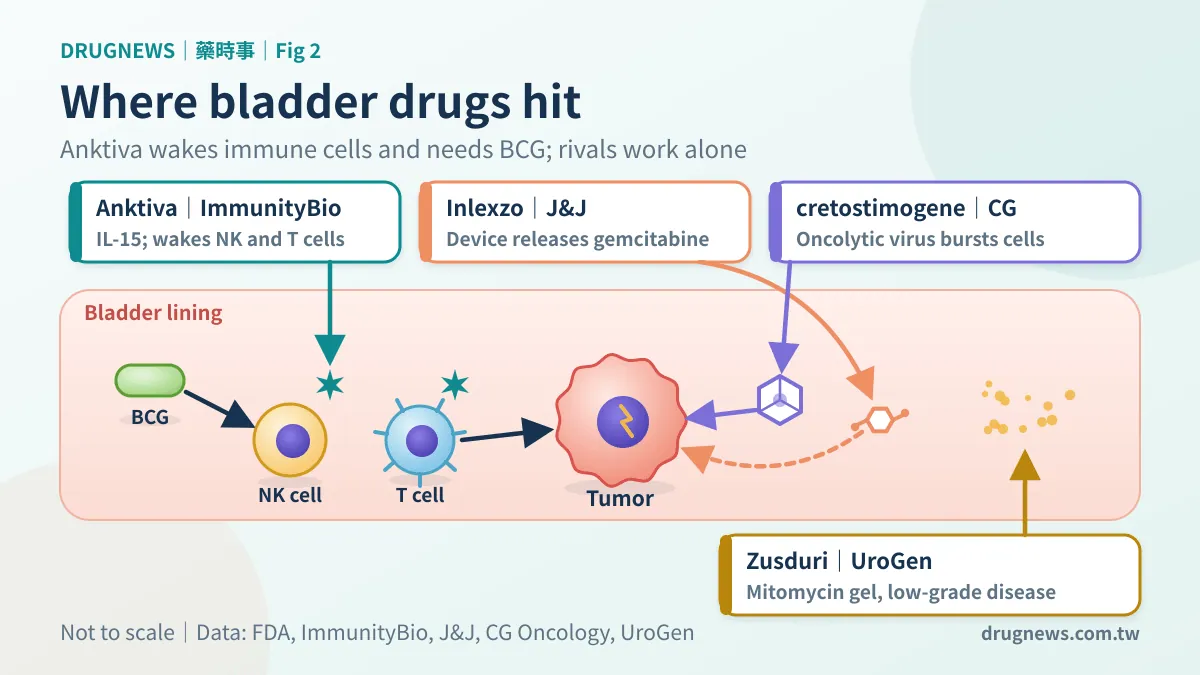
Figure 2|Only Anktiva must be paired with BCG; Inlexzo, cretostimogene and Zusduri work alone
Anktiva draws its power from BCG. BCG is also its weak spot.
03|The best response rate is not Anktiva's: J&J hits 82% without BCG
On efficacy alone, ImmunityBio would not win this race.
J&J is betting on efficacy. Inlexzo won its carcinoma in situ label on September 9, 2025, with an 82% complete response rate in 83 patients, and 51% stayed in response for at least a year. Anktiva's complete response rate in carcinoma in situ is 62%.
CG Oncology is trading time for certainty. Its BOND-003 trial showed a 41.8% complete response rate at 24 months (46 of 110). It moved completion of its BLA to the fourth quarter of 2026, and it had $1.0 billion in the bank at the end of June, enough to fund operations through 2029.
UroGen is betting on distribution. By the end of June, Zusduri had 1,444 activated sites of care and 452 prescribers.
ImmunityBio is betting on the label. It is the only one of the four approved for BCG-unresponsive patients with papillary-only tumors.
Each bet carries its own risk. J&J's best number is in carcinoma in situ, so its papillary story still depends on a trial that has not read out. CG Oncology's cash buys patience, but every quarter of delay is a quarter in which urologists learn someone else's drug. UroGen's sites are real, but its patients are a different, lower-risk group. ImmunityBio's label is the widest, but its drug cannot be given without a second product it does not fully control.
| Company|Drug | Bet | Mechanism | Needs BCG | Key data | U.S. status |
|---|---|---|---|---|---|
| ImmunityBio|Anktiva | Label | IL-15 superagonist | Yes | CIS CR 62% (n=77) | CIS + papillary |
| J&J|Inlexzo | Efficacy | Intravesical gemcitabine system | No | CIS CR 82% (n=83) | CIS |
| CG Oncology|cretostimogene | Time | Oncolytic virus | No | 24-month CR 41.8% | BLA completion Q4 2026 |
| UroGen|Zusduri | Distribution | Mitomycin gel | No | 1,444 sites | Low-grade intermediate-risk |
J&J has the best response rate and CG Oncology has the most cash. ImmunityBio has the widest label.
04|Why the FDA accepted extrapolation: a decade without enough BCG
The answer is in the FDA's own approval notice.
The FDA said plainly that it did not require new efficacy data in papillary-only disease. It concluded that the two tumor types share aggressive features, often occur together, are hard to tell apart under the microscope and carry the same high risk once BCG fails, so efficacy in carcinoma in situ could be extrapolated. It added that it is finalizing a guidance document on this approach.
That last sentence matters beyond one company. A guidance document turns a one-off decision into a rule others can cite. It tells every developer in this space that strong data in carcinoma in situ may be enough to reach papillary patients too. It also means J&J's 82% is exactly the kind of number that could ride the same road later. Soon-Shiong's advantage is a window, and he got through it first.
Now look at the patients' side. Since 2012, the United States has relied on a single supplier, Merck's TICE strain, and some patients have been unable to get full courses for a decade or more.
For a disease that has been short of its standard drug for more than ten years, the FDA chose speed over more evidence.
For ImmunityBio, that cuts both ways. Anktiva is tied to BCG: the scarcer BCG gets, the more it hurts. Merck expects a new plant to open by late 2026 and triple TICE capacity; the day it comes online, Anktiva benefits first.
ImmunityBio is not just waiting for Merck. It holds exclusive U.S. rights to Japan BCG Laboratory's Tokyo-172 strain, a second route to the BCG its drug depends on.
05|What 84 days are worth: about $557,000 a day
Start with revenue. Anktiva's net product revenue was $50.7 million in the second quarter of 2026, up from $26.4 million a year earlier, a 92% increase and the eighth straight quarter of growth. First-half revenue was $94.8 million, already close to the $113.0 million it booked in all of 2025.
UroGen's Zusduri sold $50.4 million in the same quarter. The two drugs were $300,000 apart.
Break it down by day: $50.7 million over 91 days is about $557,000 a day for Anktiva. Getting the papillary label 84 days early is close to an extra quarter on the market.
That quarter matters more than usual for ImmunityBio. It had $357.4 million at the end of June and used $141.9 million in operations in the first half. At that pace, the money lasts about 15 months.
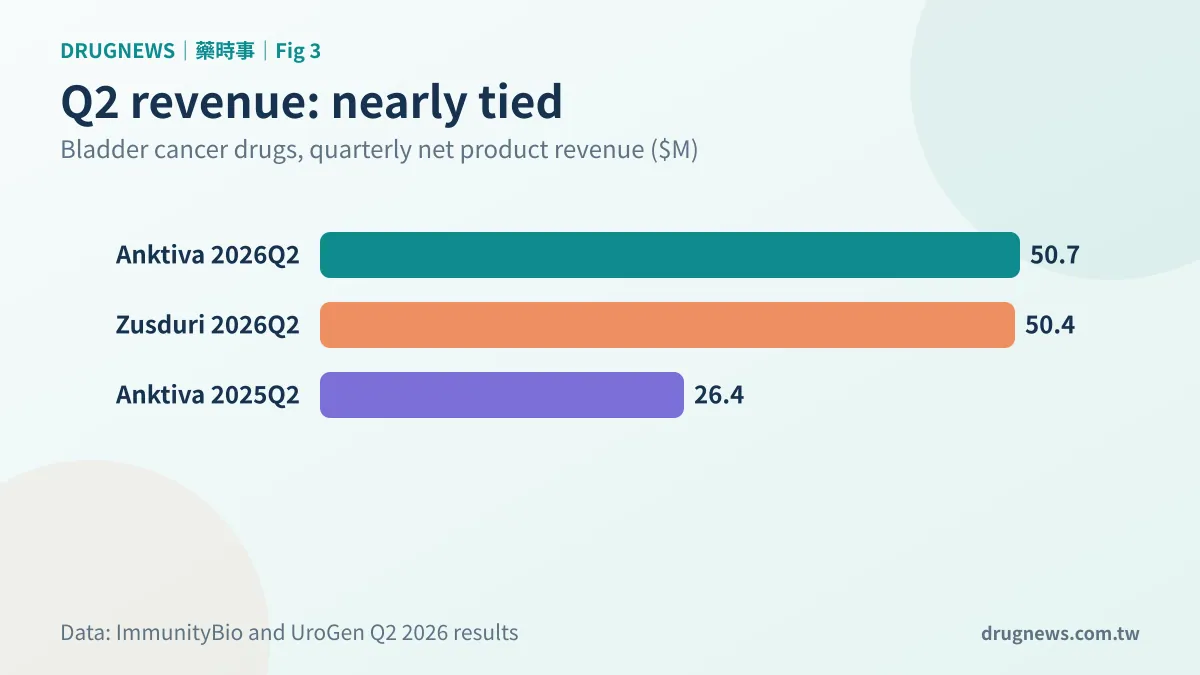
Figure 3|Anktiva grew 92%, but Zusduri caught up through faster distribution
The market had already picked a side: ImmunityBio's stock was up more than 400% this year by the day of the approval.
That rally prices in a lot of execution. A label is permission, not prescriptions. Urologists still have to choose Anktiva plus BCG over a device or a virus that needs no BCG at all, and every dose of Anktiva needs a dose of BCG that someone has to find first.
Soon-Shiong's edge is three things stacked together: the widest label, eight straight quarters of sales growth, and a precedent the FDA is now writing into guidance. Anyone who wants to follow has to show numbers better than 62%. J&J's edge is a single one, but a hard one: an 82% complete response rate without BCG.
How big he wins depends on whether Merck's new BCG plant opens on time in late 2026.
In May 2025, the FDA sent the application back and asked for a new randomized trial. Seventeen months later, it accepted follow-up in 80 patients and a shortage that had run for more than a decade.
Those 84 days were not an early finish. They were the FDA admitting, in an approval letter, that bladder cancer patients cannot wait.
This article is industry and company analysis, not investment or medical advice.
References
- FDA approves expanded indication for nogapendekin alfa inbakicept-pmln for BCG-unresponsive non-muscle invasive bladder cancer|U.S. FDA|2026-10-14|https://www.fda.gov/drugs/resources-information-approved-drugs/fda-approves-expanded-indication-nogapendekin-alfa-inbakicept-pmln-bcg-unresponsive-non-muscle
- IBRX Stock Rallies After FDA Clears Broader Anktiva Use In Bladder Cancer Months Ahead Of Deadline|Stocktwits|2026-10-14|https://stocktwits.com/news-articles/markets/equity/ibrx-stock-rallies-after-fda-clears-broader-anktiva-use-in-bladder-cancer-months-ahead-of-deadline/cZxfvaYRBq0
- ImmunityBio Reports Record Q2 2026 Net Product Revenue of $50.7 Million|ImmunityBio/BioSpace|2026-08-04|https://www.biospace.com/press-releases/immunitybio-reports-record-q2-2026-net-product-revenue-of-50-7-million-up-92-year-over-year-first-half-revenue-up-121-to-94-8-million
- ImmunityBio Reports 60% Increase in Revenue in Q2 2025 (refuse-to-file update)|ImmunityBio|2025-07-25|https://ir.immunitybio.com/node/10811
- ImmunityBio rises as route opens to broader Anktiva label|pharmaphorum|2026-01-21|https://pharmaphorum.com/news/immunitybio-rises-route-opens-broader-anktiva-label
- Patrick Soon-Shiong|Wikipedia|2026-10-17|https://en.wikipedia.org/wiki/Patrick_Soon-Shiong
- FDA Approves TAR-200 in BCG-Unresponsive NMIBC With CIS|OncLive|2025-09-09|https://www.onclive.com/view/fda-approves-tar-200-in-bcg-unresponsive-nmibc-with-cis
- UroGen Reports $50.4 Million of ZUSDURI Revenue and Provides Second Quarter 2026 Financial Results|UroGen/BioSpace|2026-08-05|https://www.biospace.com/press-releases/urogen-reports-50-4-million-of-zusduri-revenue-and-provides-second-quarter-2026-financial-results-and-highlights
- CG Oncology Reports Third Quarter 2025 Financial Results|CG Oncology|2025-11-14|https://cgoncology.com/?p=234114
- CG Oncology Reports Second Quarter 2026 Financial Results and Provides Business Updates|CG Oncology/BioSpace|2026-08-06|https://www.biospace.com/press-releases/cg-oncology-reports-second-quarter-2026-financial-results-and-provides-business-updates
- BCG Shortage: Key Facts for Bladder Cancer Patients & Families|BCAN|2026-10-17|https://bcan.org/bcg-shortage-bladder-cancer/
- ImmunityBio Signs Exclusive U.S. Agreement with Japan BCG Laboratory for the Tokyo Strain of BCG|ImmunityBio/BioSpace|2026-05-17|https://www.biospace.com/press-releases/immunitybio-signs-exclusive-u-s-agreement-with-japan-bcg-laboratory-for-the-tokyo-strain-of-bcg-to-enhance-bcg-supply-in-the-united-states
Share this analysis
Send this article to readers who follow biotech, company strategy, and capital-market signals.
Cite this article
For decks, research notes, or media references, cite Drugnews with the canonical article URL.
Drugnews Editorial Team. "Soon-Shiong Beats the FDA Clock on Anktiva." Drugnews, Oct 18, 2026. https://drugnews.com.tw/articles/2026-10-18-immunitybio-anktiva-papillary-early-approval-en.html