
A trial phase and an outcome answer different questions
The comparison covers 18 selected assets across China, Japan and South Korea. For each, the table asks the same questions. Who originated the asset? Which target and modality does it use? How far has its protocol progressed? What outcome has been disclosed, in which population and under which comparator? Is an asset-specific license public? The phase and evidence columns remain independent. A completed study establishes that participants were exposed. An interpretable result needs enough detail to identify the measured outcome and the population. [P00]
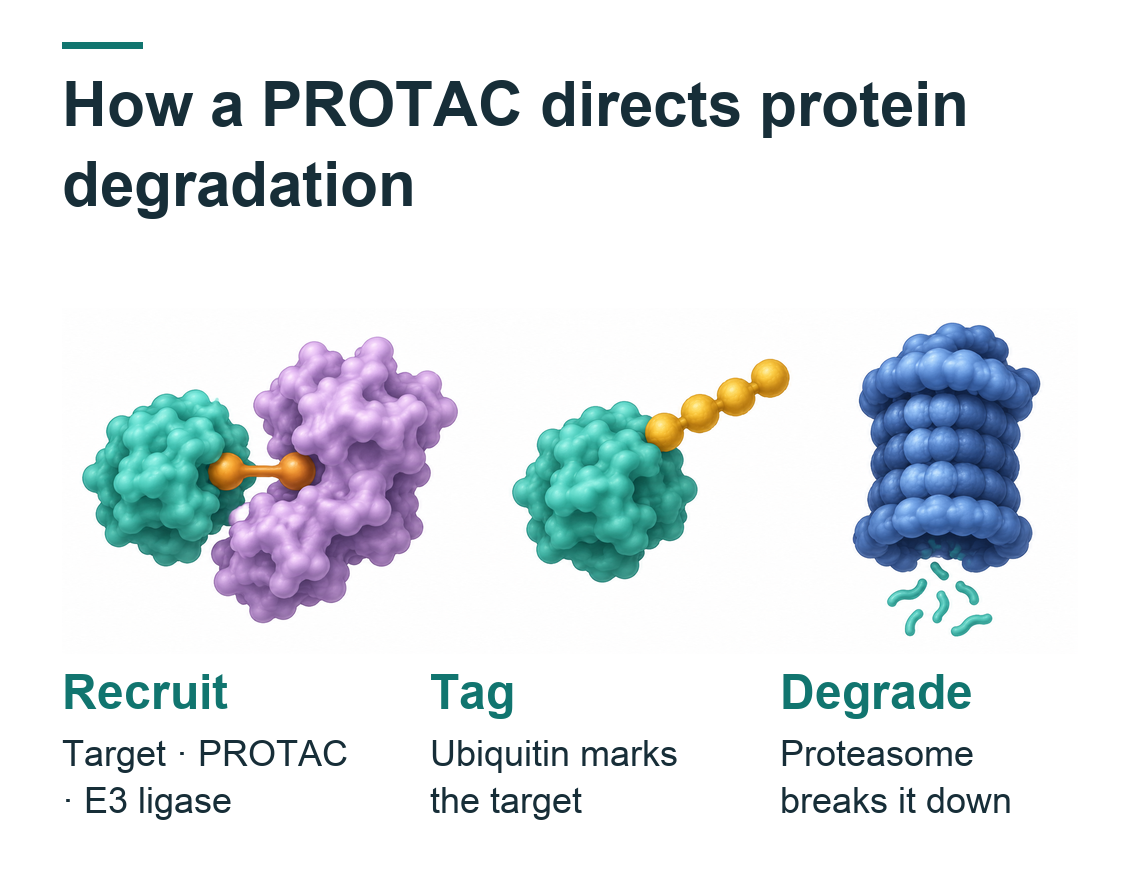
A conventional heterobifunctional degrader can recruit an E3 ubiquitin ligase to a target protein. The resulting proximity can lead to target tagging with ubiquitin and removal by the proteasome. A molecular glue can stabilize an interaction between a ligase and a target in a different way. A degrader–antibody conjugate adds a delivery step. The clinical question stays specific to the intended target, tissues and patient population. FDA approvals illustrate the scope. In May, the FDA approved vepdegestrant for a defined ESR1-mutated advanced breast cancer population after prior endocrine therapy. In August, it granted accelerated approval to iberdomide in a specified multiple-myeloma combination. Each decision applies to its labeled use and evidence package. [P20] [P21] [P30]

Japan and China have late-stage tests with different endpoints
Tacabrutideg is a BTK degrader. In BeOne’s open-label CaDAnCe-101 Phase 1 CLL/SLL cohort presented at EHA, 57 of 67 patients responded under criteria that included partial response with lymphocytosis, an 85.1% overall response rate. In November, BeOne said the pivotal Phase 2 component met its primary response endpoint in relapsed or refractory CLL. The open-label response evidence supports further development. The Phase 3 comparison against pirtobrutinib asks whether the degrader improves progression-free survival against a treatment patients can already receive. Two of the reviewed Phase 3 studies are recruiting, and one is active without further recruitment. The reviewed registries have posted no Phase 3 results. [P01] [P22] [P23]
Astellas’s setidegrasib targets KRAS G12D. The published Phase 1 study reported an objective response rate of 37.5% in 32 patients receiving second- or third-line treatment for non-small-cell lung cancer in the cited cohort, and 24% in 21 second- or third-line patients in the cited pancreatic cancer cohort. These cohorts describe single-arm activity in two different diseases. In pancreatic cancer, the Phase 3 trial adds setidegrasib or placebo to chemotherapy and uses overall survival as the primary outcome. In previously treated lung cancer, the randomized trial compares setidegrasib with docetaxel and tracks progression-free and overall survival as primary outcomes. [P02] [P24]
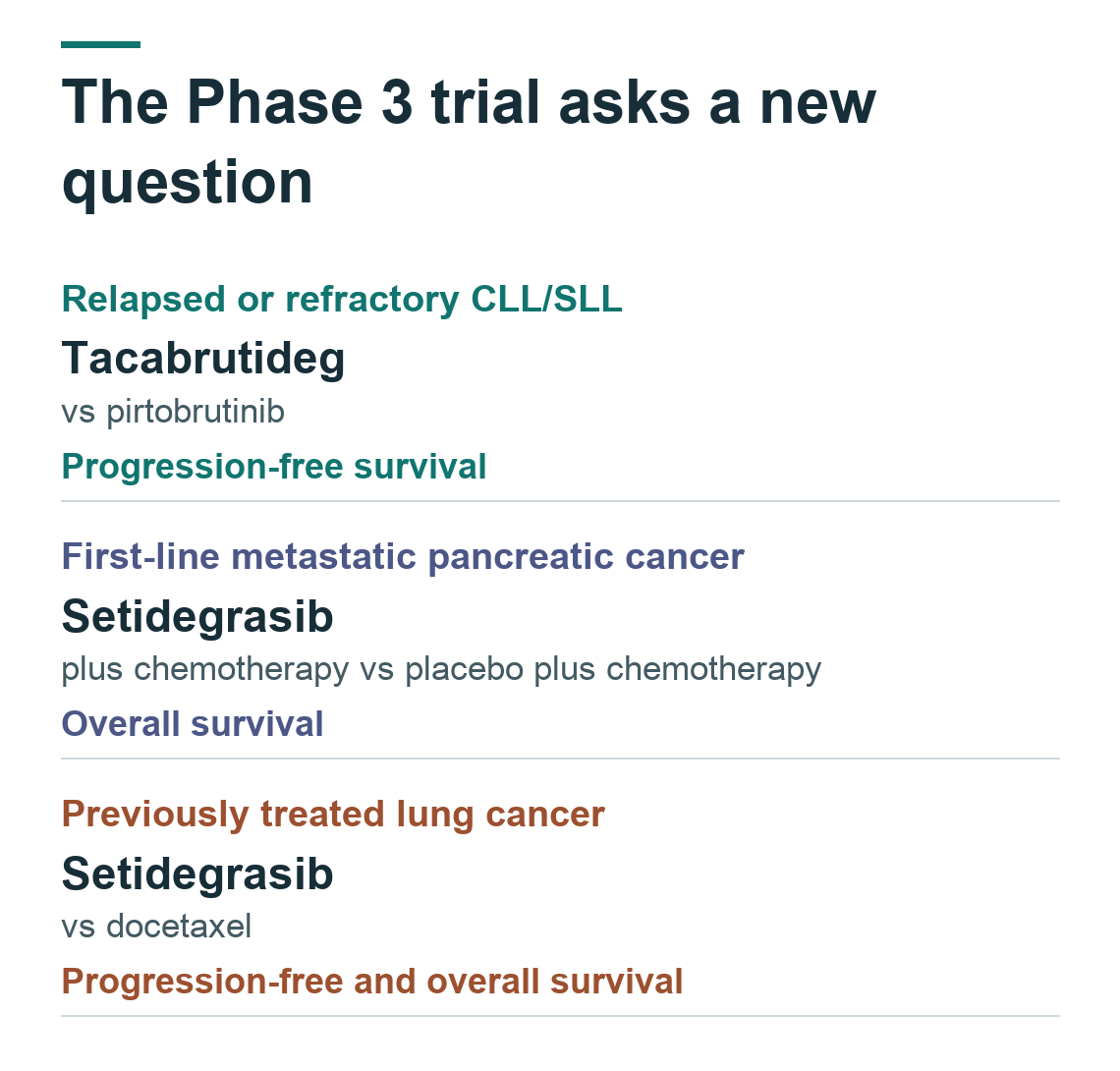
For the late-stage programs, the next change in evidence comes when a randomized trial reports. The primary endpoint, treatment line, comparator and enrolled population will determine the claim each readout can support. The response rates above belong to their own cohorts. A pooled ranking would reward differences in tumor type and trial design.
Oral prostate cancer programs and topical hair-loss trials
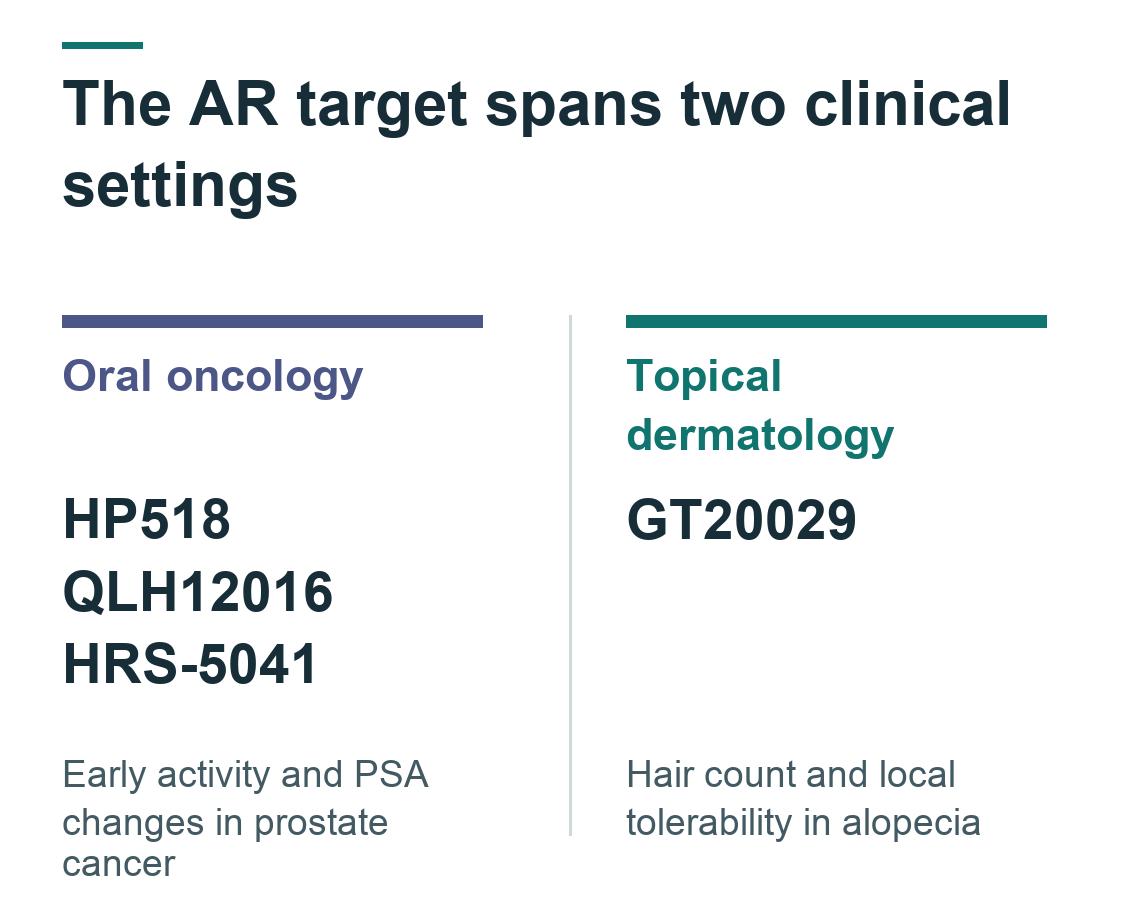
China’s androgen receptor assets already show why the route and disease belong next to each other in the comparison. Hinova’s HP518, Qilu’s QLH12016 and Hengrui’s HRS-5041 have reported early human observations in metastatic prostate cancer. Those datasets include open-label safety, pharmacokinetics and preliminary activity or prostate-specific antigen responses. The later-stage label attached to a combination protocol and the result from an earlier monotherapy cohort can both be correct descriptions of the same asset. Hinova’s current registry and issuer disclosure also carry different information about the proposed suspension of a China monotherapy study. [P05] [P06] [P07] [P31] [P32] [P33]
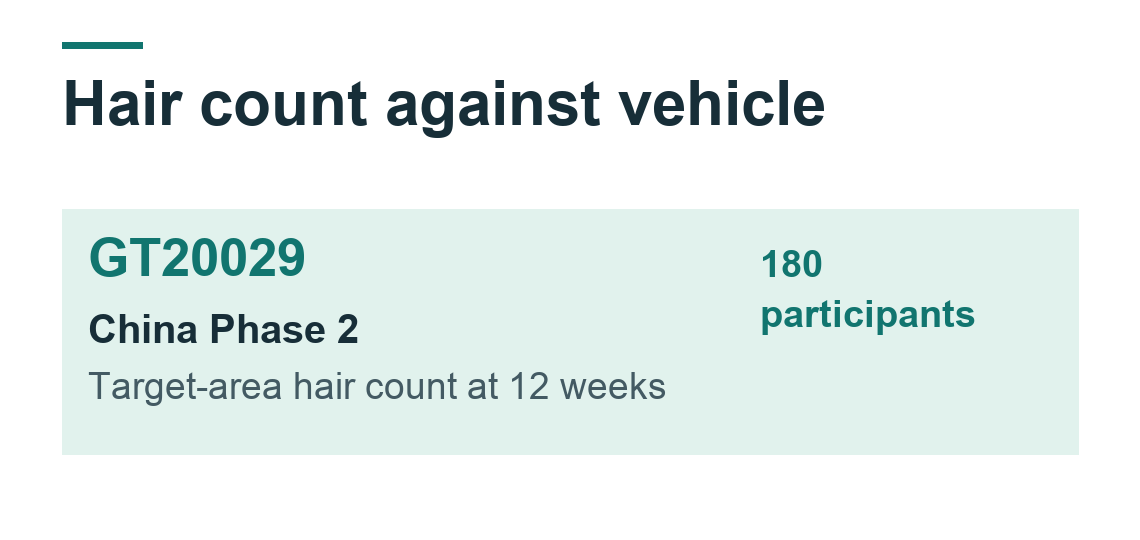
Kintor’s GT20029 addresses androgenetic alopecia with a topical treatment. Its China Phase 2 study enrolled 180 men and assessed change in non-vellus target-area hair count after 12 weeks against vehicle. The trial has a peer-reviewed efficacy report. Kintor also reported that a separate China acne Phase 2 trial reached its primary endpoint. Prostate-specific antigen change, hair count and acne endpoints are three disease-specific measurements. Each requires its own comparator and a tolerability profile appropriate for the intended use. [P03] [P25] [P34]
Korea shows why the deal must name the asset
The Korean clinical rows are early. Ubix’s UBX-303061 is recruiting in a Phase 1 study in relapsed or refractory B-cell malignancies. Pin Therapeutics announced first-patient dosing for its CK1α molecular glue PIN-5018 in South Korea. Orum dosed its first patient in the Phase 1 study of ORM-1153, a CD123-targeted GSPT1 degrader–antibody conjugate. These events establish that the programs have entered clinical development. Comparable efficacy readouts for those assets are still undisclosed in the reviewed evidence. [P13] [P18] [P19]
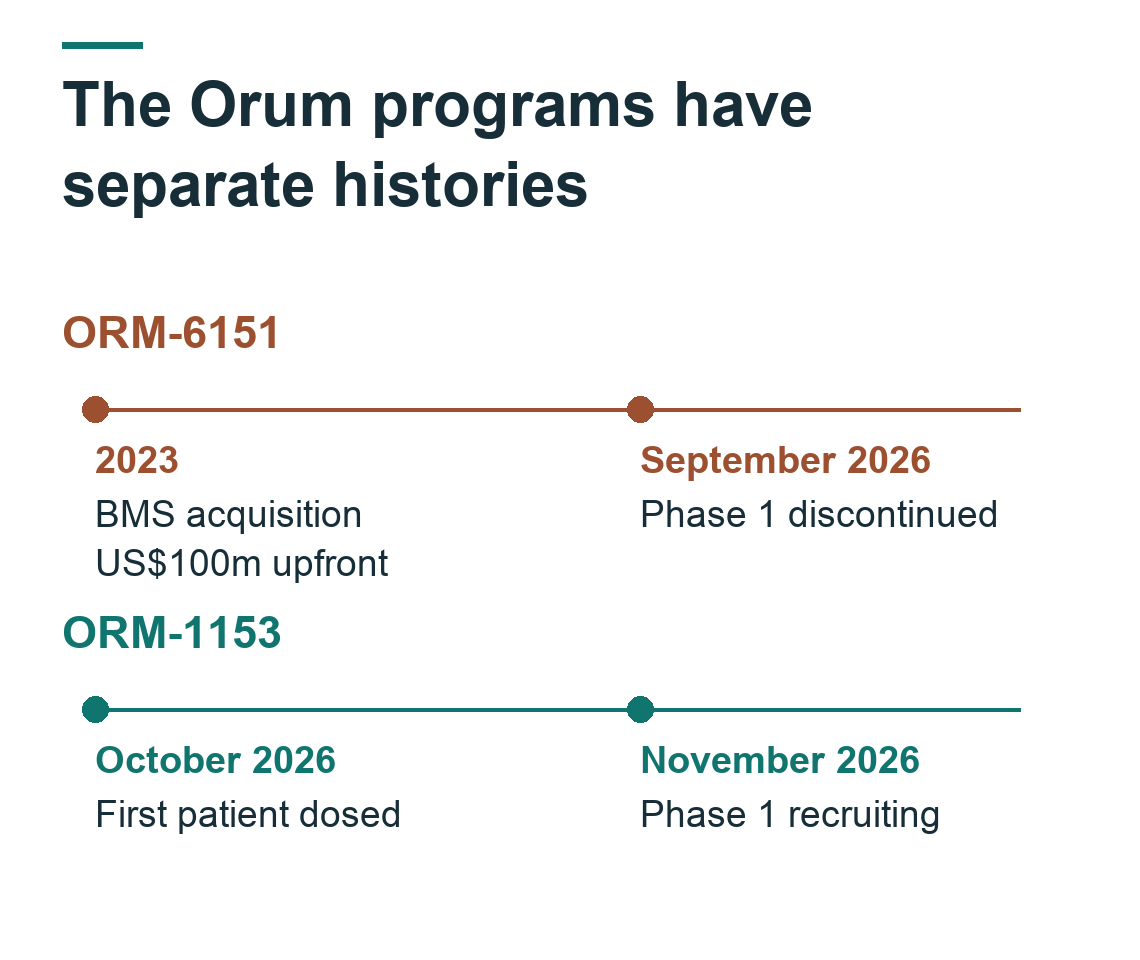
In 2023, BMS acquired rights to Orum’s earlier program, ORM-6151, with US$100 million upfront. Orum disclosed discontinuation of that program’s Phase 1 study in September 2026. ORM-1153 is a distinct drug candidate. Janssen’s 2026 research and licensing collaboration with Prazer is a platform agreement with deal-specific assets and financial terms undisclosed. Cullgen’s earlier Astellas platform collaboration involved discovery and options and carried a licensor-reported US$35 million upfront. It supplies no evidence of a license over Astellas’s setidegrasib or the named Cullgen clinical assets in this roster. [P16] [P17] [P19] [P27] [P28] [P29]
One comparison standard for all three markets
E0 indicates a registered or announced study without direct public confirmation of dose or interpretable outcomes in the reviewed source set. E1 marks documented dosing or completed exposure, which may include early safety, tolerability or drug exposure. E2 marks a public uncontrolled efficacy signal or a sponsor efficacy topline for which the controlled results are unavailable. E3 marks a public controlled efficacy result, limited to its actual comparator and endpoint. The score describes the highest outcome evidence reviewed for the asset. A higher study phase can sit beside a lower outcome tier, and a terminated protocol keeps its historic phase and current status.
| Origin | Originator / asset | Target / modality | Highest tracked phase and status | Human evidence | Asset licensing | Evidence |
|---|---|---|---|---|---|---|
| China | BeOne Medicines / BeiGene / Tacabrutideg (BGB-16673) | BTK / CDAC / chimeric degrader | Phase 3 · Two reviewed Phase 3 trials recruiting; one active, no longer recruiting | E2 · Phase 1 CLL/SLL responses plus sponsor-reported pivotal Phase 2 topline in relapsed/refractory CLL; Phase 3 comparator outcomes undisclosed | Not disclosed | [P01] [P22] [P23] |
| Japan | Astellas Pharma / Setidegrasib (ASP3082) | KRAS G12D / PROTAC / protein degrader | Phase 3 · Pancreatic and lung Phase 3 trials recruiting | E2 · Peer-reviewed Phase 1 lung and pancreatic cancer response results; Phase 3 outcomes undisclosed | Not disclosed | [P02] [P24] |
| China | Kintor Pharmaceutical Limited (Suzhou Kintor) / GT20029 | Androgen receptor (AR) / PROTAC | Phase 2 · China alopecia Phase 2 completed; acne Phase 2 topline disclosed | E3 · Peer-reviewed randomized vehicle-controlled alopecia efficacy; sponsor-reported acne topline is a separate indication | Not disclosed | [P03] [P25] [P34] |
| China | Hinova Pharmaceuticals Inc. / HP518 | Androgen receptor (AR) / PROTAC | Phase 1/2 · Registry lists China study recruiting; issuer reports proposed monotherapy suspension | E2 · Peer-reviewed open-label Phase 1 in metastatic castration-resistant prostate cancer | Not disclosed | [P05] [P32] |
| China | Qilu Pharmaceutical / QLH12016 | AR / PROTAC | Phase 1/2 · Combination study recruiting; separate trial not yet recruiting in registry | E2 · ESMO Phase 1 abstract reports early PSA response in previously treated prostate cancer | Not disclosed | [P06] [P33] |
| China | Hengrui / HRS-5041 | AR / Degrader | Phase 1 · Monotherapy and combination dose-finding records recruiting | E2 · ASCO Phase 1 abstract reports early PSA response across dose cohorts in prostate cancer | Not disclosed | [P07] [P31] |
| China | Jiangsu Hengrui Pharmaceuticals Co., Ltd. / HRS-1358 | Estrogen receptor (ER) / PROTAC | Phase 1/2 · Breast cancer combination protocol recruiting | E0 · Interpretable human outcomes not disclosed in reviewed records | Not disclosed | [P08] |
| China | BeOne Medicines / BeiGene / BGB-45035 | IRAK4 / CDAC / chimeric degrader | Phase 2, terminated · Rheumatoid arthritis trial terminated; prior Phase 1 completed | E1 · Phase 1 exposure documented, arm-level efficacy undisclosed in reviewed records; termination cites unfavorable benefit-risk | Not disclosed | [P09] |
| China | InnoCare Pharma / Beijing InnoCare Pharma Tech Co., Ltd. / ICP-490 | IKZF1 (Ikaros); IKZF3 (Aiolos) / CRBN molecular glue | Phase 1/2 · Multiple myeloma status unknown; lymphoma protocol not yet recruiting in registry | E0 · Interpretable clinical outcomes not disclosed in reviewed records | Not disclosed | [P10] |
| China | InnoCare Pharma / Beijing InnoCare Pharma Tech Co., Ltd. / ICP-538 | VAV1 / CRBN molecular glue | Phase 1 · Healthy-volunteer study recruiting in registry | E0 · Human tolerability or pharmacodynamics outcomes not disclosed in reviewed records | Not disclosed | [P11] |
| China | Haisco Pharmaceutical Group Co., Ltd. / HSK29116 | Bruton tyrosine kinase (BTK) / PROTAC | Phase 1 · Registry status unknown | E0 · Interpretable human outcomes not disclosed in reviewed records | Not disclosed | [P12] |
| South Korea | Ubix Therapeutics / UBX-303061 | BTK / PROTAC / chimeric degrader | Phase 1 · B-cell lymphoma study recruiting | E0 · Public registry specifies dose and safety objectives; outcome readout undisclosed | Not disclosed | [P13] |
| China | Haisco Pharmaceutical Group Co., Ltd. / HSK40118 | Mutant epidermal growth factor receptor (EGFR) / PROTAC | Phase 1 · Registry last listed recruitment in September 2023; current status uncertain | E0 · Interpretable human outcomes not disclosed in reviewed records | Not disclosed | [P14] |
| China | BeOne Medicines / BG-75098 | CDK2 / CDAC | Phase 1 · Solid tumor trial recruiting | E0 · Interpretable human outcomes not disclosed in reviewed records | Not disclosed | [P15] |
| China | Cullgen (Gyre Therapeutics / GNI Group) / CG001419 | TRK / PROTAC / protein degrader | Phase 1; Phase 1/2 protocol listed · Healthy-volunteer Phase 1 completed; China dose escalation within a Phase 1/2 protocol recruiting | E1 · Human exposure documented; interpretable patient efficacy undisclosed | Separate Cullgen platform arrangements are not attributed to this asset | [P16] [P29] |
| China | Cullgen (Gyre Therapeutics / GNI Group) / CG009301 | GSPT1 / Protein degrader | Phase 1 · China hematologic cancer dose escalation recruiting | E0 · Interpretable human outcomes not disclosed in reviewed records | Separate Cullgen platform arrangements are not attributed to this asset | [P17] [P29] |
| South Korea | Pin Therapeutics / PIN-5018 | CK1α / Molecular glue degrader | Phase 1 · Company announced first patient dosed in South Korea | E1 · First dose documented by the sponsor; clinical outcomes undisclosed | Not disclosed | [P18] |
| South Korea | Orum Therapeutics / ORM-1153 | CD123 / GSPT1 / Degrader-antibody conjugate (DAC) | Phase 1 · First patient dosed; registered study recruiting | E1 · First dose documented; response outcomes undisclosed | Signed asset license not disclosed; earlier ORM-6151 transaction tracked separately | [P19] [P27] |
Download the pipeline CSV. The table covers a selected roster. Origin follows the company that originated or leads the program, regardless of trial geography or later corporate ownership. For undisclosed terms and outcomes, the table records what could be verified at the cutoff. Registry status is timestamped and can lag a company filing. Asset rights and a separate platform collaboration have separate rows or explanatory notes.
The most consequential next evidence is an efficacy result against the intended comparator. For BTK that is a randomized study against an approved inhibitor. [P01]
Submit corrections with the registry ID or name of the agreement, the original document and the disclosure date. General research only. This report does not provide medical or investment advice.
Frequently asked questions
Which Chinese BTK degrader has human results and a Phase 3 head-to-head trial?
Tacabrutideg is a BTK degrader. In BeOne’s open-label CaDAnCe-101 Phase 1 CLL/SLL cohort presented at EHA, 57 of 67 patients responded under criteria that included partial response with lymphocytosis, an 85.1% overall response rate. In November, BeOne said the pivotal Phase 2 component met its primary response endpoint in relapsed or refractory CLL. The open-label response evidence supports further development. The Phase 3 comparison against pirtobrutinib asks whether the degrader improves progression-free survival against a treatment patients can already receive. Two of the reviewed Phase 3 studies are recruiting, and one is active without further recruitment. The reviewed registries have posted no Phase 3 results. [P01] [P22] [P23]
What human evidence does Astellas have for setidegrasib?
Astellas’s setidegrasib targets KRAS G12D. The published Phase 1 study reported an objective response rate of 37.5% in 32 patients receiving second- or third-line treatment for non-small-cell lung cancer in the cited cohort, and 24% in 21 second- or third-line patients in the cited pancreatic cancer cohort. These cohorts describe single-arm activity in two different diseases. [P24]
What Phase 3 comparators does Astellas have for setidegrasib?
In pancreatic cancer, the Phase 3 trial adds setidegrasib or placebo to chemotherapy and uses overall survival as the primary outcome. In previously treated lung cancer, the randomized trial compares setidegrasib with docetaxel and tracks progression-free and overall survival as primary outcomes. [P02]
Which Asian topical AR degrader has controlled hair-count data?
Kintor’s GT20029 addresses androgenetic alopecia with a topical treatment. Its China Phase 2 study enrolled 180 men and assessed change in non-vellus target-area hair count after 12 weeks against vehicle. The trial has a peer-reviewed efficacy report. Kintor also reported that a separate China acne Phase 2 trial reached its primary endpoint. Prostate-specific antigen change, hair count and acne endpoints are three disease-specific measurements. Each requires its own comparator and a tolerability profile appropriate for the intended use. [P03] [P25] [P34]
Which Korean degrader assets have started human trials, and how much is public?
The Korean clinical rows are early. Ubix’s UBX-303061 is recruiting in a Phase 1 study in relapsed or refractory B-cell malignancies. Pin Therapeutics announced first-patient dosing for its CK1α molecular glue PIN-5018 in South Korea. Orum dosed its first patient in the Phase 1 study of ORM-1153, a CD123-targeted GSPT1 degrader–antibody conjugate. These events establish that the programs have entered clinical development. Comparable efficacy readouts for those assets are still undisclosed in the reviewed evidence. [P13] [P18] [P19]
References
- P00
- 18 selected assets; China 14, Japan 1, South Korea 3. | trial registry (clinicaltrials.gov) | | https://clinicaltrials.gov/study/NCT06846671
- 18 selected assets; China 14, Japan 1, South Korea 3. | trial registry (clinicaltrials.gov) | | https://clinicaltrials.gov/study/NCT07409272
- 18 selected assets; China 14, Japan 1, South Korea 3. | trial registry (clinicaltrials.gov) | | https://clinicaltrials.gov/study/NCT06692465
- 18 selected assets; China 14, Japan 1, South Korea 3. | trial registry (clinicaltrials.gov) | | https://clinicaltrials.gov/study/NCT06155084
- 18 selected assets; China 14, Japan 1, South Korea 3. | trial registry (clinicaltrials.gov) | | https://clinicaltrials.gov/study/NCT07198633
- 18 selected assets; China 14, Japan 1, South Korea 3. | trial registry (clinicaltrials.gov) | | https://clinicaltrials.gov/study/NCT05942001
- 18 selected assets; China 14, Japan 1, South Korea 3. | trial registry (clinicaltrials.gov) | | https://clinicaltrials.gov/study/NCT06679036
- 18 selected assets; China 14, Japan 1, South Korea 3. | trial registry (clinicaltrials.gov) | | https://clinicaltrials.gov/study/NCT07100938
- 18 selected assets; China 14, Japan 1, South Korea 3. | trial registry (clinicaltrials.gov) | | https://clinicaltrials.gov/study/NCT05719701
- 18 selected assets; China 14, Japan 1, South Korea 3. | trial registry (clinicaltrials.gov) | | https://clinicaltrials.gov/study/NCT07535099
- 18 selected assets; China 14, Japan 1, South Korea 3. | trial registry (clinicaltrials.gov) | | https://clinicaltrials.gov/study/NCT04861779
- 18 selected assets; China 14, Japan 1, South Korea 3. | trial registry (clinicaltrials.gov) | | https://clinicaltrials.gov/study/NCT06590961
- 18 selected assets; China 14, Japan 1, South Korea 3. | trial registry (clinicaltrials.gov) | | https://clinicaltrials.gov/study/NCT06050980
- 18 selected assets; China 14, Japan 1, South Korea 3. | trial registry (clinicaltrials.gov) | | https://clinicaltrials.gov/study/NCT07226349
- 18 selected assets; China 14, Japan 1, South Korea 3. | trial registry (clinicaltrials.gov) | | https://clinicaltrials.gov/study/NCT06636500
- 18 selected assets; China 14, Japan 1, South Korea 3. | trial registry (clinicaltrials.gov) | | https://clinicaltrials.gov/study/NCT07347171
- 18 selected assets; China 14, Japan 1, South Korea 3. | issuer (prnewswire.com) | | https://www.prnewswire.com/news-releases/pin-therapeutics-initiates-first-patient-dosing-of-ck1-degrader-pin-5018-in-phase-1-trial-302624301.html
- 18 selected assets; China 14, Japan 1, South Korea 3. | trial registry (clinicaltrials.gov) | | https://clinicaltrials.gov/study/NCT07809906
- P01
- Tacabrutideg (BGB-16673) · NCT06846671 | trial registry (clinicaltrials.gov) | | https://clinicaltrials.gov/study/NCT06846671
- Tacabrutideg (BGB-16673) · NCT06973187 | trial registry (clinicaltrials.gov) | | https://clinicaltrials.gov/study/NCT06973187
- Tacabrutideg (BGB-16673) · NCT06970743 | trial registry (clinicaltrials.gov) | | https://clinicaltrials.gov/study/NCT06970743
- Tacabrutideg (BGB-16673) · BTK | trial investigators or issuer (beonemedicines.com) | | https://beonemedicines.com/wp-content/uploads/2026/11/BeOne-pipeline-4Nov26-Final-.pdf
- P02
- Setidegrasib (ASP3082) · NCT07409272 | trial registry (clinicaltrials.gov) | | https://clinicaltrials.gov/study/NCT07409272
- Setidegrasib (ASP3082) · NCT07566052 | trial registry (clinicaltrials.gov) | | https://clinicaltrials.gov/study/NCT07566052
- Setidegrasib (ASP3082) · KRAS G12D | trial investigators or issuer (pubmed.ncbi.nlm.nih.gov) | | https://pubmed.ncbi.nlm.nih.gov/41879829/?fc=None&ff=20260411131702&v=2.19.0.post6+133c1fe
- P03
- GT20029 · NCT06692465 | trial registry (clinicaltrials.gov) | | https://clinicaltrials.gov/study/NCT06692465
- GT20029 · NCT05428449 | trial registry (clinicaltrials.gov) | | https://clinicaltrials.gov/study/NCT05428449
- GT20029 · Androgen receptor (AR) | trial investigators or issuer (pubmed.ncbi.nlm.nih.gov) | | https://pubmed.ncbi.nlm.nih.gov/41328006/
- P05
- HP518 · NCT06155084 | trial registry (clinicaltrials.gov) | | https://clinicaltrials.gov/study/NCT06155084
- HP518 · NCT05252364 | trial registry (clinicaltrials.gov) | | https://clinicaltrials.gov/study/NCT05252364
- HP518 · Androgen receptor (AR) | issuer (static.cninfo.com.cn) | | https://static.cninfo.com.cn/finalpage/2026-08-27/1225514360.PDF
- P06
- QLH12016 · NCT07198633 | trial registry (clinicaltrials.gov) | | https://clinicaltrials.gov/study/NCT07198633
- QLH12016 · NCT07104110 | trial registry (clinicaltrials.gov) | | https://clinicaltrials.gov/study/NCT07104110
- QLH12016 · AR | trial investigators or issuer (annalsofoncology.org) | | https://www.annalsofoncology.org/article/S0923-7534%2825%2903985-7/abstract
- P07
- HRS-5041 · NCT05942001 | trial registry (clinicaltrials.gov) | | https://clinicaltrials.gov/study/NCT05942001
- HRS-5041 · NCT07115446 | trial registry (clinicaltrials.gov) | | https://clinicaltrials.gov/study/NCT07115446
- HRS-5041 · AR | trial investigators or issuer (ascopubs.org) | | https://ascopubs.org/doi/10.1200/JCO.2026.44.16_suppl.3112
- P08
- HRS-1358 · NCT06679036 | trial registry (clinicaltrials.gov) | | https://clinicaltrials.gov/study/NCT06679036
- HRS-1358 · NCT05628870 | trial registry (clinicaltrials.gov) | | https://clinicaltrials.gov/study/NCT05628870
- HRS-1358 · Estrogen receptor (ER) | issuer (static.cninfo.com.cn) | | https://static.cninfo.com.cn/finalpage/2026-08-20/1225483600.PDF
- P09
- BGB-45035 · NCT07100938 | trial registry (clinicaltrials.gov) | | https://clinicaltrials.gov/study/NCT07100938
- BGB-45035 · NCT06342713 | trial registry (clinicaltrials.gov) | | https://clinicaltrials.gov/study/NCT06342713
- BGB-45035 · IRAK4 | trial investigators or issuer (beonemedicines.com) | | https://beonemedicines.com/wp-content/uploads/2026/11/BeOne-pipeline-4Nov26-Final-.pdf
- P10
- ICP-490 · NCT05719701 | trial registry (clinicaltrials.gov) | | https://clinicaltrials.gov/study/NCT05719701
- ICP-490 · NCT06845241 | trial registry (clinicaltrials.gov) | | https://clinicaltrials.gov/study/NCT06845241
- ICP-490 · IKZF1 (Ikaros); IKZF3 (Aiolos) | issuer (innocarepharma.com) | | https://www.innocarepharma.com/uploads/2026-03-26/2025-Annual-Report-CN-A.pdf
- P11
- ICP-538 · NCT07535099 | trial registry (clinicaltrials.gov) | | https://clinicaltrials.gov/study/NCT07535099
- ICP-538 · VAV1 | issuer (innocarepharma.com) | | https://www.innocarepharma.com/uploads/2026-03-26/2025-Annual-Report-CN-A.pdf
- P12
- HSK29116 · NCT04861779 | trial registry (clinicaltrials.gov) | | https://clinicaltrials.gov/study/NCT04861779
- HSK29116 · Bruton tyrosine kinase (BTK) | issuer (disc.static.szse.cn) | | https://disc.static.szse.cn/disc/disk03/finalpage/2026-08-27/8ef41362-8592-467c-8fba-38d4f313eb45.PDF
- P13
- UBX-303061 · NCT06590961 | trial registry (clinicaltrials.gov) | | https://clinicaltrials.gov/study/NCT06590961
- P14
- HSK40118 · NCT06050980 | trial registry (clinicaltrials.gov) | | https://clinicaltrials.gov/study/NCT06050980
- HSK40118 · Mutant epidermal growth factor receptor (EGFR) | issuer (disc.static.szse.cn) | | https://disc.static.szse.cn/disc/disk03/finalpage/2026-08-27/8ef41362-8592-467c-8fba-38d4f313eb45.PDF
- P15
- BG-75098 · NCT07226349 | trial registry (clinicaltrials.gov) | | https://clinicaltrials.gov/study/NCT07226349
- BG-75098 · CDK2 | trial investigators or issuer (beonemedicines.com) | | https://beonemedicines.com/wp-content/uploads/2026/11/BeOne-pipeline-4Nov26-Final-.pdf
- P16
- CG001419 · NCT06636500 | trial registry (clinicaltrials.gov) | | https://clinicaltrials.gov/study/NCT06636500
- CG001419 · NCT07394374 | trial registry (clinicaltrials.gov) | | https://clinicaltrials.gov/study/NCT07394374
- CG001419 · TRK | issuer (ir.gyretx.com) | | https://ir.gyretx.com/news-releases/news-release-details/gyre-therapeutics-reports-third-quarter-2026-and-year-date
- P17
- CG009301 · NCT07347171 | trial registry (clinicaltrials.gov) | | https://clinicaltrials.gov/study/NCT07347171
- CG009301 · GSPT1 | issuer (ir.gyretx.com) | | https://ir.gyretx.com/news-releases/news-release-details/gyre-therapeutics-reports-third-quarter-2026-and-year-date
- P18
- PIN-5018 · CK1α | issuer (prnewswire.com) | | https://www.prnewswire.com/news-releases/pin-therapeutics-initiates-first-patient-dosing-of-ck1-degrader-pin-5018-in-phase-1-trial-302624301.html
- P19
- ORM-1153 · NCT07809906 | trial registry (clinicaltrials.gov) | | https://clinicaltrials.gov/study/NCT07809906
- ORM-1153 · CD123 / GSPT1 | issuer (orumrx.com) | | https://www.orumrx.com/news/orum-therapeutics-doses-fir-phase-1-trial-of-orm-1153-a-cd123-gspt1-degrader-antibody-conjugatest-patient-in
- P20
- May 1, 2026; Veppanu approved after at least one line of endocrine therapy for specified ER-positive HER2-negative ESR1-mutated advanced/metastatic breast cancer | regulator (fda.gov) | | https://www.fda.gov/drugs/cancer-approvals/fda-approves-vepdegestrant-er-positive-her2-negative-esr1-mutated-advanced-or-metastatic-breast
- P21
- August 13, 2026; iberdomide accelerated approval with daratumumab/hyaluronidase and dexamethasone after at least one prior therapy line including a PI and IMiD | regulator (fda.gov) | | https://www.fda.gov/drugs/cancer-approvals/oncology-cancerhematologic-malignancies-approval-notifications?param=8dda41bd
- P22
- Phase 1 CLL/SLL: 57/67 responses (85.1%), includes partial response with lymphocytosis | primary congress abstract (library.ehaweb.org) | | https://library.ehaweb.org/eha/2026/eha-2026/4206706/stephan.stilgenbauer.bgb-16673.a.bruton.tyrosine.kinase.28btk29.degrader.in.html
- P23
- Pivotal Phase 2 component met its primary overall response endpoint in relapsed/refractory CLL | issuer filing (hkexir.beonemedicines.com) | | https://hkexir.beonemedicines.com/media/hk-news/20261105/assets/12402675-0.pdf?disposition=inline
- P24
- Setidegrasib Phase 1, later-line NSCLC: 37.5% objective response among 32 second/third-line participants; PDAC: 24% among 21 second/third-line participants | primary research abstract (pubmed.ncbi.nlm.nih.gov) | | https://pubmed.ncbi.nlm.nih.gov/41879829/?fc=None&ff=20260411131702&v=2.19.0.post6+133c1fe
- 37.5% observed objective response among 32 in second/third-line lung cancer cohort | issuer presentation (astellas.com) | | https://www.astellas.com/content/dam/astellas-com/global/en/confidential-documents/Investors-Meeting/astellas_csp2026_presentation_20260526_en.pdf
- P25
- Phase 2: 180 enrolled; primary hair count measured after 12 weeks; vehicle-controlled design | primary research abstract (pubmed.ncbi.nlm.nih.gov) | | https://pubmed.ncbi.nlm.nih.gov/41328006/
- Phase 2: 180 actually enrolled; non-vellus target-area hair-count change at 12 weeks | trial registry (clinicaltrials.gov) | | https://clinicaltrials.gov/study/NCT06692465
- P27
- BMS acquired ORM-6151 in 2023 for $100m upfront; Phase 1 discontinued per September 17, 2026 filing | payer filing (sec.gov) | | https://www.sec.gov/Archives/edgar/data/14272/000001427224000044/bmy-20231231.htm
- ORM-6151 Phase 1 discontinuation disclosed on September 17, 2026 | issuer filing index (orumrx.com) | | https://www.orumrx.com/filings
- P28
- 2026 Prazer–Janssen platform research and licensing; deal-specific targets and payment not disclosed | issuer release (prazertx.com) | | https://prazertx.com/pages/board/view.php?board_sid=16&category_code1=&data_sid=278&menu_code=477&page_num=&skey=&sval=
- P29
- 2023 Cullgen–Astellas discovery/option collaboration; US$35m received upfront in licensor accounts | licensor financial statements filed with SEC (sec.gov) | | https://www.sec.gov/Archives/edgar/data/1124105/000114036126028564/ef20077460_ex99-1.htm
- P30
- PROTAC principle: link ligand-binding target to an E3 recruiting moiety, enabling targeted degradation | primary research (pnas.org) | | https://www.pnas.org/doi/10.1073/pnas.141230798
- P31
- HRS-5041 Phase 1 showed PSA responses among subsets of dose cohorts | primary congress abstract (ascopubs.org) | | https://ascopubs.org/doi/10.1200/JCO.2026.44.16_suppl.3112
- P32
- HP518 first-in-human Phase 1 reports activity and pharmacokinetics in mCRPC | primary research abstract (pubmed.ncbi.nlm.nih.gov) | | https://pubmed.ncbi.nlm.nih.gov/40289067/
- P33
- QLH12016 Phase 1 data presented at ESMO; patient responses are preliminary | primary congress abstract (annalsofoncology.org) | | https://www.annalsofoncology.org/article/S0923-7534%2825%2903985-7/abstract
- P34
- 2026 September report confirms GT20029 acne Phase 2 sponsor topline had met its primary endpoint | issuer filing (static.cninfo.com.cn) | | https://static.cninfo.com.cn/finalpage/2026-09-29/1225589146.PDF