
──────────
Share this analysis
Send this article to readers who follow biotech, company strategy, and capital-market signals.
On September 16, 2026, Novo Nordisk announced a collaboration with Anthropic to use Claude models and Claude Science for scientific reasoning and AI-driven software engineering in research and development. The announcement adds to a series of partnerships addressing different parts of Novo's work: human data and drug discovery with Valo Health, enterprise AI with OpenAI, cloud and AI infrastructure with AWS, and scientific reasoning and software tools with Anthropic.【1】
The financial terms of the Valo expansion illustrate why these arrangements need to be read carefully. Announced on January 8, 2025, the expanded collaboration covers up to 20 programs in obesity, type 2 diabetes and cardiovascular disease. Upfront payments, an equity investment and potential near-term milestone payments total up to US$190 million. This includes equity financing; it is not all an unconditional licensing payment. The announcement separately describes approximately US$4.6 billion in potential milestone payments across the expanded programs, with research funding and potential royalties additional. These categories cannot be combined and described as cash already received or guaranteed.【4】
Together, the partnerships show how a pharmaceutical company can obtain different AI capabilities and connect them to its existing operations. Their value extends beyond proposing a promising molecule: can relevant data reach a decision sooner, can a weak hypothesis be stopped earlier, and can a useful one reach experimental testing faster? These remain questions to test, not proof that a drug will succeed.
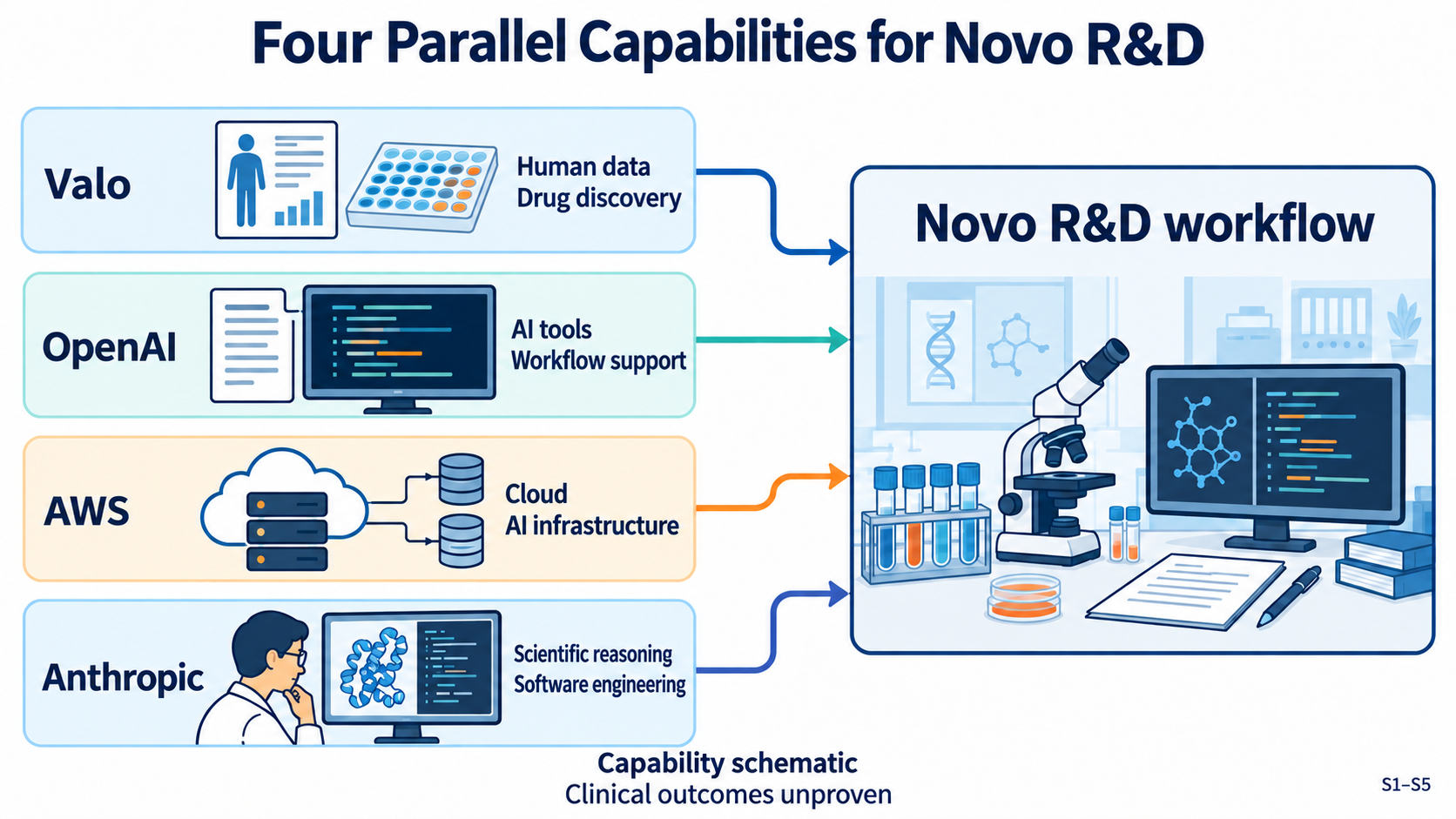
【Figure 1 | Four capabilities supporting Novo's R&D in parallel】
Novo's partnerships announced at different times involve human data and drug discovery, AI workflows, cloud infrastructure, and scientific reasoning and software engineering. These capabilities are shown in parallel. The connections include planned and pilot directions in the announcements; they do not imply a linear dependency between suppliers, completed integration of all workflows, or proven clinical benefit. Source numbers correspond to the references below: S1–S5.
【01 | Four partnerships address different needs】
Valo supplies human data and drug-discovery capabilities. The original 2023 collaboration combined its Opal Computational Platform, real-world patient data, AI-enabled small-molecule discovery and the Biowire human tissue modelling platform. Novo also licensed three preclinical cardiovascular programs discovered and developed by Valo using Opal. The 2025 expansion increased the scope from up to 11 programs to up to 20, covering obesity, type 2 diabetes and cardiovascular disease.【5】【4】
OpenAI supplies general-purpose AI capabilities and an enterprise deployment pathway. Novo's April 14, 2026 announcement describes uses in complex data analysis, candidate identification, manufacturing, supply chains, distribution and commercial operations. Pilots were planned across R&D, manufacturing and commercial operations, with integration targeted by the end of 2026. That is the announced timetable; it does not establish that integration has been completed or that drug-development success rates have improved.【2】
AWS supplies cloud, agentic AI and data infrastructure. Novo's August 10, 2026 announcement names AWS its preferred cloud provider and strategic AI partner. An AI co-innovation hub in London brings AWS engineers, AI specialists and applied scientists together with Novo's R&D teams. Goals include drug discovery, technology modernization, and connecting genomic, imaging and clinical data with early research and trial design. Novo reported that its existing AWS collaboration had reduced clinical-documentation time and supported productivity for more than 25,000 employees. Those are company-reported process developments. The announcement does not provide the magnitude or measurement method for productivity improvements among those employees, so the headcount is not a count of individually verified improvements.【3】
Anthropic supplies capabilities closer to scientific reasoning and R&D software engineering. Separately from Novo's collaboration announcement, Anthropic reported on September 17, 2026 that Claude, under technical supervision, optimized more than 30 open-source biomolecular models in less than four weeks. The models covered structure prediction, protein design, protein language models and genomics. Evaluated tasks ran about four times as fast on average when small accuracy differences were allowed; under an identical-output requirement, the overall speedup was close to twofold. This evaluates model computation and downstream task performance. It cannot be converted into a reduction in the full drug-development timeline and is not evidence of clinical success for a Novo drug.【1】【6】
【02 | Three ways AI can help pharmaceutical work】
The first is faster generation and screening of scientific hypotheses. Valo links human and genetic data, real-world patient data, AI-enabled small-molecule design and tissue models. The relevant early decisions are which targets warrant work and which compounds deserve further tests. Faster prioritization does not guarantee clinical success.【5】
The second is faster execution of existing processes. The OpenAI and AWS announcements cover manufacturing, supply chains, commercial operations, clinical documentation and software work as well as discovery. If documentation takes less time and research and operational data can be connected more effectively, a company may shorten the interval between a decision and the work it triggers.【2】【3】
The third is more usable scientific software. Claude Science and Anthropic's biomolecular-model optimization example concern tools such as structure-prediction and protein-design models. A tool improvement need not be tied to a single drug to matter to researchers running analyses and moving results toward experimental validation.【1】【6】
Across these uses, scientists still have to judge the data, the hypothesis and the result. The proposed benefit is a change in the pace at which they can work with evidence, not removal of their responsibility.
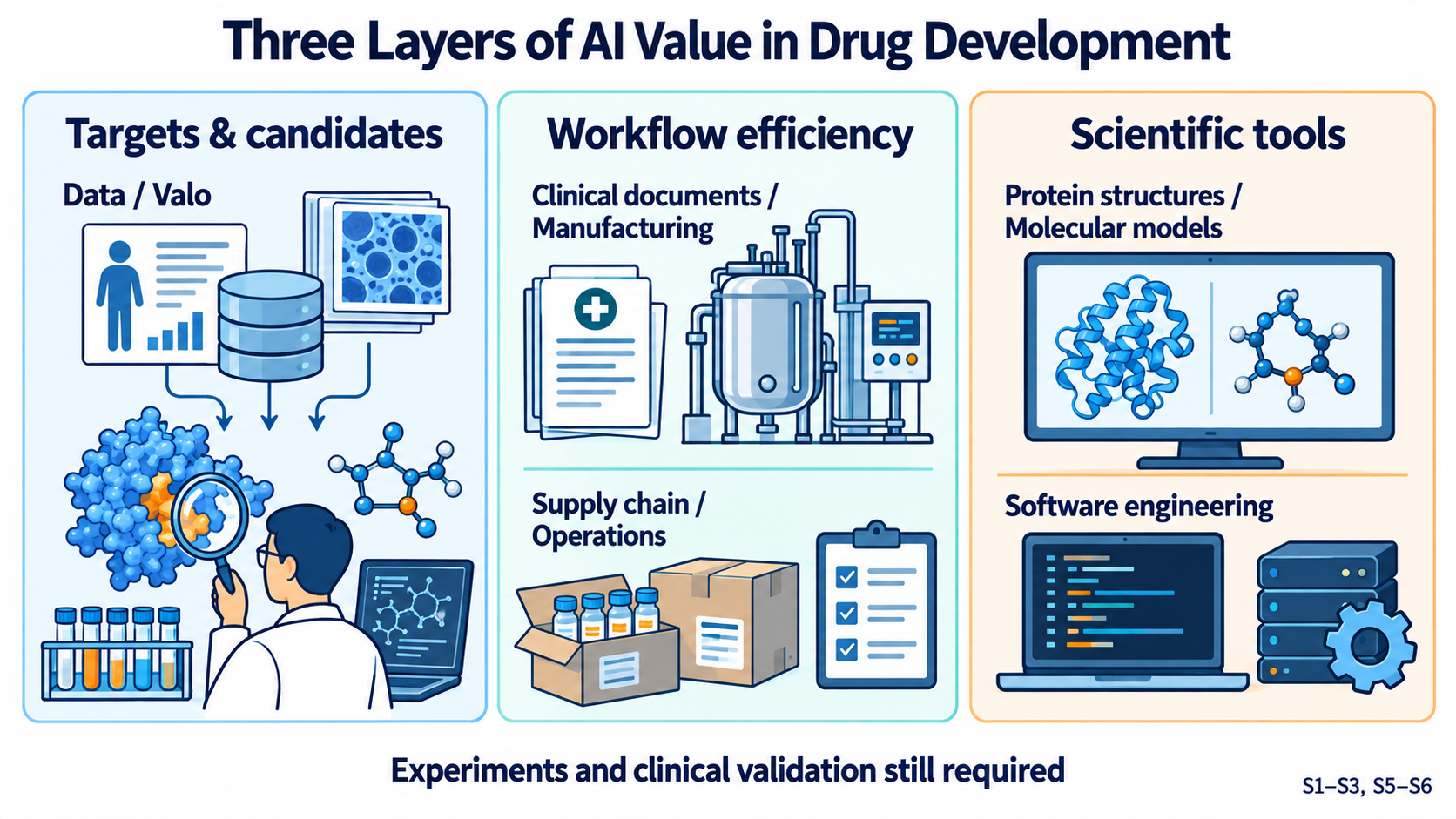
【Figure 2 | Three layers of value: target discovery, operational processes and scientific tools】
AI can support target and candidate discovery, workflow efficiency, and acceleration of scientific models and software tools. These capabilities aim to improve throughput and decision speed; they do not replace experiments or clinical validation. Source numbers correspond to the references below: S1–S3, S5–S6.
【03 | Time has commercial value; clinical success still needs proof】
Novo's partnerships connect AI to areas central to its business, including obesity, diabetes, cardiovascular disease and chronic-disease management. These areas involve large patient populations, extensive data and substantial competition. In obesity and metabolic disease, development questions extend to combinations, longer-acting and oral formulations, muscle preservation, cardiovascular risk, liver metabolism and kidney protection. Better patient segmentation, target selection or trial design could affect the pace of a pipeline. That is a commercial possibility, not an established result of these partnerships.
The decisive tests remain biological and clinical. A target requires experimental support. A candidate's safety requires preclinical and clinical evidence. A claim of superior efficacy against standard treatment needs evidence from a randomized clinical trial. Regulatory and payer decisions depend on endpoints, populations, benefits, risks and cost-effectiveness.
AI may therefore create value by increasing the amount of useful work a research organization can process and reducing the time resources remain tied to a poor decision. Stopping an unpromising program earlier, or moving a stronger hypothesis to preclinical testing sooner, can matter even without an immediate large increase in clinical success rates. Whether those gains occur must be measured.
【04 | Models, cloud infrastructure and discovery platforms have different economics】
The starting question is what capability a partnership supplies. Valo brings human data and drug-discovery tools; OpenAI and Anthropic bring models and workflow support; AWS brings cloud and AI infrastructure. Distinguishing those roles helps readers separate intended improvements in data use, reasoning and deployment from outcomes that have already been demonstrated.【1】【2】【3】【5】
Model providers supply capabilities for reasoning, software engineering and enterprise tasks. Their role in these announcements is to integrate those capabilities into pharmaceutical workflows, not to take over responsibility for each drug's clinical development.【1】【2】
Cloud infrastructure supports secure and scalable computation, data connections and AI deployment. Novo's AWS announcement names Amazon Bio Discovery, Amazon Bedrock and AgentCore, alongside work connecting genomic, imaging and clinical information. The relevant opportunity is demand for the infrastructure used in AI-enabled research and operations.【3】
Disease-data and discovery platforms sit closer to candidate selection and development. Valo's Opal combines human and real-world data, AI small-molecule design and human tissue modelling. The stated potential milestones and royalties depend on contractual conditions and program outcomes; their announcement does not establish that the amounts have been received or recognized as revenue. Equity financing must also remain separate from licensing income.【4】【5】
These business models have different exposure to development risk. Model and cloud services address capability and infrastructure needs. Discovery-platform arrangements can be tied more directly to candidate progress. The public announcements do not justify assigning an undisclosed drug royalty to a cloud or model provider.
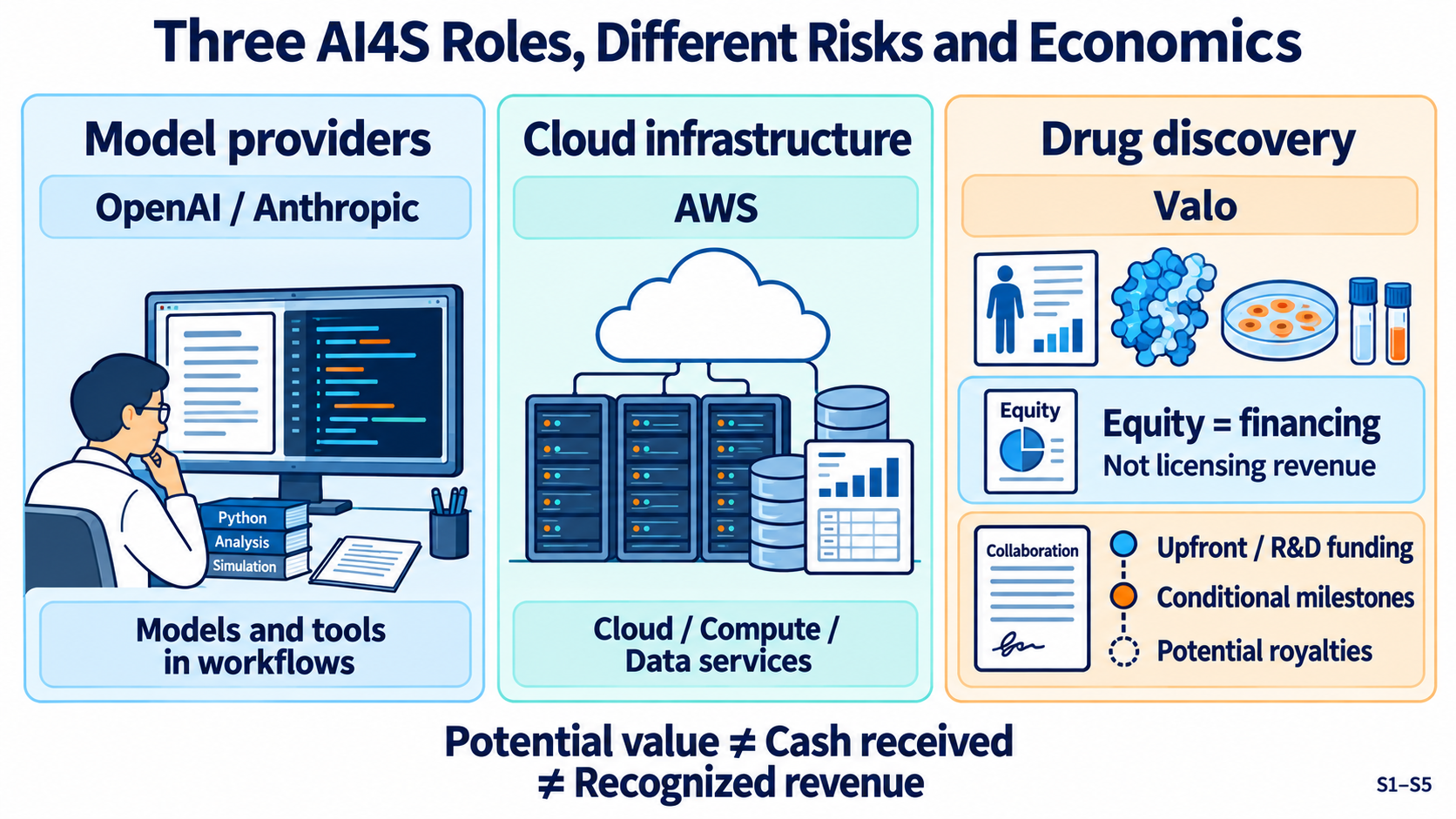
【Figure 3 | Three commercial roles: model services, cloud infrastructure and discovery platforms】
Model providers, cloud infrastructure and drug-discovery platforms have different roles and economic structures. Equity investment in the Valo collaboration is financing, not licensing revenue. Upfront payments, R&D funding, conditional milestones and potential royalties must be distinguished; potential value does not establish cash received or recognized revenue. Source numbers correspond to the references below: S1–S5.
【05 | Adjacent capabilities in Taiwan: ITRI, Repurgenesis and Topmunnity】
The three official pages reviewed here—ITRI, Repurgenesis and Topmunnity, sources 7–9—do not provide evidence of a direct commercial relationship, licence or supply contract connecting these organizations to Novo's cited partnerships with OpenAI, AWS, Anthropic or Valo. The discussion below concerns capabilities described on those pages. It does not establish that these organizations have benefited from those partnerships, nor does this limited review support a claim that no such relationships exist anywhere in Taiwan's industry.
ITRI's AI-driven drug discovery platform, AIDD, includes SEAL for target discovery and CTag for molecular design, using AI and reinforcement learning to assist candidate generation, evaluation and optimization. This is adjacent to the data-and-AI target and molecule discovery discussed in the Valo example. Evidence of licensing, joint development or customers would still be needed to connect the capability to international pharmaceutical partnerships or commercial revenue.【7】
Repurgenesis describes AI-powered technologies and platforms focused on drug repurposing and accelerating development processes. Repurposing existing drugs is not identical to Novo's search for new molecules. It is another way to reorganize data, candidates and development strategies. As an industry interpretation, it could offer Taiwan-based developers a route closer to early commercialization than starting a new molecule from scratch in some cases; clinical and regulatory validation still apply.【8】
Topmunnity Therapeutics describes an AI-driven antibody discovery and engineering platform, and its official website lists a Taipei location. This is adjacent protein and antibody engineering capability, not evidence that it participates in Novo's metabolic small-molecule or chronic-disease pipeline.【9】
Novo brings disease expertise, clinical programs, commercial operations and data assets to its partnerships. For Taiwan's ecosystem, plausible routes include supplying tools for a defined specialist task, building a disease model that can be validated using relevant clinical or biological data, or embedding AI in existing antibody-engineering, repurposing and clinical-data services. Each route needs a measurable case before a commercial claim.
【06 | What to watch: measurable execution and persistent risks】
The news is a sequence of 2026 partnerships with OpenAI, AWS and Anthropic, alongside the earlier expanded Valo collaboration covering up to 20 programs and approximately US$4.6 billion in potential milestones. The analysis concerns how these capabilities might connect target selection, molecule design, data integration, documentation, trial-design support, manufacturing and commercial operations.【1】【2】【3】【4】
If implementation works, the gains may show up as quicker decisions and earlier rejection of weak directions. They should not be assumed to increase the success probability of every drug. AI-generated hypotheses still require experiments; biased data can produce misleading outputs; clinical success still depends on human evidence. Data governance and compliance constrain what a model can use and how, while cloud and model services add ongoing costs.
Novo is seeking to make AI part of its research and operational infrastructure. The intended benefits are shorter decision cycles, broader use of relevant data and more productive research processes. Clinical outcomes must still be assessed program by program and trial by trial.
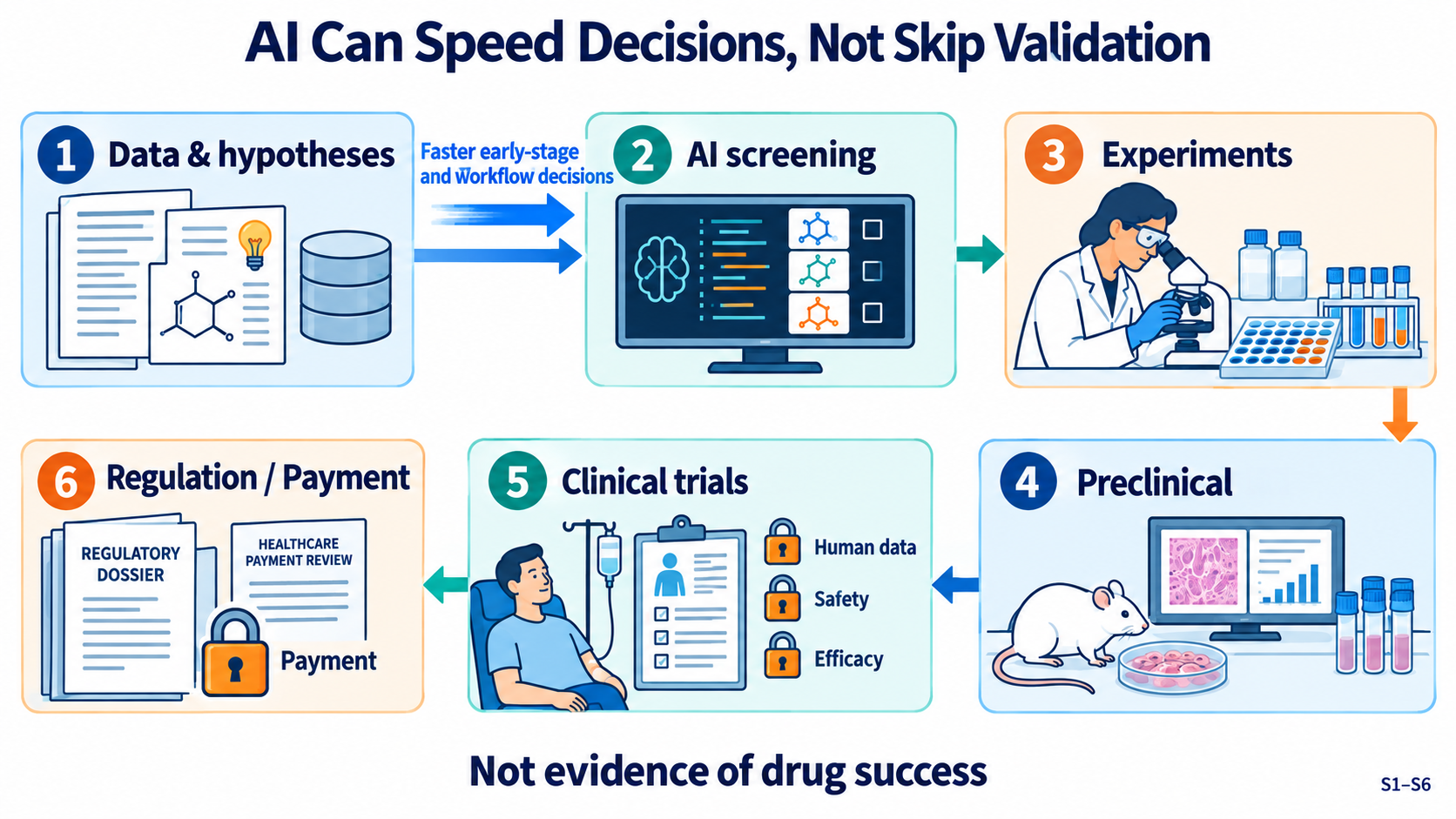
【Figure 4 | Faster decisions do not bypass experiments, trials or regulatory and payer assessment】
The diagram retains data and hypotheses, AI screening, experiments, preclinical work, clinical trials, and regulation/payment in sequence. AI can support early-stage and workflow decisions, but human-data, safety, efficacy and payment requirements cannot be skipped. This is not evidence of drug success. Source numbers correspond to the references below: S1–S6.
【Conclusion | Integration into everyday work is the real test】
The useful question is how the capabilities fit into pharmaceutical work. Valo contributes disease data and AI-enabled discovery; OpenAI contributes enterprise AI; AWS contributes cloud and agentic AI infrastructure; Anthropic contributes scientific reasoning and R&D software engineering.
If this combination is effective, progress would mean faster hypothesis generation, data integration, documentation and rejection of unproductive approaches. None of those gains replaces experiments or clinical trials. The commercial case depends on connecting tools to work that can be measured—and then showing that the resulting decisions are useful.
This article discusses biotechnology industry and technology developments and does not constitute individualized investment advice. AI partnerships and platform capabilities do not guarantee successful drug development, regulatory approval or commercialization.
Primary sources
- Novo Nordisk and Anthropic, September 16, 2026: Claude models and Claude Science for R&D scientific reasoning and AI-driven software engineering, with data governance and human oversight.
https://www.novonordisk.com/news-and-media/news-and-ir-materials/news-details.html?id=916768
- Novo Nordisk and OpenAI, April 14, 2026: pilots in R&D, manufacturing and commercial operations; integration targeted by the end of 2026, not reported as already completed.
https://www.novonordisk.com/news-and-media/news-and-ir-materials/news-details.html?id=916532
- Novo Nordisk and AWS, August 10, 2026: preferred cloud provider and strategic AI partner, London co-innovation hub, Amazon Bio Discovery, Amazon Bedrock and AgentCore.
https://www.novonordisk.com/news-and-media/news-and-ir-materials/news-details.html?id=916594
- Expanded Novo Nordisk–Valo collaboration, January 8, 2025: up to 20 programs; up to US$190 million in upfront payment, equity investment and potential near-term milestones combined; approximately US$4.6 billion in additional potential milestones, with research funding and potential royalties separate.
https://www.novonordisk.com/news-and-media/news-and-ir-materials/news-details.html?id=915085
- Original Valo–Novo collaboration: release body dated September 25, 2023; page header dated September 24. Opal, real-world patient data, small-molecule discovery and human tissue models; three preclinical cardiovascular programs licensed.
- Anthropic biomolecular-model research, September 17, 2026: more than 30 open-source models; approximately fourfold average speedup allowing small accuracy differences, close to twofold with identical outputs, and about 1.6-fold for the structure-prediction subgroup. Model-inference evaluation, not drug-development or Novo clinical success.
https://www.anthropic.com/research/claude-uplifts-biomolecular-modeling?s=04
- ITRI AIDD: SEAL target discovery, CTag molecular design, AI and reinforcement learning for candidate generation, evaluation and optimization. Undated technical page; reviewed September 20, 2026.
- Repurgenesis: AI-powered technologies and platforms for drug repurposing. Undated platform page; reviewed September 20, 2026.
- Topmunnity Therapeutics: AI-driven antibody discovery and engineering platform. Undated homepage; reviewed September 20, 2026.
Cite this article
For decks, research notes, or media references, cite Drugnews with the canonical article URL.
Drugnews Editorial Team. "Novo Nordisk teams up with Anthropic to bring Claude's reasoning and coding into drug R&D." Drugnews, Sep 25, 2026. https://drugnews.com.tw/articles/2026-09-25-novo-nordisk-anthropic-ai-rd-workflow-free-en.html