
In September, Anthropic's life-sciences chief made Reuters a promise.
"We're not competing with pharma and biotech companies that make their business in bringing drugs to market," said Eric Kauderer-Abrams.
A month later, the maker of Claude filed to go public.
Its prospectus tells investors a different story. It mentions a molecular biology lab, the purchase of AI biotech Coefficient Bio, and in-house researchers using Claude to find drugs.
Nine of the ten largest drugmakers already pay Anthropic.
Their worry is blunt. If they pour R&D data into this model every day, are they training a rival?
No. Not before the end of 2027, at least.
Anthropic is making drugs, and it is serious about it. But it has said it is not running human trials for now.
Its most valuable exit is to hand drug candidates back to pharma.
01 | "Not competing" is only half true
The pivot started on June 30, 2026, at an Anthropic event in San Francisco.
The company launched Claude Science, a research workspace for scientists.
It ships with more than 60 skills, connectors and databases. They cover genomics, single-cell work, proteomics, structural biology and cheminformatics.
It can show 3D protein structures, genome tracks and chemical structures. It keeps code and history next to every chart, so results can be checked later.
A sister product, Claude for Life Sciences, goes further down the pipeline. Forbes reports it helps with drug discovery and with paperwork such as FDA submissions.
Named users in the filing coverage include Bristol Myers Squibb, the Garvan Institute of Medical Research and UC San Francisco.
At the same event, Kauderer-Abrams made a bigger announcement.
Anthropic would run its own preclinical drug programs.
The first targets would be "neglected diseases," the ones traditional drugmakers tend to underfund.
Jonah Cool, who leads life-sciences partnerships, described two tracks.
One track sells AI tools to drugmakers and research institutes.
The other builds drug-discovery experience through Anthropic's own programs.
Then came the lab.
On September 18, Reuters reported that Anthropic had built a wet lab in the San Francisco Bay Area.
A spokesperson said it was "not for drug discovery specifically."
The same report said Anthropic had bought Coefficient Bio, a stealth AI biotech. Media reports put the price at about $400 million in stock.
Reuters listed the focus areas: rare diseases, "undruggable" conditions, and bispecific and trispecific antibodies.
Kauderer-Abrams said Anthropic was not running clinical trials for now. He said competition concerns were part of the reason.
That detail matters more than the lab itself.
Running a trial would put Anthropic in the same race as the companies paying its bills.
Five days later, the lab showed what it could do.
About 950 Claude agents ran for 21 hours.
They sifted more than 200,000 reverse transcriptases drawn from about 1.9 billion protein clusters.
They narrowed roughly 3,500 candidate systems down to 20.
The result was a previously unknown enzyme system in bacteriophage DNA. Anthropic named it ART.
Anthropic's own scientists ran every lab experiment.
The company was candid about the limits. It does not yet know what the system does.
Our September piece on the Model Hardware Standard covered the software layer. It lets AI agents run microscopes, liquid handlers and robotic arms.
The ambition is not new. Anthropic's earlier move into research tools, which we covered in July, already pointed this way.
Back then, the hardware standard was something for customers.
What changed is ownership. The lab, the team from Coefficient and the programs now sit inside Anthropic.
Now Anthropic has its own bench.
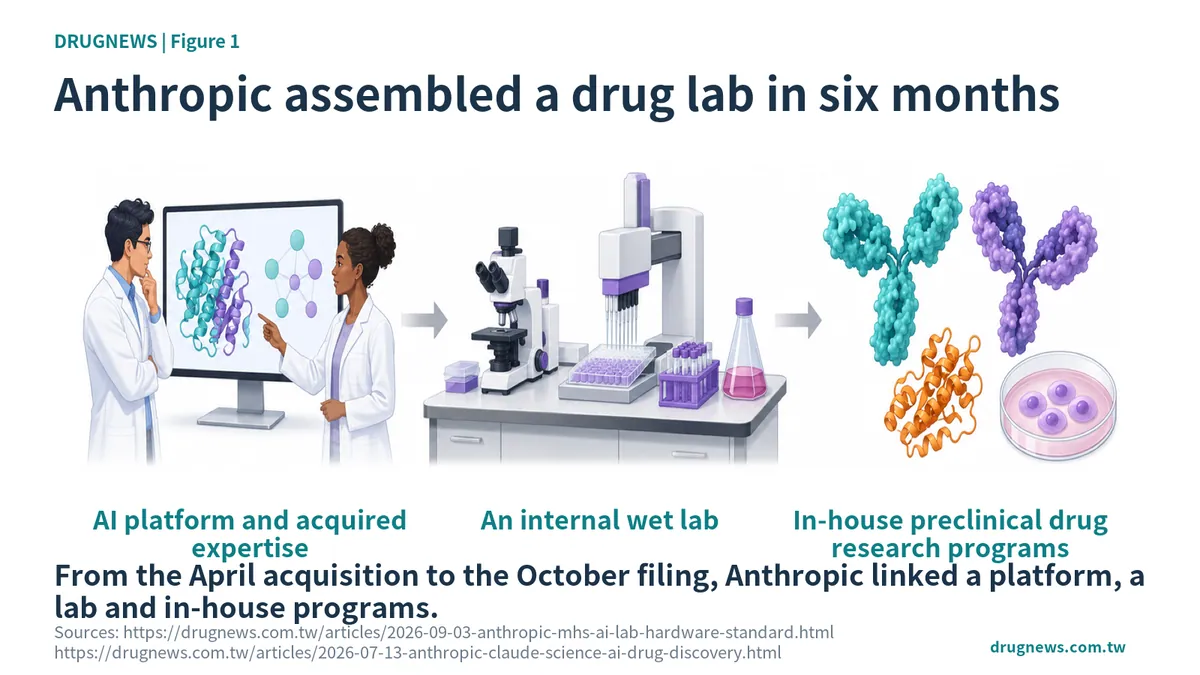
From the April acquisition to the October filing, Anthropic linked a platform, a lab and in-house programs.
02 | A one-person drug company, bought by Anthropic
Two days after the S-1 went public, Anthropic said it had acquired Mithril Medicine. The company had one employee, founder Cody Tranbarger; terms were not disclosed.
He works on LAMA2-related congenital muscular dystrophy, a rare muscle disease that starts in infancy. With no lab of his own, he used Claude to handle contracts, logistics and experiment planning while directing 11 outside labs, and went from idea to mouse data in under 18 months: mice given one antibody design had about twice the grip strength of untreated mice.
The report has not been peer reviewed. If the candidates hold up, human trials could start in late 2028 at the earliest.
The six partners announced the same day gave harder numbers. Enveda had Claude review 1,061 pages of manufacturing records; it caught all 11 issues human reviewers found plus seven more, and review time fell from almost 26 hours to under three. A clinical trial application draft took four hours instead of about three months.
Starting a drug company used to mean raising money, renting a lab and hiring a team. Mithril asks a different question: if experiments are outsourced and the workflow runs on AI, how few people does a drug company need?
Most Taiwanese biotechs are teams of a few dozen people. What they lack is usually not ideas but the people and money to push an idea to animal data. Taiwan has more reason than the US to take that question seriously.
03 | Only one of the two ledgers makes money
The S-1 went public on October 26.
Anthropic is seeking a Nasdaq listing under the ticker ANT.
Revenue for the first half of 2026 was $16.29 billion.
A year earlier, the same six months brought in $1.16 billion. That is roughly a fourteenfold jump.
The headline net loss is $80.75 billion. It looks alarming at first glance.
But $72.39 billion of it came from fair-value changes on convertible notes, derivative liabilities and SAFEs. None of that is cash.
The filing ties it mainly to the rising fair value of its outstanding convertible notes. It does not reflect money spent on labs or drugs.
The operating loss was $693 million.
A year earlier, it was $2.14 billion.
The second quarter matters more than the half.
Anthropic booked $974 million of operating income in that quarter.
In the first quarter, it had posted a $1.7 billion operating loss.
The customer base is broad.
As of September 30, nine of the ten largest pharmaceutical companies in the Fortune 500 were customers.
More than 11,900 customers each paid at least $100,000 over the prior twelve months.
That is the first ledger. Anthropic sells models and platforms, and it already collects cash.
The second ledger is drug discovery.
The filing says Claude is used in drug discovery and development "by our customers, our biotechnology partners, and our own researchers."
It does not break out revenue from research products.
From this document, investors cannot see what the lab costs or how far any program has gone.
The filing does flag new risks from the lab work.
Robotic and lab-equipment operation could cause "bodily injury, property damage," or the "release of hazardous substances," it warns.
It also calls its safeguards against weapons misuse "incomplete."
Then there is compute.
Under one arrangement, Anthropic agreed to spend up to $120.5 billion on compute through 2029.
That is where the cash goes.
A company whose operating line just turned positive, with that compute bill ahead, will not trade the trust of nine top drugmakers for a clinical program.
Clinical programs take years to read out.
Novartis CEO Vas Narasimhan sits on Anthropic's board.
He has estimated that AI platforms could cut the path from research to approval from about 12 years to 7 or 8.
He also thinks they could lift the industry's success rate from about 8% to 16%.
But he split drug-development delays into three kinds: information, operational and biological.
AI helps most with the first two.
Biological time, the animal, cell and human testing, is the hardest to compress.
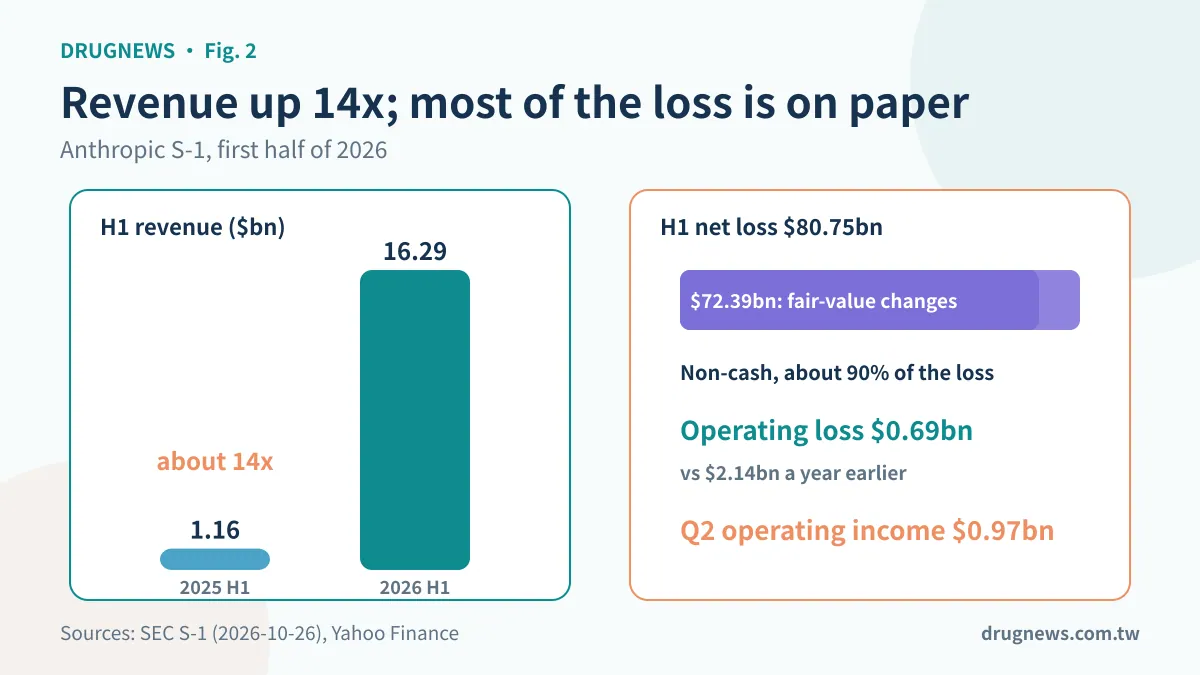
First-half 2026 revenue was $16.29 billion; $72.39 billion of the $80.75 billion net loss was non-cash fair-value changes.
04 | Pharma's answer: sign with both
Reuters spelled out the customer concern.
Drugmakers may worry that Anthropic will learn from their competing drug programs.
It is a reasonable fear.
A drugmaker that uses a model to reason through its targets is exposing strategy, not just data. Which targets it chases, which it drops, and why.
Their response has been to diversify, not to walk away.
Novo Nordisk is the clearest case.
On April 14, it announced a company-wide partnership with OpenAI.
That deal covers R&D, manufacturing, supply chain and corporate work.
On September 16, Novo signed with Anthropic as well.
It will first test Claude Science in specific R&D workflows.
The release stressed "robust data governance and human oversight."
The OpenAI release had used similar language, promising "strict data protection."
Neither release disclosed financial terms. Neither described exclusivity.
Read together, the two deals say something simple. Novo is keeping both vendors close and neither one in charge.
One drugmaker, two model companies, five months apart.
OpenAI has moved too.
On October 20, it bought Orchestra Bio.
Orchestra coordinates drug-development work across biopharma teams, pairing people with AI agents.
OpenAI folded it into Rosalind, its life-sciences line, which includes the GPT-Rosalind model.
Both model companies are pushing deeper into how drugs get made.
OpenAI says Moderna uses its tools to turn complex data into experimental workflows.
So the competition between model companies is now playing out inside pharma's R&D budget.
An AI company that truly makes its own drugs looks different.
Alphabet's Isomorphic Labs raised $2.1 billion in May.
Its first clinical trials are now expected by the end of 2026. The earlier target was the end of 2025.
That is what owning a pipeline costs: time, and a lot of capital.
Isomorphic has not yet started those first human trials.
And as of early July 2026, no drug explicitly labeled "AI-designed" had completed clinical trials and won FDA approval.
| Company | Main revenue | Own drug programs | Human trials | Named pharma ties |
|---|---|---|---|---|
| Anthropic | Model and platform sales | Yes, preclinical | Not for now | Novo Nordisk, BMS, Genentech |
| OpenAI | Model and platform sales | Not disclosed | Not disclosed | Novo Nordisk, Moderna |
| Isomorphic Labs | Partnerships and own pipeline | Yes | Targeted by end-2026 | — |
Whoever goes into the clinic alone becomes the competitor customers guard against.
There is a second reason the lab matters.
Our AstraZeneca–insitro piece found that AI drug-discovery deals pay little upfront.
Pharma waits for human data before writing big checks.
The licensing model can still be lucrative.
In January 2026, Insilico Medicine signed an oncology deal with Servier worth up to $888 million.
The headline value is mostly milestones. But it shows where AI-discovered assets get priced: at the licensing table, by drugmakers.
A tools vendor has little leverage in that negotiation.
A model company holding its own validated candidates walks into licensing talks from a different position.
That is the business logic of the lab.
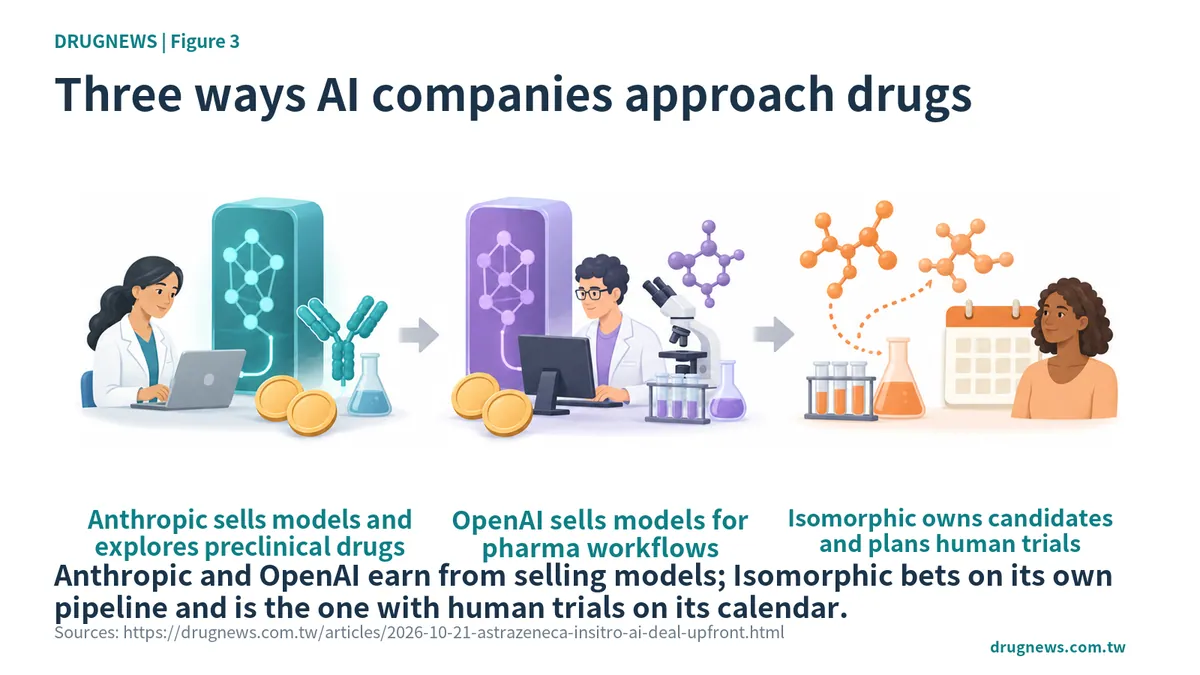
Anthropic and OpenAI earn from selling models; Isomorphic bets on its own pipeline and is the one with human trials on its calendar.
05 | Where Taiwan fits
Anthropic has one public tie to a Taiwanese company.
Nextlink Technology (6997) became Anthropic's distribution partner in Taiwan on January 23, 2026.
It offers Claude through Amazon Bedrock and AWS's Taipei region.
At launch, it named finance and retail as the industries looking hardest at Claude.
The local region matters for regulated buyers. It keeps latency low and helps with data-residency rules.
That is a distribution channel, not a drug partnership. But it means Taiwanese hospitals and drug developers can buy the same models without building their own infrastructure.
The biotech opening sits after the lab.
Anthropic's target formats include bispecific and trispecific antibodies.
Moving those from candidate to clinic takes cell-line development, process scale-up and GMP manufacturing.
EirGenix (6589) said at BIO 2026 in June that it is expanding capacity for monoclonal and bispecific antibodies.
It pitches itself as a one-stop CDMO, from cell lines to commercial supply.
There is no public record of any deal between Anthropic and EirGenix.
But the chain is easy to follow.
If Anthropic leaves human trials to pharma, and pharma outsources development and manufacturing, that is the slot a Taiwanese antibody CDMO is built for.
For Taiwanese drug developers, the nearer point is on the research side.
The same tools nine of the top ten drugmakers use are open to them.
How research data may be used is something to settle in the contract up front.
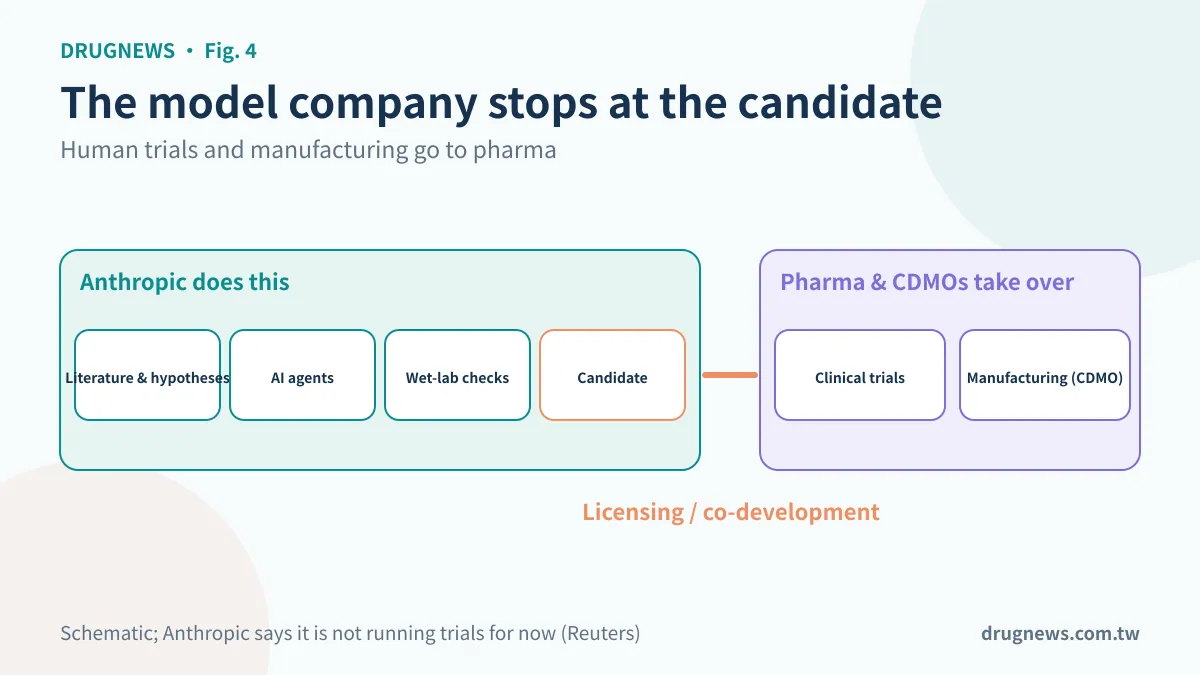
Anthropic does the work up to wet-lab validation and a candidate; trials and manufacturing go to pharma and CDMOs.
06 | A seat at the table, not a pipeline
Back to the headline.
Anthropic does want to make drugs.
It built a lab, bought a biotech and found a new enzyme system.
But its $16.29 billion of first-half revenue comes from customers, nine top drugmakers among them.
None of it comes from a medicine.
What Anthropic wants is not pharma's patients.
It wants a seat at pharma's licensing table.
Our call: before the end of 2027, Anthropic will hand its first in-house drug programmes to pharma partners through licensing or co-development rather than sponsoring human trials itself.
One result would prove us wrong: if Anthropic itself takes Mithril's antibody into human trials in 2028, it wants to be a drug company, not just a seat at the negotiating table.
This article is industry and company analysis, not investment or medical advice.
References
- Anthropic, PBC Form S-1 | U.S. SEC | 2026-10-26 | https://www.sec.gov/Archives/edgar/data/0002130357/000162828026067168/anthropicpbc-sx1.htm
- Exclusive: Anthropic quietly sets up biology lab as it ramps AI drug program | Reuters (via Yahoo Finance) | 2026-09-18 | https://ca.finance.yahoo.com/news/exclusive-anthropic-quietly-sets-biology-100255331.html
- Anthropic IPO filing flags healthcare, drug discovery as growth bets | Becker's Hospital Review | 2026-10-26 | https://www.beckershospitalreview.com/healthcare-information-technology/ai/anthropic-ipo-filing-flags-healthcare-drug-discovery-as-growth-bets/
- Anthropic IPO live updates: S-1 filing discloses $16.3B in first-half revenue | Yahoo Finance | 2026-10-26 | https://finance.yahoo.com/technology/live/anthropic-ipo-live-updates-frontier-ai-lab-discloses-revenue-and-risks-in-highly-anticipated-s-1-filing-141702607.html
- What Anthropic's S-1 Reveals About Its Plans For Scientific Research | Forbes | 2026-10-26 | https://www.forbes.com/sites/alexknapp/2026/10/26/anthropics-s-1-promises-new-scientific-discoveries-and-new-threats/
- Anthropic launches Claude Science for in-house AI drug discovery | TechNews | 2026-07-08 | https://technews.tw/2026/07/08/anthropic-launches-claude-science-for-in-house-ai-drug-discovery/
- Claude AI helps uncover new enzyme system in bacteriophage DNA | ForkLog | 2026-09-24 | https://forklog.com/en/news/claude-ai-helps-uncover-new-enzyme-system-in-bacteriophage-dna
- Anthropic is operating a lab that conducts biology experiments | TechCrunch | 2026-09-18 | https://techcrunch.com/2026/09/18/anthropic-is-operating-a-lab-that-conducts-biology-experiments/
- Novo Nordisk and Anthropic collaborate on drug discovery | Novo Nordisk | 2026-09-16 | https://www.novonordisk.com/news-and-media/news-and-ir-materials/news-details.html?id=916768
- Novo taps OpenAI to deploy AI across R&D, manufacturing and corporate functions | Fierce Pharma | 2026-04-14 | https://www.fiercepharma.com/pharma/novo-taps-openai-deploy-ai-across-rd-manufacturing-and-corporate-functions
- OpenAI acquires Orchestra Bio to expand Rosalind life sciences tools | Unite.AI | 2026-10-20 | https://unite.ai/openai-acquires-orchestra-bio-to-expand-rosalind-life-sciences-tools
- Google-backed Isomorphic raises $2.1 billion to scale AI-driven drug discovery | Reuters (via WHTC) | 2026-05-12 | https://whtc.com/2026/05/12/google-backed-isomorphic-raises-2-1-billion-to-scale-ai-driven-drug-discovery/
- Nextlink Technology becomes Anthropic distribution partner in Taiwan | Commercial Times | 2026-01-23 | https://wantrich.chinatimes.com/news/20260123900310-420101
- EirGenix at BIO 2026: CDMO and biosimilar dual track | GeneOnline | 2026-06-30 | https://geneonline.news/bio2026-eirgenix-026newsjune/
- Anthropic buys a one-person biotech and starts its own drug programmes | The Next Web | 2026-10-28 | https://thenextweb.com/news/anthropic-mithril-acquisition-claude-drug-development
Share this analysis
Send this article to readers who follow biotech, company strategy, and capital-market signals.
Cite this article
For decks, research notes, or media references, cite Drugnews with the canonical article URL.
Drugnews Editorial Team. "Anthropic's Drug Lab Will Sell to Pharma." Drugnews, Nov 01, 2026. https://drugnews.com.tw/articles/2026-11-01-anthropic-ipo-ai-drug-lab-en.html