
──────────
Share this analysis
Send this article to readers who follow biotech, company strategy, and capital-market signals.
Treatment for spinal muscular atrophy (SMA) has gained an option that acts directly on muscle. On September 11, 2026, Scholar Rock announced US FDA approval of ISEMBYLD (apitegromab-mstn) for adults and children aged two years and older who are receiving an SMN2-targeting therapy.【1】
The new therapy starts with a specific aim: achieving additional motor function benefits on top of existing treatment. In the trial, the between-group difference on a motor function scale after one year was 2.2 points. For the company, the next task is to bring that clinical evidence to physicians, patients and payers so that eligible people can start treatment and continue receiving it.【2】【3】
The launch can therefore be viewed from two angles: how much therapeutic value a muscle-directed intervention adds, and whether that value supports the additional infusion, payment and long-term care arrangements it requires.
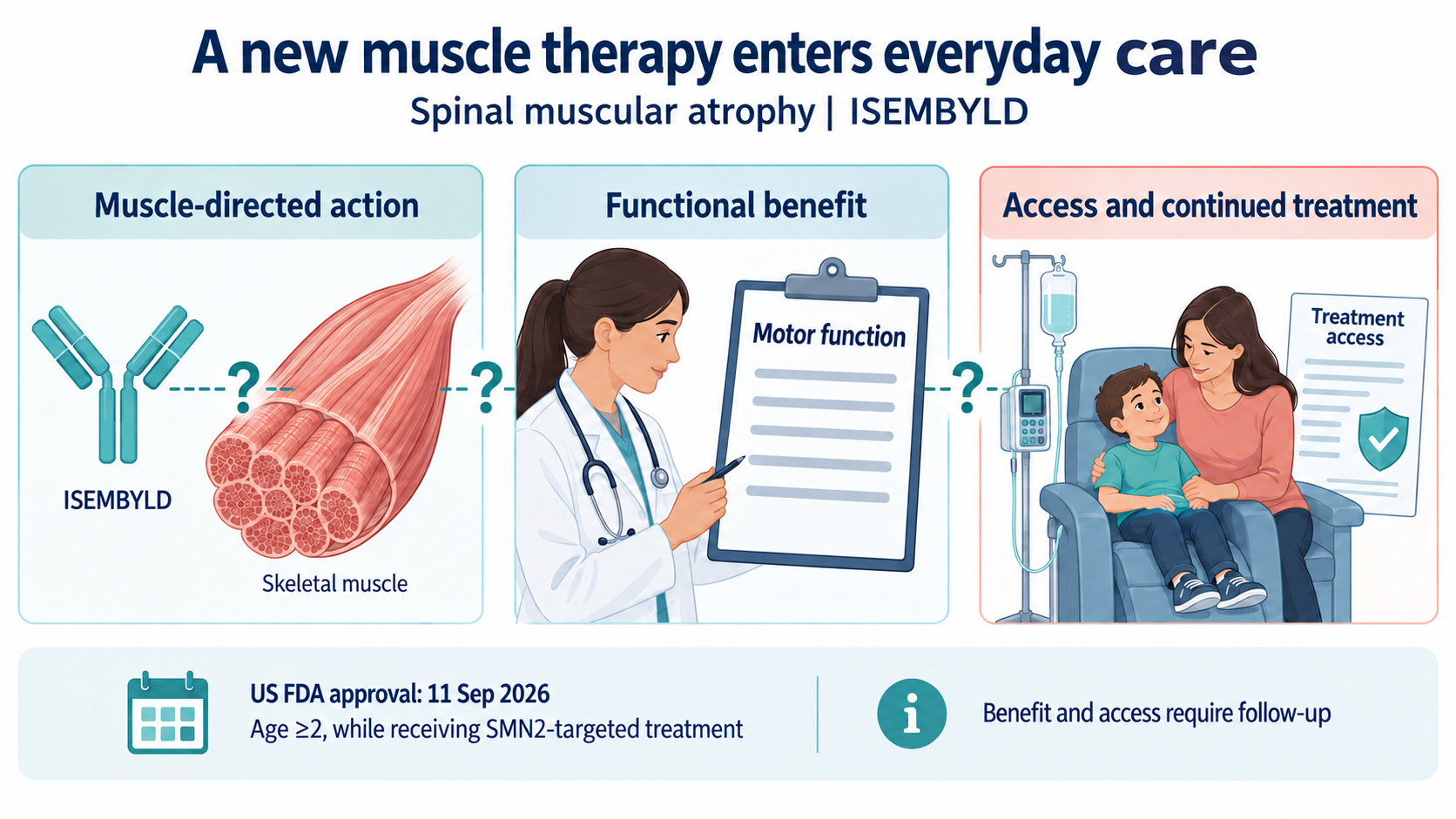
【Figure 1 | From a New Treatment Option to Everyday Care】
A muscle-directed therapy adds a new option to existing SMA treatment. Turning its clinical evidence into everyday use requires patient assessment, payment arrangements and coordination of infusion care; approval alone does not describe how many people will start or continue treatment. Dashed question-mark links connect the article's questions, not proven outcomes or conversion rates.
【01|Targeting Muscle to Build Value Beyond Existing Treatment】
SMA involves motor neuron loss and muscle atrophy. SMN2-targeting therapies and ISEMBYLD act at different points; in its approval presentation, the company identified motor neurons and muscle as two treatment dimensions.【3】
ISEMBYLD is an antibody that binds the precursor and latent forms of myostatin, inhibiting its activation. This extends the development focus to muscle, with motor function trials testing its clinical contribution.【1】
That positioning also defines the commercial starting point: adding a new therapy for people already receiving SMN2 treatment. Physicians and patients need to assess how much functional benefit this additional intervention can deliver on top of existing care. Payers likewise face evidence that must explain the added value.
ISEMBYLD's differentiation therefore rests on a concrete question: what more can a muscle-directed intervention offer patients who are already being treated? The answer depends on a controlled trial with background treatment, rather than on a new mechanism of action alone.
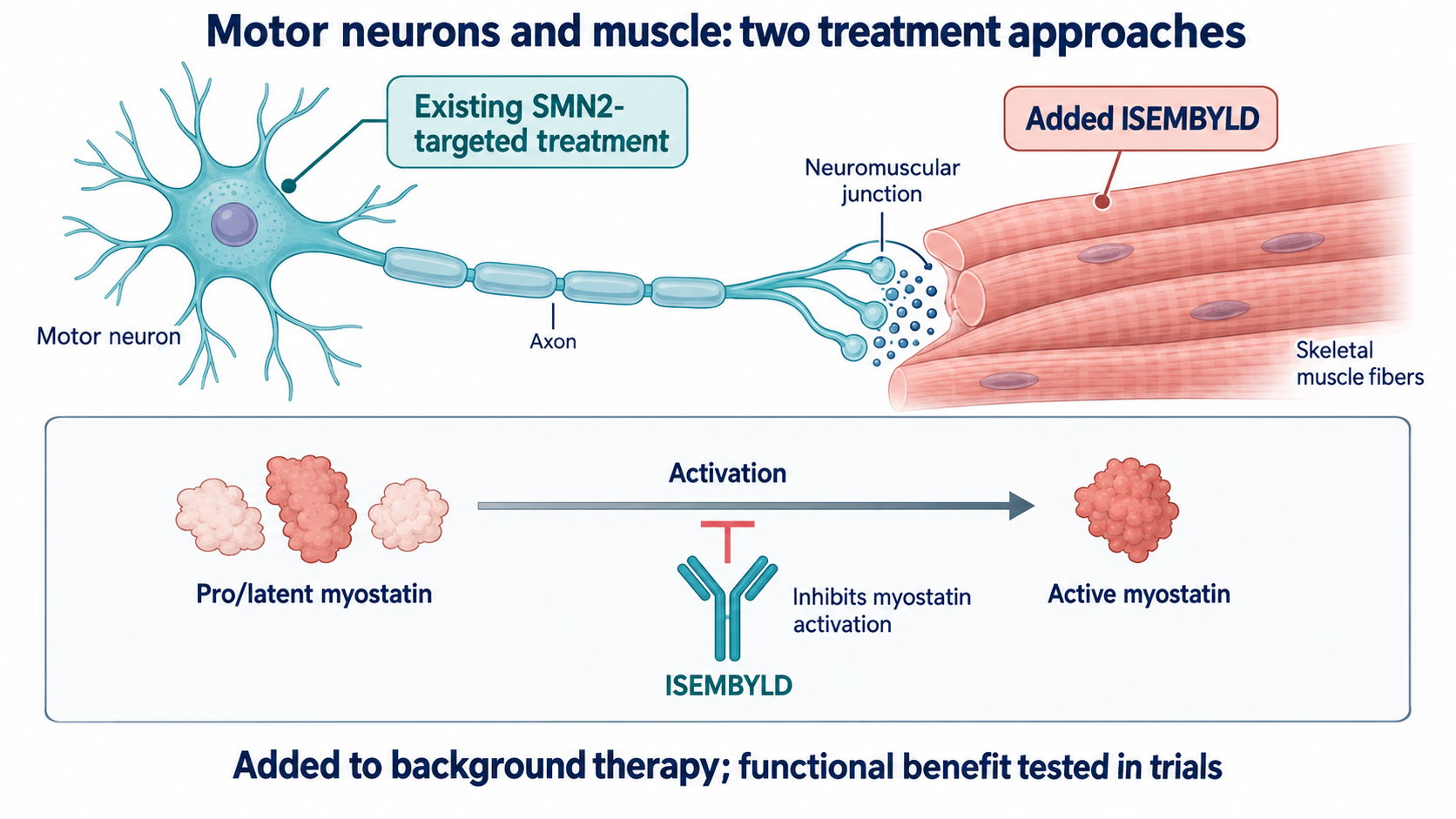
【Figure 2 | Motor Neurons and Muscle: Two Treatment Dimensions】
ISEMBYLD adds a muscle-directed action on top of SMN2 background treatment. The rationale for addressing both dimensions needs functional trial evidence to establish the incremental clinical benefit. The positions indicate treatment approaches, not exclusive tissue distribution; background therapy is continued.
【02|How the 2.2-Point Difference Was Produced Shapes the Efficacy Story】
The Phase III SAPPHIRE trial enrolled 188 participants overall. The recommended-dose efficacy comparison presented here concerns participants aged 2–12 years who were nonambulatory at baseline: 53 in the ISEMBYLD 10 mg/kg group and 50 in the placebo group. Both groups continued receiving SMN2 background treatment.【2】【3】
At 52 weeks, the ISEMBYLD group's HFMSE motor function score had increased by 1.0 point from baseline, while the control group's score had declined by 1.2 points. This produced a between-group difference of 2.2 points, with a 95% confidence interval of 0.49–3.95 points. HFMSE stands for Hammersmith Functional Motor Scale–Expanded.【2】【3】
The result captures both improvement in the ISEMBYLD group and decline in the control group over the same period. This incremental evidence underpins the commercial case for an add-on therapy: while existing treatment continues, an additional intervention can still produce a difference in functional performance at the group level.
The distribution of improvement offers another perspective. The reported proportions achieving an increase of at least 3 HFMSE points were 34.2% in the ISEMBYLD group and 13.5% in the control group. Looking at the mean difference alongside the proportion reaching a specified threshold helps describe the magnitude and distribution of benefit, rather than selecting only the most striking number.【1】【3】
The scale still matters when interpreting these findings: 2.2 points is the difference between the changes in the two groups, while 34.2% is the proportion reaching a specified improvement threshold. Neither can be converted directly into an individual patient's probability of regaining the ability to walk or being cured. Longer-term data and experience in routine care may help clarify what these scores mean in the lives of different patients.
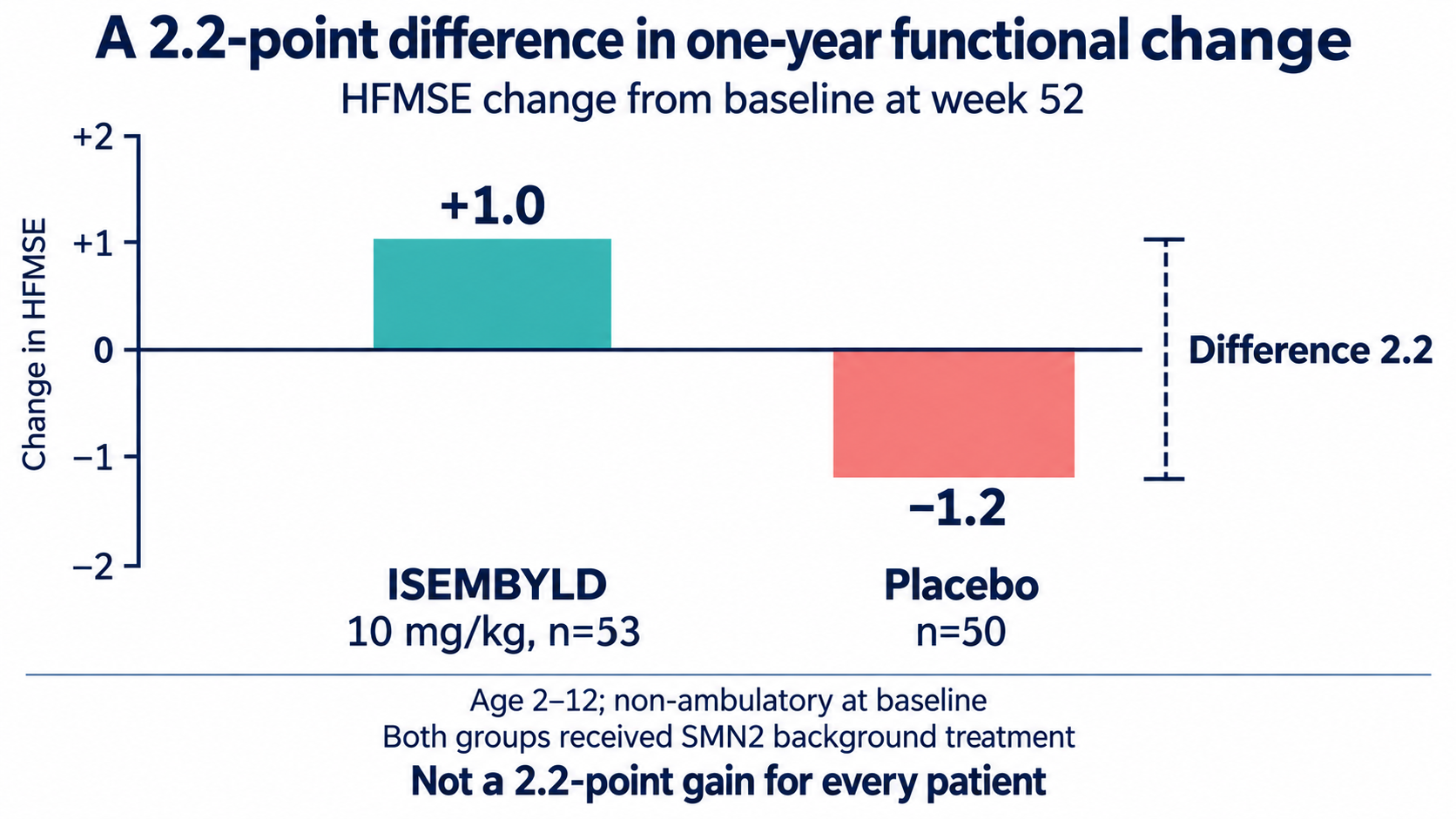
【Figure 3 | A 2.2-Point Difference Between Groups at One Year】
In the recommended-dose comparison, the 52-week HFMSE changes were +1.0 and −1.2 points, yielding a between-group difference of 2.2 points (95% CI 0.49–3.95). This comparison involved 53 and 50 participants, respectively, aged 2–12 years and nonambulatory at baseline; both groups received SMN2 background treatment.
【03|Eligible Patients and Safety Define the Boundaries of Long-Term Value】
The US approval covers adults and children aged two years and older who are receiving an SMN2-targeting therapy. The specific efficacy comparison above, however, comes from participants aged 2–12 years who were nonambulatory at baseline. Evaluating a new patient requires attention to age, existing function and background treatment; the same average benefit cannot be applied to everyone.【1】【2】
Risks also need to be monitored during long-term use. The US label warns about fracture risk. Separately, in a September 15 filing with the SEC, the company corrected an answer given on the previous day's call about postmarketing safety requirements: the FDA required a pregnancy safety study and separately requested that serious and non-serious fractures, both domestic and foreign, be submitted as 15-day alert reports.【2】【4】
These follow-up activities will continue to build the postmarketing safety record. For a therapy requiring repeated administration, how long functional benefits last, which patients benefit more, and how risks emerge over time all contribute to its long-term value. The available 52-week findings provide a starting point that needs to be extended through further follow-up.
【04|About 6,600 Is a Company Estimate of the Patient Population—Starting Treatment Is Another Step】
In its September 14 presentation, Scholar Rock estimated that approximately 6,600 people in the United States were receiving SMN2-targeting therapies. The number describes the company's view of an already-treated population; it is neither a count of ISEMBYLD prescriptions nor a sales forecast.【3】
The company also outlined patient support arrangements, including help with insurance information, infusion-day logistics and financial assistance for eligible patients. These services address factors beyond clinical value that can nevertheless affect whether treatment actually begins.【1】【3】
From a commercial perspective, people already receiving background treatment provide a defined population to reach and assess. Moving from eligibility under the approval to starting the new therapy still requires medical judgment, payment arrangements and coordination of care. The trial's incremental benefit provides a rationale for those decisions; patient support and supply execution help connect that rationale to actual treatment.
Three distinct developments will therefore be worth observing after launch: how many people enter assessment, how many complete payment and infusion arrangements, and how many actually start treatment. The company has disclosed its preparations and support plans; subsequent operating data will be needed to show how people progress through these steps.
【05|Infusions Every Four Weeks Make Continued Treatment Another Commercial Test】
The US label specifies intravenous infusion every four weeks, while the patient's SMN2 background treatment continues. For families, the new therapy becomes part of an existing care routine, requiring repeated scheduling and treatment. For the company, the work after the first dose includes reliable supply, coordinated services and continuing support.【2】
The treatment settings described by the company include hospitals, infusion centers and home arrangements for eligible patients. These offer different ways to deliver care, with actual use determined by patient circumstances and medical care arrangements.【1】【3】
The rationale for staying on treatment also comes back to clinical value: whether a patient retains benefits that justify continuing, whether safety remains acceptable, and whether payment and infusion arrangements work smoothly. Support for all three in actual use could help sustain demand for treatment. This is the article's commercial interpretation, not a published retention rate or revenue result.
Early launch performance is therefore best considered in two stages: starting treatment and continuing treatment. The former reflects the speed of access after approval; the latter more closely reflects the combined effects of clinical benefit, service delivery and payment conditions. A single estimate of the patient population cannot substitute for actual performance at either stage.
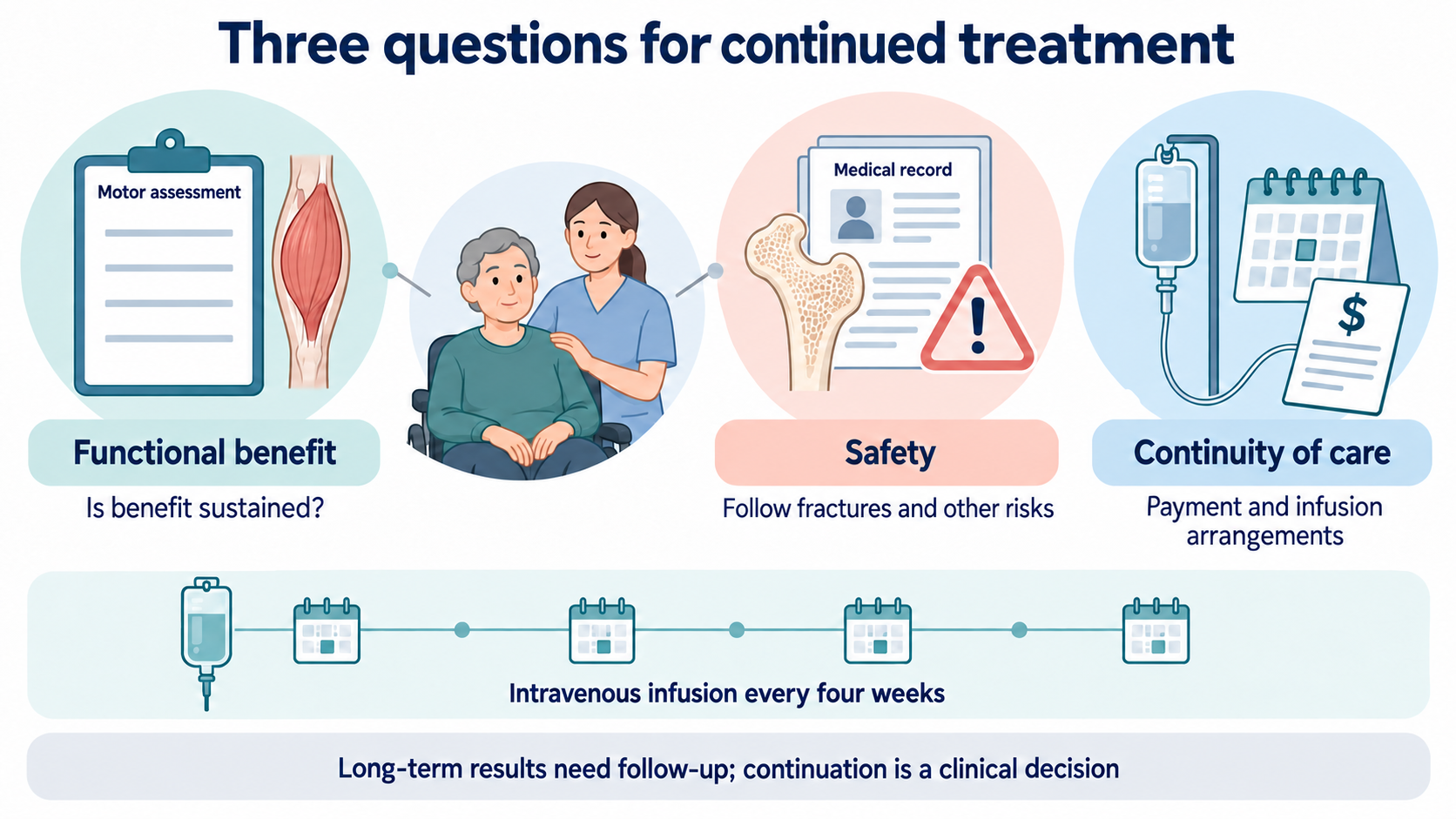
【Figure 4 | Continued Treatment Depends on Benefit, Safety and Access】
Continued use depends on clinical benefit, safety and the practical conditions of treatment working together. Infusions every four weeks create recurring care needs, while the September 15 SEC correction adds relevant context on postmarketing safety follow-up. Long-term value still requires support from actual use and follow-up data.
【06|Taiwan's Relevant Capability: Moving a Drug Candidate Into Human Evaluation】
Taiwan's AnnJi (7754) provides another example of drug development in a neuromuscular disease. Its oral small molecule AJ201 targets Kennedy's disease, also called spinal and bulbar muscular atrophy (SBMA), through approaches involving the mutant androgen receptor protein and cellular protective pathways. This differs from the SMA disease and myostatin-antibody therapy discussed here; the two programs' trial results cannot be ranked directly against one another.【5】
In 2025, AnnJi reported an early human study conducted at six US centers, generating safety, pharmacokinetic and exploratory findings. The study was not powered to establish efficacy. On September 3, 2026, the company announced that it had submitted an application to the FDA for a Phase III trial. That announcement establishes application progress, not approval or the start of enrollment; further development still requires robust studies demonstrating meaningful functional benefit for patients.【6】【7】
For investors, the key assets of such companies are their drug candidates and the clinical evidence accumulated around them. If subsequent validation and development conditions are met, they may support commercial partnerships, licensing or development into the company's own products. Each route still needs to address trials, funding, regulation and access to treatment. Scholar Rock's approval offers a case for examining how additional functional improvement can become treatment value that payers will support; it does not establish that AnnJi has received orders or licensing deals, or will achieve the same efficacy.
【Conclusion|Value After Launch Comes From Moving Trial Gains Into Everyday Treatment】
ISEMBYLD adds a muscle-directed option for spinal muscular atrophy and has demonstrated a functional difference on top of existing treatment. Its commercial value will now need to emerge through actual use by eligible patients, financial access and benefits sustained over time.
For readers, the 2.2-point difference is an entry point into understanding this development. Following the evidence further raises questions about who can benefit, how treatment starts and whether it can continue. That path from clinical evidence to everyday use explains the real post-launch challenge better than a single price tag.
This article provides public medical and industry information and does not constitute individualized treatment or investment advice. Eligibility and treatment arrangements should be assessed by a medical team familiar with the person's condition.
【Sources】
【1】Scholar Rock. Announcement of US FDA approval of ISEMBYLD, September 11, 2026. Indication, mechanism, efficacy and patient support information. https://investors.scholarrock.com/news-releases/news-release-details/scholar-rock-announces-fda-approval-isembyldtm-apitegromab-mstn
【2】ISEMBYLD US Prescribing Information, revised September 2026. Administration, trial population, efficacy tables and safety warnings. https://www.scholarrock.com/documents/label/us/ISEMBYLD_PI.pdf
【3】Scholar Rock. US approval conference-call presentation, September 14, 2026; filed with the SEC as Exhibit 99.2, particularly slides 9–12 and 15–18. https://www.sec.gov/Archives/edgar/data/1727196/000110465926107273/tm2625362d1_ex99-2.htm
【4】Scholar Rock. SEC Form 8-K, September 15, 2026, Item 7.01. Correction of statements about postmarketing safety requirements made on the September 14 call. https://www.sec.gov/Archives/edgar/data/1727196/000110465926107721/tm2625438d1_8k.htm
【5】AnnJi. AJ201 development page; no page-wide update date stated, accessed September 21, 2026. Used for the indication, small-molecule approach and relevant pathways, not market forecasts or patent counts. https://www.ajpharm.com/rd/rd02/91
【6】AnnJi. Announcement of Phase I/IIa study results for AJ201, May 21, 2025. Early human research at six US centers, primarily assessing safety, tolerability and pharmacokinetics/pharmacodynamics; not powered to establish efficacy. https://www.ajpharm.com/news/index/2/148?lang=en
【7】AnnJi. Announcement of an application to the US FDA for a Phase III trial of AJ201 in Kennedy's disease, September 3, 2026. The announcement supports application progress, not approval or enrollment. https://www.ajpharm.com/news/index/1/262
Cite this article
For decks, research notes, or media references, cite Drugnews with the canonical article URL.
Drugnews Editorial Team. "A new US therapy for muscle-wasting disease: bringing four-weekly infusions into everyday care." Drugnews, Sep 26, 2026. https://drugnews.com.tw/articles/2026-09-26-scholar-rock-isembyld-sma-care-en.html