
For someone preparing for conventional autologous CAR-T treatment, a doctor saying “we can try this therapy” does not mean the medicine will be ready tomorrow.
Share this analysis
Send this article to readers who follow biotech, company strategy, and capital-market signals.
Their T cells still have to be collected, sent to a factory, modified, grown, tested and returned to the hospital in a bag made for that patient alone. They are not waiting for a pharmacy to restock. They are waiting for a manufacturing batch made from their own cells. The US National Cancer Institute describes this process as taking roughly three to five weeks.
What if the material delivered into the body were instructions rather than finished cells? If T cells already in the body could receive those instructions and acquire a tool for recognising cancer cells, might the patient avoid waiting for their own bag of treatment to leave the factory?
On September 26, IASO Biotherapeutics disclosed first-in-human results for its in vivo CAR-T product IASO206. Nine of ten patients with relapsed or refractory multiple myeloma had an objective response after a single intravenous infusion. They had received neither ex vivo cell manufacturing nor chemotherapy to deplete lymphocytes before treatment.
These are early data that could make the cell-therapy industry reconsider how it delivers treatment. The attraction is not simply the 90% figure. A different route around several previously essential steps now has human results that can be examined.
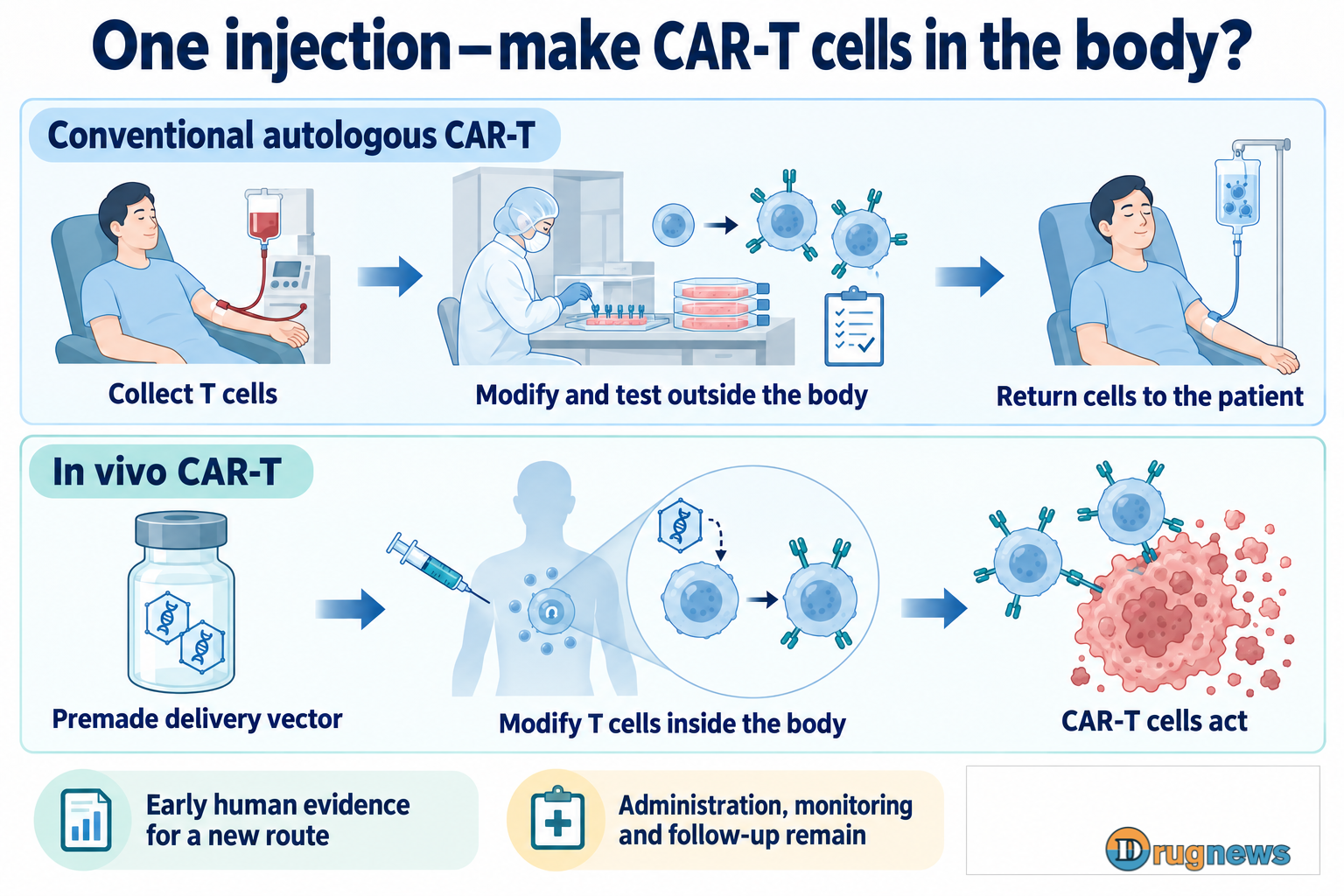
Conventional autologous and in vivo CAR-T take different manufacturing routes. In vivo delivery modifies T cells already present in the body; administration, monitoring and follow-up remain necessary.
Let patients reach treatment before debating the size of the market
CAR-T is not simply a way of sending a drug into a tumour. It uses T cells to help the immune system recognise a particular target.
A CAR—a chimeric antigen receptor—is rather like a new sensor fitted to a T cell. Its outer part recognises a particular antigen; its inner part transmits a signal that activates the cell’s attack and expansion. IASO206 targets BCMA, an important therapeutic target on malignant plasma cells in multiple myeloma.
Conventional autologous CAR-T completes that modification in a factory. One advantage is that the clinician receives cells that have already been manufactured and tested. The patient’s identity, the product bag and its release records can be matched individually.
That also means the supply chain must follow each patient. Arranging blood collection and apheresis, shipping the sample, completing manufacture and managing disease while the patient waits are all part of treatment. Expanding a factory does not allow every patient’s cells to be mixed into one large batch.
In vivo CAR-T aims to change that entry point. A delivery vehicle is manufactured in advance and carries the genetic instructions for a CAR into T cells inside the body. The cells then produce the new receptor. The approach does not create immune cells out of nothing, or make a tumour disappear automatically after an injection.
For patients, this could remove part of the wait for personalised cell manufacture. For hospitals, it may change collection and logistics. For companies, it raises a different question: can a process that runs separately for every patient become a batch-manufactured product used at the point of treatment?
That is the reason to take the opportunity seriously. This is not only a story about making treatment cheaper. It is also about how many people currently held up at the entrance to treatment might gain another option.
Move the factory into the body—and the hardest task is delivering to the right cells
Moving cell modification back into the body removes part of the ex vivo process. It does not remove manufacturing technology.
The administered vector must protect the genetic instructions, enter suitable cells and allow those instructions to be read and expressed as a CAR. Injection into the bloodstream does not mean every instruction will reach a T cell. Nor are T cells the only cells in the body.
IASO describes two layers of selectivity in its in vivo CAR-T platform: engineered viral surface proteins to improve targeting of T cells, and T-cell-specific promoters to restrict CAR expression. The first is about “where the delivery goes”; the second is about “who can switch it on after it arrives.” This is the company’s description of its platform design. The performance of an individual product still has to be assessed in human data.
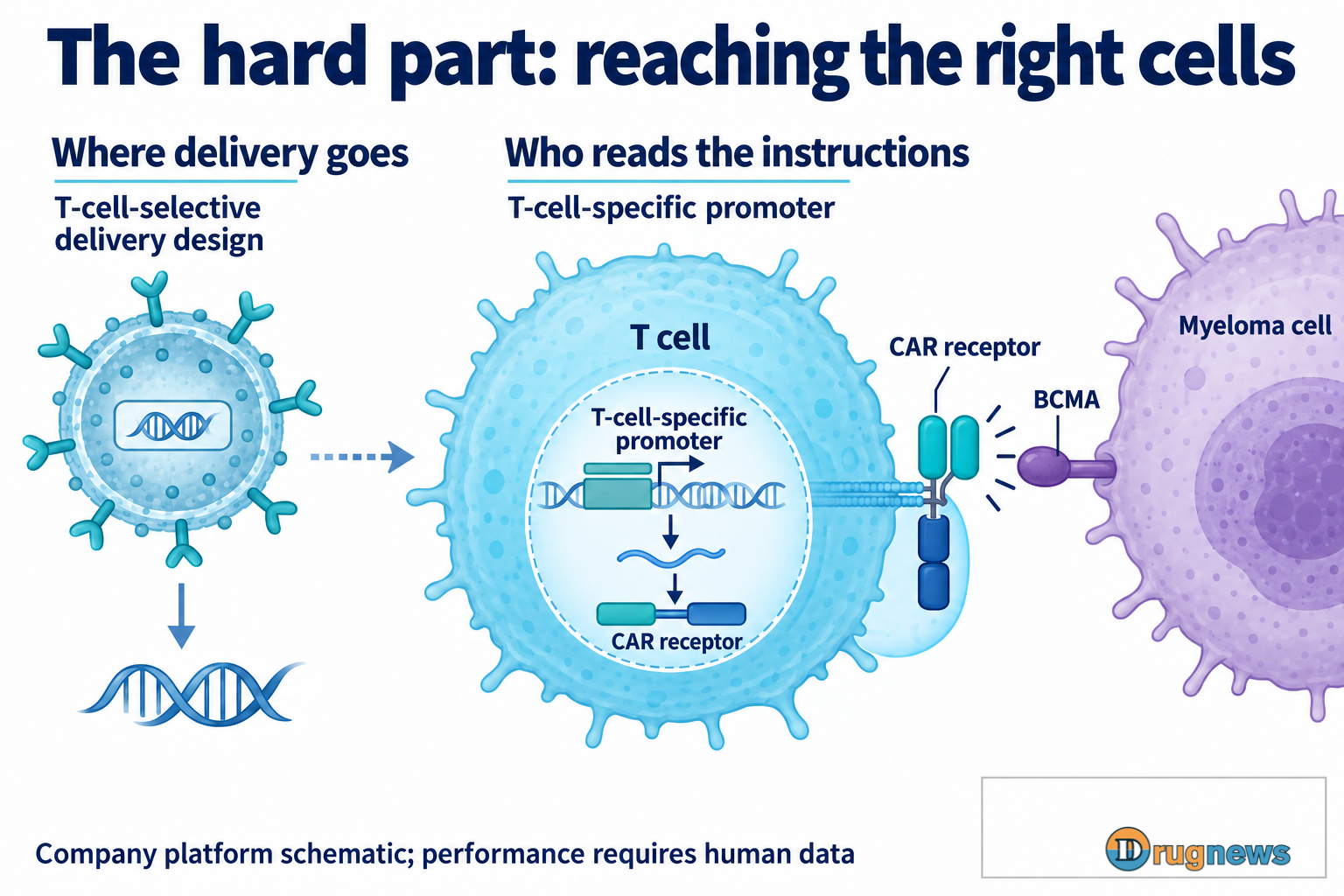
Delivery selectivity and a T-cell-specific promoter address different layers. This is a company-platform schematic, not proof of every IASO206 performance characteristic in humans.
This is where the science meets the business. If the delivery vector can be manufactured consistently at scale, a company may no longer need to make a separate batch of cells for every patient. What it must sell, however, is a delivery capability that works reliably inside different patients.
The same vial encounters different T-cell states, immune environments and tumour burdens in different bodies. Some characteristics that can be measured directly in an external factory will instead require clinical sampling and follow-up.
“Moving the factory into the body” is a useful metaphor, not the abolition of the factory. Viral-vector production, purification and quality testing remain outside the body. Receptor expression, cell expansion and therapeutic action are increasingly left to the patient’s body.
The next competition will not be won by the most attractive diagram. It will be about linking vector quality, administration and the response inside the body. Owning a CAR design is only one part of that chain.
Which assumption do ten patients’ results change?
The IASO206 results come from an early Phase 1 investigator-initiated trial presented at the International Myeloma Society’s annual meeting. Patients had received a median of three previous treatment lines. The company reported that nine of the ten had high-risk disease.
The two points worth retaining are that nine of ten patients had an objective response, and that those results came from a treatment design with neither ex vivo cell manufacturing nor lymphodepleting chemotherapy.
An objective response is an improvement that meets the disease-assessment criteria. It does not mean nine patients have been cured. Ten patients and limited follow-up cannot settle long-term efficacy, uncommon toxicities or performance in a larger population. This was not a randomised comparison with an approved CAR-T therapy.
Lymphodepletion is another step that readers may overlook but treatment centres will care about. Some approved autologous CAR-T products, including CARVYKTI, require lymphodepleting chemotherapy before administration under their labels. It is not simply intended to kill the tumour; it also prepares the immune environment for the cell therapy that follows.
Observing cell generation and disease responses with IASO206 without that preparation addresses an important development question: could this approach avoid a treatment-preparation step while still allowing the modified cells to function?
That is more useful than ranking a 90% response rate against figures from other trials. Manufacturing has changed, and so has pretreatment. The therapy must still do its job inside real patients.
Simplifying the process has not removed clinical care. According to the company, most patients experienced Grade 1 cytokine release syndrome, and one experienced Grade 2. Two had Grade 3 or higher viral infections with low immunoglobulin levels; both recovered after immunoglobulin treatment. These findings matter to a hospital arranging monitoring and support.
What the market can incorporate today is human evidence for a new delivery route. Whether another group of patients reproduces the result, and how long their responses last, will determine what that evidence is worth.
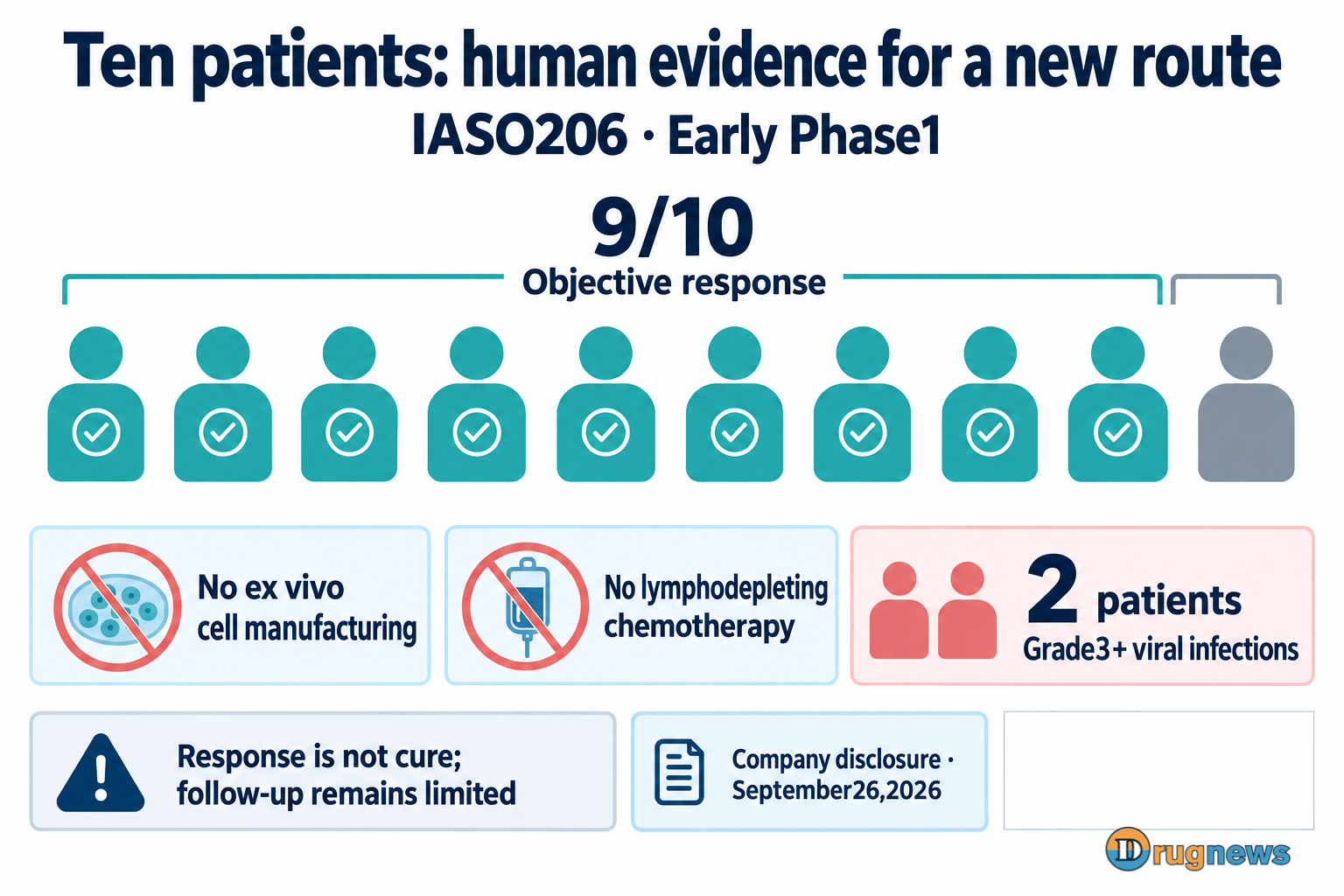
The company reported objective responses in nine of ten early-trial patients without ex vivo cell manufacturing or lymphodepletion. Two Grade3+ viral infections are a separate safety observation, not a mutually exclusive outcome group.
The pricing story must first pass through delivery
In vivo CAR-T is easily described as “cell therapy finally sold like an ordinary medicine.” The prospect is appealing. Without individual cell manufacturing, supply could potentially be organised around inventory and batch production, instead of opening a bespoke work order whenever another patient arrives.
Imagine the same treatment centre. Today it coordinates collection, transport between facilities and the return-infusion date. If a qualified, premade delivery product becomes available, the entrance to treatment could instead look more like selecting a patient, arranging administration and following the response. This is a business scenario to be tested, not an outpatient workflow IASO206 has already established.
Manufacturing capacity and treatment capacity are different bottlenecks. The number of vials a factory can supply each day must connect to the number of patients a hospital can accept, and to support when reactions occur. A growth story that answers only the first question may scale supply without scaling the number of people actually treated.
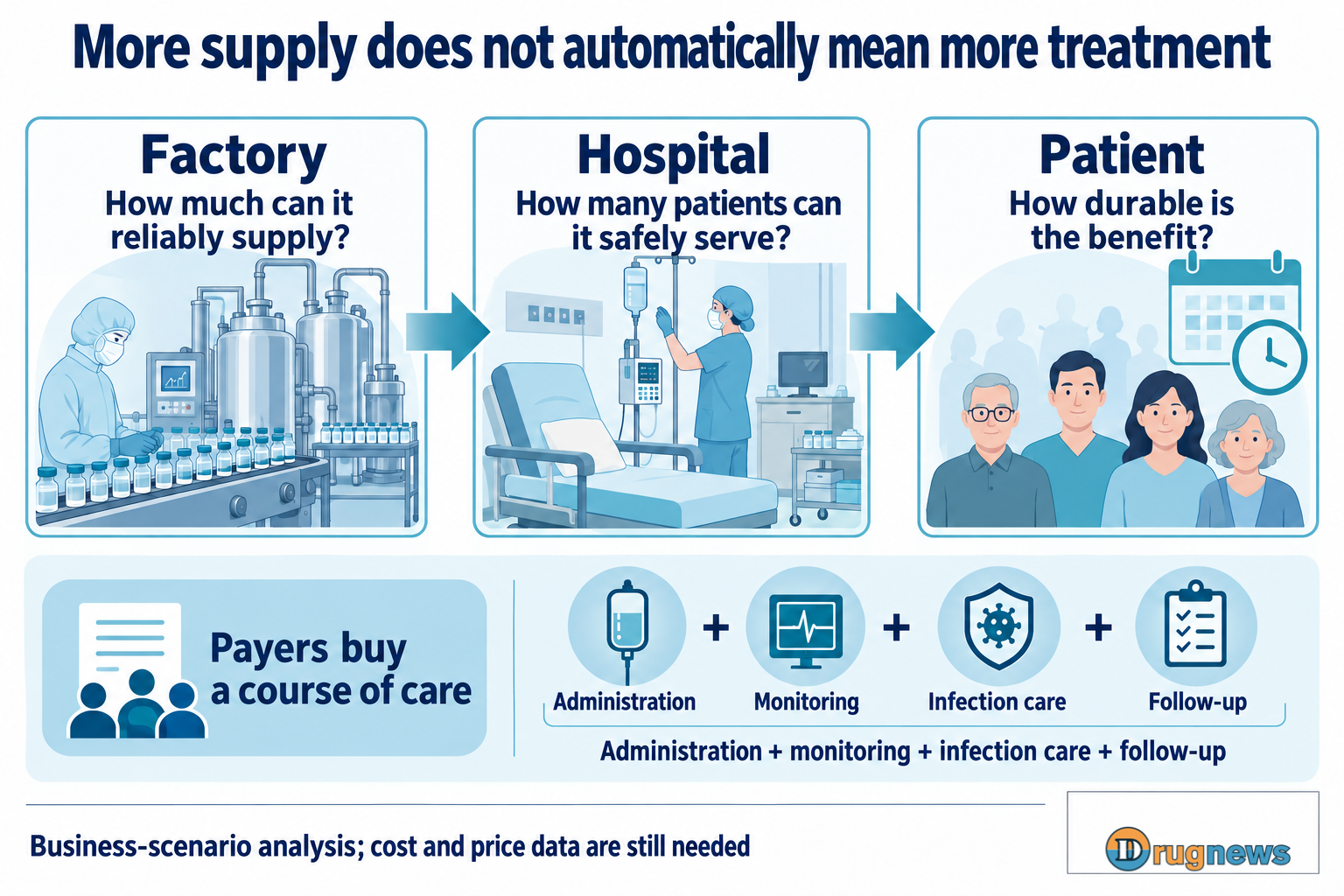
Supply, hospital capacity and durable patient benefit are separate requirements for expansion. Payers fund a course of care; manufacturing changes alone do not establish a particular price or margin.
Removing personalised cell manufacture could change how a company expands. If an additional patient no longer occupies the same set of cell-manufacturing steps, there is room to redesign the cost structure of serving more patients.
Translating that possibility into a particular price reduction or profit increase requires information that is still missing: vector manufacture, release testing, clinical monitoring and payment. Avoiding the wait for a bag of cells does not establish a cheap, predictable price for the whole course of treatment.
Payers do not buy only a vial of vector. The healthcare system bears the costs of administration, monitoring, possible infection management and follow-up. If savings in manufacturing are absorbed elsewhere in care, the value captured by the product and by the healthcare system will differ.
This is why investors should not value the approach simply as “one fewer cell factory.” A genuinely scalable platform must make supply easier for the company, treatment easier for healthcare providers to accommodate, and outcomes sufficiently meaningful and durable for patients.
Put those three things on the same diagram and the commercial imagination has something to stand on. Ten patients have opened a scientific door. A repeatable capability for delivering care will determine how much demand a company can actually serve.
The next question is not another declaration of 90%
Beyond whether responses persist, subsequent data must show whether CAR-T generation across patients remains manageable, what care infections and falling immunoglobulin levels require, and how a batch-manufactured product can be delivered consistently.
Moving a patient from “waiting for my cells to be made” to “the treatment centre can arrange use” would change the entry point to cell therapy. That would have more industrial significance than making an existing process a few days faster.
But when the next patient arrives, can the company and the hospital produce the result again? That is the answer still owed after the factory moves into the body.
Sources
| Research or material | What it supports | Primary source |
|---|---|---|
| IASO206 first-in-human results, September26,2026 | Ten-patient design, responses, pretreatment and safety; company disclosure | IASO Biotherapeutics |
| In vivo CAR-T technology platform | Selective delivery and T-cell-specific promoters; company platform description | IASO Biotherapeutics |
| CAR T Cells, updated February26,2025 | CAR structure, conventional manufacturing and the roughly3–5week process | US National Cancer Institute |
| CARVYKTI label, October2025 | Lymphodepletion requirements for this approved autologous CAR-T example | US FDA |
This article provides industry information and commercial analysis. It is not individualized medical or investment advice.
Cite this article
For decks, research notes, or media references, cite Drugnews with the canonical article URL.
Drugnews Editorial Team. "One injection—and the body makes its own cancer-fighting cells?" Drugnews, Oct 07, 2026. https://drugnews.com.tw/articles/2026-10-07-in-vivo-car-t-iaso206-first-human-en.html