
KRW 510 billion. That is the preliminary third-quarter operating profit Celltrion announced on October 12, the first time it has crossed KRW 500 billion since the company was founded.
Revenue reached KRW 1.5 trillion, up 45.8% year on year. Operating profit rose 69.2%, putting the operating margin at about 34%.
Profit grew faster than revenue. The company gave two reasons: it sold more high-margin products, and its factories made those medicines more cheaply.
Our view: after a decade of price competition in biosimilars, the money is flowing toward companies that make the medicines themselves. Switzerland's Sandoz has reached the same conclusion and is turning its European factories into a network capable of accommodating more than 100 medicines. But factories require money upfront. The next contest is about whose new products sell fast enough to fill the new capacity.
01|From Making Medicines for Others to Choosing Its Own
Celltrion started out making medicines for other companies.
In 2005, it signed a contract with Bristol Myers Squibb to manufacture the rheumatoid arthritis medicine Orencia at its factory in Songdo, Incheon. Contract manufacturing taught the Korean company a difficult first lesson: how to build a large-scale antibody plant and pass a U.S. FDA inspection. Later, it began using its own factories to make its own biosimilars.
Today, Songdo Plants 1 through 3 have a combined drug-substance capacity of 250,000 liters. On September 22, all three completed EU GMP renewal. Plant 3, which began commercial production only in late 2024, is expected to produce 128 batches this year, about 142% more than last year. Output across Songdo is expected to rise by about 15%.
Those two figures belong together. The new plant is ramping up from a low base, which explains its steep growth rate. The increase in medicines available to sell across the site is on the scale of that 15% figure.
Most factory costs are fixed. When the same buildings and quality-control teams produce more batches that meet quality standards, the cost allocated to each batch falls. Some products are also moving to higher-yield processes, allowing the same-sized bioreactor to produce more antibody. That is the arithmetic behind 34%.
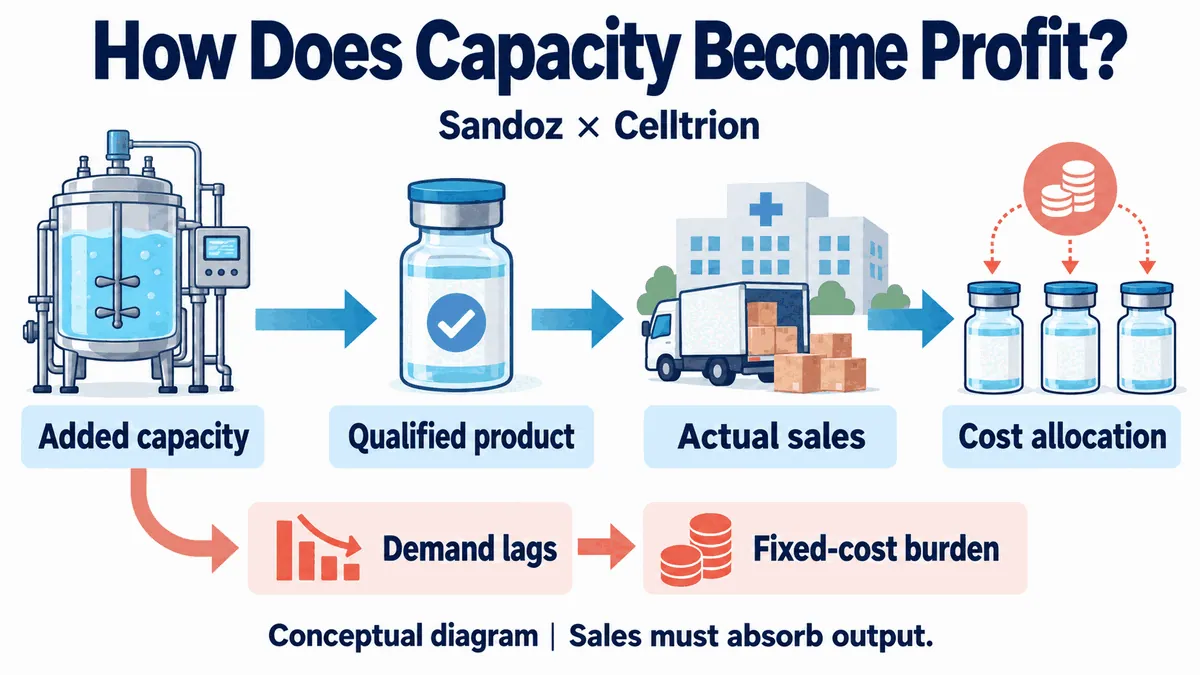
Figure 1|The route from capacity to profit: output that meets quality standards, drug-product release, and actual sales. If the medicines do not sell, the same factory becomes a cost burden.
Next, Celltrion plans to bring the final drug-product manufacturing stage in-house as well, reducing its reliance on outsourcing. When it announced the update in September, the new drug-product plant was still undergoing equipment qualification.
02|Sandoz's Challenge: 100 Medicines Cannot All Fit the Same Factory
Sandoz's story starts at the other end.
In October 2023, it separated from Novartis and became an independently listed company. Generics still account for about two-thirds of its revenue. In the first half of this year, biosimilar sales reached USD 1.875 billion, roughly one-third of the total.
At its September 8 Capital Markets Day, Sandoz unveiled “Bio100”: expanding its biosimilar portfolio from 13 at the time to more than 100 by 2040. From 2035 onward, it aims to cover about 80% of the value of originator medicines losing patent protection.
The difficulty is that sales volumes vary widely across 100 medicines. High-volume products need large tanks running for long periods. For low-volume products, using a large tank can be wasteful. Sandoz's answer is to run three manufacturing approaches side by side:
- Lendava, Slovenia: a high-volume drug-substance center opened on September 29.
- Toulouse, France: continuous manufacturing.
- Ljubljana, Slovenia: an approximately USD 300 million, 8,000-liter single-use manufacturing facility, expected to become operational in 2029, serving clinical-stage and low- to medium-volume products.
The difference in one sentence: Celltrion is filling its existing factories, while Sandoz is building a network that can accommodate a wider range of medicines.
| Celltrion | Sandoz | |
|---|---|---|
| Latest results | Third-quarter operating profit of KRW 510 billion and an operating margin of about 34% (preliminary) | First-half biosimilar revenue of USD 1.875 billion, about 33% of group revenue |
| Manufacturing strategy | Raise yields at Songdo's 250,000-liter site and bring drug-product manufacturing in-house | Three manufacturing approaches, with another 8,000 liters coming in 2029 |
| Product goal | Scale up high-margin new products | Expand from 13 biosimilars to more than 100 by 2040 |
| Next test | Can Omlyclo scale up in the United States? | Can new products fill the new network? |
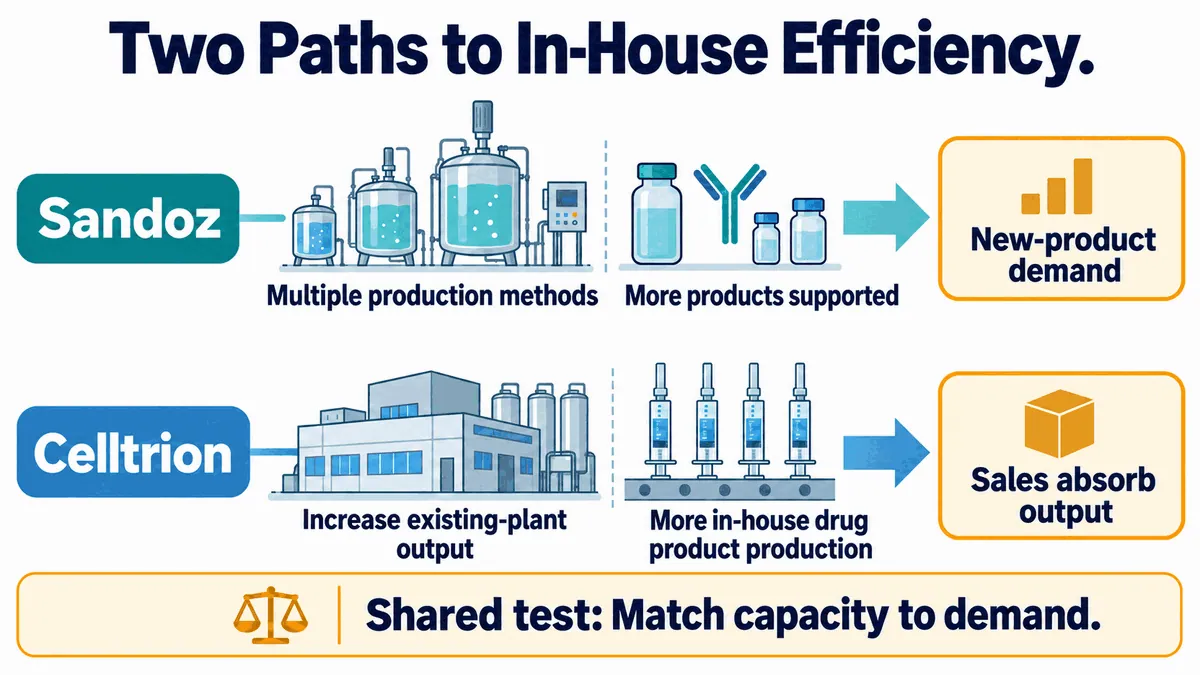
Figure 2|Both companies are bringing manufacturing under their own control: Sandoz is expanding across different production approaches, while Celltrion is raising output at existing factories and bringing drug-product manufacturing in-house.
03|The Factories Are Built. Who Will Pay?
Capacity is only half the story. The other half is whether hospitals and insurers will use the products.
Celltrion launched Omlyclo in the United States in early October. It is a biosimilar to Xolair, a medicine for allergies and asthma, and currently the only version with FDA interchangeability status. Priced about 15% below the originator's wholesale price, it entered the market with preferred commercial-insurance formulary placement at Optum, one of the three largest U.S. pharmacy benefit managers.
Europe has already provided an answer. Omlyclo is sold in 26 countries and had captured more than 90% of the Spanish market by July. After winning Denmark's national supply contract, the company expects its market share there to exceed 98% by year-end.
Sandoz has a model of its own. Its North American biosimilar sales grew 47% at constant exchange rates in the first half, driven mainly by Wyost and Jubbonti, two denosumab biosimilars launched in June 2025.
The sequence in this contest is clear: build the factories, secure coverage, then bring in prescriptions. Fourth-quarter U.S. prescription volume for Omlyclo will provide the first answer to whether there is demand for Celltrion's new capacity.
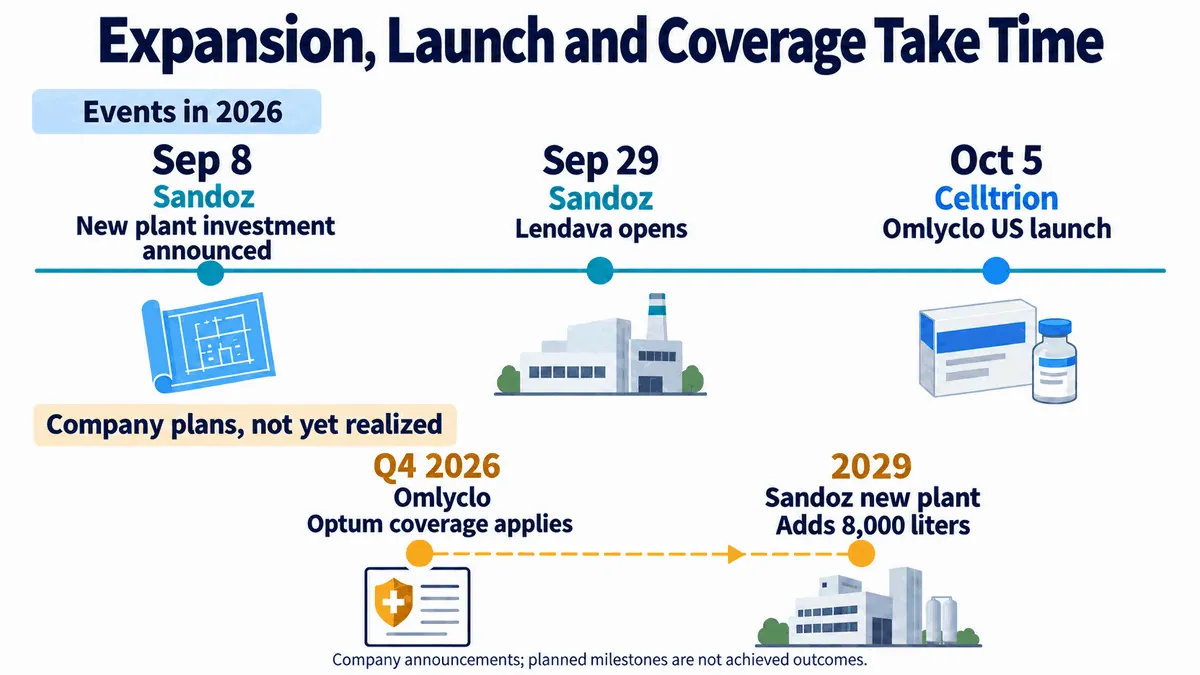
Figure 3|Factory expansion, product launches, and coverage happen at different times. Sandoz's additional 8,000-liter facility will not become operational until 2029.
04|34% and 20.9% Cannot Be Used to Rank the Companies
It is tempting to compare Celltrion's 34% with Sandoz's first-half core EBITDA margin of 20.9%. The two figures use different definitions: one is a preliminary operating margin for a single quarter; the other covers six months, includes company-defined adjustments, and includes the generics business.
What matters is each company's own trend. Will Celltrion's finalized financial results confirm its preliminary figure? As biosimilars account for a larger share of Sandoz's business, can its margin move toward the company's target of more than 30% in 2035?
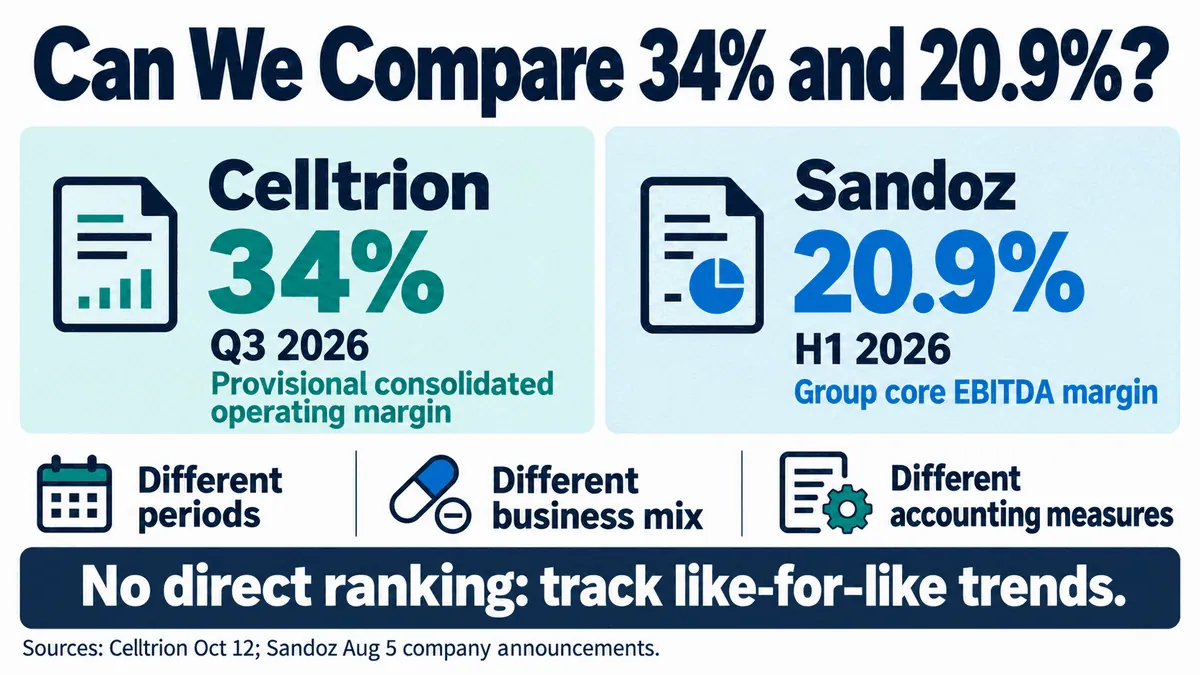
Figure 4|Celltrion's 34% is its preliminary consolidated operating margin for the third quarter of 2026. Sandoz's 20.9% is its group core EBITDA margin for the first half of 2026.
Conclusion|The Next Round Is About How Quickly Factories Fill Up
Ten years ago, biosimilar competition was about who secured approval first and who cut prices the most. Celltrion's record this quarter shows that the rules have changed: companies that can make medicines more cheaply and sell them are the ones that keep the profit.
Watch two figures next: Omlyclo's fourth-quarter U.S. prescription volume, and whether Sandoz's new products can sustain the 47% North American growth achieved in the first half. Whichever company fills its additional capacity first will be the first to pocket the money from this round.
This article is an industry and company analysis and does not constitute investment or medical advice.
References
- Celltrion|셀트리온, 2026년 3분기 매출 1조 5천억원·영업이익 5,100억원 기록 (preliminary third-quarter 2026 results announcement)|2026-10-12|https://www.celltrion.com/ko-kr/company/media-center/press-release/4941
- The Korea Times|Celltrion Q3 operating profit tops W500 bil. mark for 1st time|2026-10-12|https://www.koreatimes.co.kr/business/companies/20261012/celltrion-q3-operating-profit-tops-w500-bil-mark-for-1st-time
- Celltrion|셀트리온, 송도 25만 리터 생산시설 EU-GMP 갱신 완료, 송도 생산량 15% 확대 (Songdo EU GMP renewal and production plan)|2026-09-22|https://celltrion.com/ko-kr/company/media-center/press-release/4925
- BioSpace|FDA Approves Celltrion, Inc. to Manufacture ORENCIA (abatacept)|https://www.biospace.com/fda-approves-celltrion-inc-to-manufacture-orencia-r-abatacept
- Celltrion USA (company release distributed through PR Newswire)|OMLYCLO® (omalizumab-igec), the first and only FDA-approved interchangeable biosimilar to XOLAIR®, now commercially available in the U.S.|2026-10-05|https://www.prnewswire.com/news-releases/omlyclo-omalizumab-igec-the-first-and-only-fda-approved-interchangeable-biosimilar-to-xolair-now-commercially-available-in-the-us-302898400.html
- Asia Economy|Celltrion Launches Omniclo in the U.S., Listed in Major PBM Formulary|2026-10-06|https://view.asiae.co.kr/en/article/2026100607483182165
- Bär & Karrer|Bär & Karrer Advises Novartis and Sandoz on the Spin-off of Sandoz|2023-10-04|https://www.baerkarrer.ch/fr/news/bar-karrer-advises-novartis-and-sandoz-on-the-spin-off-of-sandoz
- Sandoz (issuer release distributed through EQS)|Sandoz hosts Capital Markets Day and unveils Bio100 ambition – maximising Sandoz value in its golden decade for biosimilars|2026-09-08|https://www.eqs-news.com/news/ad-hoc/sandoz-hosts-capital-markets-day-and-unveils-bio100-ambition-maximising-sandoz-value-in-its-golden-decade-for-biosimilars/4ae64d18-0bb3-4810-9580-f79b3dcfb3f5_en
- Sandoz (issuer release distributed through EQS)|Sandoz opens advanced high-volume drug substance manufacturing centre in Lendava, significantly strengthening in-house capacity and flexibility across leading European biosimilar network|2026-09-29|https://www.eqs-news.com/news/corporate/sandoz-opens-advanced-high-volume-drug-substance-manufacturing-centre-in-lendava-significantly-strengthening-in-house-capacity-and-flexibility-across-leading-european-biosimilar-network/83e1a16b-468d-47e0-aa04-3d07daa9c4f0
- Sandoz (issuer release distributed through EQS)|Sandoz invests in new drug substance facility in Ljubljana, Slovenia, to expand biosimilar manufacturing capacity|2026-09-08|https://www.eqs-news.com/news/ad-hoc/sandoz-invests-in-new-drug-substance-facility-in-ljubljana-slovenia-to-expand-biosimilar-manufacturing-capacity/4504cda3-96d7-4d77-be1b-c3ca3ad0e637_en
- Sandoz (issuer release distributed through EQS)|Sandoz delivers strong H1 2026 results, with outstanding biosimilar growth in the second quarter|2026-08-05|https://www.eqs-news.com/news/ad-hoc/sandoz-delivers-strong-h1-2026-results-with-outstanding-biosimilar-growth-in-the-second-quarter/33059f69-12ad-47e0-bab8-ee4e76b1bbdb_en
Share this analysis
Send this article to readers who follow biotech, company strategy, and capital-market signals.
Cite this article
For decks, research notes, or media references, cite Drugnews with the canonical article URL.
Drugnews Editorial Team. "Celltrion's Record Profit Starts in Its Own Factories." Drugnews, Oct 15, 2026. https://drugnews.com.tw/articles/2026-10-15-sandoz-celltrion-biosimilar-profit-capacity-en.html