
In 2016, Taiwanese investor Huang Min-chi sold Hermes Microvision to ASML for $3 billion. A year later he put NT$800 million into a machine that did not exist yet: one that kills cancer cells with neutrons.
On October 15, that company, Heron Neutron Medical (禾榮科), spent another NT$1.555 billion, about $48 million, on 2.19 hectares of industrial land in the Miaoli high-speed rail district. It plans to build its own accelerators there and develop its own boron drugs.
It is a bold check to write. Heron lost NT$39 million in August alone, and in the first seven months of 2025 its revenue was just over NT$3 million.
Its rival is Japan's Sumitomo Heavy Industries. In March 2020, Sumitomo's system became the world's first boron neutron capture therapy (BNCT) device approved as a medical device. By June it was covered by Japanese national health insurance.
Heron's fight will not be decided by NT$1.5 billion of land, or by a NT$1.2 billion machine. It will be decided by a boron drug the company aims to get approved by the end of this year.
01 | The man who sold Hermes put NT$800 million on a machine that did not exist
BNCT is not new in Taiwan. Since 2010, National Tsing Hua University has treated patients with boron neutron capture using its campus research reactor.
The problem is that a reactor will not fit in a hospital. Tsing Hua and the Industrial Technology Research Institute built an accelerator version instead, and in 2017, as they prepared to transfer the technology, Huang funded Heron to take it over.
The Hanmin group's industrial network helped Heron line up suppliers quickly, and the machine was finished in 2019. The hard part came next. The device had not been validated, and hospitals were reluctant to be the first site.
Huang went in person to China Medical University chairman Tsai Chang-hai and persuaded him to host the first accelerator BNCT system in Zhubei. Heron paid for the installation.
The machine treats terminal cancer patients at China Medical University Hsinchu Hospital under compassionate-use rules. By its March 2026 investor briefing, Heron had treated 188 cases from nine countries, across more than 20 cancer types.
General manager Shen Hsiao-lien put the company's position this way: "Only five companies in the world can develop BNCT equipment: one each in the US, China, Japan and Korea, and Heron."
Investors bought the story. Heron listed on September 15, 2025, at NT$600 a share, raised NT$10.854 billion in a cash offering, and passed NT$100 billion in market value. On its first day it became the most valuable biotech stock in Taiwan.
Before the listing, Heron had raised more than NT$1.4 billion in four rounds since 2022, mostly from its original shareholder, the Hanmin group. At the end of the second quarter of 2025 it had no financial debt and about NT$580 million in cash.
It has also started moving abroad, with subsidiaries in Japan, Singapore and Nanjing, a partnership with Siemens on imaging and treatment planning, and work with Singapore's A*STAR and National University Hospital to open that market.
The war chest is deep. The hard part is turning it into revenue.
02 | A sugar-coated bomb
The simplest way to picture BNCT is to plant explosives inside the cancer cell, then light the fuse with neutrons.
The explosive is a boron drug called BPA. It looks like the amino acid phenylalanine, so fast-growing cancer cells swallow it as food, and boron-10 ends up inside them.
The fuse is a neutron beam. When the patient is irradiated, boron-10 captures a neutron and splits into an alpha particle and a lithium-7 nucleus. Both travel only 5 to 9 micrometers, roughly the diameter of a single cell.
So the blast stays inside the cell that ate the boron. Its healthy neighbors are out of range.
To reach deep enough, the beam uses slightly higher-energy epithermal neutrons. They slow down as they pass through tissue and become thermal neutrons, the kind boron captures most easily, near the tumor.
There is also a gate before treatment. Heron has a diagnostic drug, FBPA, which is injected for a PET scan to see whether a tumor actually takes up boron. Only tumors that take up enough are worth treating. A scan costs about NT$40,000 to NT$80,000.
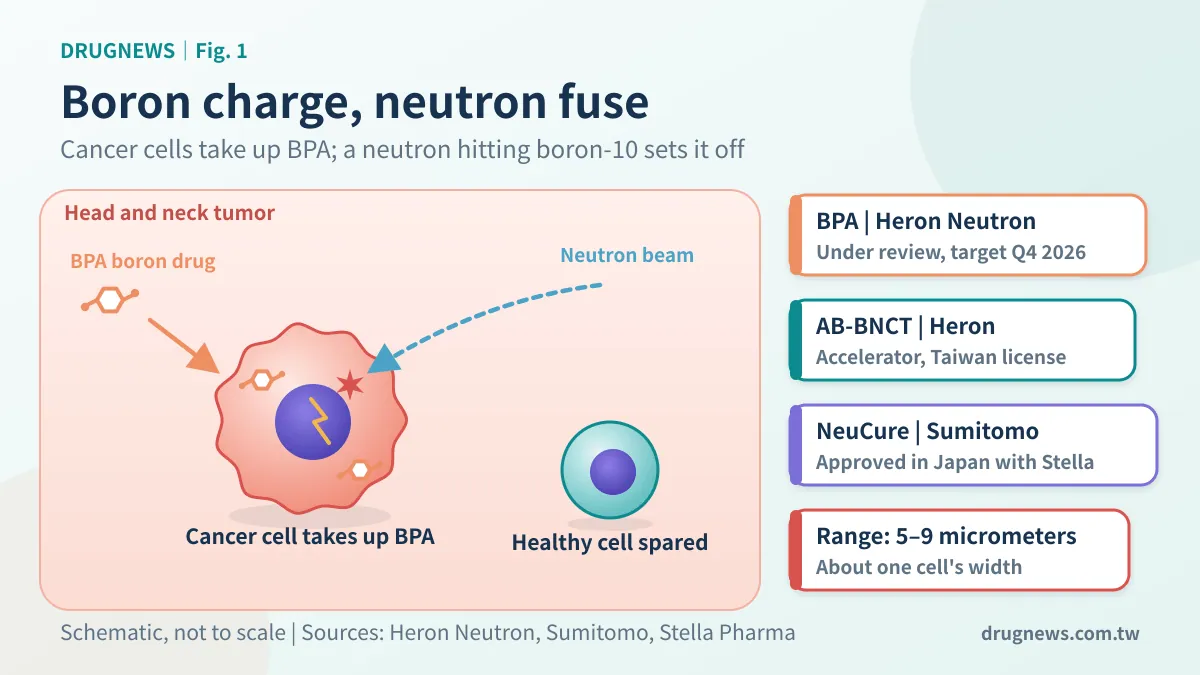
Fig. 1 | Cancer cells take up BPA; after a neutron hits boron-10, the particles travel only about one cell's width.
Japan already has real-world results. After Sumitomo's system and Stella Pharma's boron drug Steboronine launched in 2020, post-marketing surveillance enrolled 162 patients.
In squamous cell carcinoma of the head and neck, the overall response rate was 72.3%, the complete response rate 46.0%, and one-year survival 78.8%. The price is frequent acute side effects; 84.0% of patients saw elevated amylase.
Most of these patients had unresectable or locally recurrent head and neck cancer, with few options left. Heron's own figure sits at the same level: a response rate of about 70% in recurrent head and neck cancer.
BNCT needs only one or two short sessions and targets patients who have run out of road after recurrence. Once a treatment like that has a drug approval and reimbursement, hospitals have a reason to buy the machine.
03 | Everyone builds machines. Only Japan has the drug and the insurance too
Few companies build accelerator-based BNCT, and the market is still small. TechNews, citing GII, put the global BNCT market at $174 million in 2023 and projected $2.199 billion by 2030.
The pie is small, and each player is betting on a different slice.
Sumitomo Heavy Industries bet on getting both approvals first. It delivered its first machine to Kyoto University in 2009, then to Southern Tohoku Hospital in 2015 and Osaka Medical College in 2019. The device was approved in 2020 and entered national insurance together with Stella Pharma's boron drug. That took more than a decade. Commercial treatment in Japan runs at two centers, Southern Tohoku and Kansai.
Neuboron bet on China. Its NeuPex system entered the NMPA's special review process for innovative medical devices in August 2023, in a race for China's first approval.
TAE Life Sciences bet on the US. In October 2025 it signed an agreement with the University of Wisconsin–Madison to build what would be the first accelerator-based BNCT center in the country, and to develop boron drugs together.
Heron bet on doing the device and the drug together. Its system holds a Taiwan FDA medical device license, its Singapore registration is in the final stage, and it has filed pre-market information with the US FDA. Its own BPA is targeted for Taiwan approval in the fourth quarter of 2026.
Beyond Taipei Veterans General Hospital, five more sites are in talks or under contract: Chu Ming Hospital, Nanjing BenQ Medical Center, China Medical University Hsinchu Hospital, National University Hospital in Singapore and E-Da Hospital. Hospitals can buy outright, lease, or share revenue with Heron, an approach meant to shorten long hospital purchasing cycles.
| Sumitomo | Neuboron | TAE Life Sciences | Heron Neutron | |
|---|---|---|---|---|
| Country | Japan | China | US | Taiwan |
| Device | Approved 2020 | Special review since 2023 | First US center planned | Taiwan FDA license |
| Boron drug | Stella Pharma, approved | In-house | Co-developed with university | BPA, target Q4 2026 |
| Reimbursement | Japanese insurance | Not launched | Not launched | Not launched |
| The bet | Both approvals first | China | US | Device plus drug |
Everyone is building machines. What is scarce is the full set of machine, drug and reimbursement in place at once. So far only Japan has it.
Heron is closest to second place. Neuboron is still under review in China, and TAE has only just signed for a US center. Heron already holds a device license and has its drug under review. If BPA is approved, Heron becomes the second company in the world, after the Japanese pairing, to hold both a machine and a boron drug.
04 | The NT$1.2 billion Taipei machine is only the first payment
Heron's first big order came from Taipei Veterans General Hospital: an AB-BNCT treatment center worth NT$1.2 billion, expected to be accepted and booked in 2027. A contract with Nanjing BenQ Medical Center is worth NT$1.68 billion. The Zhubei machine was paid for by Heron. The Taipei one is a hospital paying real money.
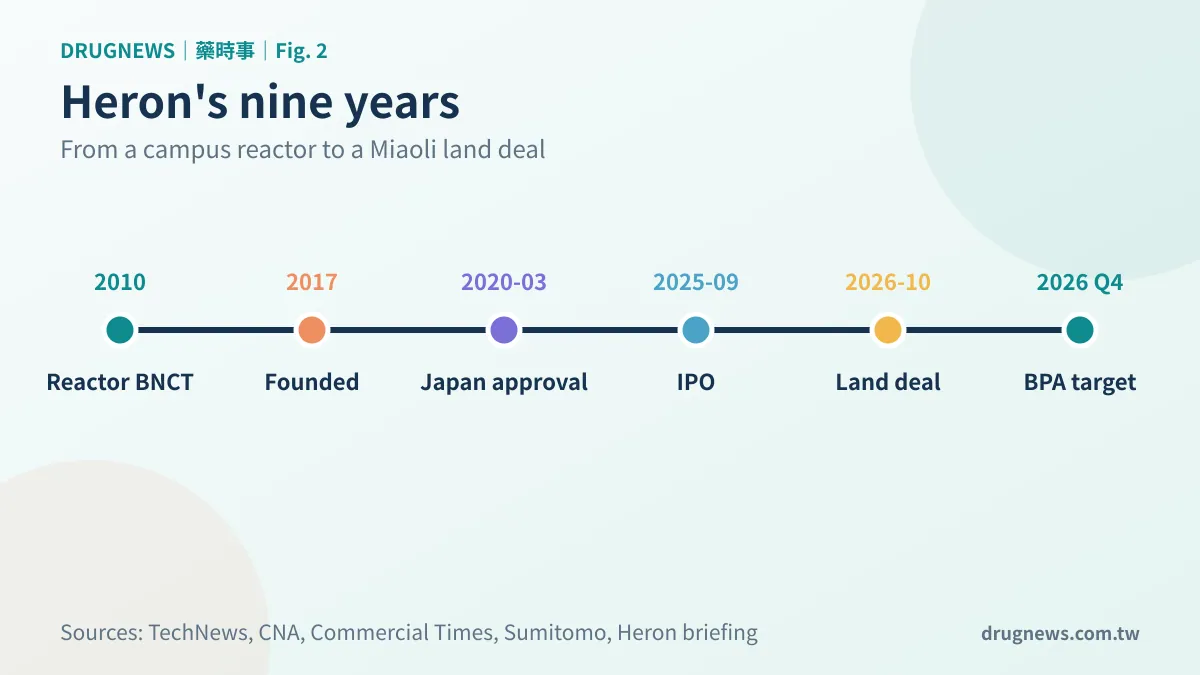
Fig. 2 | From Tsing Hua's reactor to the Miaoli land deal took nine years; the next turning point is the boron drug at year-end.
The NT$1.2 billion arrives once. The money that keeps coming is in two other lines.
According to Heron's investor briefing, one BPA treatment costs about NT$400,000, annual maintenance runs 5% to 9% of the equipment contract, and a center treating 500 patients a year would generate about NT$200 million from the drug alone.
Apply that to a full Taipei center: NT$200 million of drug sales a year plus NT$60 million to NT$108 million of maintenance, about NT$260 million to NT$310 million in total. In four to five years, recurring revenue overtakes the NT$1.2 billion machine.
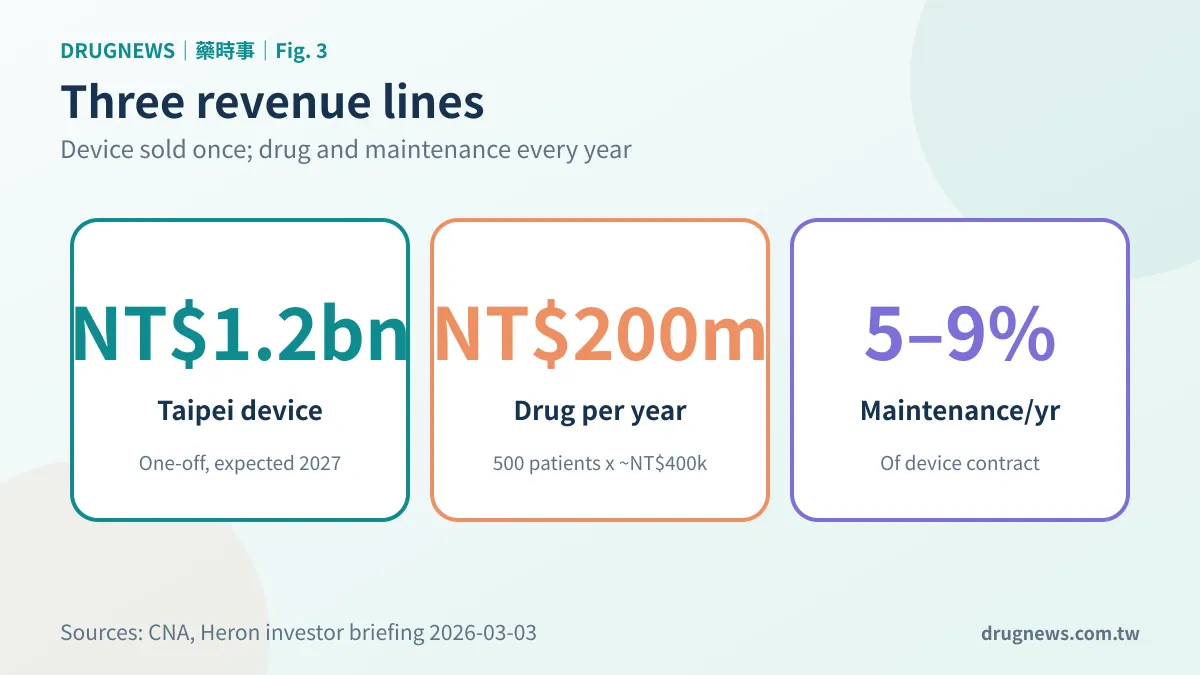
Fig. 3 | The device is sold once; the drug and maintenance pay every year.
August's NT$39 million loss annualizes to about NT$470 million. Two full centers would bring in NT$520 million to NT$620 million from drug and maintenance, enough to cover the gap.
Heron sells printers. The money is in the ink.
The accelerator locks a hospital in, and the boron drug charges every time a patient is treated. That explains why the Miaoli site will hold both an accelerator line and drug research. NT$1.555 billion is about a seventh of what Heron raised at its listing. It is buying the location of an ink factory.
The market is still hesitating. Heron hit NT$776 on its first trading day and closed at NT$414.5 on September 11, 2026. The stock has been cut nearly in half, and what it is waiting for is the drug approval that turns the ink into real money.
The ceiling can be calculated too. Using its own assumptions, Heron estimates about 11,600 patients a year in Taiwan who could be suitable for BNCT. If one in ten were treated at NT$400,000 each, that is about NT$460 million a year in drug revenue.
Heron should be valued on how many doses each machine delivers every year, not on how many machines it sells.
05 | Nine years in, one drug short
Go back to 2017, and the man who sold Hermes Microvision and put NT$800 million on killing cancer with neutrons.
Nine years later, Heron has the machine, the land and 188 patients. It is missing one thing: Taiwan approval for BPA, targeted for the end of this year.
Sumitomo spent more than a decade proving that the machine runs on the drug. Heron's moat is that boron drug, not the accelerator.
This article is industry and company analysis, not investment or medical advice.
References
- Heron Neutron spends NT$1.5 billion on Miaoli HSR district land, targets global BNCT demand (in Chinese)|Commercial Times|2026-10-15|https://www.ctee.com.tw/news/20261015701882-430201
- Heron Neutron hits NT$776 on listing day (in Chinese)|Yahoo Finance Taiwan|2025-09-15|https://tw.stock.yahoo.com/news/%E7%94%9F%E6%8A%80%E8%82%A1%E7%8E%8B%E6%8F%9B%E4%BA%BA%E7%95%B6%EF%BC%81%E7%A6%BE%E6%A6%AE%E7%A7%91%E4%B8%8A%E5%B8%82%E9%A6%96%E6%97%A5%E5%A4%A7%E6%BC%B2%E8%87%B3776%E5%85%83-%E4%B8%AD%E7%B1%A4%E7%8F%BE%E8%B3%BA176%E8%90%AC%E5%85%83-013426305.html
- Heron Neutron: BNCT and Huang Min-chi's investment (in Chinese)|TechNews|2025-08-25|https://finance.technews.tw/2025/08/25/heron-neutron/
- Heron Neutron investor conference notes, 2026-03-03 (in Chinese)|Fugle|2026-03-03|https://blog.fugle.tw/post/earnings-call-7799-2026-03-03
- Heron Neutron's BNCT device and boron drug (in Chinese)|Anue|2026-09-12|https://news.cnyes.com/news/id/6604630
- Fubon Securities-sponsored Heron Neutron lists today (in Chinese)|Central News Agency|2025-09-15|https://www.cna.com.tw/business/chinese/412347
- Heron Neutron raises NT$10.854 billion ahead of September 15 listing (in Chinese)|Genet|2025-09-09|https://www.genetinfo.com/investment/featured/item/89507.html
- Heron Neutron reports August consolidated loss of NT$39 million (in Chinese)|MoneyDJ|2026-09-18|https://www.moneydj.com/kmdj/news/newsviewer.aspx?a=f6034e1b-a837-4d6b-a129-288afee9c375
- Japanese BNCT facilities have started clinical treatments under the national health insurance system with NeuCure|Sumitomo Heavy Industries|2020-06-18|https://www.shi.co.jp/english/info/2020/6kgpsq0000002p30.html
- Sumitomo Heavy Industries × Advanced Medicine|Sumitomo Group|2026-10-17|https://www.sumitomo.gr.jp/english/act/social-issue/shi/
- Safety of BNCT with Borofalan(10B) and Its Efficacy on Recurrent Head and Neck Cancer: Real-World Outcomes from Nationwide Post-Marketing Surveillance|Cancers|2024-02-21|https://www.mdpi.com/2072-6694/16/5/869
- Neuboron's NeuPex AB-BNCT System Approved for the "Green Channel" Special Review Process by the NMPA|Neuboron|2023-08-15|https://en.neuboron.com/news/300.html
- UW–Madison to lead nation in boron neutron capture therapy for cancer|UW School of Medicine and Public Health|2025-10-10|https://www.med.wisc.edu/news/cancer-particle-therapy-agreement/
- Neutron capture therapy of cancer|Wikipedia|2026-10-17|https://en.wikipedia.org/wiki/Neutron_capture_therapy_of_cancer
Share this analysis
Send this article to readers who follow biotech, company strategy, and capital-market signals.
Cite this article
For decks, research notes, or media references, cite Drugnews with the canonical article URL.
Drugnews Editorial Team. "Heron Neutron Buys Land for NT$1.5 Billion. Its BNCT Bet Rides on a Boron Drug." Drugnews, Oct 19, 2026. https://drugnews.com.tw/articles/2026-10-19-heron-neutron-bnct-miaoli-land-boron-drug-en.html