
On October 8, Viatris agreed to buy Pacira BioSciences for $36.50 a share in cash, a deal worth about $1.65 billion. The prize was Exparel, the long-acting local anesthetic that dominates post-surgical pain control in American operating rooms.
Eleven days later, at 4 p.m. on October 19, a Taiwanese company walked into the Taipei Exchange with news that complicates that bet. TLC BioSciences (TLC-KY, 7924), formerly Taiwan Liposome Company, said its non-opioid drug TLC590 had beaten Exparel head-to-head in a US Phase 3 trial: less pain, and fewer opioids.
That result turns TLC590 from "another long-acting painkiller" into the only late-stage candidate with randomized, head-to-head data showing an edge over the market leader.
By the end of 2027, TLC will sign a US licensing deal for TLC590 with an upfront payment larger than the $30 million it received for TLC599 in 2022.
01 | The three worst days after surgery
Bunion correction, hernia repair, knee replacement: for most patients, the first two or three days after the operation hurt the most.
The default answer used to be opioids. They work, but they carry addiction risk, and hospitals have spent years trying to prescribe fewer of them.
The alternative is to numb the surgical site directly. Surgeons inject a long-acting local anesthetic into the tissue around the wound, so the nerves there stop relaying pain signals through the worst stretch.
Exparel is the standard-bearer for that approach. It packs bupivacaine, an old local anesthetic, into multivesicular liposomes that release the drug slowly around the wound. Pacira sold $575.1 million of it in 2025, up about 5% from $549.0 million in 2024.
Washington is pushing in the same direction. Under the NOPAIN Act, Medicare has paid separately since 2025 for qualifying non-opioid post-surgical pain products used in hospital outpatient departments and ambulatory surgery centers.
For TLC590, that policy matters directly. If the drug is approved and qualifies as a non-opioid post-surgical product, it would be eligible for the same separate Medicare payment in the outpatient settings where bunion and hernia operations increasingly happen, which removes one of the cost arguments hospitals use to stick with cheaper generic anesthetics.
The demand is there. The money is there.
What is missing is growth. Exparel sales were $291.1 million in the first half of 2026, just 4% above the prior year, and $147.8 million in the second quarter, up 3%. Pacira itself pointed to group purchasing discounts offsetting volume gains.
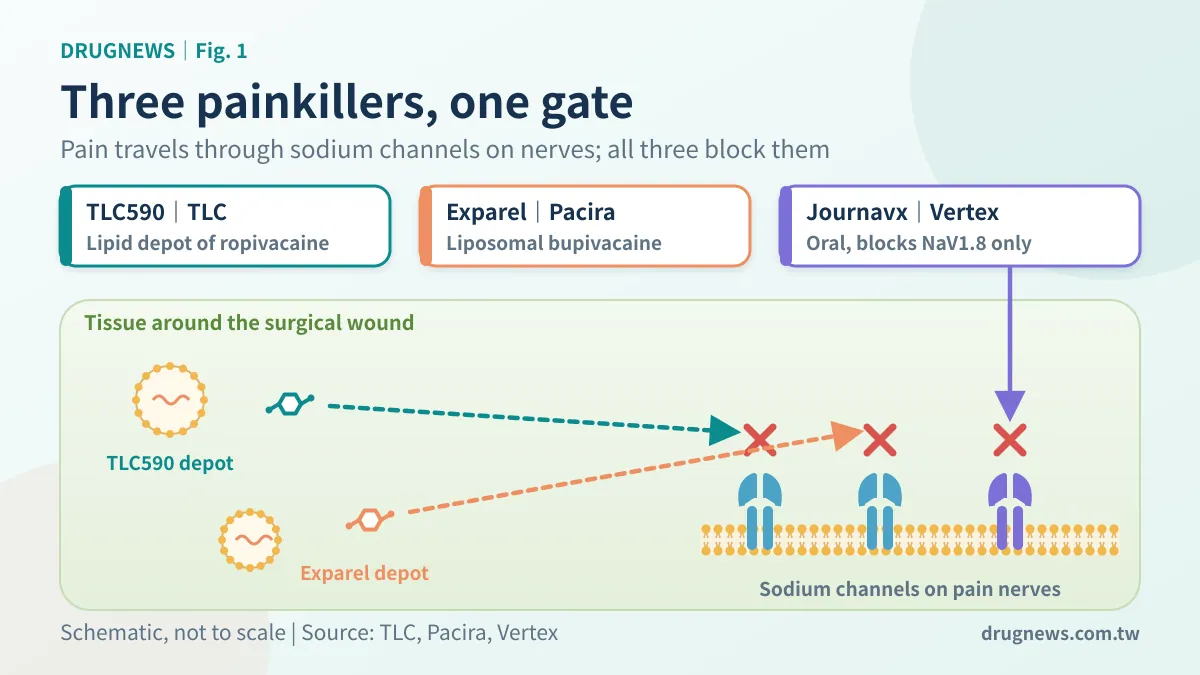
Fig. 1 | TLC590, Exparel and Journavx all block sodium channels on pain-sensing nerves; they differ in where the drug sits and how long it lasts.
02 | One yardstick, four non-opioid options
Line up the main US non-opioid options for post-surgical pain and measure them the same way: how the drug is given, how long it works, and how much it sells.
| Drug | Company | How it is given | Stated duration | Q2 2026 sales |
|---|---|---|---|---|
| Exparel | Pacira (being acquired by Viatris) | Injected around the wound; liposomal bupivacaine | About 24–72 hours (per TLC) | $147.8M |
| Journavx | Vertex | Oral, twice daily; blocks NaV1.8 only | While taken | $50.0M |
| Zynrelef | Heron | Applied to the wound during surgery; bupivacaine plus meloxicam | Up to 72 hours | $11.1M |
| TLC590 | TLC-KY | Injected around the wound; extended-release ropivacaine | Still significant at 168 hours | Not yet approved |
Two things stand out.
The first is Journavx. Vertex won FDA approval in January 2025 for the first new class of pain medicine in more than 20 years. Second-quarter 2026 revenue reached $50 million, up 71% from the first quarter, with nearly 900,000 prescriptions filled in the first half.
An oral drug growing that fast tells you how badly physicians want to write fewer opioid prescriptions.
The second is Zynrelef. It launched in 2021 and sold just $11.1 million in the second quarter, and Heron withdrew its full-year 2026 guidance while it reviews strategic alternatives.
Exparel is not about to lose its moat to copies, either. The FDA approved a generic competitor in 2024, but Pacira settled its patent suits with Fresenius Kabi, eVenus and Jiangsu Hengrui in 2025, and its chief executive says Exparel's strengthened intellectual property provides protection into the 2040s. Cheaper bupivacaine liposomes are not what will dent it. A better product might.
For a late entrant in local post-surgical pain, "also effective" is not enough. It has to prove it is better than Exparel.
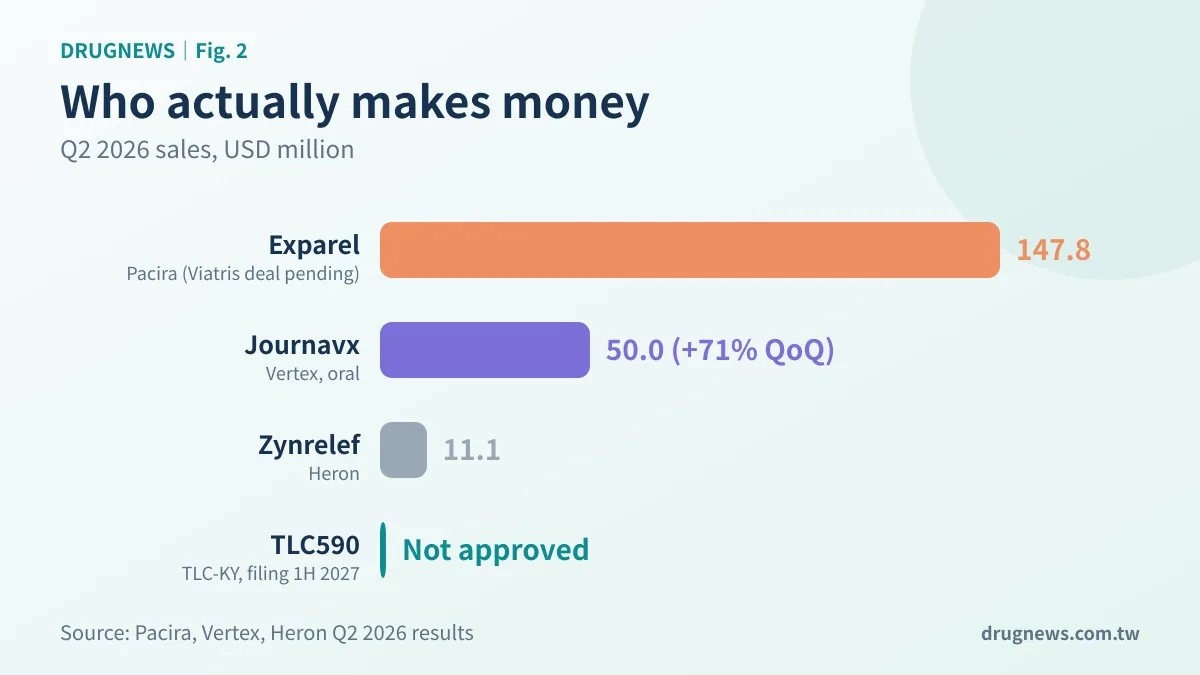
Fig. 2 | Exparel sells three times as much as Journavx and 13 times as much as Zynrelef per quarter; a newcomer needs head-to-head proof to take a share.
03 | What TLC590 proved
The Phase 3 trial enrolled 304 patients undergoing bunion surgery, randomized and double-blind, split 1:1:1 among TLC590, Exparel and placebo, and followed for 43 days.
The primary endpoint was against placebo. Overall pain through 72 hours was significantly lower (p=0.0024), and rescue opioid use was significantly reduced (p=0.0109).
Most long-acting anesthetics clear that bar. The valuable part sits in the secondary endpoints, where TLC590 faced Exparel.
Through 72 hours, overall pain was significantly lower with TLC590 (p=0.0202), and opioid consumption was significantly lower as well (p=0.0177).
Stretched to 168 hours, a full week, TLC590 still showed significantly lower overall pain than both placebo (p=0.0168) and Exparel (p=0.0226).
Adverse events were similar in type and rate to placebo and Exparel, with no deaths, no life-threatening events and no drug-related serious adverse events.
One shot, one week. That is the line TLC590's eventual sales team will use.
Why would ropivacaine outlast bupivacaine? The molecule itself is not the secret. Ropivacaine is a well-known local anesthetic, and TLC says it carries a better cardiovascular and central nervous system safety profile than bupivacaine. The difference is the packaging. TLC has spent three decades on lipid-based delivery, and TLC590 loads ropivacaine into a multilamellar liposome formulation designed to release it into the wound over days rather than hours.
That design has been tested before. In an earlier hernia-repair study, 58.3% of TLC590 patients needed no rescue opioids, and mean total opioid consumption through 96 hours was 54% lower than with plain ropivacaine. A Phase 2 bunionectomy study then compared TLC590 with placebo and bupivacaine. The Phase 3 trial was the first time it faced Exparel itself.
David Leiman of Evolution Research Group, a co-principal investigator, said a single dose of TLC590 delivered significant pain relief through 168 hours after surgery, which he called clinically important.
TLC disclosed significance, not effect sizes. How many points lower the pain scores were, and how many fewer opioids patients took, will come with a medical meeting or journal publication. Those numbers will set the price at the licensing table.
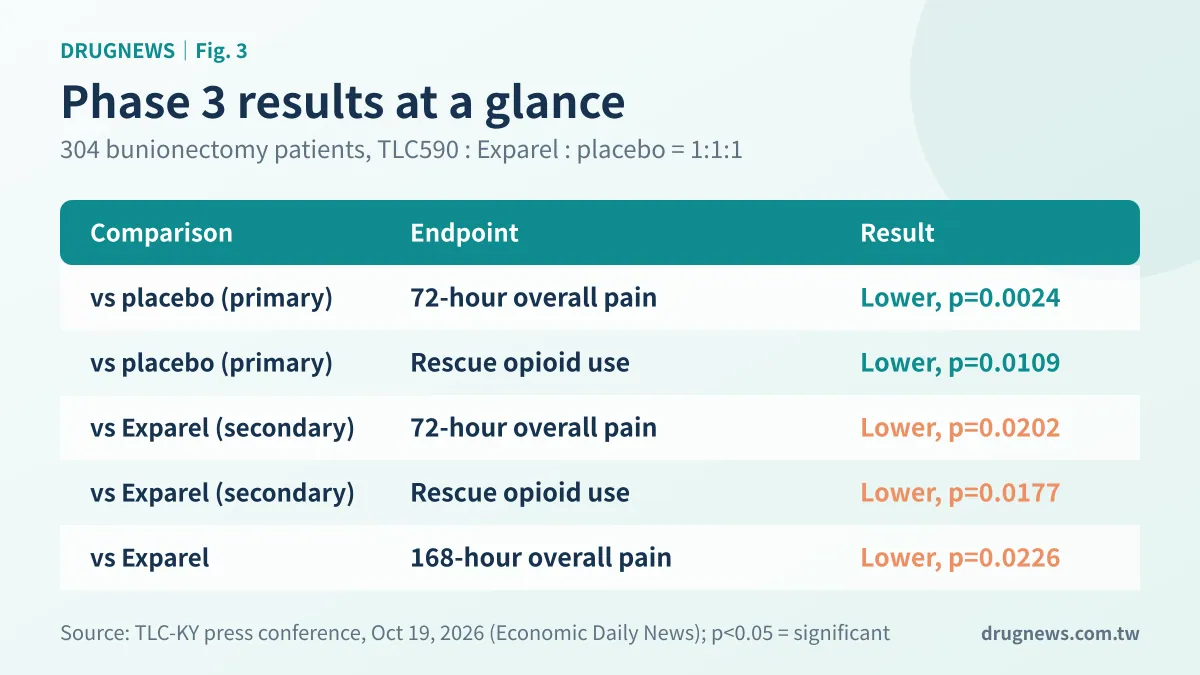
Fig. 3 | TLC590 met its primary endpoint against placebo, beat Exparel on both secondary endpoints, and held up at 168 hours.
04 | Viatris just bought Exparel, and that raises TLC590's price
The obvious objection: the wins over Exparel came on secondary endpoints, so they count for less.
That is half right. Getting a comparative claim onto a US label generally takes more evidence than one trial's secondary endpoints, so TLC590's prescribing information may well describe only its advantage over placebo.
But licensing partners are buying something else: the ability to walk into a hospital's pharmacy and therapeutics committee and argue for replacing Exparel. Two significant secondary endpoints, still holding at 168 hours, are enough for that conversation.
Then look at Viatris. Chief executive Scott A. Smith called Exparel and the knee osteoarthritis drug Zilretta "synergistic" additions that "strengthen our position in non-opioid pain management." The deal is expected to close by the end of 2026.
A global generics giant has just put $1.65 billion behind the idea that this market is worth paying for.
It is the same Viatris that, as our October 22 piece on its presbyopia drops Ryzumvi noted, said on approval day it would look for a partner to sell its new eye drops. For pain, it bought the whole company.
Big pharma is voting with its wallet, and the vote went to post-surgical pain.
For a drugmaker without a pain franchise that wants in, the menu is short. Exparel is taken. Zynrelef is not selling. Journavx belongs to Vertex. TLC590 is the only Phase 3 dataset on the table that beat Exparel head-to-head.
TLC chief executive Yeh Chih-hung said the company put Exparel into the trial as a comparator because it was confident in the product, that several international drugmakers have shown strong interest, and that licensing to a partner who would handle sales is an option.
05 | The Taiwan angle: from delisting to a Phase 3 win
TLC's predecessor, Taiwan Liposome Company, left Taiwan's over-the-counter market in October 2021. On June 26, 2026, it returned to the emerging-stock board as TLC-KY with a reference price of NT$200 a share, the highest for any biotech listing that year.
It has licensed drugs before. In June 2022, its knee osteoarthritis drug TLC599 went to Endo for $30 million upfront and up to $140 million including development, regulatory and manufacturing milestones. In early October 2026, Japanese rights to TLC599 went to Nippon Zoki Pharmaceutical in a deal worth up to $203 million.
TLC590 arrives at the table in a stronger position than TLC599 did in 2022: Phase 3 is done, and it beat the market leader.
There is a domestic angle as well. Taiwan's biotech sector has produced plenty of licensing deals built on early data; far fewer of its companies have taken a drug through a US Phase 3 trial against the market leader and won. A head-to-head win is the kind of evidence global partners pay upfront for, rather than spreading the money across distant milestones.
The calendar is set. TLC aims to file a new drug application with the FDA in the first half of 2027; with a 9-to-12-month review, launch could come in late 2027 or early 2028. TLC590 is covered by more than 90 patents, some running to 2044, and the company also plans filings in Taiwan, the EU and Japan.
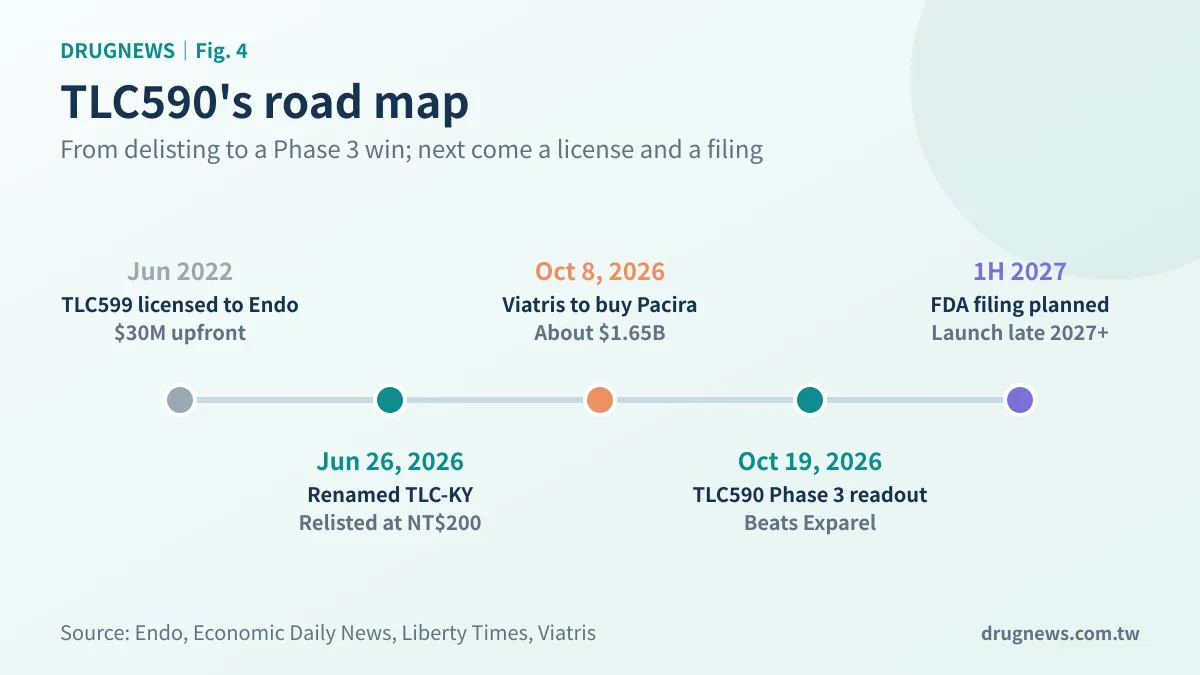
Fig. 4 | From the 2022 TLC599 deal to a 2027 filing, both of TLC's lead drugs have reached the stage where they should start earning.
Exparel's $575 million a year is what the market pays the incumbent. How much of that TLC590 can claim will get its first price tag in the licensing contract signed around its FDA filing.
Taiwan stock link
TLC-KY (7924) trades on Taiwan's emerging-stock board, and TLC590 is its product closest to market. Japanese licensing income from TLC599 and a future US deal for TLC590 are its two next sources of revenue.
This article is industry and company analysis, not investment or medical advice.
References
- TLC新藥三期大勝、碾壓美國主流藥 挾Best in Class優勢搶攻百億商機|Economic Daily News (udn.com)|2026-10-19|https://udn.com/news/story/7241/9824345
- TLC-KY長效止痛新藥解盲成功 預計最快明年底美國上市|Liberty Times|2026-10-19|https://ec.ltn.com.tw/article/breakingnews/5611408
- TLC停牌 新藥解盲聚焦|Economic Daily News (udn.com)|2026-10-19|https://udn.com/news/story/7252/9822494
- 快訊/注意!這家生技股下午4點召開重訊 說明新藥解盲結果|SETN|2026-10-19|https://www.setn.com/news/1924944
- Viatris to acquire Pacira BioSciences for $1.65 billion bolstering non-opioid pain treatment portfolio|Indian Pharma Post|2026-10-11|https://www.indianpharmapost.com/ma/viatris-to-acquire-pacira-biosciences-for-165-billion-bolstering-non-opioid-pain-treatment-portfolio-22115
- Viatris communications regarding tender offer for Pacira (Form SC TO-C, Ex.99.1)|SEC|2026-10-08|https://www.sec.gov/Archives/edgar/data/0001396814/000114036126039148/ef20083527_ex99-1.htm
- Pacira BioSciences Reports Fourth Quarter and Full-Year 2025 Financial Results|Pacira BioSciences|2026-02-26|https://investor.pacira.com/node/19206
- Pacira BioSciences Q2 2026 results (Form 8-K, Ex.99.1)|SEC|2026-08-04|https://www.sec.gov/Archives/edgar/data/0001396814/000162828026052527/pcrx-06302026x991.htm
- Acute pain drug Journavx helps drive Vertex growth in second quarter|Managed Healthcare Executive|2026-08-05|https://www.managedhealthcareexecutive.com/view/acute-pain-drug-journavx-helps-drive-vertex-growth-in-second-quarter
- Vertex Announces FDA Approval of JOURNAVX (suzetrigine), a First-in-Class Treatment for Moderate-to-Severe Acute Pain|Vertex Pharmaceuticals|2025-01-30|https://investors.vrtx.com/news-releases/news-release-details/vertex-announces-fda-approval-journavxtm-suzetrigine-first-class
- Heron Therapeutics Announces Second Quarter 2026 Financial Results|Heron Therapeutics|2026-08-10|https://ir.herontx.com/node/17851
- Heron Therapeutics combo drug for post-surgical pain wins FDA nod on third try|MedCity News|2021-05-13|https://medcitynews.com/2021/05/heron-therapeutics-combo-drug-for-post-surgical-pain-wins-fda-nod-on-third-try/
- Endo Executes Agreement with TLC to Commercialize Phase 3 Orthopedic Product for the Treatment of Osteoarthritis Knee Pain|Endo International (Cision)|2022-06-13|https://www.newswire.ca/news-releases/endo-executes-agreement-with-tlc-to-commercialize-phase-3-orthopedic-product-for-the-treatment-of-osteoarthritis-knee-pain-853434315.html
- 台微體改名TLC-KY重新登興櫃…每股參考價200元 創今年生技股掛牌新高|Economic Daily News (udn.com)|2026-06-25|https://udn.com/news/story/7254/9589022
- TLC590 pipeline page|TLC BioSciences|2026-10-19|https://www.tlcbio.com/en/pipeline/TLC590
- TLC-KY明登興櫃 每股參考價200元 雙三期新藥拚授權|Commercial Times|2026-06-25|https://www.ctee.com.tw/news/20260625701728-430503
- TLC-KY術後止痛新藥TLC590三期完成收案 解盲倒數 搶攻706億美元市場|Commercial Times|2026-07-30|https://www.ctee.com.tw/news/20260730701681-430504
Share this analysis
Send this article to readers who follow biotech, company strategy, and capital-market signals.
Cite this article
For decks, research notes, or media references, cite Drugnews with the canonical article URL.
Drugnews Editorial Team. "Taiwan's TLC590 Beats Exparel Head-to-Head in Post-Surgical Pain." Drugnews, Oct 23, 2026. https://drugnews.com.tw/articles/2026-10-23-tlc590-exparel-postsurgical-pain-phase3-en.html