
Taiwan has more than 90,000 people on dialysis. The bill runs close to NT$50 billion a year.
There are many roads to dialysis. IgA nephropathy is one of them, and it often starts in a patient's twenties or thirties.
On October 22, at the American Society of Nephrology's Kidney Week, two companies reported two-year results on the same day.
Patients on placebo lost 4 to 6 points of kidney function a year. Patients on the new drugs lost almost nothing.
Four drugs with closely related mechanisms are now chasing the same disease.
The ranking is already visible. Otsuka's Voyxact and Vertex's povetacicept, both given once every four weeks, will lead. Vera Therapeutics' Trutakna, a weekly shot with the highest price, will be pushed into third.
01 | How IgA nephropathy ends in dialysis
IgA is the antibody that guards the body's mucous linings, in the throat and the gut.
In IgA nephropathy, B cells make a version of IgA1 that is missing part of its sugar coat.
The immune system treats it as an intruder. Antibodies latch on, and the clumps travel through the blood until they lodge in the kidney's filters, the glomeruli.
The filters become inflamed. Protein leaks into the urine. Over years, the filtering tissue turns into scar.
It is a quiet disease.
Many patients learn about it only when a routine check finds blood or protein in their urine.
A 2024 review of the Asia-Pacific region in BMC Nephrology found that about 26% of Taiwanese patients biopsied for primary glomerulonephritis had IgA nephropathy.
The same review cites estimates that nearly one in three patients reaches end-stage kidney disease within 10 years.
Until recently, doctors mostly worked downstream. They lowered blood pressure, cut protein loss, and added steroids in severe cases.
Nobody had a drug that shut off the signal telling B cells to make the faulty IgA1 in the first place.
The four drugs reporting now go after that source.
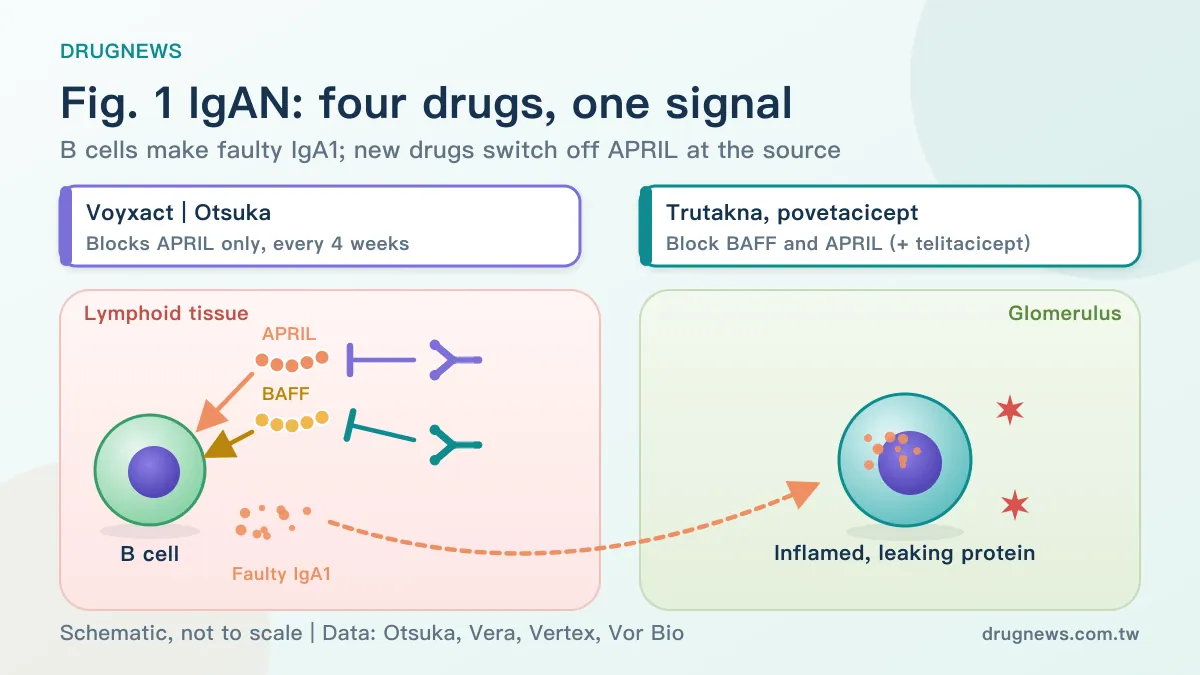
Fig. 1 | All four drugs act at the B-cell end, switching off APRIL so the kidney stops receiving a steady supply of faulty IgA1
That signal is called APRIL, and it has a helper called BAFF.
Think of them as overtime orders in a factory. As long as APRIL keeps issuing them, B cells keep producing faulty IgA1.
Otsuka's Voyxact (sibeprenlimab) is an antibody that blocks APRIL alone.
Vera's Trutakna (atacicept), Vertex's povetacicept and telitacicept from China's RemeGen are fusion proteins. They block BAFF and APRIL together.
Does blocking one extra signal matter? The two-year data answer that.
First, though, it helps to know why two years is the number everyone waited for.
The FDA's approvals of Voyxact and Trutakna are accelerated approvals. They rest on a drop in urine protein, a marker that predicts kidney outcomes but is not an outcome itself.
To convert an accelerated approval into a full one, a company has to show that kidney function itself declines more slowly. That is what the eGFR slope over two years measures.
Vertex's own Phase 3 design says as much. RAINIER's primary endpoint at the final analysis is the total eGFR slope through week 104.
So the October data were not a victory lap. They were the exam that decides which drugs keep their labels and which get full ones.
02 | One yardstick: how much kidney is left after two years
Nephrologists track the eGFR slope, the number of points of filtering capacity a patient loses each year.
The KDIGO kidney guidelines treat a loss of less than 1 point a year (mL/min/1.73m²) as close to the normal pace of ageing.
Start with Otsuka. Its VISIONARY trial randomized 510 people.
On Voyxact, eGFR actually rose 0.3 points a year over two years. On placebo, it fell 4.2 a year. The gap was 4.5.
Kidney failure or a sharp decline in function hit 1 of 259 patients on Voyxact, against 28 of 251 on placebo.
Put plainly, about one placebo patient in nine got clearly worse over two years. On Voyxact, it was one in more than two hundred.
Urine protein fell 61.3% at month 24.
The safety table was almost dull, which is what a drug taken for years needs. Any adverse event: 90.7% on Voyxact, 90.0% on placebo. Infections: 51.4% against 51.0%.
That matters for a drug that dampens part of the immune system. Blocking APRIL has not, so far, shown up as extra infections.
On the same day, Vor Bio released two-year results for telitacicept from the TELIGAN trial, run by its partner RemeGen in China.
Among 318 patients, the drug arm lost 0.6 points a year and the placebo arm lost 5.7. The gap was 5.1.
At week 104, urine protein had fallen 60.3% from baseline on telitacicept.
By the end, 44.0% of telitacicept patients had urine protein below 0.5 g/g, a level nephrologists treat as well controlled. On placebo, 8.2% did.
Serious adverse events were lower on the drug, at 8.2% against 18.2% on placebo.
Vor Bio added a caveat of its own: the data were generated by RemeGen, and Vor has not independently verified them.
Vera reported first, in mid-September. The final ORIGIN 3 analysis covered 428 patients.
Trutakna patients lost 0.6 points a year, against 5.6 on placebo. Disease-progression events fell 76%, with 11 cases against 38.
Three drugs. Three numbers. All inside the 1-point line.
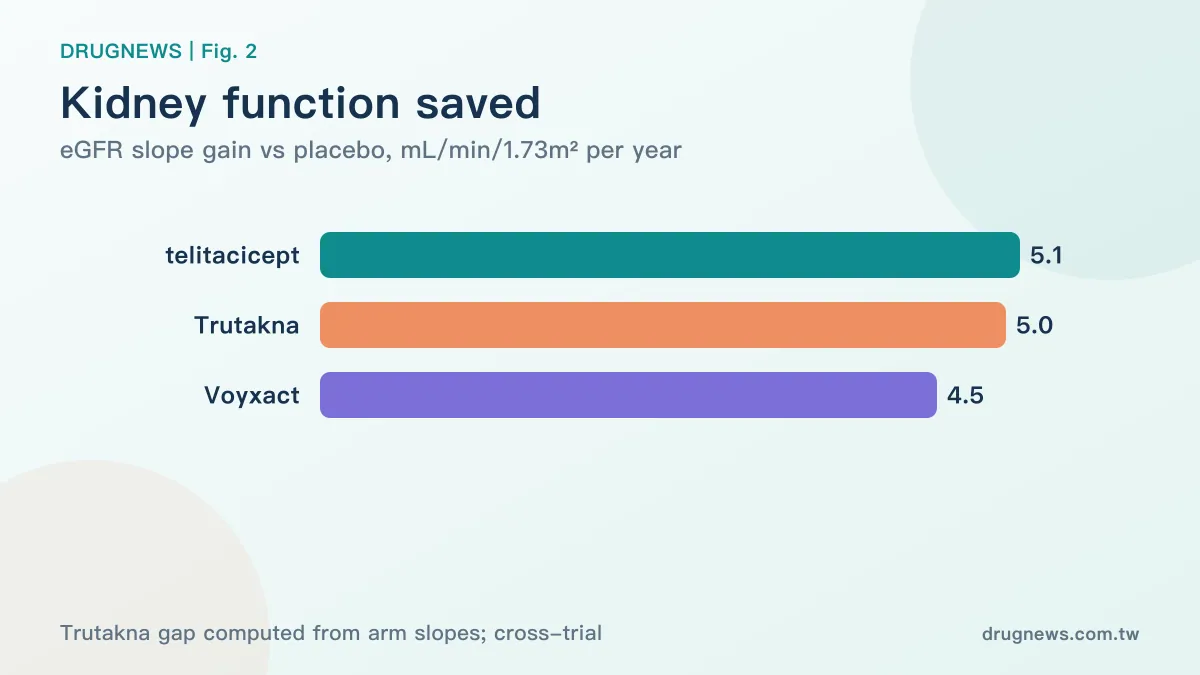
Fig. 2 | Against placebo, each drug saves roughly 4.5 to 5 points of eGFR a year, too close to rank
One caution matters here.
The three trials enrolled different patients in different countries on different background therapy.
Comparing Voyxact's +0.3 with Trutakna's -0.6 across trials does not hold up statistically.
With the data tied, the contest moves elsewhere.
It moves to a market that is larger than it first looks. Vera estimates that about 160,000 people in the US have IgA nephropathy. Vertex puts the US and European total at about 300,000.
Vertex's own disease summary is bleaker than the Asian review: up to 72% of adult patients progress to end-stage kidney disease within 20 years of diagnosis.
At list prices near $400,000 a year, even a modest share of treated patients makes this a multibillion-dollar class.
| Drug (company) | Target | Dosing | US status | US list price | Two-year eGFR slope |
|---|---|---|---|---|---|
| Voyxact (Otsuka) | APRIL | Every 4 weeks | Accelerated approval Nov 2025; full-approval filing completed | $390,000/yr | +0.3/yr |
| Trutakna (Vera) | BAFF+APRIL | Weekly | Accelerated approval Jul 2026; full-approval filing planned Q4 2026 | $425,000/yr | -0.6/yr |
| povetacicept (Vertex) | BAFF+APRIL | Every 4 weeks | FDA decision due Nov 30, 2026 | Not set | Not yet reported |
| telitacicept (RemeGen/Vor) | BAFF+APRIL | Weekly, then every 2 weeks after week 40 | Conditional approval in China Jun 2026; no global IgAN trial | — | -0.6/yr |
03 | With the data tied, the shot count decides
IgA nephropathy often strikes people in their twenties and thirties. A drug like this may be taken for years.
Fifty-two injections a year and thirteen are two different lives.
Voyxact is a once-every-four-weeks injection that patients give themselves at home.
Povetacicept is also dosed every four weeks. Vertex says it plans to launch it in an autoinjector holding less than 0.5 mL.
Trutakna is a weekly shot.
Vera knows this is a weakness.
It has registered a 90-patient Phase 2 study on ClinicalTrials.gov with a blunt title: "Monthly Dosing of Atacicept in IgAN."
Price does not help Vera either.
According to BioPharma Dive, Trutakna launched in July at a list price of $425,000 a year. Voyxact's wholesale cost is $390,000.
More shots and a higher price leave Vera with one argument for switching patients: it blocks BAFF as well.
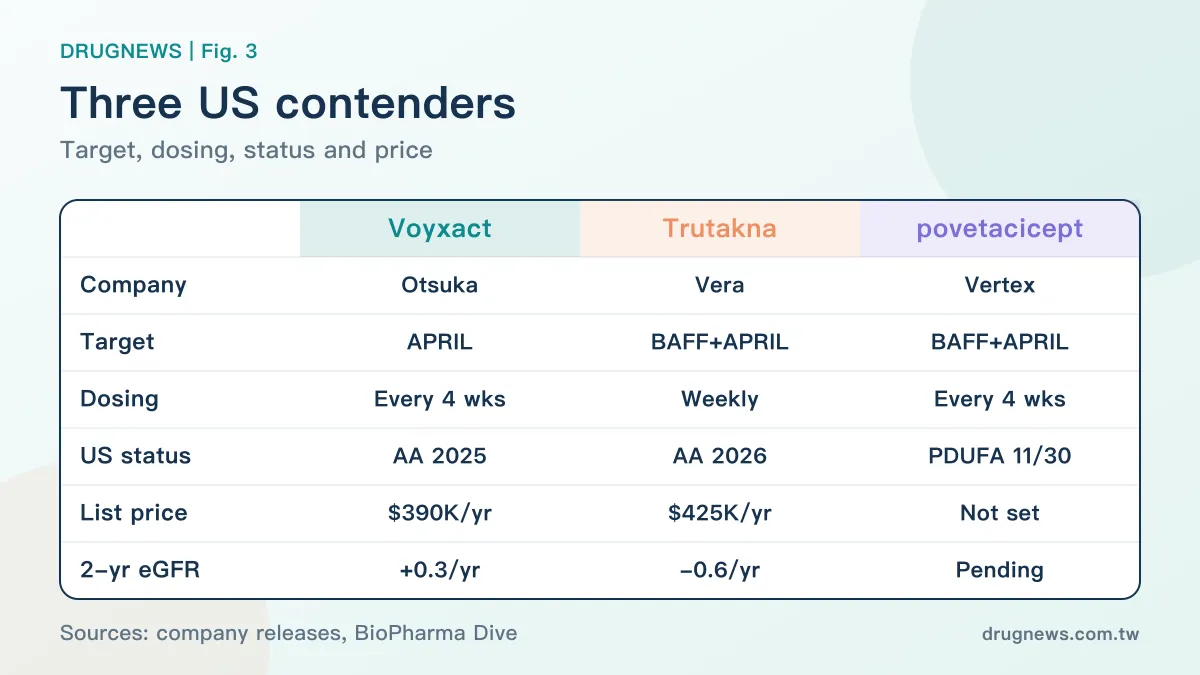
Fig. 3 | Otsuka and Vertex dose every four weeks; Vera doses weekly at a higher price, and that is what prescribers will weigh
Vertex is the one to watch.
Its Phase 3 RAINIER trial enrolled 605 people. Vertex calls it the largest trial ever run in IgA nephropathy.
At a 36-week interim analysis, urine protein fell 52.0% from baseline, or 49.8% after adjusting for placebo.
Levels of the faulty, sugar-poor IgA1 fell 79.3% more than on placebo.
The FDA has set November 30, 2026, as its target date for a decision.
04 | Who leads and who gets squeezed
Here is the order, judged on what each company controls now: data in hand, dosing, price, and where it stands with the FDA.
Accelerated approval is a provisional license. If a company cannot confirm the benefit on kidney function, the FDA can pull it. Whoever converts to full approval first gets to tell doctors and insurers that the question is settled.
That is why the filing calendar matters as much as the eGFR chart.
Otsuka is first. It won accelerated approval earliest, on November 25, 2025.
Its two-year eGFR slope is the only positive one of the three. It has also completed its rolling filing for full approval.
Otsuka's chief medical officer, John Kraus, said the VISIONARY results "redefine what may be possible for people living with IgA nephropathy."
Vertex is second. It is more than a year late, but its drug is also monthly.
Vertex also brings deep pockets, built on its cystic fibrosis franchise.
If povetacicept is approved by November 30, the US market becomes two monthly drugs against one weekly drug.
Vera is third. Its data are as good. It loses on shot count and price.
Telitacicept is fourth. It won approval in China in June.
But Vor Bio's second-quarter report makes its priorities clear. Its global Phase 3 programs are in myasthenia gravis and Sjögren's disease. There is no global IgA nephropathy trial.
Voyxact will win full FDA approval before Trutakna, and povetacicept will win accelerated approval by its November 30 deadline.
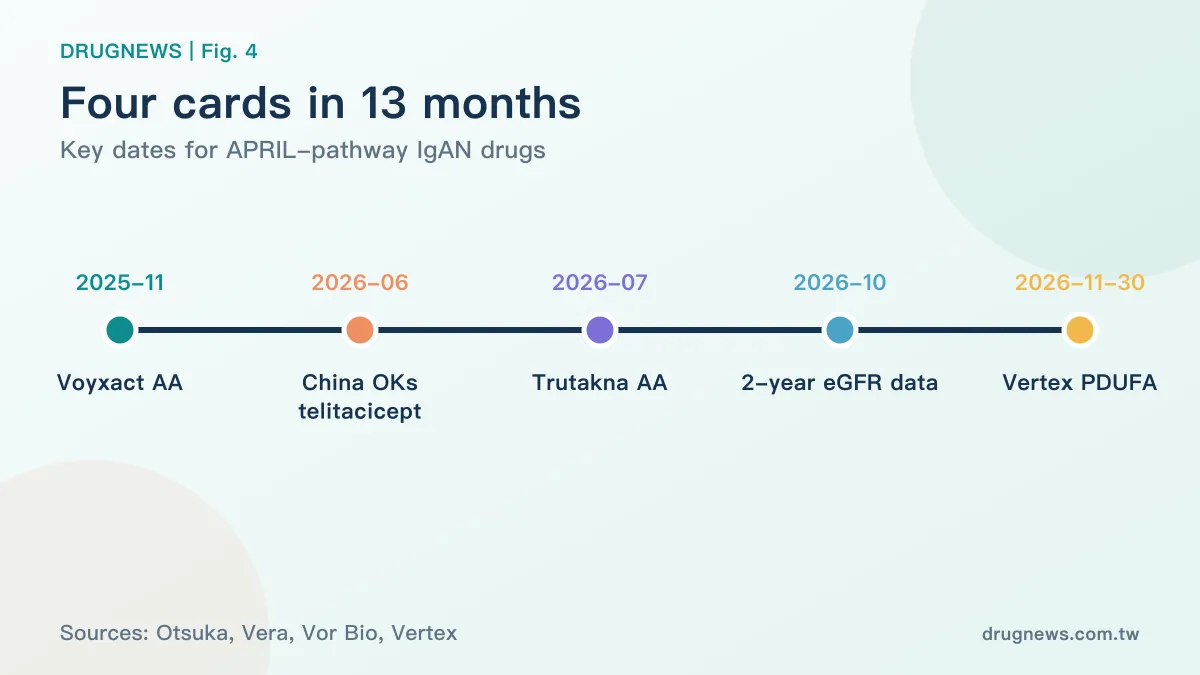
Fig. 4 | From Voyxact's approval to Vertex's FDA deadline is about a year, taking IgA nephropathy from no targeted drugs to four
The other side deserves a hearing.
Vera argues that blocking BAFF and APRIL together suppresses the disease-driving B cells more completely. Its 76% cut in progression events looks strong.
The case for Otsuka and Vertex is practical.
Two-year eGFR is already in the same range for every drug. Blocking BAFF too has not bought a difference patients can feel. What it has bought is 39 extra injections a year.
There is also a latecomer.
Novartis is running BEYOND, a Phase 3 trial of its own anti-APRIL antibody, zigakibart, with 383 patients registered.
It is behind. But Novartis has a large kidney sales force, and it will be the variable after 2027.
05 | How far Taiwan's patients are from these drugs
Taiwan is not sitting this race out.
The country has also been working down its dialysis problem. Age-standardized dialysis incidence fell from 318 per million people in 2005 to 290 per million in 2022, President Lai Ching-te said in December 2025.
A government white paper now targets 18% home-dialysis prevalence by 2035. Drugs that keep young patients off dialysis altogether attack the same bill from the other end.
ClinicalTrials.gov listings show six Taiwanese sites in Otsuka's VISIONARY trial and eight in Novartis's BEYOND.
Taiwanese nephrologists have already used both drugs in trials.
That is good news for patients, and for the doctors who will eventually prescribe these drugs.
When a country's patients are in the pivotal data, review moves faster and doctors climb the learning curve sooner.
Otsuka enrolled Taiwanese patients and was first to US approval. It is best placed to bring Voyxact to Taiwan first.
The hard part is money.
More than 90,000 patients and nearly NT$50 billion a year works out to about NT$550,000 per dialysis patient per year.
The new drugs start at $390,000 a year in the US.
Taiwan's National Health Insurance will have to ask whether paying early to delay kidney failure saves decades of dialysis later.
IgA nephropathy patients tend to be young. The longer that ledger runs, the better the new drugs look.
For patients with the disease today, one practical step is to ask their nephrologist whether they qualify for a trial enrolling in Taiwan.
The four drugs have shown that kidney function in IgA nephropathy can hold almost steady for two years. The FDA's November 30 decision on Vertex, and the race between Otsuka and Vera to full approval, will set the final order.
This article is industry and company analysis, not investment or medical advice.
References
- Otsuka Presents Landmark Final Phase 3 VISIONARY Results at ASN|Otsuka America Pharmaceutical|2026-10-22|https://www.otsuka-us.com/Otsuka-Presents-Final-Phase-3-VISIONARY-Results
- Telitacicept Demonstrates Durable Preservation of Kidney Function Through Two Years in Phase 3 TELIGAN Trial in IgA Nephropathy|Vor Bio (GlobeNewswire)|2026-10-22|https://www.globenewswire.com/news-release/2026/10/22/3386893/0/en/telitacicept-demonstrates-durable-preservation-of-kidney-function-through-two-years-in-phase-3-teligan-trial-in-iga-nephropathy.html
- Atacicept Cuts IgAN Progression Risk 76% in ORIGIN 3 Final Data|HCPLive|2026-09-15|https://www.hcplive.com/view/atacicept-cuts-igan-progression-risk-76-in-origin-3-final-data
- Atacicept Slows IgAN Decline to Physiologic Rate|HCPLive|2026-09-29|https://www.hcplive.com/view/atacicept-slows-igan-decline-to-physiologic-rate-with-sayna-norouzi-md
- FDA approves Vera's Trutakna for IgA nephropathy|BioPharma Dive|2026-07-07|https://www.biopharmadive.com/news/vera-fda-approve-trutakna-IgAN-kidney-disease-atacicept/824620/
- Otsuka's Voyxact faces rival as FDA okays Vera IgAN drug|pharmaphorum|2026-07-08|https://pharmaphorum.com/news/otsukas-voyxact-faces-rival-fda-okays-vera-igan-drug
- Vertex Announces US FDA Acceptance of Biologics License Application for Accelerated Approval of Povetacicept in IgA Nephropathy|Vertex Pharmaceuticals|2026-06-01|https://investors.vrtx.com/news-releases/news-release-details/vertex-announces-us-fda-acceptance-biologics-license-application
- Vor Bio Reports Second Quarter 2026 Financial Results and Provides Corporate Update|Vor Bio|2026-08-11|https://ir.vorbio.com/node/11036/pdf
- Review on epidemiology, disease burden, and treatment patterns of IgA nephropathy in select APAC countries|BMC Nephrology|2024-04-16|https://pmc.ncbi.nlm.nih.gov/articles/PMC11021013/
- President Lai hopes home dialysis reaches 18% prevalence by 2035 (in Chinese)|Commercial Times|2025-12-06|https://www.ctee.com.tw/news/20251206700062-430101
- Trial of Sibeprenlimab in the Treatment of IgA Nephropathy (VISIONARY, NCT05248646)|ClinicalTrials.gov|2026-10-23|https://clinicaltrials.gov/study/NCT05248646
- A Study of Zigakibart in Adults With IgA Nephropathy (BEYOND, NCT05852938)|ClinicalTrials.gov|2026-10-23|https://clinicaltrials.gov/study/NCT05852938
- Monthly Dosing of Atacicept in IgAN (NCT07020923)|ClinicalTrials.gov|2026-10-23|https://clinicaltrials.gov/study/NCT07020923
- Vertex Announces Progress in Povetacicept Development Program|Vertex Pharmaceuticals (Business Wire)|2025-10-16|https://seekingalpha.com/pr/20270393-vertex-announces-progress-in-povetacicept-development-program-and-presentation-of-new-data-at
Share this analysis
Send this article to readers who follow biotech, company strategy, and capital-market signals.
Cite this article
For decks, research notes, or media references, cite Drugnews with the canonical article URL.
Drugnews Editorial Team. "IgA nephropathy drugs: monthly shots will win." Drugnews, Oct 27, 2026. https://drugnews.com.tw/articles/2026-10-27-iga-nephropathy-april-drugs-voyxact-trutakna-povetacicept-en.html