
On October 28, US Health Secretary Robert F. Kennedy Jr. signed an interim policy, and within hours wellness newsletters were announcing that six peptides were "back."
They are not back in the way most readers assume. The document does not approve anything, and it says so. What it does is promise that the Department of Health and Human Services will not go after pharmacies that compound six unapproved peptides while the FDA works through a formal rulemaking.
The first company to move was not a drugmaker. It was Hims & Hers, the telehealth platform that spent the past three years selling compounded copies of semaglutide. A day after the policy was signed, it opened a waitlist for a peptide storefront.
01|What was actually granted: a promise not to enforce
The interim policy was published in the Federal Register on October 30. It covers BPC-157, TB-500, Epitalon, KPV, MOTS-c and Semax, compounds that their promoters pitch for everything from wound healing and osteoporosis to weight loss, insomnia and inflammation.
The legal reach is narrow. Until the FDA formally adds these substances to its 503A bulks list, HHS will not take enforcement action against state-licensed pharmacies, federal facilities or licensed physicians that compound them.
There are 10 conditions. The bulk ingredient must come from an FDA-registered, GMP-compliant manufacturer with a valid certificate of analysis. Each product may contain only one active ingredient. Labels must read "This is a compounded drug product. Not for resale." Serious adverse events go to the FDA's MedWatch system.
HHS also wrote down its stated motive. It wants to pull consumers away from "research use only" peptides shipped from foreign manufacturers, which have been sold online for years with no prescription and nobody accountable for purity.
The last condition is an exit. If a safety signal or a product quality problem appears, HHS says it may revisit the policy.
Public comments close on November 13.
The same FDA advisory committee is scheduled to review five more peptides in February, so the list may grow before it shrinks.
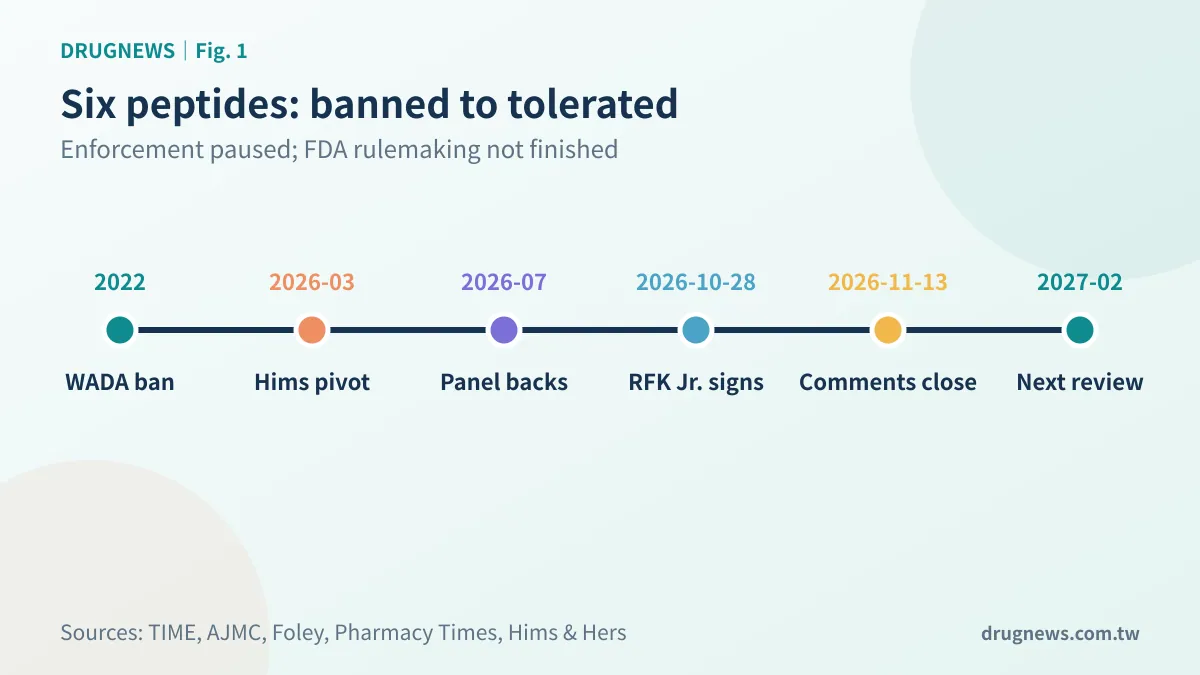
The opening rests on HHS declining to enforce. The FDA rulemaking has not been completed.
02|Hims is lining up for the same model it used with GLP-1s
To see who profits, look at how Hims & Hers built its weight-loss business.
Hims entered the US weight-loss market in 2023. Its offering included compounded semaglutide, the same molecule as Novo Nordisk's Ozempic and Wegovy, mixed by compounding pharmacies rather than made by Novo. Novo sued.
On March 9 this year, Hims changed course. It stopped advertising compounded GLP-1s, began offering Novo's branded Ozempic and Wegovy injections and Wegovy tablets, and kept compounded semaglutide only for a small group of patients whose providers judge it clinically necessary. Novo dropped its lawsuit the same day.
That left Hims looking for the next product people would pay for every month.
It also went to Washington. Under the executive order that lets outside parties meet White House regulatory reviewers before a rule is released, four groups asked for meetings on the peptide policy: the American Academy of Peptide Medicine on October 21, Hims & Hers on October 23, the Alliance for Pharmacy Compounding on October 27, and the Center for Science in the Public Interest the same day. Three of the four stood to gain from a wider opening. Hims met the reviewers five days before Kennedy signed.
On October 29, Hims previewed Peptides+. The launch list is sermorelin, glutathione, B12, NAD+ and L-carnitine. BPC-157 and TB-500 are slated to follow "when allowable." Co-founder and CEO Andrew Dudum said the company is "focused on entering this specialty the right way, not the fastest."
The supply chain is the compounded-GLP-1 chain with a new molecule in it. A bulk manufacturer ships the ingredient, a compounding pharmacy fills a prescription, a remote physician writes it after an online consult, and the patient pays a subscription. TIME reported that telehealth sites were already listing these peptides at $199 to $249 a month, and analysts put the eventual market at $3.3 billion.
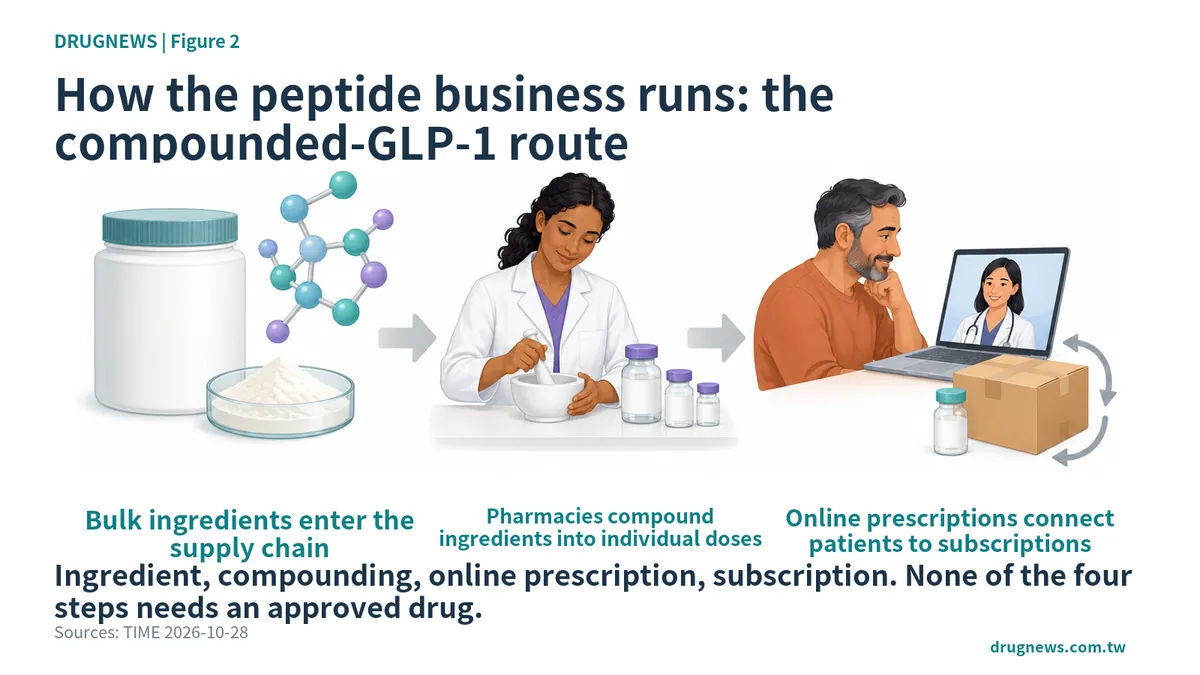
Ingredient, compounding, online prescription, subscription. None of the four steps needs an approved drug.
The fine print shapes what Hims can sell. Any injectable must ship only with an FDA 510(k)-cleared syringe, and anyone compounding an oral peptide has to keep documentation that the formulation is adequately absorbed in humans. Capsules and drinkable versions, a format consumer brands favor, now need data that most peptide sellers have never generated. Injections, the format with the cleanest regulatory path, also carry the most clinical risk.
Pharmaceutical companies have no seat in this chain. None of the six peptides has an approval, so there is no patent or exclusivity that would let anyone recover the cost of a real trial program.
The money goes to whoever owns the patient relationship.
Our call: Hims & Hers will put BPC-157 or TB-500 on sale through Peptides+ before June 30, 2027. If neither is listed by then, or if HHS pulls the policy first over a safety signal, the call was wrong.
The first public test of how Hims frames this business comes with its third-quarter results on November 9. Two later dates can move the call: the comment deadline, which could bring a flood of objections from medical groups, and the February advisory meeting, which could widen the list or expose the panel to fresh scrutiny over its membership.
03|The FDA's own scientists said no
The policy overrode the agency's internal experts.
Before the Pharmacy Compounding Advisory Committee met in July, the FDA appointed eight new members, several of whom were reported to have ties to peptide prescribing or promotion. The committee backed the six substances. FDA career scientists had recommended against listing any of them.
The evidence base is thin. BPC-157 is a synthetic peptide derived from a protein fragment in human gastric juice. Pharmacy Times counted three uncontrolled pilot studies in humans, with 30 participants combined. The World Anti-Doping Agency banned it in 2022, and the FDA had placed it among bulk substances with significant safety concerns, citing a potential for immune reactions.
Adriane Fugh-Berman, a pharmacology professor at Georgetown University, called the peptides "untested and poorly characterized experimental drugs." She cited two women who needed emergency treatment after receiving peptides at a festival in Las Vegas.
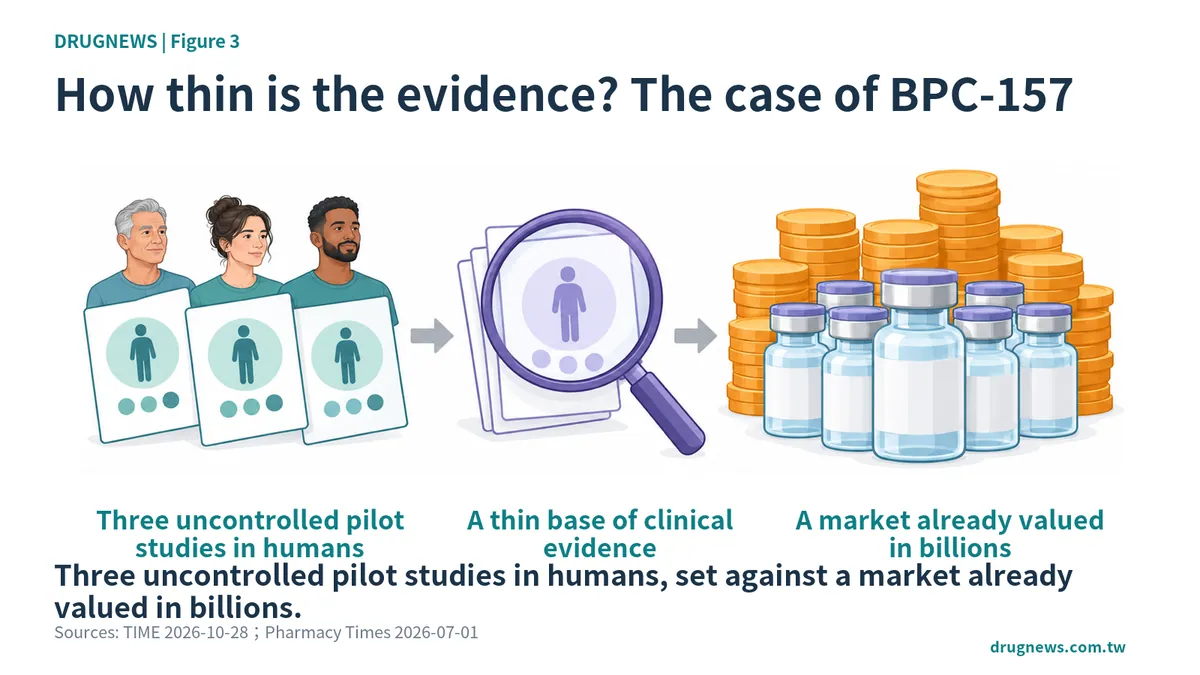
Three uncontrolled pilot studies in humans, set against a market already valued in billions.
Peter Lurie and colleagues at the Center for Science in the Public Interest made the institutional argument in a JAMA viewpoint: "Listing would fundamentally undermine the FDA drug approval process itself." If a substance can reach patients through compounding because an advisory panel liked it, the expensive route of running controlled trials looks optional.
The pharmacists who would do the compounding have their own worries. Annie Lambert, a pharmacist who manages compliance programs at Wolters Kluwer Health, told TIME that compounding "is not a substitute for FDA-approved manufacturing," and warned that some pharmacies may "make a dollar faster rather than make sure they meet every requirement." She expects the peptide boom to add pressure on the pharmacies that already supply telehealth sites.
There is also a federalism problem. Jeff Cohen, co-founder of the American Peptide Association, told Reuters that states may not follow Washington's relaxation, which would leave the same vial legal to compound in one state and a target for regulators in the next.
Advocacy groups went further. Robert Steinbrook of Public Citizen urged HHS to rescind the policy. The Partnership for Safe Medicines petitioned the FDA to disregard the July vote, arguing it violated the Federal Advisory Committee Act and federal ethics law.
Supporters have a point too. HHS argues that bringing peptides into inspected pharmacies beats leaving consumers to buy unlabeled vials from abroad. Lee Rosebush, chair of the American Academy of Peptide Medicine, called the move "a vital step toward eliminating the unsafe gray and black markets."
Both sides agree the gray market already exists. They disagree on whether patients with no clinical evidence behind their treatment should carry the cost of absorbing it.
04|Taiwan: without a license, it is a prohibited drug
For readers in Taiwan, the key point is simple. The US policy stops at the US border.
Selling a drug in Taiwan requires a license from the Taiwan Food and Drug Administration. Article 22 of the Pharmaceutical Affairs Act classifies drugs imported without approval as prohibited drugs, and Article 82 allows prison terms of up to 10 years and fines of up to NT$100 million. A vial compounded legally in a US pharmacy does not acquire a Taiwanese license by being shipped through a personal shopper.
Taiwan has already watched this pattern with GLP-1s. A January investigation by The Reporter found a weight-loss LINE group adding about 500 members a month and passing 2,000, with Mounjaro changing hands for NT$9,500 to NT$15,000.
Since 2024 the TFDA has inspected 487 pharmacies and clinics, found violations at 85 of them, and levied NT$2.6 million in fines. Wang Shu-fen, director of the TFDA's drug division, acknowledged that the agency has no jurisdiction over websites hosted overseas and can only post warnings.
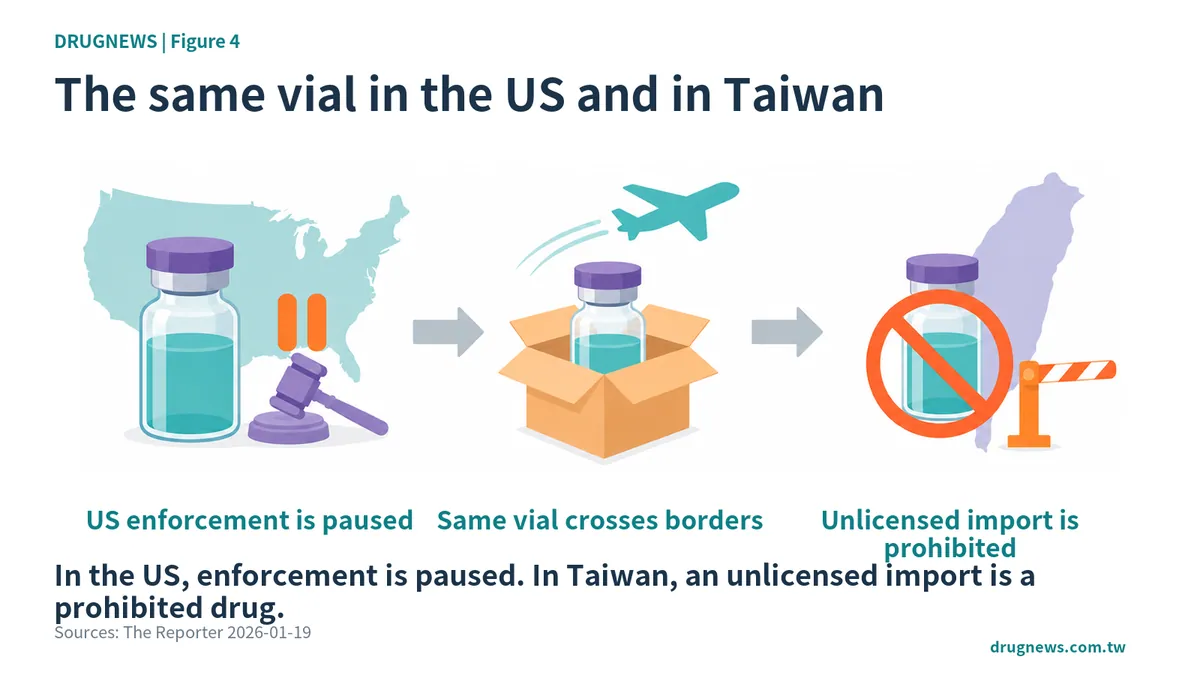
In the US, enforcement is paused. In Taiwan, an unlicensed import is a prohibited drug.
That is the practical effect on Taiwan. Once US platforms start compounding at scale and social media fills with user reports, local personal-shopper and group-buy channels are likely to follow, and enforcement will run into the same offshore-website problem.
Peptides are harder to police than GLP-1s. With Mounjaro, a buyer can at least compare a pen against the genuine product. These six peptides exist only as compounded or research-grade material, so there is no genuine article to compare against. Anyone considering one should first check the TFDA's drug license search for a Taiwanese license.
05|Six peptides, one new sales channel
The compounded-GLP-1 era taught telehealth platforms a lesson: if a compounding pharmacy can legally fill the prescription, the subscription business can start now and the approval question can wait.
The difference this time is the starting point. Compounded semaglutide copied a drug that had passed phase 3 trials and FDA review, so the debate was about quality and supply. With BPC-157 and its five companions, the debate is about whether the molecules work at all, and the subscription will be running before anyone finds out.
HHS has now applied that model to substances that have never held an FDA approval. Most Taiwanese readers will not recognize the names of these six peptides. The route they are about to travel, Taiwan's GLP-1 gray market has already mapped.
This article is industry and company analysis, not investment or medical advice.
References
- Enforcement Discretion Policy Regarding 503A Compounding Using Certain Peptide Bulk Drug Substances|Federal Register (HHS)|2026-10-30|https://www.federalregister.gov/public-inspection/2026-22192/enforcement-discretion-policy-regarding-503a-compounding-using-certain-peptide-bulk-drug-substances
- July 23-24, 2026: Meeting of the Pharmacy Compounding Advisory Committee|U.S. FDA|2026-07-23|https://www.fda.gov/advisory-committees/advisory-committee-calendar/july-23-24-2026-meeting-pharmacy-compounding-advisory-committee-07232026
- 5 Things to Know About HHS's Interim Peptide Compounding Policy|AJMC|2026-10-29|https://www.ajmc.com/view/5-things-to-know-about-hhs-s-interim-peptide-compounding-policy
- HHS will permit compounding of six peptides ahead of formal rulemaking|RAPS Regulatory Focus|2026-10-29|https://www.raps.org/resource/hhs-will-permit-compounding-of-six-peptides-ahead-of-formal-rulemaking.html
- Peptides: HHS Announces Limited Enforcement Discretion for Compounding of Six Peptides|Foley & Lardner|2026-10-30|https://www.foley.com/insights/publications/2026/10/peptides-hhs-announces-limited-enforcement-discretion-for-compounding-of-six-peptides/
- The Peptide Rush Has Begun|TIME|2026-10-28|https://time.com/article/2026/10/28/peptide-rush-has-begun/
- Starting Today, These Six Peptides Are Back|Dr. Jesse Morse Substack|2026-10-30|https://drjessemorse.substack.com/p/starting-today-these-six-peptides
- Expanding Safe Access to Peptides|Hims & Hers Newsroom|2026-10-29|https://news.hims.com/newsroom/expanding-safe-access-to-peptides
- Hims & Hers Announces Strategic Shift for US Weight Loss Business|Hims & Hers IR|2026-03-09|https://investors.hims.com/news/news-details/2026/Hims--Hers-Announces-Strategic-Shift-for-US-Weight-Loss-Business/default.aspx
- Hims & Hers to Announce Third Quarter 2026 Financial Results on November 9, 2026|Hims & Hers IR|2026-10-12|https://investors.hims.com/news/news-details/2026/Hims--Hers-to-Announce-Third-Quarter-2026-Financial-Results-on-November-9-2026/default.aspx
- Heal or Harm? Body Protective Compound-157 in the Gray Zone|Pharmacy Times|2026-07-01|https://pharmacytimes.com/view/heal-or-harm-body-protective-compound-157-in-the-gray-zone
- Illicit distribution of GLP-1/GIP drugs in Taiwan (社群販售、藥局私賣、日本代購)|The Reporter|2026-01-19|https://www.twreporter.org/a/illicit-drug-distribution-of-glp-1-gip-in-taiwan-1
Share this analysis
Send this article to readers who follow biotech, company strategy, and capital-market signals.
Cite this article
For decks, research notes, or media references, cite Drugnews with the canonical article URL.
Drugnews Editorial Team. "RFK Jr. Clears Peptides, Hims Reruns GLP-1 Play." Drugnews, Nov 04, 2026. https://drugnews.com.tw/articles/2026-11-04-hhs-peptide-compounding-bpc157-hims-glp1-playbook-en.html