
Key takeaways
- The first approved PROTAC, Arvinas and Pfizer's Veppanu (vepdegestrant), won FDA approval on May 1, 2026. Rights now sit with Rigel, and Arvinas booked only $0.5 million in royalties in Q3 2026.
- Asian degraders are closest to the next approval: BeOne's BTK degrader tacabrutideg met the primary endpoint of its pivotal Phase 2 with a filing planned for mid-2027, and Astellas has started a 614-patient Phase 3 of its KRAS G12D degrader setidegrasib in pancreatic cancer.
- Taiwan is taking a topical route: AnHorn Medicines completed a 64-subject Phase 1 of AH-001, a topical androgen receptor (AR) degrader for androgenetic alopecia. Its closest rival is Kintor's GT20029, which finished a 180-patient Phase 2 in China.
Key numbers (with sources)
| Item | Value | Date | Source |
|---|---|---|---|
| Veppanu (vepdegestrant) FDA approval | 2026-05-01 | 2026-05-01 | https://www.fda.gov/drugs/resources-information-approved-drugs/fda-approves-vepdegestrant-er-positive-her2-negative-esr1-mutated-advanced-or-metastatic-breast |
| VERITAC-2 median PFS, ESR1-mutant (Veppanu vs fulvestrant) | 5.0 vs 2.1 months | 2026-05-01 | Same |
| VERITAC-2 objective response rate | 19% vs 4% | 2026-05-01 | Same |
| Arvinas Q3 2026 revenue (all Rigel royalties) | $0.5 million | 2026-11-03 | https://www.sec.gov/Archives/edgar/data/0001655759/000162828026069101/q32026earningsrelease.htm |
| Arvinas Q3 2025 revenue | $41.9 million | 2026-11-03 | Same |
| Astellas setidegrasib Phase 3 planned enrollment (NCT07409272) | 614 | 2026-11-03 | https://clinicaltrials.gov/study/NCT07409272 |
| BeOne tacabrutideg planned filing after pivotal Phase 2 (CaDAnCe-101) met its primary endpoint | Mid-2027 | 2026-11-05 | https://www.biospace.com/press-releases/beone-medicines-announces-third-quarter-2026-financial-results-and-business-updates |
| BeOne tacabrutideg Phase 3 planned enrollment (NCT06846671) | 250 | 2026-09-28 | https://clinicaltrials.gov/study/NCT06846671 |
| AnHorn AH-001 Phase 1 actual enrollment (NCT06927960) | 64 | 2025-12-19 | https://clinicaltrials.gov/study/NCT06927960 |
| Kintor GT20029 China Phase 2 actual enrollment (NCT06692465) | 180 | 2024-11-18 | https://clinicaltrials.gov/study/NCT06692465 |
On November 5, BeOne said its BTK degrader tacabrutideg met a pivotal Phase 2 goal.
A filing is planned for mid-2027.
Two days earlier, Arvinas reported third-quarter results.
The company built the world's first approved PROTAC, yet the quarter brought in just $0.5 million.
A year earlier the same quarter showed $41.9 million, mostly Pfizer collaboration revenue.
That revenue has run off, the drug's rights now belong to Rigel, and what remains is a royalty stream.
BeOne is not alone in Asia.
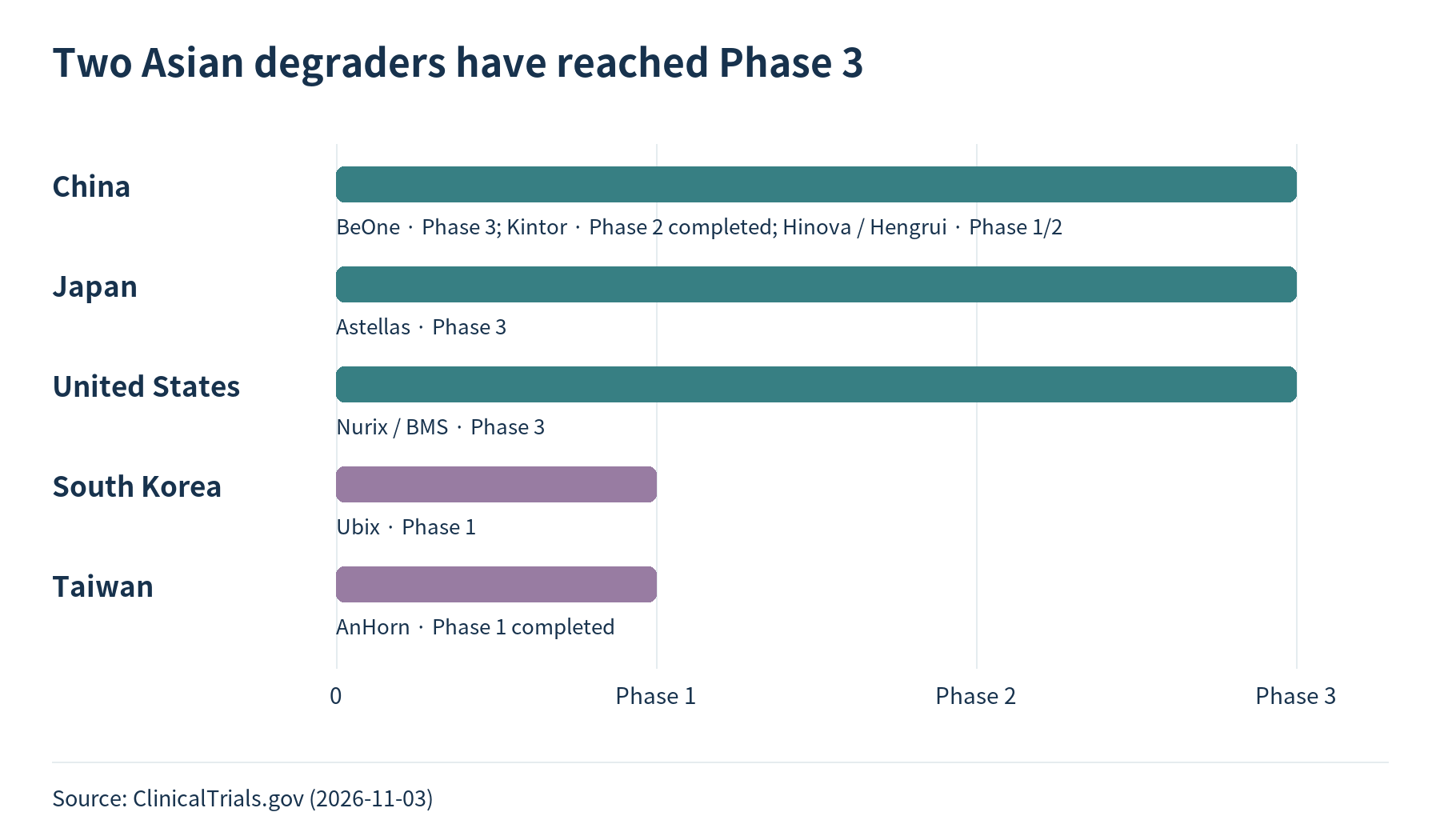
Astellas has a KRAS G12D degrader in a pancreatic cancer Phase 3, and BeOne's degrader is also in a Phase 3 race against Nurix.
The first leg is done. The second leg is being run in Asia.
01 | Degraders don't block a protein, they throw it away
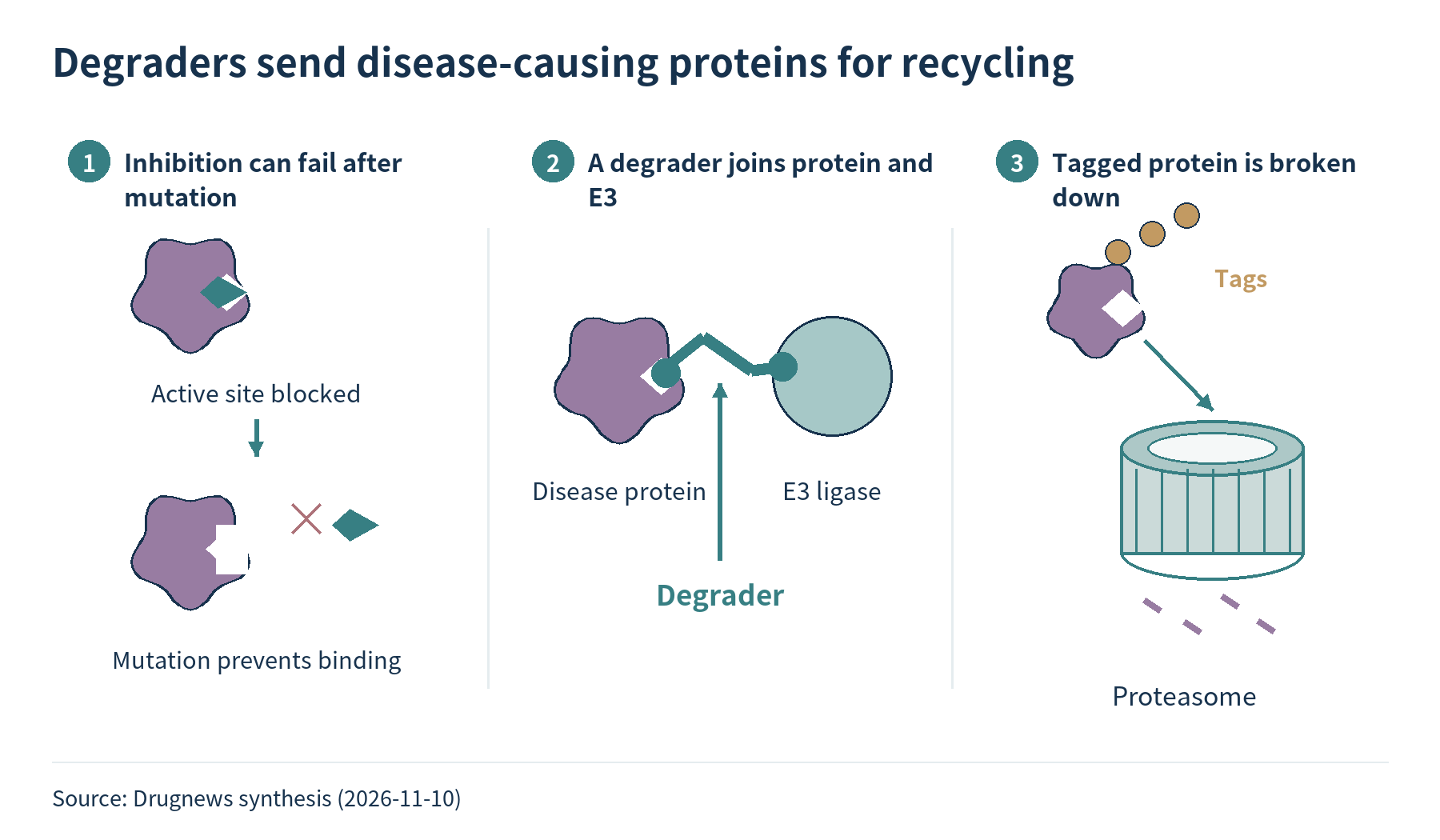
A conventional targeted drug works like a key jammed into a lock: it blocks the disease protein's active site.
The protein stays, and once a mutation changes the lock, the drug stops working.
A degrader grabs the disease protein with one end and an E3 ligase, the cell's recycling tag, with the other.
The protein is marked for disposal and destroyed by the proteasome.
Because the whole protein disappears, resistance mutations go with it.
That is the core case for degraders: treating patients whose targeted drugs have stopped working.
Source: Drugnews synthesis (2026-11-10)
02 | Lesson from the first approval: degradation alone doesn't make a blockbuster
In VERITAC-2, Veppanu beat fulvestrant in ESR1-mutant breast cancer: median progression-free survival of 5.0 versus 2.1 months and a response rate of 19% versus 4%.
But the label covers only ESR1-mutant patients after at least one line of endocrine therapy, a narrow market where oral SERDs already compete.
Whether a degrader becomes a big drug depends on the target and the patients, not on how new the technology is.
Arvinas handed the rights to Rigel and is redirecting resources to BCL6, HPK1 and LRRK2.
Its BCL6 degrader ARV-393 will present first monotherapy data at ASH on December 12–15.
03 | Asia's two Phase 3 bets both target places where inhibitors fail
BeOne tacabrutideg: the next line after BTK inhibitors. The Phase 3 enrolls chronic lymphocytic leukemia patients previously exposed to both BTK and BCL2 inhibitors, about 250 patients, against investigator's choice.
On November 5 BeOne added another piece: the pivotal Phase 2 portion of CaDAnCe-101 met its primary endpoint of overall response rate.
Six tacabrutideg abstracts were accepted for the ASH meeting in December.
This is home turf for degraders.
Long-term BTK inhibitor use breeds resistance mutations; a degrader removes the whole BTK protein regardless of mutation.
Nurix's bexobrutideg is in Phase 3 on the same target, so whichever reads out first will define the new class.
Nurix said on November 5 it will present updated Phase 1 bexobrutideg data at ASH on December 13.
Astellas setidegrasib: KRAS G12D, with no approved targeted drug. KRAS mutations drive most pancreatic cancers and G12D is the most common, yet no G12D-targeted drug is approved. Astellas is testing setidegrasib with mFOLFIRINOX or NALIRIFOX against placebo in about 614 patients, enrolling since February 17, 2026.
Source: ClinicalTrials.gov (2026-11-03)
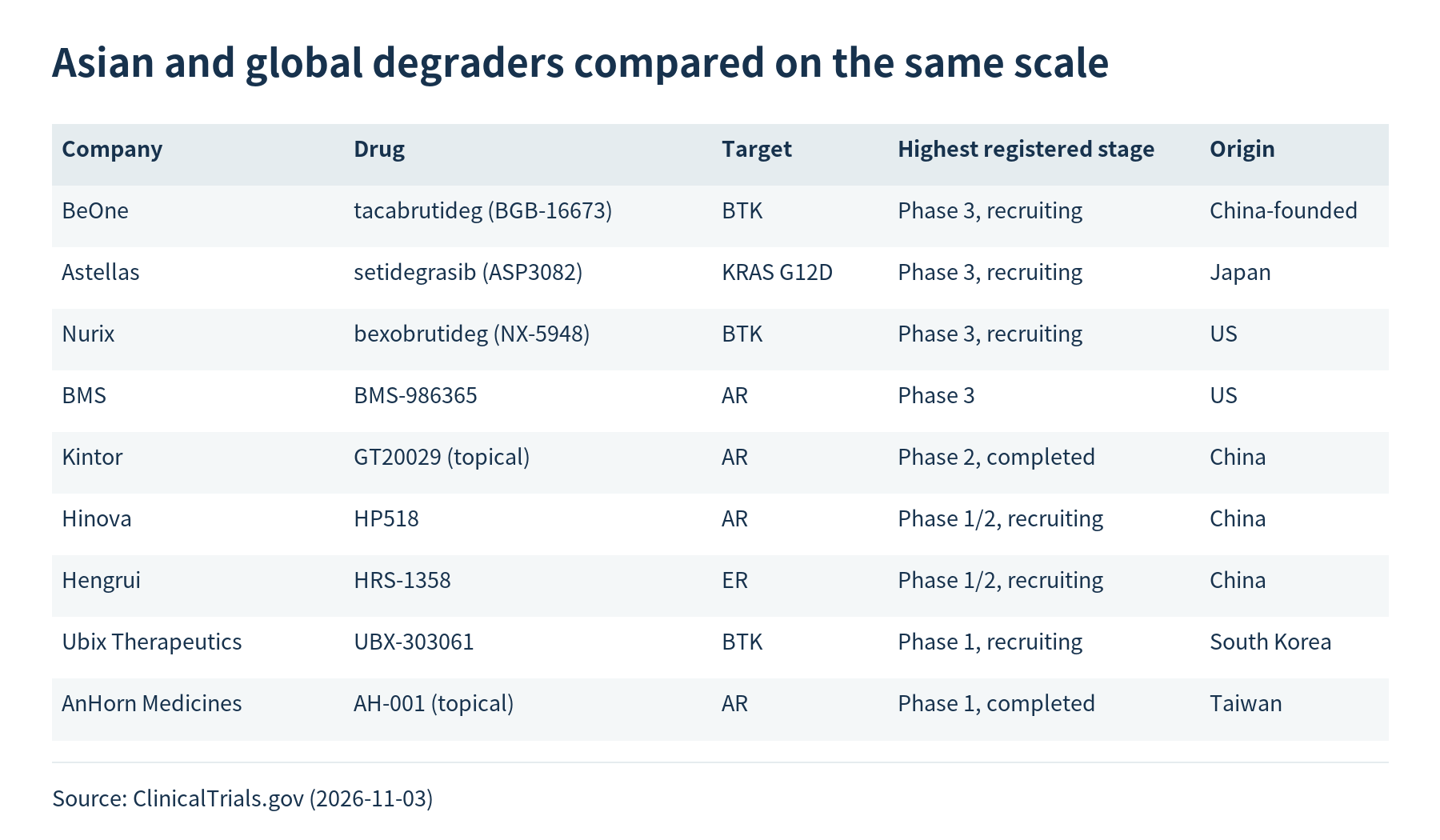
| Company | Drug | Target | Highest registered stage | Origin |
|---|---|---|---|---|
| BeOne | tacabrutideg (BGB-16673) | BTK | Phase 3, recruiting | China-founded |
| Astellas | setidegrasib (ASP3082) | KRAS G12D | Phase 3, recruiting | Japan |
| Nurix | bexobrutideg (NX-5948) | BTK | Phase 3, recruiting | US |
| BMS | BMS-986365 | AR | Phase 3 | US |
| Kintor | GT20029 (topical) | AR | Phase 2, completed | China |
| Hinova | HP518 | AR | Phase 1/2, recruiting | China |
| Hengrui | HRS-1358 | ER | Phase 1/2, recruiting | China |
| Ubix Therapeutics | UBX-303061 | BTK | Phase 1, recruiting | South Korea |
| AnHorn Medicines | AH-001 (topical) | AR | Phase 1, completed | Taiwan |
China has the densest pipeline: Hengrui has both AR and ER degraders, Hinova and Qilu each have an AR degrader, Haisco works on BTK and mutant EGFR, and InnoCare pursues a molecular glue.
South Korea's Ubix joins BeOne and Nurix on BTK. Not every bet works: BeOne's IRAK4 degrader BGB-45035 shows a terminated Phase 2.
Source: ClinicalTrials.gov (2026-11-03)
04 | Taiwan: AnHorn goes topical, away from systemic oncology
AnHorn's AH-001 is an AR degrader applied to the scalp for androgenetic alopecia.
Oral anti-androgens act body-wide; a topical degrader is designed to clear AR in the scalp.
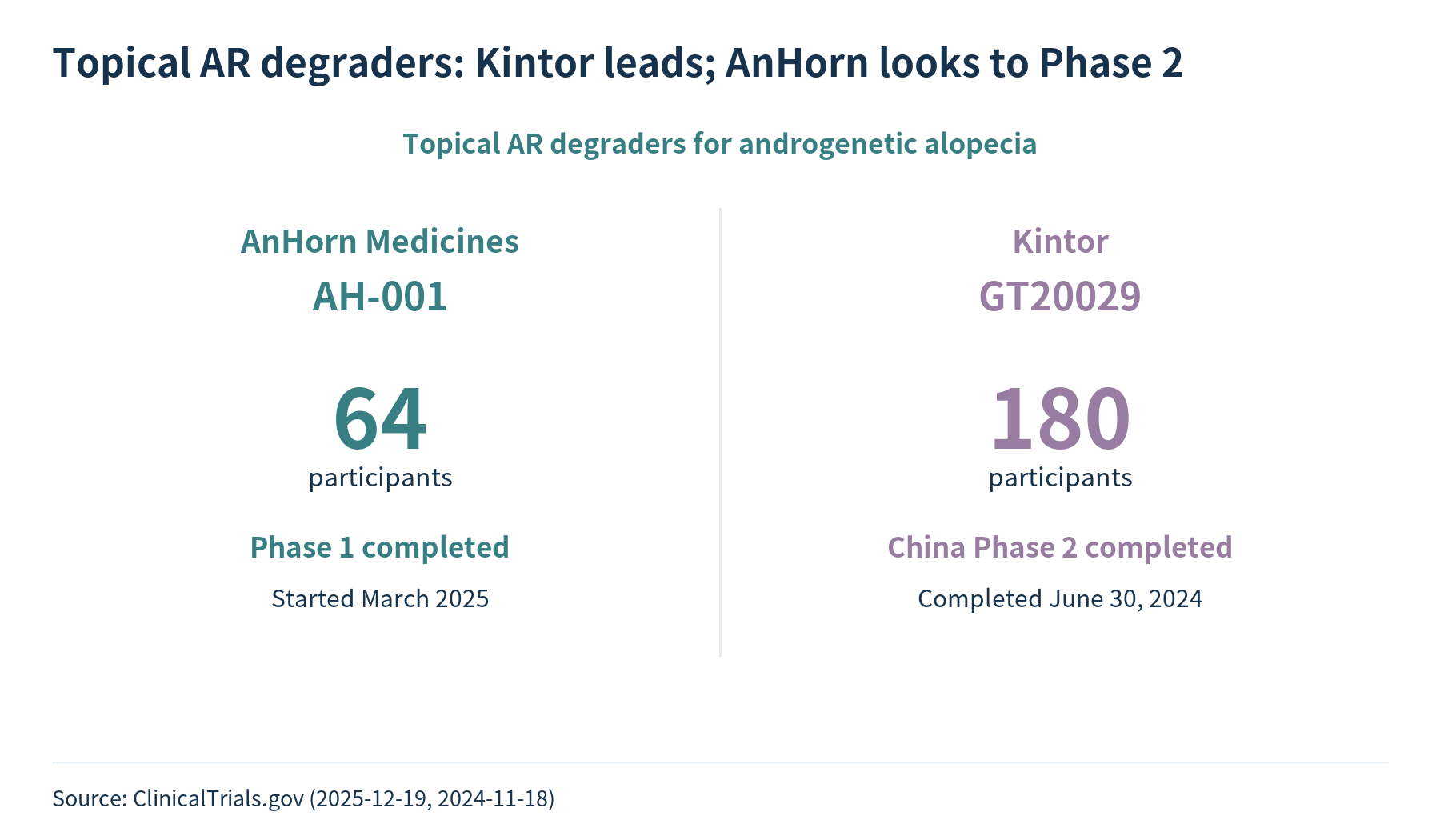
Its Phase 1 began in March 2025, enrolled 64 subjects in single and multiple ascending doses, and is registered as completed.
The closest comparator is Kintor's topical GT20029, whose China Phase 2 in 180 adult men was completed on June 30, 2024.
For Taiwan, the test is whether AnHorn's Phase 2 hair data can beat GT20029. Hair loss is a self-pay, long-term market with a very different economics from a narrow oncology label.
Source: ClinicalTrials.gov (2025-12-19, 2024-11-18)
05 | Three things to watch
The first approval proved degraders can be made into medicines, and that technology alone does not sell.
Three milestones will reshape the field: ARV-393 BCL6 data at ASH in December; BeOne's mid-2027 filing and which BTK Phase 3, BeOne or Nurix, reads out first; and the start and design of AnHorn's AH-001 Phase 2.
If either Asian Phase 3 succeeds, the second approved degrader may well come from Asia.
This article is industry and company analysis and is not investment or medical advice.
References
- FDA approves vepdegestrant for ER-positive, HER2-negative, ESR1-mutated advanced or metastatic breast cancer | U.S. FDA | 2026-05-01 | https://www.fda.gov/drugs/resources-information-approved-drugs/fda-approves-vepdegestrant-er-positive-her2-negative-esr1-mutated-advanced-or-metastatic-breast
- Arvinas Q3 2026 earnings release (Form 8-K) | Arvinas / SEC | 2026-11-03 | https://www.sec.gov/Archives/edgar/data/0001655759/000162828026069101/q32026earningsrelease.htm
- BeOne Medicines Announces Third Quarter 2026 Financial Results and Business Updates | BeOne Medicines | 2026-11-05 | https://www.biospace.com/press-releases/beone-medicines-announces-third-quarter-2026-financial-results-and-business-updates
- Nurix Therapeutics to Present New and Updated Data of Bexobrutideg (NX-5948) at the 68th ASH Annual Meeting | Nurix Therapeutics | 2026-11-05 | https://globenewswire.com/news-release/2026/11/05/3396262/0/en/nurix-therapeutics-to-present-new-and-updated-data-from-ongoing-phase-1a-1b-trial-of-bexobrutideg-nx-5948-in-relapsed-refractory-cll-sll-at-the-68th-ash-annual-meeting-and-expositi.html
- NCT06846671 tacabrutideg in CLL/SLL | ClinicalTrials.gov | 2026-09-28 | https://clinicaltrials.gov/study/NCT06846671
- NCT07409272 setidegrasib in pancreatic cancer | ClinicalTrials.gov | 2026-11-03 | https://clinicaltrials.gov/study/NCT07409272
- NCT06927960 AH-001 topical SAD/MAD | ClinicalTrials.gov | 2025-12-19 | https://clinicaltrials.gov/study/NCT06927960
- NCT06692465 GT20029 in androgenetic alopecia | ClinicalTrials.gov | 2024-11-18 | https://clinicaltrials.gov/study/NCT06692465
- NCT07516093 bexobrutideg Phase 3 | ClinicalTrials.gov | 2026-08-31 | https://clinicaltrials.gov/study/NCT07516093
- NCT06764485 BMS-986365 Phase 3 | ClinicalTrials.gov | 2026-09-30 | https://clinicaltrials.gov/study/NCT06764485
- NCT06155084 HP518 | ClinicalTrials.gov | 2025-12-22 | https://clinicaltrials.gov/study/NCT06155084
- NCT06555068 HRS-1358 | ClinicalTrials.gov | 2026-10-22 | https://clinicaltrials.gov/study/NCT06555068
- NCT06590961 UBX-303061 | ClinicalTrials.gov | 2026-10-21 | https://clinicaltrials.gov/study/NCT06590961
- NCT07100938 BGB-45035 | ClinicalTrials.gov | 2026-05-28 | https://clinicaltrials.gov/study/NCT07100938
Share this analysis
Send this article to readers who follow biotech, company strategy, and capital-market signals.
Cite this article
For decks, research notes, or media references, cite Drugnews with the canonical article URL.
Drugnews Editorial Team. "Asia's Protein Degraders After First PROTAC." Drugnews, Nov 10, 2026. https://drugnews.com.tw/articles/2026-11-10-asia-protein-degraders-landscape-veppanu-beone-astellas-anhorn-en.html