
How AI platforms and the discovery flywheel could open new partnership opportunities for AnHorn
Drugnews | November 3, 2026
Insight
On September 23, 2026, Anthropic released early results from its own life sciences laboratory. Claude agents had identified biological systems worth investigating in large genomic datasets and passed them to scientists for experimental validation. OpenAI had already introduced a research preview of Rosalind Workbench, bringing life sciences models, specialized tools, and experiment planning into a single workspace. Major AI developers are now testing how their models can contribute to experimental science. [1,2]
That same week, Iambic filed for a U.S. initial public offering (IPO) on September 21 and announced a multiyear small-molecule discovery collaboration with AbbVie. The agreement filed with the SEC provides for a $40 million upfront payment from AbbVie. Together, the announcements show both a broader supply of research tools and pharmaceutical companies contracting for external drug discovery work. [3,4,5]
These developments point to a semiconductor-like transition in AI drug discovery. Rapid gains in early research are exposing constraints further along the development process. As research hypotheses and molecular designs become more plentiful, synthesis, experimental validation, data interpretation, and optimization for development increasingly determine which ideas can advance. Funded research programs create an opening for teams that can produce reliable data, overcome development obstacles, and retain rights to the resulting assets or technology. AnHorn's opportunity sits within this changing division of labor.
01 Major AI Companies Broaden the Research Agenda
Anthropic's work illustrates the gap between searching at scale and deciding what to test. According to the company, roughly 950 Claude agents spent 21 hours searching and analyzing data in the effort that identified the enzyme system now known as ART. The agents narrowed about 3,500 candidate systems to 20, prepared detailed reports, and passed them to scientists for selection. Human scientists performed the laboratory experiments, and ART's primary biological function remains under investigation. [1]
Researchers can explore more directions in parallel and choose where to commit reagents, equipment, and staff. The practical value of that computing power depends on what the experiments can resolve and whether the results inform the next decision.
Rosalind Workbench brings research questions, tools, and evidence into one workflow. OpenAI's announcement demonstrated structural analysis, molecular docking, and planning and cost estimates for protein-binding tests. Research agents can consolidate tool outputs and suggest what to do next, while scientists decide how to validate the results. Smaller specialist teams could therefore access computational capabilities across a broader range of disciplines. [2]
This changes who can access early discovery capabilities. More teams can pursue questions that previously required expensive or fragmented tools. If those projects secure research budgets, they can generate paid demand for molecule preparation, dependable assays, and development expertise. For specialist providers, the meaningful signals are new funded programs, repeat orders, and experimental results that improve the next design decision.
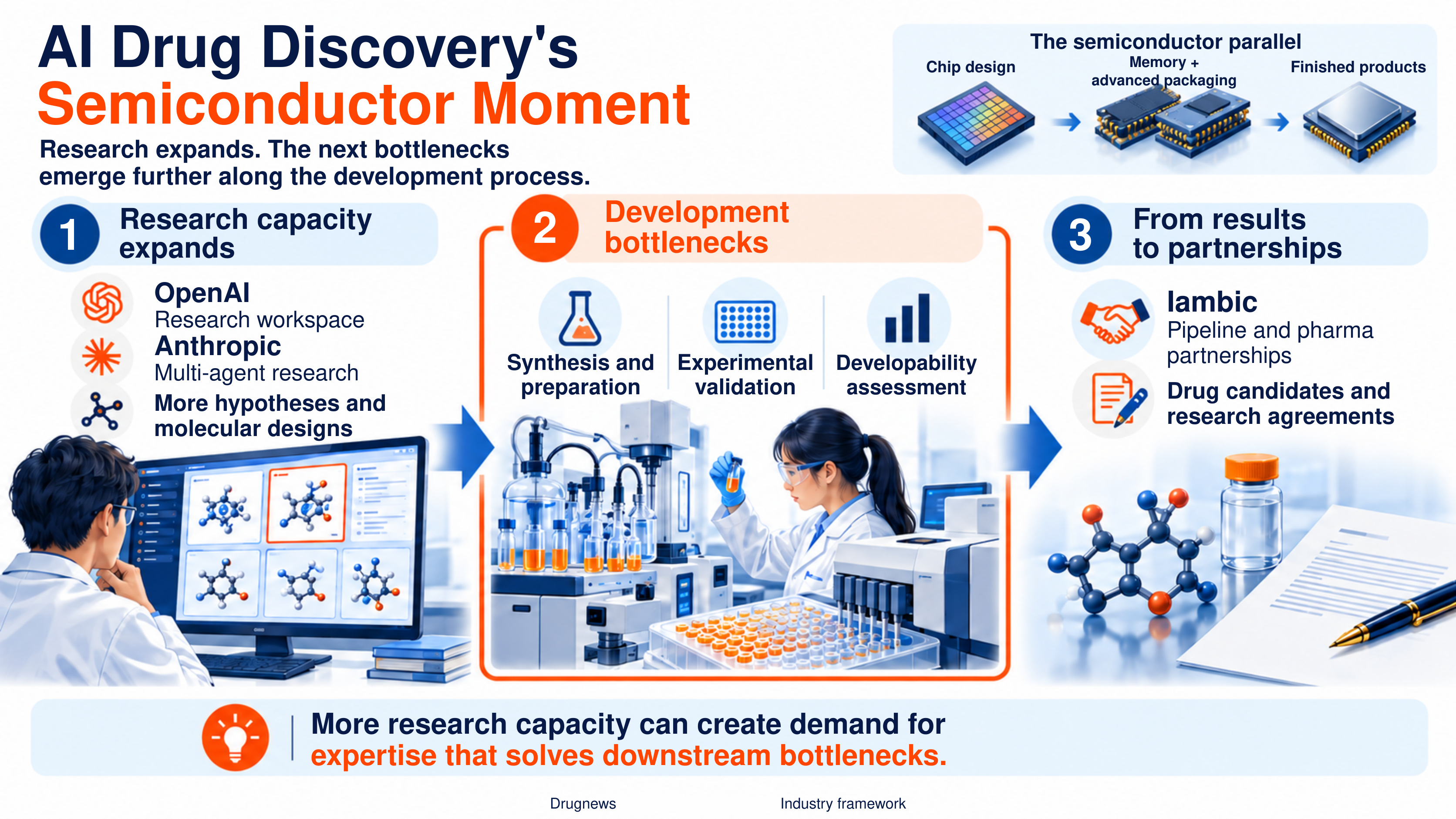
Research tools, experimental validation, and discovery partnerships play distinct roles. The companies shown are pursuing separate initiatives and collaborations. [1,2,4,5]
02 How the Discovery Flywheel Starts to Turn
The semiconductor parallel lies in how progress shifts the constraint. Rising demand for AI chips has increased the importance of high-bandwidth memory, advanced packaging, and supporting infrastructure. On its second-quarter 2025 earnings call, TSMC emphasized the need to expand CoWoS advanced packaging capacity to narrow the supply gap. A sophisticated design becomes a deliverable product only when the supporting capabilities are in place. Freda Duan's October 2026 discussion of an AI drug discovery "bottleneck trade" makes a related point: more designs could drive demand for synthesis, production, and testing. [6,7]
Drug discovery adds another requirement. Experimental results must be interpretable, comparable, and traceable if they are to improve the next decision. A molecule may appear inactive because of synthesis quality, poor cell permeability, inadequate exposure in vivo, or a flawed target hypothesis. Well-documented conditions, appropriate controls, and a clear understanding of why an experiment failed can make negative results useful for training models or guiding decisions, provided the necessary data rights are in place.
A positive flywheel begins when models and scientists select promising ideas for testing, generate comparable results through synthesis and biological experiments, and use those results to guide the next round of design. If this cycle consistently produces candidates suitable for development, research collaborations and licensing agreements can bring in the funding needed for more experiments, additional talent, and further product development.
Lilly and NVIDIA Plan a Continuous Learning System
In January 2026, Lilly and NVIDIA announced plans to invest up to $1 billion over five years in a joint innovation lab combining computing, scientific talent, and experimental research. The aim is a continuous learning system that links computational work with laboratory experiments and keeps scientists involved in key decisions. Separately, Lilly's own LillyPod computing system went live in February. Together, the planned lab and operating computing infrastructure are intended to support a cycle in which models propose directions, experiments test them, and the results inform further research. [8,9]
Lilly's TuneLab extends selected modeling capabilities to outside biotech companies. Participants can contribute to model improvement through federated learning while keeping raw data within their own environments. Twist joined in September to provide antibody characterization services, giving users a way to generate experimental data under specified protocols. These arrangements connect computing resources, models, testing services, and drug developers more directly. Greater use of the models could, in turn, create demand for specialist experimental services. [10,11]
Genesis and Incyte Connect Research Progress to an Expanded Commitment
In May 2026, Incyte expanded its collaboration with Genesis to use proprietary experimental data to train the GEMS molecular model and add at least five new targets. The companies linked the expansion to results from their initial programs. Incyte's second-quarter financial filing subsequently confirmed that it had paid $80 million upfront in cash and made a separate $40 million equity investment. The agreement also provides for ongoing research funding. [12,13]
This is a concrete example of the flywheel's commercial logic. Experimental data feeds model development, research progress supports additional target programs, and the expanded collaboration brings in new capital. A partner's decision to broaden its commitment offers a clearer signal of demand for discovery capabilities than a headline milestone ceiling alone.
Insilico and Lilly Move from Software to Drug Assets
Lilly's relationship with Insilico Medicine shows how a partnership can move further into the drug development process. It began with a Pharma.AI software license in 2023, expanded into a research collaboration in 2025, and progressed to a new agreement announced in March 2026. That deal grants Lilly exclusive worldwide development, manufacturing, and commercialization rights to preclinical oral drug candidates, alongside research on multiple targets selected by Lilly. The agreement calls for a $115 million upfront payment and approximately $2.75 billion in potential total payments, including milestones, plus royalties. [14,15]
Insilico's 2026 interim report provides a broader view of the company's output, reporting 33 cumulative preclinical candidate (PCC) nominations. Its oral GIPR antagonist ISM0676 took 14 months from project initiation to PCC nomination, with fewer than 200 molecules synthesized and tested. The company recognized $103.1 million in revenue from drug discovery and pipeline development in the first half of 2026. These figures provide separate measures of candidate output and commercial revenue. Time to PCC reflects early discovery efficiency; the clinical and product value of those candidates will depend on human safety and efficacy data. [16]
The three partnerships support different parts of the flywheel. Lilly and NVIDIA are committing to infrastructure and long-term research capacity. Genesis and Incyte have expanded their collaboration and disclosed payments. Insilico and Lilly have brought drug assets and research programs into a licensing agreement. Each partnership has its own terms governing data use and the returns to each party.
A smaller experiment offers a more direct test of the learning cycle. In work reported by OpenAI and Ginkgo, GPT-5 used results from six rounds covering more than 36,000 reaction formulations to plan subsequent tests. Under the study's specific conditions for cell-free production of sfGFP, the approach reduced production costs by 40% relative to the best existing benchmark used in the study. It illustrates how experimental feedback can improve a defined task. The larger partnerships seek to expand the resources and applications available for such cycles. [17]
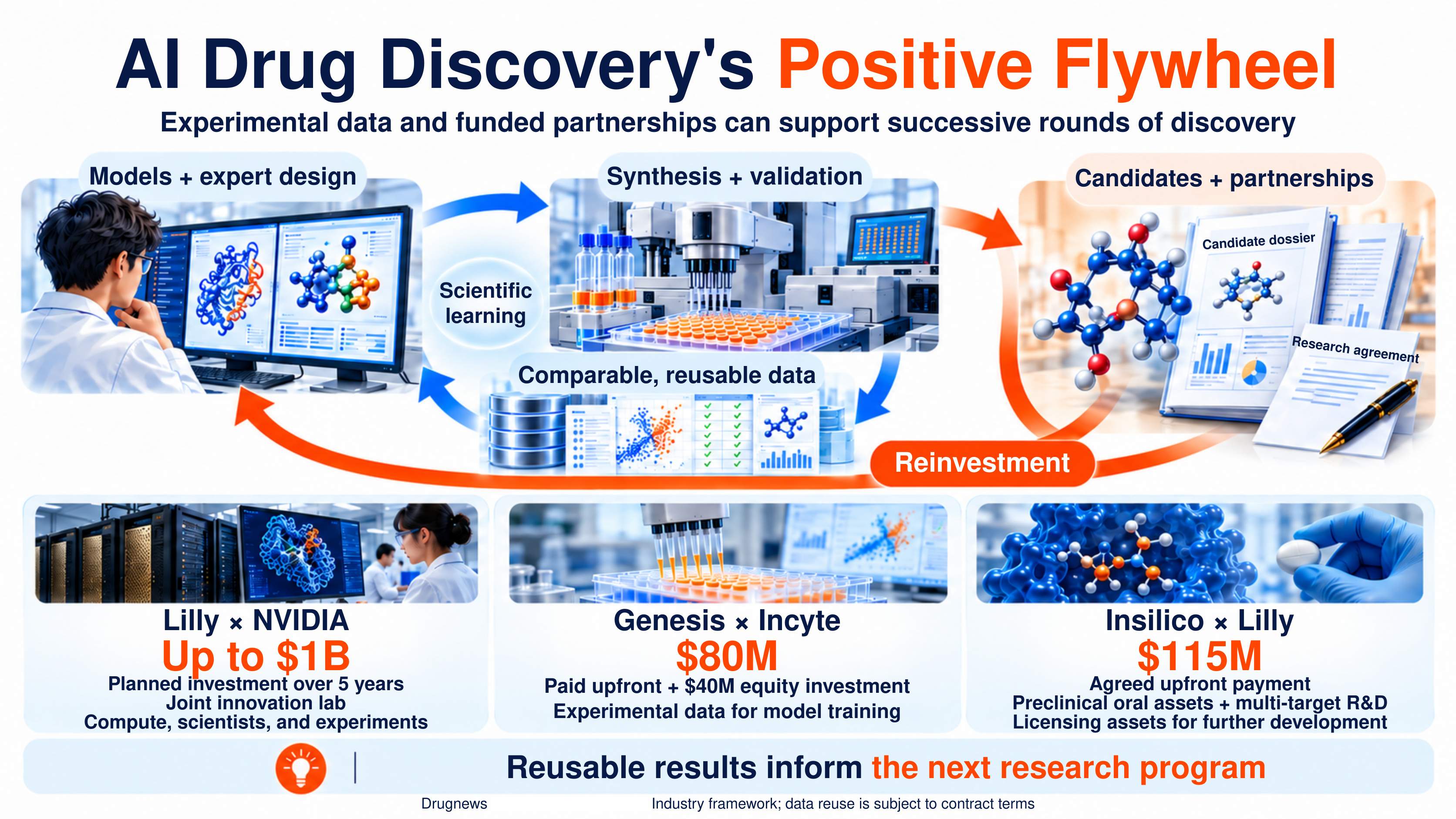
Lilly and NVIDIA announced a five-year investment plan. Incyte's financial filing confirms that the Genesis cash upfront payment and equity investment have been paid. The Insilico and Lilly upfront payment is a contractual commitment. The figure summarizes the distinct research investments and collaboration structures. [8,12,13,14]
03 Iambic Shows How AI Drug Discovery Becomes a Business
After filing for an IPO in September, Iambic began trading on Nasdaq on October 15 and completed the offering on October 16. Its filings lay out the financials and contracts behind its business model. The company develops its own drug candidates, retaining rights to their future development, while working with pharmaceutical partners under agreements covering specific research capabilities, target programs, and model access. The disclosures make it possible to assess both its pipeline and the additional programs those capabilities might support. [18,39,40]
In its amended S-1 filing dated October 8, Iambic reported $12.753 million in collaboration revenue for the first half of 2026, compared with $3.928 million a year earlier. That revenue came from its partnerships with Lundbeck, Revolution Medicines, and Takeda. These research and technology collaborations show how R&D capabilities can generate reported revenue before product sales begin. [18]
The Takeda collaboration shows how model access and research deliverables can sit within the same agreement. It covers access to NeuralPLexer as well as small-molecule discovery using AI design and automated wet-lab experiments. The October 8 filing disclosed that Takeda had paid $27 million upfront. The agreement also includes research, technology, and target-related payments, with success-based payments that could exceed $1.7 billion. The September agreement with AbbVie provides for a $40 million upfront payment and covers small-molecule research in immunology, neuroscience, and oncology, with options for subsequent licenses. [4,5,18,19,20]
How much a partnership contributes to future work also depends on the contract. The Iambic–Takeda agreement places different conditions on the use of particular models, research results, and Takeda's data. Research experience that carries forward, data that can be reused under the agreement, and retained drug rights all affect the starting point for the next program. Whether Iambic can turn an initial collaboration into a lasting business will depend on what it delivers next. [20]
04 Drugmakers Buy Discovery Capabilities as AI Biotechs Buy Enabling Technologies
Large drugmakers can invest in internal capabilities while sourcing innovation externally. As shared research tools broaden the scope of discovery, individual molecules still require synthesis, biological validation, tissue-exposure studies, and work to establish manufacturability. A deal's deliverables and allocation of development responsibilities show what the buyer is paying for.
Under the Iktos–Servier collaboration announced in January 2026, Iktos handles AI design, robotic synthesis, and optimization. Servier evaluates the compounds with its proprietary biological assays, then advances selected programs through preclinical and clinical development. The potential deal value could exceed €1 billion, including upfront payments, research funding, and milestones. The agreement formalizes the handoff from design and synthesis to validation by the drugmaker. [21]
Relation's collaboration with GSK addresses a different constraint: data on disease biology. Expanded in July 2026, the partnership plans to use automated experiments to generate multiomics data from human cells following genetic or pharmacological perturbations. Those data are intended to train, validate, and improve models supporting target research. The agreement provides for up to $110 million in upfront and success-based milestone payments. Reproducibly generated data relevant to human biology have become a deliverable in their own right. [22]
Earendil's deal with WuXi XDC shows demand from the AI biotech side. In February 2026, Earendil obtained an exclusive worldwide license to WuXiTecan-2 payload-linker technology for multiple specified targets, for use with antibodies and bispecific antibodies discovered through its AI platform. WuXi XDC also provides chemistry, manufacturing, and controls (CMC) and manufacturing support. Upfront and potential milestone payments total up to approximately $885 million, payable to WuXi XDC. [23]
The arrangement illustrates a division of labor similar to that in semiconductors. An AI biotech combines its antibody designs with external payload-linker technology and CMC support to advance antibody-drug conjugates (ADCs). Drug designers and specialist suppliers bring different technologies, assets, and rights to these transactions. Following that division of work through product development helps readers identify where customers are paying for specialized capabilities.
Table 1 Representative Partnerships and Payment Structures Across AI Drug Discovery
Partnership | Capabilities or assets obtained | Payment structure and commercial significance |
|---|---|---|
Lilly / NVIDIA | Joint innovation lab combining compute, talent, and experimental work. LillyPod is operational. | Planned investment of up to $1 billion over five years. Infrastructure to connect computational and laboratory research. [8,9] |
Insilico Medicine / Lilly | Global exclusive rights to preclinical oral drug assets, plus R&D across multiple targets. | Agreed $115 million upfront; total potential value of approximately $2.75 billion, including milestones. A transaction for drug candidates and discovery capabilities. [14] |
Genesis / Incyte | Training molecular models on proprietary experimental data, with at least five additional targets. | Incyte has paid $80 million cash upfront and made a $40 million equity investment. An expanded collaboration that directs resources back into research. [12,13] |
Iambic / Takeda | Model access and small-molecule discovery using AI design and automated wet-lab experiments. | Takeda has paid $27 million upfront. Success-based payments could exceed $1.7 billion. Both tool access and research deliverables can form the basis of commercial agreements. [18,19,20] |
Iktos / Servier | AI design, robotic synthesis, and optimization, followed by the drugmaker's proprietary biological assays. | Potential value could exceed €1 billion, including upfront payments, research funding, and milestones. Illustrates demand for experimental work after design. [21] |
Relation / GSK | Human-cell perturbation data for model training and validation. | Up to $110 million in upfront and success-based milestone payments. Paid demand for high-quality biological data. [22] |
Earendil / WuXi XDC | Earendil gains ADC payload-linker technology, along with CMC and manufacturing support. | Up to approximately $885 million in upfront and potential milestone payments, payable to WuXi XDC. An AI biotech buying specialized drug-development technology. [23] |
The figures in the table cover different categories, including investment plans, agreed upfront payments, payments already made, and contingent milestones. Each should be read in its own context. Across these deals, companies are committing capital to usable data, experimental deliverables, drug candidates, and specialist technologies. The agreements demonstrate commercial adoption. Evidence of safety and efficacy in humans, as well as product revenue, will depend on subsequent development and commercialization.
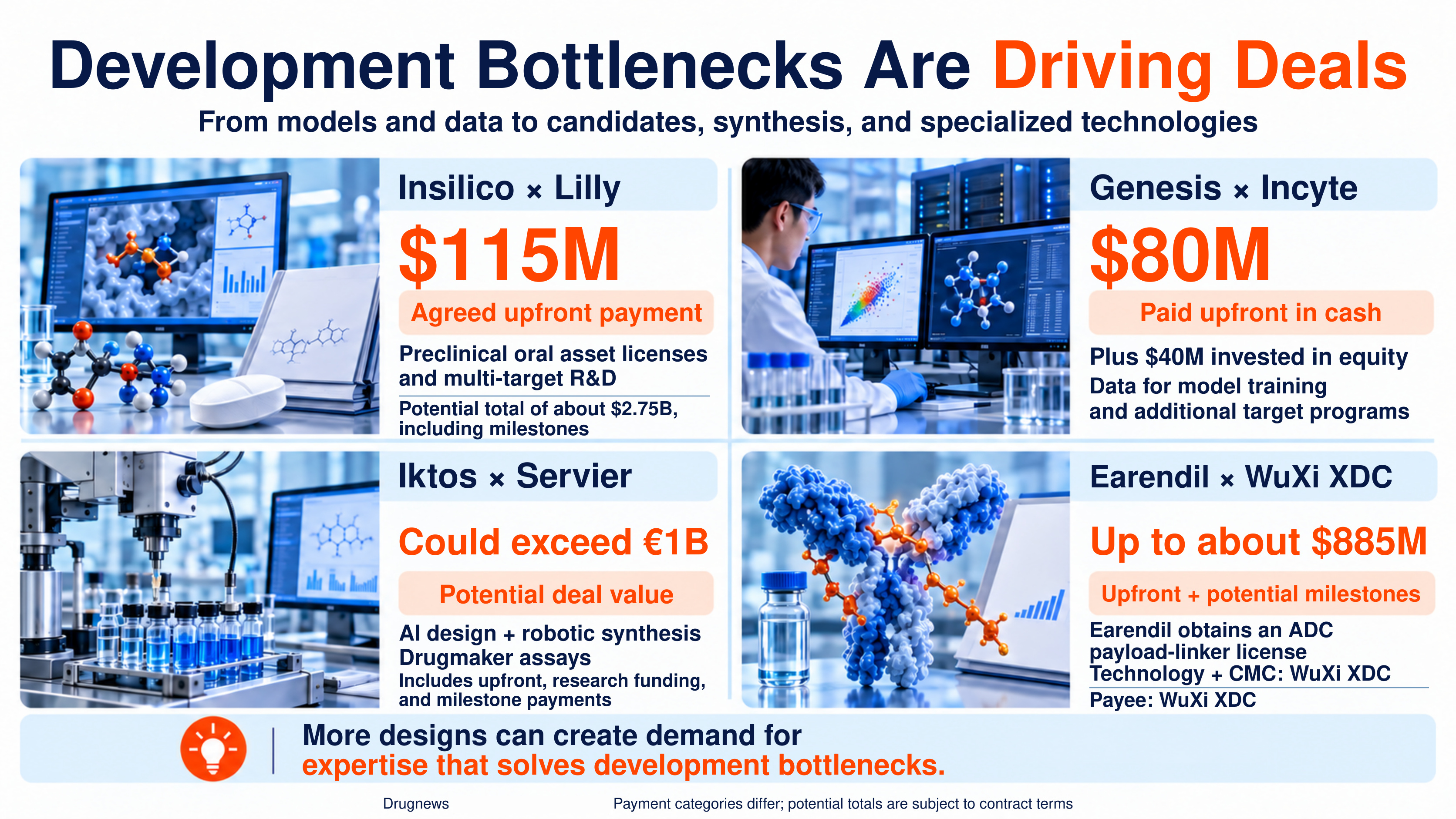
The four examples cover assets, model training data, experimental work, and enabling technologies. Their financial terms cover different categories of payments. Earendil is the technology buyer, while WuXi XDC licenses the technology and provides support. The potential total of up to approximately $885 million comprises the upfront license payment and potential milestones. [12,13,14,21,23]
05 The AnHorn Opportunity in Drug Design and Clinical Development
Developing AH-001 as a Topical Protein Degrader
The value of a protein degrader candidate depends on whether a computational design can be synthesized and validated pharmacologically, with the required intracellular activity and an appropriate exposure profile. For potential partners, the resulting molecules and data form the basis of an asset they can advance into further development. [24,25]
Industry collaborations reflect the same focus. In September 2026, Elix and Axcelead announced a collaboration to develop AI models for targeted protein degradation, combining molecular structures, experimental data, and drug discovery expertise. The goal is to feed validation results into the next design cycle. AnHorn's published AIMLinker research on linker generation and PROTAC design provides a public record of its computational methods. Pipeline progress will help establish whether those methods can consistently produce candidates suitable for further development. [24,25,26]
AH-001 provides more concrete evidence of progress toward a drug product. In a poster presented at ISID 2023, AnHorn reported an androgen receptor (AR) degradation DC50 of 16.4 nM in LNCaP cells. Topical dosing reversed DHT-induced suppression of hair regrowth in a mouse model. Blood concentrations measured on days 7, 14, and 19 of repeated dosing were all below 1 ng/mL. These preclinical findings address target degradation, topical activity, and systemic exposure. [27]
For a topical treatment for androgenetic alopecia, the molecule must reach its site of action and produce sufficient target degradation, with an acceptable balance of local tolerability and systemic exposure. In October 2025, AnHorn announced that AH-001 had completed its U.S. Phase 1 trial. The company reported favorable safety and tolerability at the doses tested during the observation period, with no drug-related adverse events; the clinical trial registry also lists the study as completed. Subsequent patient efficacy data, longer-term use data, and the dosing regimen will determine how the product differentiates itself. The existing preclinical and Phase 1 records give potential partners a starting point for evaluating further development. [28,41]
Advancing AH-008 from Taiwanese Research to a U.S. Phase 1 Trial
AH-008 (DBPR168) offers a view of AnHorn's ability to advance innovation sourced externally. Developed by Taiwan's National Health Research Institutes and National Cheng Kung University, this neuroprotective small molecule is being developed to prevent chemotherapy-induced peripheral neuropathy (CIPN). The original preclinical work focused on reducing chemotherapy-associated neuroinflammation and immune cell infiltration. The intended product would intervene before nerve damage occurs. If subsequent human studies support a preventive effect, the drug could reduce the need to lower chemotherapy doses or interrupt treatment because of neurotoxicity, linking supportive care to patients' ability to complete their cancer treatment. [29,30,31]
Following completion of the technology transfer in December 2024, AnHorn took on manufacturing process development, regulatory work, and clinical planning. In June 2026, it announced that AH-008 had received U.S. IND clearance. On July 23, the company announced that the first healthy volunteer had been dosed in the U.S. Phase 1 trial. An October 21 review of ClinicalTrials.gov found the study still listed as recruiting, with the record last updated on July 29. The trial evaluates safety, tolerability, and pharmacokinetics, laying the groundwork for subsequent studies in patients with cancer. [29,30,32,33,34,35]
AnHorn says it advanced AH-008 from the preclinical stage to IND clearance in about 12 months. [35]
AH-001 and AH-008 thus document two complementary development paths. AH-001 connects in-house drug design and protein degradation with topical product development. AH-008 follows a different route: licensing a neuroprotective small molecule developed at Taiwan's research institutions and advancing it into a U.S. clinical trial. Together, the programs provide a basis for assessing AnHorn's ability to turn molecules into clinical assets. Whether its AI and protein degradation methods can consistently generate new molecules will require further evidence from the relevant pipeline programs and collaboration outcomes.
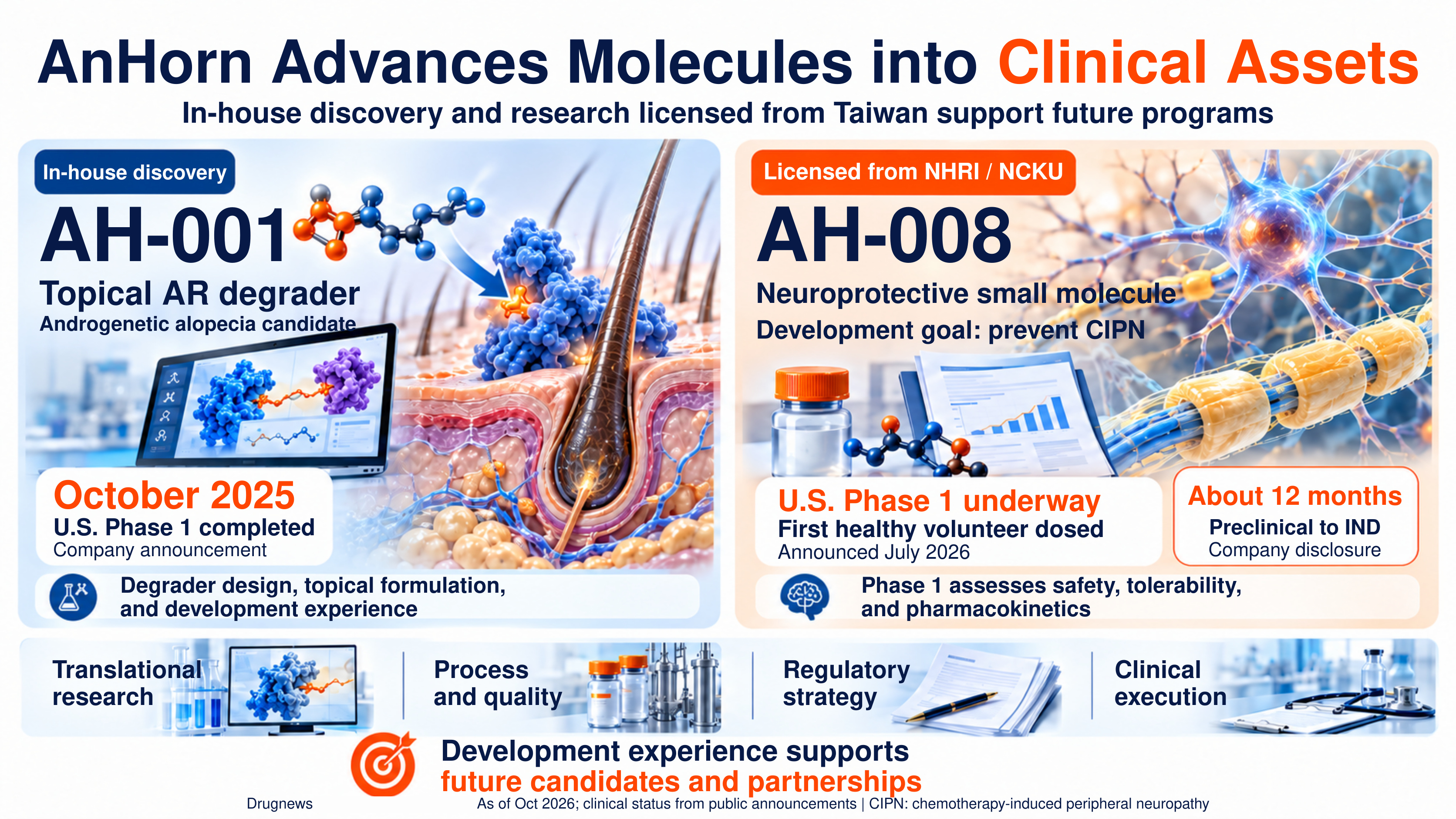
AH-001 is a topical AR degrader candidate; AH-008 is an in-licensed neuroprotective small molecule. The approximately 12-month timeline for AH-008 refers to the company's reported progression from the preclinical stage to IND clearance. In July 2026, AnHorn announced dosing of the first healthy volunteer. Phase 1 focuses on safety, tolerability, and pharmacokinetics. [28,29,30,35]
06 Building the Next Round of Partnerships from Taiwan
These two development paths help define AnHorn's role as a drug developer based in Taiwan. One connects the company to global AI tools: AnHorn joined NVIDIA Inception in 2023 and integrates BioNeMo and proprietary AIMCADD into the drug discovery process for tasks including protein structure prediction, alongside its own drug design capabilities. The other connects it to Taiwan's original research and translational resources. AH-008 illustrates how AnHorn has taken research from the National Health Research Institutes and National Cheng Kung University into international clinical development. [30,32,36]
For potential partners, the value lies in developing viable candidates from target-based research, model-generated designs, or compounds originating in academia. Medicinal chemistry, process development, regulatory work, and clinical execution connect global AI tools with original research from Taiwan. AnHorn now has a development record spanning assets from two different sources. Its ability to deliver consistently will influence whether partners choose to work with the company.
AnHorn describes AIMCADD as a platform that combines generative AI, scientific judgment, and feedback from internal experiments. Computing support and integration are helping AnHorn accelerate protein-degrader molecular simulations and expand its dataset. [37] If that workflow can consistently produce molecules suitable for development, it could support partnerships through both product licensing and research on specified targets. The experience of taking on AH-008 also gives AnHorn a basis for identifying and advancing additional assets from external research. [38]
Table 2 AnHorn Capabilities and Potential Partnership Routes
Partnership route | Starting point | Development value and commercial rights |
|---|---|---|
Product licensing or co-development | AH-001: The company and trial registry report completion of the U.S. Phase 1 study. AH-008: U.S. Phase 1 in healthy volunteers; the registry listed recruiting when checked on October 21, 2026. [28,29,34,41] | Use human, formulation, and manufacturing process data from further development to support product positioning. Define development responsibilities, milestones, and product economics by territory, indication, and each partner's contribution. |
Research collaborations on specified targets | AIMLinker methods, protein degrader design capabilities, and candidate development experience. [24,25,28] | Develop candidates for agreed targets, tissue exposure goals, and dosing requirements. Set terms for new intellectual property, data use, and reuse of existing technology. |
Reusable technology and experience could improve subsequent discovery efforts. Data that can be reused under partnership agreements could support better design decisions, while retained product rights would allow AnHorn to share in the value created through further development. How effectively partnership revenue, accumulated capabilities, and drug assets reinforce one another will determine how much momentum AnHorn's own positive flywheel can build.
Key developments to watch include future patient data for AH-001, Phase 1 safety and pharmacokinetic results for AH-008, and whether AnHorn secures R&D partnerships with clearly defined deliverables. Clinical results will inform development decisions and licensing terms; paid collaborations would provide evidence of external demand for the company's R&D capabilities. This is a concrete path for AnHorn to participate in the "semiconductor moment" for AI drug discovery: using global tools and original research from Taiwan to build assets and research outcomes that buyers are willing to take forward.
References
[1] Claude discovers a novel enzyme system with CRISPR-like repeats
Anthropic | September 23, 2026
[2] Meet Rosalind Workbench: Empowering every scientist to be their own research team
OpenAI | August 28, 2026
[3] Iambic Therapeutics Form S-1
U.S. Securities and Exchange Commission | September 21, 2026
[4] AbbVie and Iambic Announce Collaboration to Accelerate AI-driven Drug Discovery
AbbVie | September 21, 2026
[5] Iambic–AbbVie Collaboration and Option to License Agreement, Exhibit 10.17, Section 7.1
U.S. Securities and Exchange Commission | Effective September 18, 2026; filed September 21, 2026
[6] AI Drug Discovery Is Becoming a Bottleneck Trade
Freda Duan / Robonomics | October 4, 2026
[7] TSMC 2Q25 Earnings Conference Transcript
Taiwan Semiconductor Manufacturing Company | July 17, 2025
[8] NVIDIA and Lilly Announce Co-Innovation AI Lab to Reinvent Drug Discovery in the Age of AI
NVIDIA / Eli Lilly and Company | January 12, 2026
[9] Now Live The World’s Most Powerful AI Factory for Pharmaceutical Discovery and Development
NVIDIA | February 26, 2026
[10] Lilly TuneLab platform and frequently asked questions
Eli Lilly and Company | Information as of September 2026; accessed October 21, 2026
[11] Twist Bioscience Joins Lilly TuneLab to Advance Antibody Drug Discovery
Twist Bioscience | September 16, 2026
[12] Incyte and Genesis Expand Molecular AI Collaboration to Accelerate Drug Discovery
Incyte / Genesis Molecular AI | May 20, 2026
[13] Incyte Form 10-Q, Quarter Ended June 30, 2026 — Genesis Molecular AI Collaboration
Incyte / U.S. Securities and Exchange Commission | Quarter ended June 30, 2026; note on Genesis Molecular AI Collaboration
[14] Insilico Medicine Announces a Global Pipeline Licensing and AI Drug Discovery Collaboration with Lilly
Insilico Medicine / Hong Kong Exchanges and Clearing | March 29, 2026
[15] Insilico and Lilly Enter a Research & Licensing Collaboration to Advance AI-Driven Drug Discovery
Insilico Medicine | November 10, 2025
[16] Interim Report 2026 — Business Review and Financial Statements
Insilico Medicine / Hong Kong Exchanges and Clearing | August 26, 2026
[17] GPT-5 lowers the cost of cell-free protein synthesis
OpenAI | February 5, 2026
[18] Iambic Therapeutics Form S-1/A
U.S. Securities and Exchange Commission | October 8, 2026
[19] Iambic Announces Collaboration with Takeda to Advance AI-Driven Design of Small Molecules
Iambic | February 9, 2026
[20] Iambic–Takeda Research Collaboration and License Agreement, Exhibit 10.12
U.S. Securities and Exchange Commission | Effective February 3, 2026; filed September 21, 2026
[21] Iktos Announces Strategic Collaboration with Servier
Iktos | January 8, 2026
[22] Relation Announces Expanded Collaboration with GSK
Relation Therapeutics | July 30, 2026
[23] WuXi XDC Enters Strategic Collaboration with Earendil Labs on WuXiTecan-2 Payload-Linker Technology Platform
WuXi XDC | February 27, 2026
[24] Fragment Linker Prediction Using the Deep Encoder-Decoder Network for PROTACs Drug Design
Kao et al. / Journal of Chemical Information and Modeling | May 8, 2023
[25] A Novel Rational PROTACs Design and Validation via AI-Driven Drug Design Approach
Chou et al. / ACS Omega | September 6, 2024
[26] Elix and Axcelead Drug Discovery Partners Enter into Collaborative Research Agreement
Axcelead Drug Discovery Partners | September 9, 2026
[27] Novel androgen receptor degrader for Androgenetic alopecia application
AnHorn Medicines / ISID 2023 research poster | 2023
[28] AI-Designed Drug AH-001 Complete U.S. Phase I Trial Demonstrating Excellent Safety and Tolerability
AnHorn Medicines | October 30, 2025
[29] AH-008 Achieves Key Clinical Milestone with Successful First Subject First Dose in Phase I Study
AnHorn Medicines | July 23, 2026
[30] NHRI and NCKU License Neuroprotective Drug Candidate DBPR168 to AnHorn Medicines
National Cheng Kung University | December 17, 2024; Chinese-language announcement
[31] DBPR168 — Prevention of Chemotherapy-Induced Peripheral Neuropathy
National Health Research Institutes, Technology Transfer and Incubation Center | January 10, 2024
[32] NHRI, NCKU, and AnHorn Medicines Advance Neuroprotective Drug Candidate DBPR168/AH-008
National Health Research Institutes | June 23, 2026; Chinese-language announcement
[33] NCKU at BIO 2026 — DBPR168 Clinical Translation
National Cheng Kung University | BIO 2026 coverage; accessed October 21, 2026
[34] Safety, Tolerability, and PK of AH-008 Following Single Ascending Dose in Healthy Subjects
ClinicalTrials.gov / AnHorn Medicines | NCT07697560; last updated July 29, 2026; accessed October 21, 2026
[35] AH-008 Achieves Dual Regulatory Milestones with U.S. FDA IND Clearance and Taiwan CDE Index Case Designation
AnHorn Medicines | June 23, 2026
[36] AnHorn Medicines to Present AI-Driven Drug Discovery in Protein Degradation at NVIDIA AI Summit in Taiwan
AnHorn Medicines | June 3, 2024
[37] CommonWealth interview on donated computing resources for Taiwanese biotech
CommonWealth Magazine | October 30, 2026
[38] Our Technology AIMCADD and Targeted Protein Degradation
AnHorn Medicines | Accessed October 21, 2026
[39] Investor FAQs — Iambic IPO and Nasdaq Trading
Iambic Therapeutics | Accessed October 21, 2026
[40] Iambic Therapeutics Form 8-K — Completion of Initial Public Offering
U.S. Securities and Exchange Commission | October 16, 2026
[41] NCT06927960 — Evaluation of the Safety, Tolerability and Pharmacokinetics of AH-001 Following Topical Single and Multiple Ascending Dose Administration
ClinicalTrials.gov / AnHorn Medicines | NCT06927960; last updated December 19, 2025; accessed October 21, 2026
Share this analysis
Send this article to readers who follow biotech, company strategy, and capital-market signals.
Cite this article
For decks, research notes, or media references, cite Drugnews with the canonical article URL.
Drugnews Editorial Team. "The Semiconductor Moment in AI Drug Discovery." Drugnews, Nov 06, 2026. https://drugnews.com.tw/articles/2026-11-06-anhorn-ai-drug-discovery-semiconductor-moment-en.html