
In the first full quarter of the obesity pill race, Novo Nordisk won by a factor of 4.4.
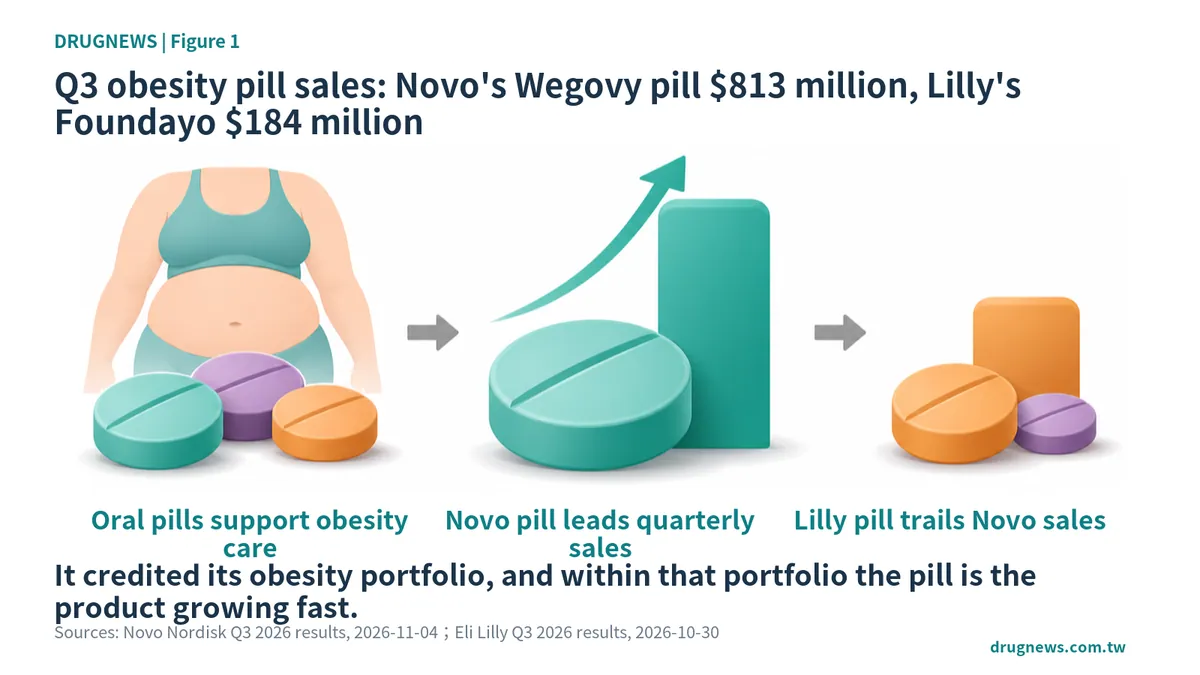
On November 4, Novo reported third-quarter sales of DKK 5.39 billion, about $813 million, for the Wegovy pill.
A week earlier, Eli Lilly had reported $184 million for its rival pill, Foundayo (orforglipron), short of the $217 million analysts expected.
In injections, the scoreboard runs the other way. Lilly grew revenue 39% in the quarter, while Novo's injectable Wegovy and Ozempic both shrank.
**The 4.4x headline overstates the gap. Novo's international pill sales alone matched all of Foundayo. U.S. against U.S., the ratio is 3.4x.
Converted to prescriptions, Lilly holds about 23%, yet it is winning roughly a third of new patients. The difference comes from the three months Novo had the market to itself, and it should shrink with time.**
01 | $813 million against $184 million: the pill is stopping Novo's injection bleed
Wegovy pill sales rose 53% from the second quarter and beat the analyst consensus of DKK 4.62 billion by 17%.
U.S. prescriptions reached about 3.6 million in the quarter and more than 8 million since launch.
Chief executive Mike Doustdar called it the strongest U.S. pharma launch by volume in a decade.
In the same quarter, injectable Wegovy fell 2% to DKK 20.4 billion and Ozempic fell 5% to DKK 29.7 billion, as patients kept moving to Lilly's Zepbound and Mounjaro.
The pill was 6.8% of Novo's quarterly sales, equal to about a quarter of injectable Wegovy.
Novo raised its full-year outlook for the third time, from a 0% to 6% decline to a range of plus or minus 2% (adjusted, at constant exchange rates).
It credited its obesity portfolio, and within that portfolio the pill is the product growing fast.
Sources: (Novo Nordisk Q3 2026 results, 2026-11-04); (Eli Lilly Q3 2026 results, 2026-10-30)
02 | Same receptor, but one pill needs an empty stomach
Both pills act on the GLP-1 receptor, the same target as the weight-loss injections, so people feel full sooner and eat less.
The difference is in the pill itself.
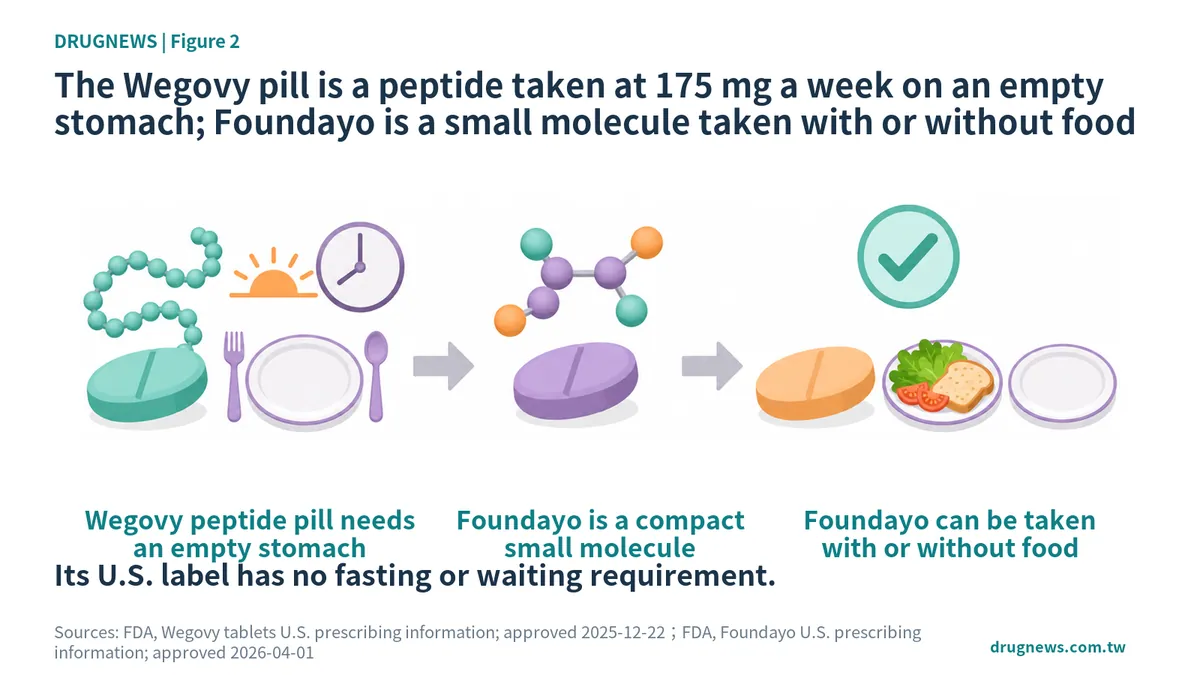
The Wegovy pill contains semaglutide, the same peptide as the Wegovy injection. Peptides break down in the stomach and little gets absorbed.
The doses show it: the top pill dose is 25 mg a day, or 175 mg a week, while the injection is 2.4 mg a week. The pill uses 73 times as much drug.
That is why the Wegovy pill comes with strict rules.
It is taken in the morning on an empty stomach with no more than 4 ounces of water, followed by at least 30 minutes without food, drink or other oral medicines.
Lilly's Foundayo is a small molecule, absorbed like an ordinary tablet. Its U.S. label has no fasting or waiting requirement.
Sources: (FDA, Wegovy tablets U.S. prescribing information; approved 2025-12-22); (FDA, Foundayo U.S. prescribing information; approved 2026-04-01)
Efficacy is a separate question.
In the companies' Phase 3 trials, the 25 mg Wegovy pill produced 13.6% average weight loss over 64 weeks in the 307-person OASIS 4 trial (placebo 2.2%).
Foundayo at its top 17.2 mg dose produced 11.2% over 72 weeks in the 3,127-person ATTAIN-1 trial (placebo 2.1%).
The trials differ in design and were never run head to head. Net of placebo, the figures are 11.4 and 9.1 percentage points.
Prices are close. Starter doses cost $149 a month for U.S. cash-pay patients for both drugs.
The top Wegovy pill dose costs $299; Foundayo's top doses cost $349, or $299 with Lilly's refill program.
One pill takes off about 2 points more and comes with a morning ritual; the other is easier and takes off a little less.
The drugs alone do not explain a 4.4x gap.
03 | Lilly is winning more new patients than its sales suggest
Start by splitting the 4.4x.
Of Novo's pill sales, the U.S. contributed DKK 4.18 billion, about $630 million, and international markets DKK 1.22 billion, about $184 million.
Launched only months ago in the UAE, the UK and Germany, the international business already equals Lilly's entire Foundayo quarter.
Comparing the U.S. alone, and counting all of Lilly's $184 million as U.S. sales, the gap is 3.4x.
Now convert to prescriptions. Novo's U.S. revenue works out to about $175 per prescription ($630 million over 3.6 million).
At the same price, Foundayo filled roughly 1.05 million prescriptions in the quarter, about 23% of the two drugs combined.
New patients tell a different story. In late October, Lilly said Foundayo has taken 40% of new patient starts since launch.
Doustdar countered with a data caveat: IQVIA prescription data capture 90% to 95% of Lilly's scripts but only 65% of Novo's, because telehealth platforms such as Hims & Hers and Ro do not report to it.
Adjusting with his own coverage figures puts Lilly's share of new patients at about 32%.
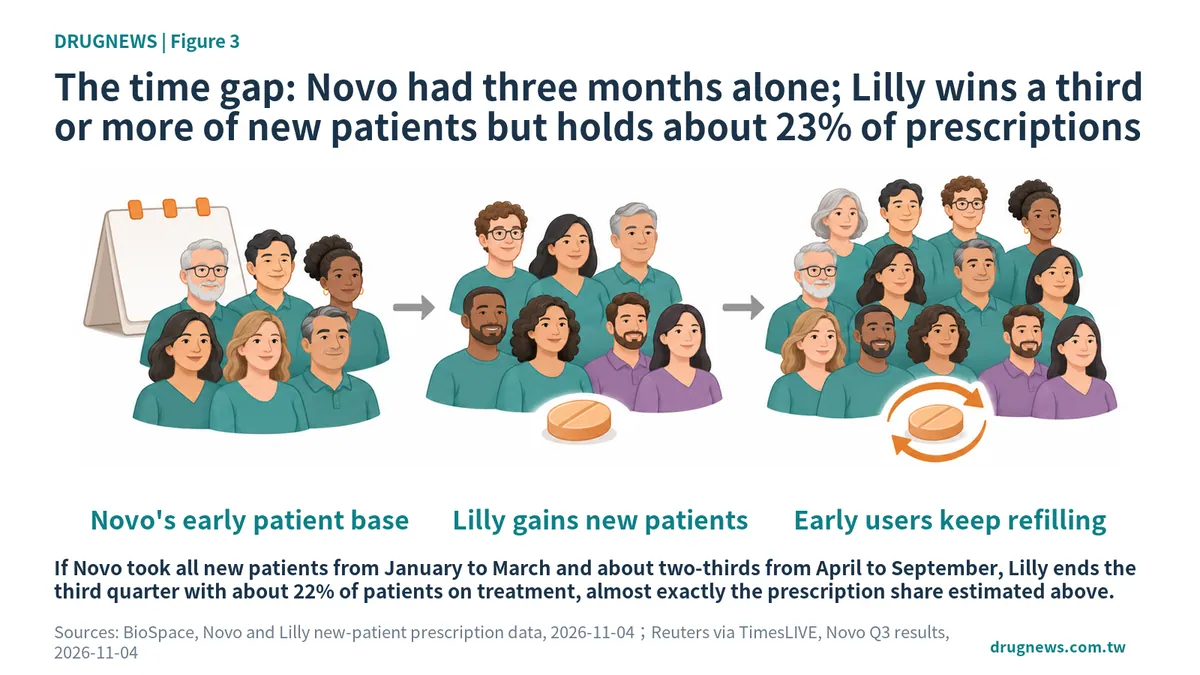
Whether the number is 40% or 32%, Lilly's share of new patients exceeds its 23% share of total prescriptions. The gap is timing.
The Wegovy pill launched in the U.S. in January; Foundayo was approved on April 1.
For three months Novo had no competitor, and the patients who started then still refill every month on Novo's books.
A simple model makes the point. Assume the same number of new patients each month and the same dropout rate for both drugs.
If Novo took all new patients from January to March and about two-thirds from April to September, Lilly ends the third quarter with about 22% of patients on treatment, almost exactly the prescription share estimated above.
Sources: (BioSpace, Novo and Lilly new-patient prescription data, 2026-11-04); (Reuters via TimesLIVE, Novo Q3 results, 2026-11-04)
04 | The counterargument: Novo's lead is more than an early start
Novo sees it differently. Doustdar says 80% of Wegovy pill users are new to obesity medication, evidence that the pill is opening a new market.
Cash-paying telehealth patients, greater weight loss and the Wegovy brand are advantages Lilly cannot match quickly.
Those advantages are real, and they show up in new-patient share.
Using Novo's own coverage adjustment, Novo takes about two-thirds of new patients, roughly twice Lilly's.
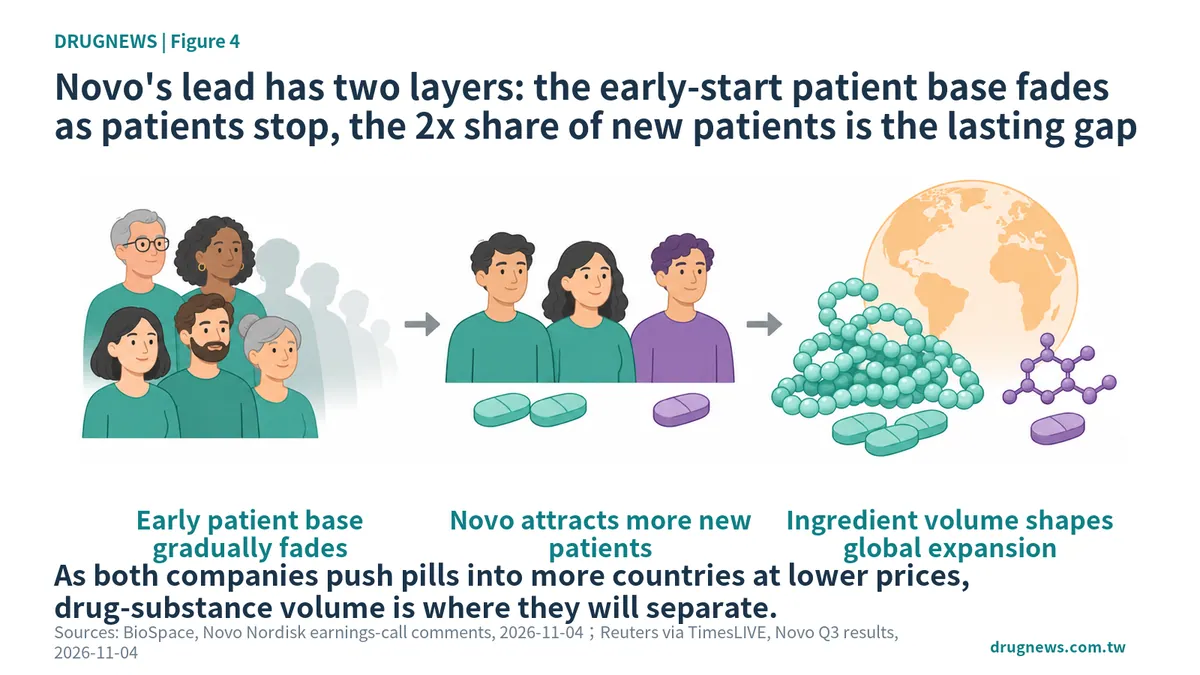
So Novo's lead has two layers. The first is the patient base built during three months of exclusivity, which fades as those patients stop treatment.
The second is the roughly 2-to-1 lead in new patients, which is the lasting gap.
The 4.4x figure adds both layers together and looks bigger than either.
Lilly holds a long-term card too. The Wegovy pill needs 175 mg of peptide a week against 2.4 mg for the injection.
With a 73-fold difference in drug volume, manufacturing costs are unlikely to match those of a small-molecule tablet.
As both companies push pills into more countries at lower prices, drug-substance volume is where they will separate.
Sources: (BioSpace, Novo Nordisk earnings-call comments, 2026-11-04); (Reuters via TimesLIVE, Novo Q3 results, 2026-11-04)
05 | By mid-2027, watch whether Lilly reaches 30%
On this arithmetic, if Lilly keeps a third or more of new patients, Foundayo's share of combined pill revenue should climb from 18.5% in the third quarter toward 30% as Novo's early cohort drops off.
If Foundayo's share is still below 25% in the second quarter of 2027, Novo's advantage runs deeper than timing: telehealth channels and the brand are locking in new patients too, and Lilly would need price cuts or new indications to catch up.
For people weighing a switch from injections to a pill, the trade-off is already clear.
The Wegovy pill takes off about 2 points more at the cost of an empty-stomach morning and a 30-minute wait; Foundayo drops the rules and some of the weight loss.
Much of the 4.4x lead in the first pill quarter was bought with time.
This article is industry and company analysis and does not constitute investment or medical advice.
References
- Novo Nordisk lifts 2026 outlook as Wegovy pill surges | Reuters (via TimesLIVE) | 2026-11-04 | https://www.timeslive.co.za/news/world/2026-11-04-novo-nordisk-lifts-2026-outlook-as-wegovy-pill-surges/
- Oral Wegovy bolsters Novo in Q3 | pharmaphorum | 2026-11-04 | https://pharmaphorum.com/news/oral-wegovy-bolsters-novo-q3
- Novo, Lilly battle for oral GLP-1 dominance with data tit for tat | BioSpace | 2026-11-04 | https://www.biospace.com/business/novo-lilly-battle-for-oral-glp-1-dominance-with-data-tit-for-tat
- Eli Lilly lifts revenue outlook as weight-loss shots offset Foundayo sales miss, shares jump | Reuters (via Devdiscourse) | 2026-10-29 | https://www.devdiscourse.com/article/international/3999015-eli-lilly-lifts-revenue-outlook-as-weight-loss-shots-offset-foundayo-sales-miss-shares-jump
- Novo Nordisk reports adjusted operating profit of DKK 33,389 million for Q2 2026 and raises full-year outlook | Novo Nordisk | 2026-08-04 | https://www.biospace.com/press-releases/novo-nordisk-reports-adjusted-operating-profit-of-dkk-33-389-million-for-q2-2026-and-raises-full-year-outlook
- FDA approves Lilly obesity pill, triggering battle with Novo Nordisk | BioPharma Dive | 2026-04-01 | https://www.biopharmadive.com/news/fda-approves-lilly-obesity-pill-orforglipron-foundayo-novo/816359/
- Novo Nordisk’s oral semaglutide 25 mg delivered 16.6% weight loss in a newly published study · Novo Nordisk (via BioSpace) · 2025-09-17 · https://www.biospace.com/press-releases/novo-nordisks-oral-semaglutide-25-mg-wegovy-in-a-pill-delivered-16-6-weight-loss-in-people-with-obesity-in-a-newly-published-study
- What effect did Foundayo (orforglipron) have on body weight in Phase 3 studies? · Lilly Medical · 2026-11-05 · https://medical.lilly.com/us/products/answers/what-effect-did-foundayo-orforglipron-have-on-body-weight-in-phase-3-studies-for-weight-management-366872
- Foundayo vs Wegovy Pill: Cost Without Insurance (citing both U.S. labels) | Mira | 2026-08-04 | https://www.talktomira.com/post/foundayo-vs-wegovy-pill-cost-without-insurance
- FDA Approves New Drug Treatment for Chronic Weight Management, First Since 2014 | U.S. FDA | 2021-06-04 | https://www.fda.gov/news-events/press-announcements/fda-approves-new-drug-treatment-chronic-weight-management-first-2014
Share this analysis
Send this article to readers who follow biotech, company strategy, and capital-market signals.
Cite this article
For decks, research notes, or media references, cite Drugnews with the canonical article URL.
Drugnews Editorial Team. "Novo Pill Leads Lilly 4x, Lilly Takes 1/3 of Starts." Drugnews, Nov 10, 2026. https://drugnews.com.tw/articles/2026-11-10-novo-wegovy-pill-lilly-foundayo-oral-obesity-race-en.html