
Akeso's ivonescimab beat Keytruda, then ran into a barrier at the FDA. The reason was simple: it had not shown that patients lived longer.
That puts the question straight to the challengers. Pfizer, BMS and Merck have all signed major deals for drugs in this class. Can their trials answer the FDA's question?
Of the three challengers, Pfizer is the one putting survival into the main test. Its phase 3 trial makes overall survival (OS) and progression-free survival (PFS) co-primary endpoints; BioNTech and BMS's corresponding study makes PFS primary and OS secondary, while Merck remains in phase 2. The FDA's rejection letter has effectively told the field which design comes closer to the answer it wants.
A well-chosen design does not guarantee a win. But choose the wrong test, and even a win may not count. The November 17 article, Akeso's Bispecific Rejected in the US: The FDA Wants Survival Evidence, examined Akeso; the focus now turns to the challengers.[1]
01 · Pfizer puts the hardest question into the main test
Pfizer and 3SBio's tivunatamig (SSGJ-707) already has a phase 3 design that directly challenges established first-line lung cancer treatment. Symbiotic-Lung-01 plans to enroll 1,410 participants and compares the drug plus chemotherapy against pembrolizumab plus chemotherapy. OS and independently reviewed PFS are co-primary endpoints.[2]
The value lies in asking a direct question: does replacing the existing immunotherapy improve outcomes? Testing against the treatment clinicians would actually replace makes the evidence easier to connect to prescribing decisions.
PFS tracks progression or death; OS tracks death directly. They provide different information, with challenges involving the speed of event accumulation and the effects of subsequent treatment. Making OS primary commits the trial to answering the survival question; results, the analysis plan and the full benefit-risk profile will determine the answer.
BioNTech and BMS are also pursuing global first-line non-small cell lung cancer (NSCLC). ROSETTA Lung-02 plans 1,580 participants, with BICR-PFS primary in phase 3 and OS secondary. It studies survival too, but the endpoint has a different status; the statistical analysis plan and results will determine the conclusions supported.[3]
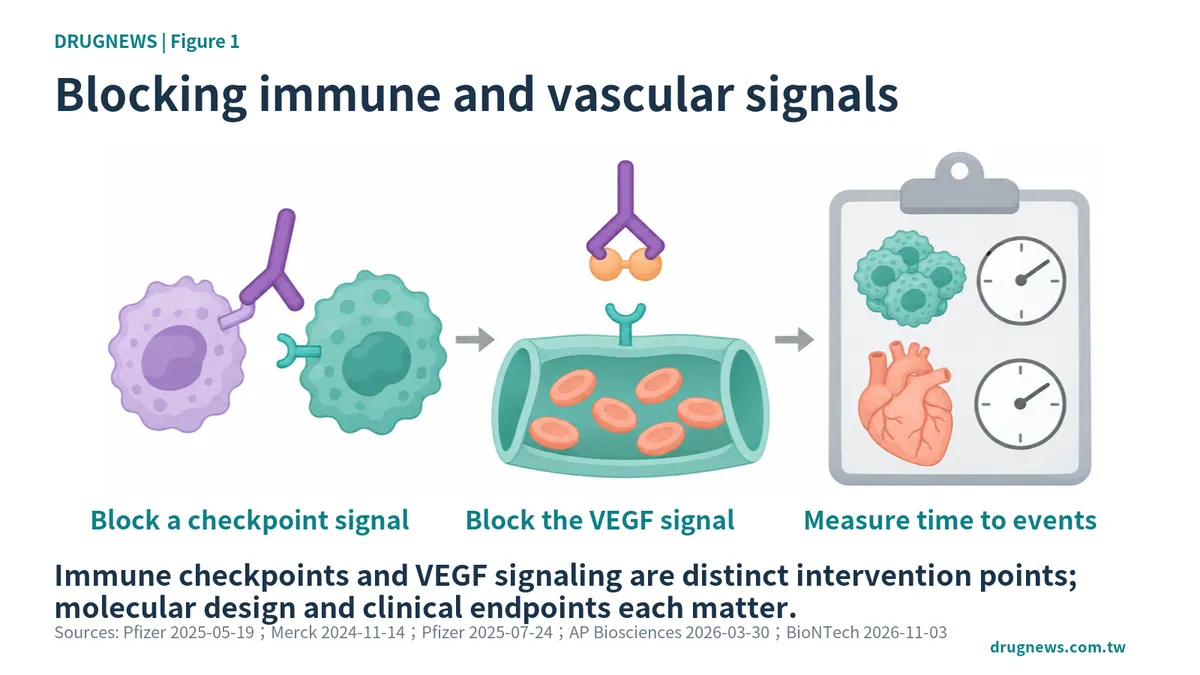
Figure 1 · Immune checkpoints and VEGF signaling are distinct intervention points; molecular design and clinical endpoints each matter.
| Company / drug | Representative study / population | Comparator | Primary endpoint | Estimated primary completion |
|---|---|---|---|---|
| Pfizer / 3SBio tivunatamig | Symbiotic-Lung-01; phase 3; first-line NSCLC; planned 1,410 | pembrolizumab + chemotherapy | OS, BICR-PFS | 2029-02-27 |
| BioNTech / BMS pumitamig | ROSETTA Lung-02; phase 2/3; first-line NSCLC; planned 1,580 | phase 3: pembrolizumab + chemotherapy | phase 3: BICR-PFS | 2029-01 |
| Merck / LaNova MK-2010 | MK-2010-002; phase 2; advanced solid tumors; planned 480 | cohort dependent | safety, ORR and other measures | 2028-09-26 |
| RemeGen RC148 | NCT07416474; phase 3; first-line squamous NSCLC; planned 574 | tislelizumab + chemotherapy | PFS | 2027-12-31 |
| AP Biosciences / Tasly AP505 | NCT06838546; phase 2; advanced colorectal cancer; planned 80 | single-arm cohorts | ORR | 2027-01-01; older record |
All enrollment figures are registry estimates. The patient populations differ across studies.[2–6]
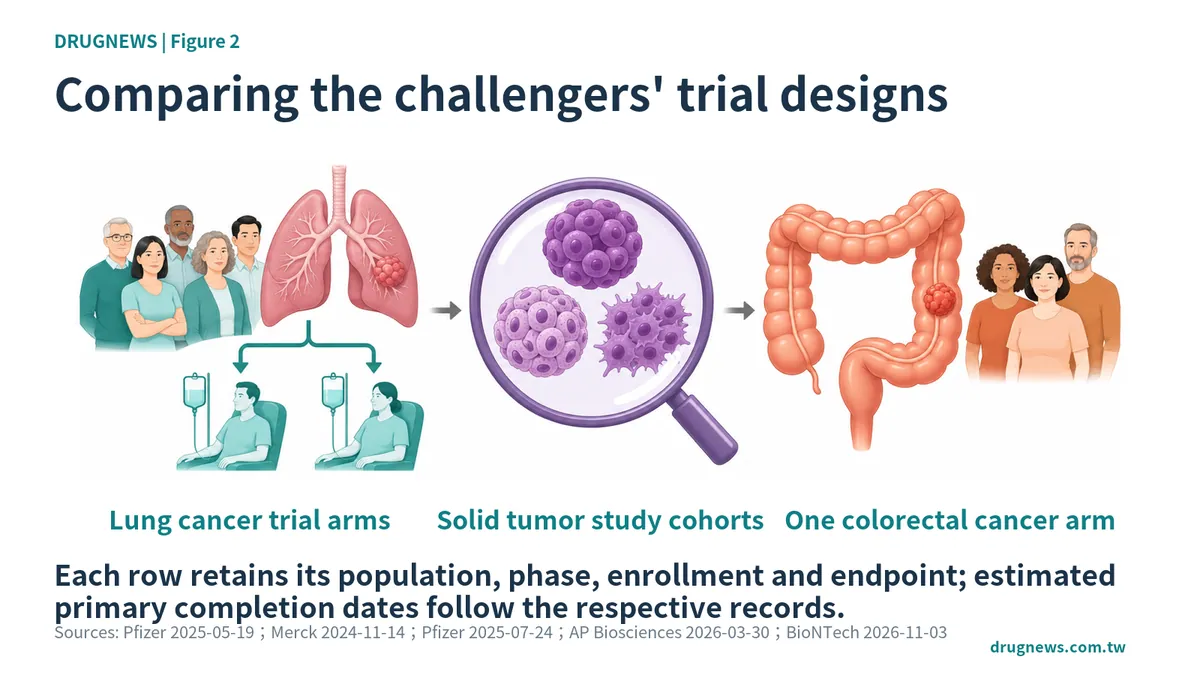
Figure 2 · Each row retains its population, phase, enrollment and endpoint; estimated primary completion dates follow the respective records.
RC148 shows why those details matter. Its registered completion estimate is earlier, but the comparator is tislelizumab and the population is squamous NSCLC. Its implications for global first-line treatment will depend on the enrolled patients, results and regional reviews.[5]
Large controlled trials also expose bispecifics to a practical commercial test. Clinicians already have immunotherapy plus chemotherapy, so a new drug must show what replacing that choice adds. Tumor shrinkage and better overall outcomes after switching treatments have very different commercial meanings.
02 · BioNTech's earlier result concerns different patients
BioNTech's pumitamig (BNT327) has a nearer phase 3 follow-up timeline in Chinese second-line small cell lung cancer (SCLC). NCT06616532 plans 404 participants, makes OS primary and estimates primary completion in May 2027. The company's quarterly report says enrollment has stopped while follow-up continues.[7,18]
Survival trials need events to accumulate. Recruitment ending marks enrollment progress; event accumulation and data maturity determine when analysis has enough information. May 2027 is therefore a useful point to check the registry again, with the public readout date dependent on formal company disclosure.
These are Chinese patients with second-line SCLC, a different disease, treatment line and comparator from Pfizer's first-line NSCLC trial. An earlier result matters for pumitamig itself, but it answers the SCLC question. It cannot stand in for the first-line NSCLC test.
BioNTech also has ROSETTA Lung-01 in global first-line extensive-stage SCLC. It plans 621 participants, uses atezolizumab plus chemotherapy as the comparator, makes OS primary and estimates primary completion in April 2029. That is another global first-line question to assess separately.[8]
The molecules differ too. Pumitamig targets PD-L1 and VEGF-A, while tivunatamig and MK-2010 target PD-1 and VEGF. The three molecules do not hit exactly the same targets.[9–11]
03 · Merck has paid for admission; the main test is still ahead
Merck's representative MK-2010 program remains in phase 2, seeking monotherapy and combination approaches worth advancing. MK-2010-002 plans 480 participants, with primary measures including adverse events, dose-limiting toxicities and objective response rate (ORR). PFS and OS are not listed as primary endpoints.[4]
That leaves Merck outside this endpoint comparison for now. The upfront payment bought admission; a survival trial against Keytruda is still some way off.
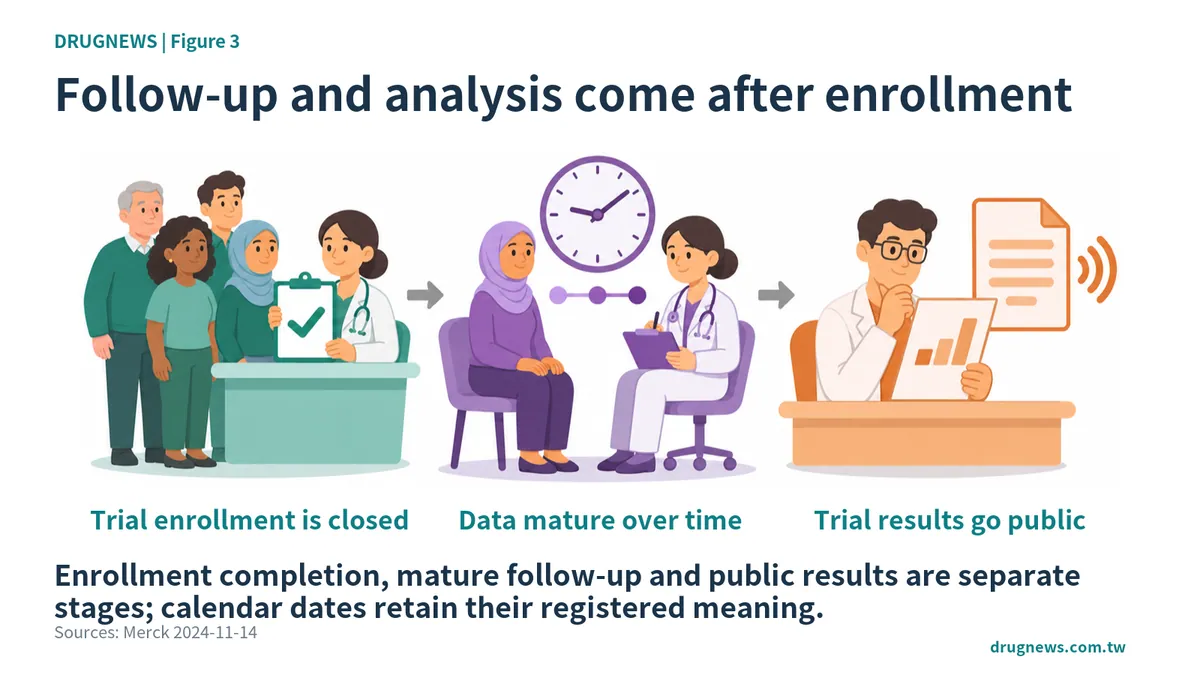
Figure 3 · Enrollment completion, mature follow-up and public results are separate stages; calendar dates retain their registered meaning.
The deal figures make one point here: BMS has paid $2.0 billion, about 18% of the $11.1 billion ceiling.[14,15] Committed money means someone is carrying development risk. It does not replace survival data.
04 · Taiwan's AP Biosciences takes another route
Taiwan's AP Biosciences is in this field too. AP505 (B1962) is a PD-L1×VEGF bispecific; in March 2026, the company said phase 1 was complete and licensing partner Tasly was advancing phase 2. The registered trial targets advanced colorectal cancer, plans 80 participants and makes ORR primary.[6,17] It has chosen another indication, in a different examination room from the lung cancer programs.
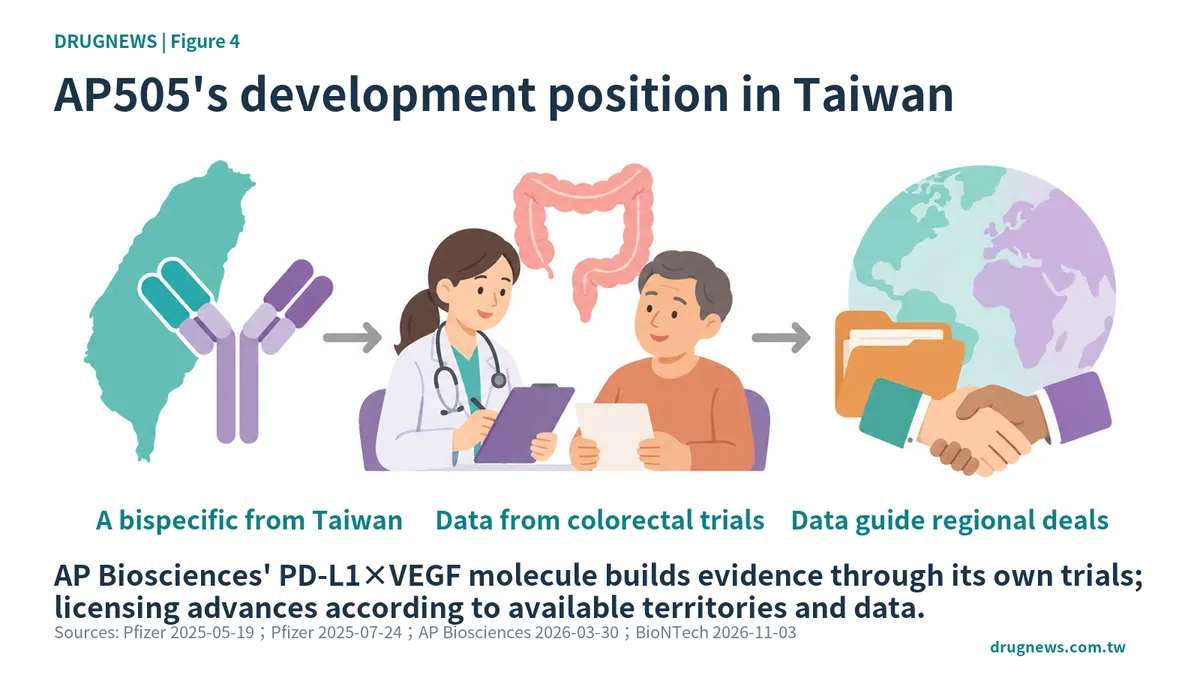
Figure 4 · AP Biosciences' PD-L1×VEGF molecule builds evidence through its own trials; licensing advances according to available territories and data.
Pfizer's and BioNTech/BMS's first-line lung cancer trials both have registered primary completion estimates in early 2029.[2,3] By then, the market will ask the question facing Akeso today: did patients live longer? Those who put it into the main test at least avoid having to add it after handing in their results.
This article is industry and company analysis, not investment or medical advice.
References
- Ivonescimab BLA update · Summit · 2026-11-15 · https://www.smmttx.com/news/press-releases/news-details/2026/Summit-Therapeutics-Provides-Update-Regarding-Ivonescimab-Biologics-License-Application/default.aspx?use_xbridge3=true
- Symbiotic-Lung-01 · ClinicalTrials.gov · 2026-10-08 · https://clinicaltrials.gov/study/NCT07222566
- ROSETTA Lung-02 · ClinicalTrials.gov · 2026-11-02 · https://clinicaltrials.gov/study/NCT06712316
- MK-2010-002 · ClinicalTrials.gov · 2026-11-05 · https://clinicaltrials.gov/study/NCT07793942
- RC148 first-line squamous NSCLC · ClinicalTrials.gov · 2026-07-14 · https://clinicaltrials.gov/study/NCT07416474
- B1962 colorectal phase IIb · ClinicalTrials.gov · 2025-02-20 · https://clinicaltrials.gov/study/NCT06838546
- PM8002 second-line SCLC · ClinicalTrials.gov · 2026-10-22 · https://clinicaltrials.gov/study/NCT06616532
- ROSETTA Lung-01 · ClinicalTrials.gov · 2026-10-14 · https://clinicaltrials.gov/study/NCT06712355
- A Transformative Global Partnership for BNT327 · BMS / BioNTech · 2025-06-02 · https://www.bms.com/assets/bms/us/en-us/pdf/investor-info/doc_presentations/2025/BioNTech-BMS-Partnership-Presentation.pdf
- Pfizer enters 3SBio agreement · Pfizer · 2025-05-19 · https://www.pfizer.com/news/press-release/press-release-detail/pfizer-enters-exclusive-licensing-agreement-3sbio
- LM-299 global license · Merck · 2024-11-14 · https://www.merck.com/news/merck-enters-into-exclusive-global-license-for-lm-299-an-investigational-anti-pd-1-vegf-bispecific-antibody-from-lanova-medicines-ltd/
- MK-2010 with sac-TMT · ClinicalTrials.gov · 2026-10-15 · https://clinicaltrials.gov/study/NCT07785609
- 2025 Form 10-K · Merck / SEC · 2026-02-24 · https://www.sec.gov/Archives/edgar/data/310158/000031015826000063/mrk-20251231.htm
- 2026 Q3 Form 10-Q · BMS / SEC · 2026-10-29 · https://www.sec.gov/Archives/edgar/data/14272/000001427226000024/bmy-20260930.htm
- 2025 Q3 quarterly report · BioNTech / SEC · 2025-11-03 · https://www.sec.gov/Archives/edgar/data/1776985/000177698525000065/bnt_2025q3ex99x1quarterlyr.htm
- Pfizer completes 3SBio license · Pfizer · 2025-07-24 · https://www.pfizer.com/news/press-release/press-release-detail/pfizer-completes-licensing-agreement-3sbio
- AP505 amended out-licensing arrangement · AP Biosciences · 2026-03-30 · https://www.apbioinc.com/en/news-detail67.htm
- 2026 Q3 quarterly report · BioNTech · 2026-11-03 · https://biontechse.gcs-web.com/static-files/5248a6ea-b3c1-4985-95d4-a56e0aaa1e7a
Share this analysis
Send this article to readers who follow biotech, company strategy, and capital-market signals.
Cite this article
For decks, research notes, or media references, cite Drugnews with the canonical article URL.
Drugnews Editorial Team. "After Ivonescimab's Rejection, Pfizer Is the One Testing Survival First." Drugnews, Nov 19, 2026. https://drugnews.com.tw/articles/2026-11-19-pd1-vegf-challengers-evidence-en.html