
IL-12 and Acute Radiation Syndrome (ARS) Pipeline
As of 6 November 2026, Drugnews tracks 13 assets: 4 approved and 4 in clinical development for acute radiation syndrome; 4 clinical, 1 preclinical and 1 with rights returned in IL-12 cancer immunotherapy. Taiwan’s Libo Pharma is developing LIB-101 in both areas.
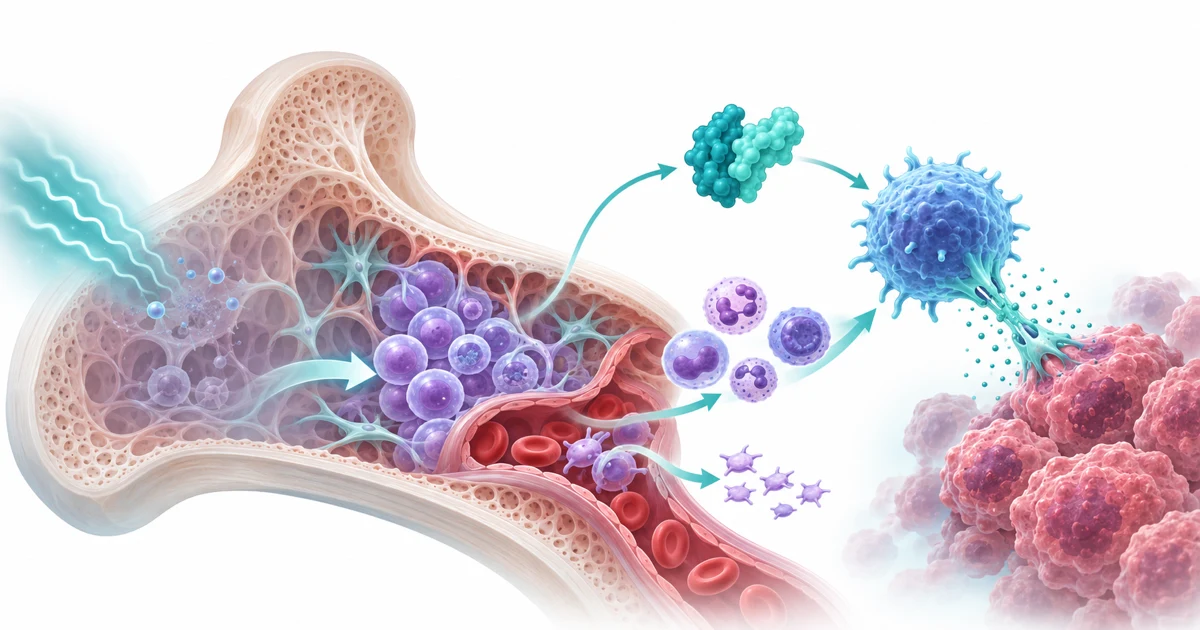
After a nuclear plant accident or a nuclear detonation, heavy radiation hits the bone marrow first. White cells and platelets fall, and patients die of infection and bleeding.
Drugs for this hematopoietic acute radiation syndrome (H-ARS) cannot be tested for efficacy in people. The FDA reviews them under the Animal Rule: efficacy comes from animal studies, and human studies only establish safety.
This page covers 13 assets: in ARS, 4 approved and 4 in clinical development; in IL-12 cancer immunotherapy, 4 in clinical development, 1 preclinical and 1 with rights returned. Libo Pharma's LIB-101, from Taiwan, appears in both groups.
01 | The four approved drugs each rescue one blood-cell line
- Neupogen (filgrastim): Amgen, 30 March 2015, the first H-ARS drug approved under the Animal Rule.
- Neulasta (pegfilgrastim): Amgen, 13 November 2015, the long-acting version.
- Leukine (sargramostim): Partner Therapeutics, 29 March 2018.
- Nplate (romiplostim): Amgen, January 2021, a TPO-receptor agonist.
The first three restore white cells and Nplate restores platelets. All four are existing blood-cell drugs whose labels were extended to ARS.
This is a government business. In October 2022, HHS's BARDA used Project BioShield funds to buy US$290 million of Nplate from Amgen. Amgen holds the stock as vendor-managed inventory, moving doses near expiry to the commercial market and replacing them for the government.
02 | LIB-101: one IL-12 dose for several blood-cell lines
LIB-101 is recombinant human interleukin-12 (IL-12). Libo Pharma says a single subcutaneous dose supports recovery across several blood-cell lineages, its main difference from the four approved drugs.
- Its predecessor, HemaMax (NM-IL-12), completed a 200-subject Phase 2 safety study in healthy volunteers in the US.
- BARDA has invested more than US$70 million in the program (2022 report).
- The Phase 3 plans about 300 healthy volunteers; as of March 2026, about 81 more were needed to finish enrollment.
- An investigator-initiated trial with Fukushima Medical University and TEPCO will make the drug in the US and store it in Fukushima for workers exposed at nuclear plants.
A nuclear plant operator willing to keep it on site is a second kind of buyer beyond government stockpiles.
03 | Rivals for the next stockpile order
- Entolimod (Tivic Health): a TLR5 agonist; met BARDA in January and March 2026 on funding and the Strategic National Stockpile.
- BIO 300 (Humanetics): oral, for prevention before exposure in military personnel and first responders. No FDA-approved drug prevents ARS before exposure.
- PLX-R18 (Pluri): placenta-derived cells in Phase 1; evaluated mass-production readiness in 2024.
LIB-101 and entolimod compete to save lives after exposure. BIO 300 targets the open gap of protection before exposure.
04 | IL-12 in cancer: big pharma is split
IL-12 can turn "cold" tumors hot and draw immune cells in, but systemic toxicity has long stalled development. The new approach is to make it act only inside the tumor:
- Xilio's efarindodekin alfa (XTX301) is activated in the tumor microenvironment. Gilead paid US$43.5 million upfront in 2024 with up to US$604 million more, and Phase 2 began in September 2025.
- Werewolf's WTX-330 is a conditionally activated prodrug. One gallbladder cancer patient had a partial response, but further development needs funding and the company is seeking partners.
- Ankyra's tolododekin alfa (ANK-101) is anchored in the tumor after injection; at ASCO 2026 it showed no dose-limiting toxicities.
- Dragonfly's DF6002: Bristol Myers Squibb licensed it in 2020 for US$475 million and returned it in February 2023.
- Audax's DAX-044: IL-12 fused to an antibody to concentrate it in the tumor microenvironment, still preclinical. On 27 October 2026 Astellas took an exclusive option to a worldwide license, with US$285 million in upfront and option-exercise payments and up to US$1.34 billion in total.
An IL-12 that has not yet reached patients drew US$285 million in upfront payments. After BMS walked away, Gilead and Astellas both paid in; big pharma is betting on designs that make IL-12 act only inside the tumor.
LIB-101 takes a different route: subcutaneous injection combined with radiotherapy. In a Phase 2a in cutaneous T-cell lymphoma (CTCL), the combination produced a 100% overall response rate in early-stage (IB) patients (company briefing). It has FDA and EMA orphan designations, and a multinational pivotal trial is planned. Diffuse large B-cell lymphoma (DLBCL) is in Phase 2.
05 | Taiwan: where Libo Pharma stands
Of the 13 assets on this page, LIB-101 is the only IL-12 in clinical development for both ARS and cancer, and the only Taiwanese asset.
Libo Pharma listed on Taiwan's emerging stock board (7888) on 23 December 2025 after raising about NT$850 million in a Series C in July 2025. It describes itself as a dual platform for defense-readiness medicine and immunotherapy: win ARS government procurement and nuclear-plant stockpiles first, then open the cancer market with a CTCL pivotal trial.
06 | Timeline
- Ongoing: LIB-101 Phase 3 enrollment (about 81 subjects short as of March 2026).
- Ongoing: entolimod funding and stockpile talks with BARDA.
- Planned: LIB-101 multinational pivotal trial in CTCL.
- Pending: efarindodekin alfa Phase 2 results and whether Gilead takes over development.
- 2027: DAX-044 expected to enter Phase 1.
Hematopoietic acute radiation syndrome (H-ARS)
| Drug | Company | Country | Mechanism | Route | Stage | Indication | Trial IDs | Deals | Latest update and date | Sources |
|---|---|---|---|---|---|---|---|---|---|---|
| Neupogen (filgrastim) | Amgen | US | G-CSF; restores neutrophils | Subcutaneous | Approved (Animal Rule) | Acute exposure to myelosuppressive doses of radiation | — | FDA-approved on 2015-03-30 under the Animal Rule, the first H-ARS drug | www.fda.gov | |
| Neulasta (pegfilgrastim) | Amgen | US | Long-acting G-CSF | Subcutaneous | Approved (Animal Rule) | Patients at risk of myelosuppression after a radiological or nuclear incident | — | FDA-approved on 2015-11-13 | www.fda.gov | |
| Leukine (sargramostim) | Partner Therapeutics | US | GM-CSF; restores white blood cells | Subcutaneous | Approved (Animal Rule) | Improving survival after acute exposure to myelosuppressive doses of radiation | — | FDA-approved on 2018-03-29 | www.fda.gov | |
| Nplate (romiplostim) | Amgen | US | TPO-receptor agonist; stimulates platelet production | Subcutaneous | Approved (Animal Rule) | H-ARS | Oct 2022: HHS/BARDA bought US$290M under Project BioShield | FDA-approved for ARS in January 2021; held as vendor-managed inventory for the government | www.ntd.com | |
| LIB-101 (recombinant human IL-12) | Libo Pharma (TPEx Emerging: 7888) | Taiwan | Recombinant human interleukin-12 that modulates immunity and supports blood-cell recovery; the company says a single subcutaneous dose aids recovery across several blood-cell lineages | Subcutaneous | Phase 3 (healthy-volunteer safety, Animal Rule) | H-ARS | NCT02343133 NCT01742221 | BARDA has invested over US$70M (2022 report); in-licensed in 2017 | Phase 3 plans about 300 healthy volunteers; as of March 2026 about 81 more were needed to complete enrollment. Its predecessor HemaMax (NM-IL-12, Neumedicines) completed a 200-subject Phase 2 safety study. An investigator-initiated trial with Fukushima Medical University and TEPCO will ship US-made drug to Fukushima for storage and use in exposed plant workers. Listed on Taiwan's emerging board on 2025-12-23 | www.ctee.com.tw geneonline.news geneonline.news clinicaltrials.gov |
| Entolimod (CBLB502) | Tivic Health | US | TLR5 agonist that activates NF-κB cell-protective pathways | Intramuscular | Advanced development (Animal Rule) | ARS (hematopoietic and gastrointestinal) | — | Met BARDA on 2026-01-26 and again on 2026-03-10 on funding and the Strategic National Stockpile; separate NIAID non-clinical evaluation agreement for GI-ARS | www.biospace.com www.biospace.com | |
| BIO 300 | Humanetics | US | Radioprotective agent given before exposure | Oral | Phase 1 (Animal Rule) | ARS prophylaxis (military, first responders) | NCT06741345 NCT04650555 | — | Phase 1 of the oral suspension (56 healthy volunteers) completed in August 2025; no FDA-approved drug prevents ARS before exposure | clinicaltrials.gov www.biospace.com |
| PLX-R18 (placenta-derived cells) | Pluri | Israel | Placenta-derived cells that secrete hematopoietic factors | Intramuscular | Phase 1 | H-ARS (post-exposure prevention or treatment) | NCT03797040 | — | Evaluating mass-production readiness as of November 2024; Phase 1 registry status not updated | clinicaltrials.gov www.quantisnow.com |
No matching assets. Clear your search.
IL-12 in cancer immunotherapy
| Drug | Company | Country | Mechanism | Route | Stage | Indication | Trial IDs | Deals | Latest update and date | Sources |
|---|---|---|---|---|---|---|---|---|---|---|
| efarindodekin alfa (XTX301) | Xilio Therapeutics (licensed to Gilead) | US | Tumor-activated IL-12, unmasked in the tumor microenvironment | Intravenous | Phase 2 | Advanced solid tumors | NCT05684965 | Mar 2024: Gilead paid US$43.5M upfront (US$30M cash + US$13.5M equity), up to US$604M contingent; US$75M transition fee if Gilead takes over | Phase 2 began in September 2025, triggering a US$17.5M Gilead milestone | www.gilead.com www.itiger.com |
| LIB-101 (recombinant human IL-12) | Libo Pharma (TPEx Emerging: 7888) | Taiwan | Recombinant human IL-12 combined with radiotherapy | Subcutaneous | Phase 2a completed | Cutaneous T-cell lymphoma (CTCL); Phase 2 in DLBCL | NCT02542124 NCT02544724 | — | In Phase 2a, the combination produced a 100% overall response rate in early-stage (IB) CTCL patients (company briefing); FDA and EMA orphan designations; multinational pivotal trial planned | geneonline.news blog.fugle.tw clinicaltrials.gov |
| WTX-330 | Werewolf Therapeutics | US | Conditionally activated IL-12 (INDUKINE prodrug) | Intravenous | Phase 1b/2 | Solid tumors | Seeking partners | Among the first 12 patients, one confirmed partial response in metastatic gallbladder cancer (45% target-lesion reduction); further development requires additional funding | www.biospace.com | |
| tolododekin alfa (ANK-101) | Ankyra Therapeutics | US | Anchored IL-12 that stays in the tumor after injection | Intratumoral | Phase 1 | NSCLC (with anti-PD-1/PD-L1), cutaneous squamous cell carcinoma, solid tumors | — | ASCO 2026: no dose-limiting toxicities across multiple solid tumor types | www.biospace.com | |
| DAX-044 (IL-12 antibody-cytokine fusion) | Audax Biosciences (option and license: Astellas) | Australia / Japan | Immune-targeted IL-12 antibody-cytokine fusion (AVIKINE platform) that concentrates IL-12 activity in the tumor microenvironment | — | Preclinical (IND/CTN-enabling) | Immuno-oncology | On 2026-10-27 Astellas took an exclusive option to a worldwide license: US$285M in upfront and option-exercise payments plus up to US$1.05B in milestones, up to US$1.34B in total (excluding tiered double-digit royalties) | Audax continues development, with Phase 1 expected to start in 2027 | www.placera.se pharmaphorum.com | |
| DF6002 (IL-12 Fc fusion) | Dragonfly Therapeutics | US | Monovalent IL-12 Fc fusion protein | Subcutaneous | Phase 1/2 (rights returned) | Metastatic solid tumors (alone or with nivolumab) | BMS licensed it in 2020 for US$475M and returned the rights in Feb 2023 | BMS returned all rights in February 2023; Dragonfly continues development | www.geneonline.com |
No matching assets. Clear your search.
Frequently asked questions
Which drugs are approved in the US for acute radiation syndrome?
This dataset lists four: Neupogen (filgrastim)、Neulasta (pegfilgrastim)、Leukine (sargramostim)、Nplate (romiplostim). All four are listed as approved under the Animal Rule.
Why do ARS drugs follow the Animal Rule rather than human efficacy trials?
Drugs for this hematopoietic acute radiation syndrome (H-ARS) cannot be tested for efficacy in people. The FDA reviews them under the Animal Rule: efficacy comes from animal studies, and human studies only establish safety.
How far has Libo Pharma’s LIB-101 progressed?
The ARS Phase 3 plans about 300 healthy volunteers; a March 2026 report said about 81 more were needed to complete enrollment. In oncology, CTCL Phase 2a is completed, DLBCL is in Phase 2, and a multinational pivotal trial is planned. FDA and EMA orphan designations have been granted.