
Injectable Fat Reduction Pipeline
As of November 6, 2026, Drugnews tracks 12 injectable fat-reduction assets: 3 approved, 8 in clinical development and 1 discontinued. Three clinical assets have reached Phase 3, including completed trials; 6 have an Asian company or rights holder.
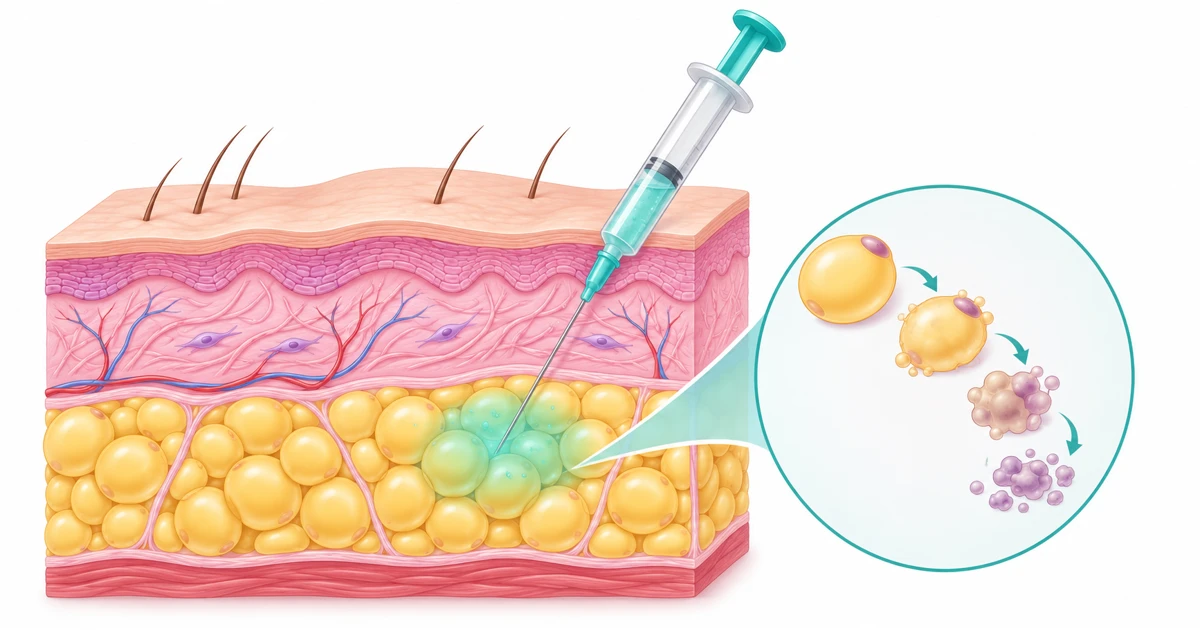
Weight-loss drugs bring the scale down, but fat on the lower belly, under the arms and under the chin often stays. As of November 2026, only three injectables that dissolve local fat are approved anywhere, and all three are approved only for the chin.
This page tracks 12 assets: 3 approved, 8 in clinical development and 1 discontinued. Six of the eight clinical assets come from Asian companies or are licensed to an Asian drugmaker.
01 | The three approved drugs: all bile acids, all for the chin
- KYBELLA / BELKYRA (deoxycholic acid): AbbVie; FDA-approved in 2015, the first injectable fat-reduction drug approved by the FDA.
- VOILET (deoxycholic acid): Daewoong; approved in Korea in 2021, with more than 200,000 vials sold to over 2,000 clinics.
- Newbeju (cholic acid, MT921): Medytox; approved in Korea on 19 September 2025 after a 240-patient Phase 3.
Bile-acid drugs work by dissolving fat-cell membranes, which causes swelling and pain. Patients tolerate that under the chin, where the area is small. The abdomen needs far more injection points, so swelling and pain become the limit.
The demand is real. In July 2026 Daewoong partnered with Seoul National University Bundang Hospital and 365mc to extend VOILET to anterior axillary fat, then the abdomen, arms and thighs, citing rising demand for treating localized fat and loose skin as GLP-1 weight-loss drugs spread.
02 | Eight drugs in the clinic, three routes
Reformulate. Sichuan Huiyu's HY-2003 wraps deoxycholic acid in liposomes and uses BELKYRA as a comparator in Phase 1. Taiwan's Glonova Ronkyla Plus turns sodium deoxycholate into a hydrogel under the skin and is in Phase 1 for superficial lipoma.
Change the mechanism. Caliway's CBL-514 and AMI Pharm's AYP-101 induce fat-cell apoptosis instead of dissolving membranes. Cutia's CU-20401 is a recombinant mutant collagenase that acts on the extracellular matrix around fat. Sirnaomics' STP705 is an siRNA that silences both TGF-β1 and COX-2.
Change the body area. Of the 12 assets on this page, only CBL-514 has entered global Phase 3 with abdominal subcutaneous fat as its main indication. RZL-012 and AYP-101, the other two that reached Phase 3, both treat the chin.
RZL-012 is closest to market. In September 2026 its 480-patient China Phase 3 showed a responder rate 30 percentage points above placebo, and Fosun Pharma plans to file in China by the end of 2026.
03 | The Qwo lesson: side effects are the market
Endo's Qwo, a collagenase, was FDA-approved in 2020 for cellulite of the buttocks. Endo stopped making and selling it in December 2022 because bruising was extensive, unpredictable and could leave prolonged discoloration.
Aesthetic patients pay out of pocket and are not sick. Bruising alone is enough for physicians to stop recommending a product, which is why newer drugs emphasize less inflammation and less swelling.
04 | Taiwan: where Caliway's CBL-514 stands
Caliway (TWSE: 6919) is developing CBL-514, a small molecule injected under the skin that induces fat-cell apoptosis.
- Phase 2b CBL-0205 (173 participants, US and Canada): 54.2% achieved at least a 20% reduction in fat volume versus 0% on placebo. The mean reduction was 166.6 mL (22.4%), while placebo rose by 15.7 mL.
- Two global pivotal Phase 3 trials: SUPREME-01 (about 320 participants, 13 US and Canadian sites; enrollment announced in August 2026) and SUPREME-02 (about 320, US, Canada and Australia). Results are expected in 2027.
- The FDA has cleared a Phase 2 combining CBL-514 with tirzepatide (Zepbound) in about 120 participants.
- The Asia-Pacific Phase 2 CBL-0206 (about 250 participants) is approved in Taiwan and Australia and enrolling in Australia, and a China Phase 3 (CBL-0304) application is planned for the second half of 2026.
- CBL-514 is also being studied in Dercum's disease (as CBL-514D) and cellulite.
All three approved drugs are limited to the chin, so the abdomen is an open gap among approved drugs worldwide. If CBL-514 succeeds in Phase 3 in 2027, it would be the first injectable fat-reduction drug to file for approval for large-area abdominal fat. It is also the only asset on this page being tested with a weight-loss drug.
Taiwan's other entrant is Glonova's Ronkyla Plus, in Phase 1 at three Taiwanese sites.
05 | Timeline
- By end of 2026: RZL-012 new drug application in China.
- Pending: results of AMI Pharm's completed 252-patient Korean Phase 3 of AYP-101.
- December 2026: primary completion of the HY-2003 Phase 1.
- 2027: results from both CBL-514 global Phase 3 trials.
Stage distribution
Country / region
Drug assets
| Asset | Company | Country | Mechanism | Stage | Indication | Trial ID | Deal | Latest development / date | Sources |
|---|---|---|---|---|---|---|---|---|---|
| KYBELLA / BELKYRA (deoxycholic acid) | AbbVie (formerly Allergan) | US | Deoxycholic acid; disrupts adipocyte membranes (cytolysis with local inflammation and swelling) | Approved | Moderate-to-severe submental fat | — | — | FDA-approved in 2015; the first injectable fat-reduction drug approved by the FDA2015-04-29 | 1 2 |
| VOILET (deoxycholic acid) | Daewoong Pharmaceutical | South Korea | Deoxycholic acid; disrupts adipocyte membranes | Approved (Korea) | Submental fat; investigator-initiated trial in anterior axillary fat cleared | — | — | Approved in Korea in 2021; over 200,000 vials sold to 2,000+ clinics; July 2026 MOU with SNU Bundang Hospital and 365mc to expand to anterior axillary fat, then abdomen, arms and thighs2026-07-16 | 1 2 |
| Newbeju (cholic acid, MT921) | Medytox | South Korea | Cholic acid; lower surfactant activity than deoxycholic acid | Approved (Korea) | Moderate-to-severe submental fat | NCT05195112 | — | Approved by Korea's MFDS on 2025-09-19; Phase 3 in 240 patients (completed Feb 2023) showed significantly greater MRI fat-volume reduction than placebo2025-09-19 | 1 2 3 |
| CBL-514 | Caliway Biopharmaceuticals (TWSE: 6919) | Taiwan | Small molecule that induces adipocyte apoptosis | Phase 3 | Abdominal subcutaneous fat (large area); also cellulite and Dercum's disease (CBL-514D) | NCT07140939 NCT07526974 NCT07733947 NCT07608770 NCT06005441 | — | Two global pivotal Phase 3 trials: SUPREME-01 (CBL-0301, ~320 participants, 13 US/Canada sites, enrollment announced Aug 2026) and SUPREME-02 (CBL-0302, ~320, US/Canada/Australia), results expected in 2027. Phase 2b CBL-0205 (n=173): 54.2% reached ≥20% fat-volume reduction vs 0% on placebo; mean reduction 166.6 mL (22.4%). FDA cleared a Phase 2 with tirzepatide. Asia-Pacific Phase 2 CBL-0206 (~250) approved in Taiwan and Australia, enrolling in Australia. China Phase 3 (CBL-0304) application planned for 2H 20262026-08-25 | 1 2 3 4 5 |
| RZL-012 | Raziel Therapeutics (China rights: Fosun Pharma affiliate JuveStar) | Israel / China | Injectable lipolytic molecule that destroys targeted fat cells | Phase 3 completed (China) | Submental fat; Fosun planning a body-contouring trial | NCT05763160 | 2020 license for mainland China, Hong Kong, Macau and Taiwan: up to US$74M in milestones (US$27M pre-approval, US$47M sales) plus tiered royalties | On 2026-09-02, the China Phase 3 (n=480) showed a 30-percentage-point responder-rate advantage over placebo; NDA to China's regulator planned by end of 20262026-09-02 | 1 2 |
| AYP-101 (polyene phosphatidylcholine) | AMI Pharm | South Korea | Polyene phosphatidylcholine; induces adipocyte apoptosis without an inflammatory response | Phase 3 completed | Submental fat | NCT06256445 | — | Korean Phase 3 (n=252) completed, results not yet published; in Phase 2, over 70% improved by at least one grade2025-08-11 | 1 2 |
| CU-20401 (recombinant mutant collagenase) | Cutia Therapeutics (HKEX: 2487) | China | Acts on the extracellular matrix surrounding fat tissue | Phase 2 completed | Submental fat | NCT06194188 | — | On 2024-11-29, the China Phase 2 (n=108) showed significantly higher response rates than placebo at both doses, with no serious adverse events2024-11-29 | 1 2 |
| STP705 (siRNA) | Sirnaomics (HKEX: 2257) | US / China | siRNA that silences TGF-β1 and COX-2 | Phase 2 | Submental fat | NCT07677683 | — | Australian Phase 2 (n=30) began enrolling on 2026-07-282026-07-28 | 1 |
| 10XB-101 | 10xBio | US | Not disclosed | Phase 2 completed | Submental fat | NCT05154955 | — | US Phase 2 (n=51) completed in March 20242024-03-19 | 1 |
| HY-2003 (liposomal deoxycholic acid) | Sichuan Huiyu Pharmaceutical | China | Liposome-encapsulated deoxycholic acid | Phase 1 | Submental fat | NCT06756490 | — | China Phase 1 (n=30) versus BELKYRA and placebo; primary completion December 20262024-12-26 | 1 |
| Ronkyla Plus (new sodium deoxycholate formulation) | Glonova Pharma | Taiwan | Sodium deoxycholate that forms a hydrogel at the injection site | Phase 1 | Superficial lipoma; submental fullness | NCT07237425 | — | Taiwan Phase 1 (n=56, 3 sites) enrolling since November 20252025-11-14 | 1 |
| Qwo (collagenase clostridium histolyticum-aaes) | Endo | US | Collagenase that releases the fibrous septae behind dimpling | Discontinued | Cellulite of the buttocks in adult women | — | — | FDA-approved in 2020; production and sales ended in December 2022 over the extent and variability of bruising and possible prolonged skin discoloration2022-12-12 | 1 2 |
Frequently asked questions
Which injectable fat-reduction drugs are currently approved?
KYBELLA / BELKYRA (deoxycholic acid), VOILET (deoxycholic acid), and Newbeju (cholic acid, MT921). KYBELLA received FDA approval in 2015; VOILET was approved in Korea in 2021 and Newbeju in Korea on September 19, 2025. All three are approved for submental fat.
How far has Caliway’s CBL-514 progressed?
CBL-514 is in global pivotal Phase 3 development. SUPREME-01 and SUPREME-02 each plan about 320 participants, with results expected in 2027. SUPREME-01 enrollment was announced in August 2026. The FDA has also cleared a Phase 2 trial combining CBL-514 with tirzepatide.
Why is treating a large area such as the abdomen difficult?
Approved bile-acid drugs dissolve fat-cell membranes and cause swelling and pain. The abdomen requires far more injection points than the chin, making swelling and pain a limiting factor. CBL-514 induces adipocyte apoptosis and is the only asset in this dataset in global Phase 3 for large-area abdominal fat.