BMS and Merck Face the Steepest Cliffs, Yet Made One Acquisition Between Them in 2026
On 24 November, Sanofi (Euronext Paris: SAN) agreed to buy Insmed (NASDAQ: INSM) for $175 a share in cash, about $41 billion, to own Brinsupri, an oral drug for non-cystic fibrosis bronchiectasis. It is the largest acquisition by a top-20 drugmaker this year.
Who needs new drugs and who can afford them are often treated as the same question.
We measured the 20 largest drugmakers on one ruler: how much of 2025 revenue comes from products that face US generic or biosimilar entry by 2030; cash and leverage; and every acquisition worth $1 billion or more announced since 2022.
The result is lopsided. Bristol Myers Squibb (BMS, NYSE: BMY) and Merck & Co. (NYSE: MRK), the two companies with the steepest cliffs, made one acquisition between them this year. Eli Lilly (NYSE: LLY) made ten, funded by fast-growing obesity drug sales.
Cliffs decide who needs to buy. Cash flow decides who can.
01 | BMS and Merck: more than half of revenue faces generics
BMS booked $48.2 billion of revenue in 2025. The anticoagulant Eliquis sold $14.4 billion and the immuno-oncology drug Opdivo $10.0 billion. Both face the earliest possible US generic or biosimilar entry in 2028.
Add Pomalyst, Revlimid and Sprycel, and products opening to competition by 2030 make up 63.6% of BMS's 2025 revenue.
Merck is more concentrated. Keytruda alone sold $31.6 billion in 2025, 48.7% of revenue, with US entry possible from 2028.
With Januvia/Janumet, Bridion, Lenvima and Dificid, Merck's figure is 57.4%. Amgen (NASDAQ: AMGN), in third place, is at 17.7%.
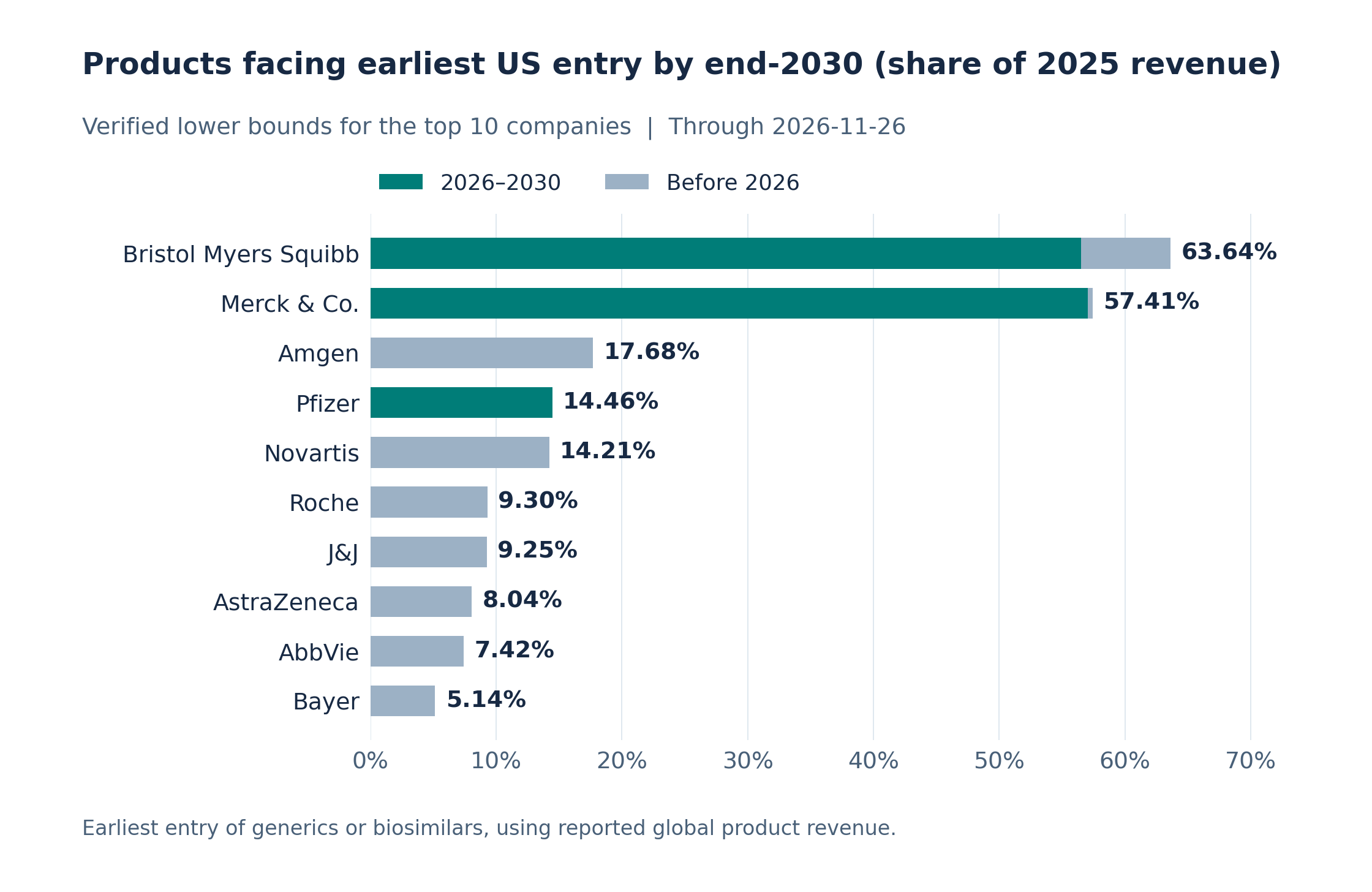
| Rank | Company | Verified exposure by 2030 | Main products (earliest US entry year) | Products with entry year not found |
|---|---|---|---|---|
| 1 | BMS | 63.6% | Eliquis, Opdivo (2028); Pomalyst (2026); Revlimid (2022); Sprycel (2024) | 2 |
| 2 | Merck & Co. | 57.4% | Keytruda (2028); Januvia/Janumet, Bridion (2026); Lenvima (2030); Dificid (2025) | 3 |
| 3 | Amgen | 17.7% | Prolia, Xgeva (2025) | 10 |
| 4 | Pfizer (NYSE: PFE) | 14.5% | Eliquis (2028); Xeljanz (2026) | 3 |
| 5 | Novartis (SIX: NOVN) | 14.2% | Entresto (2025) | 5 |
| 6 | Roche (SIX: ROG) | 9.3% | MabThera/Rituxan, Herceptin, Avastin (2019); Actemra (2024) | 0 |
| 7 | Johnson & Johnson (NYSE: JNJ) | 9.3% | Stelara, Xarelto (2025) | 2 |
| 8 | AstraZeneca (LSE: AZN) | 8.0% | Symbicort (2023); Soliris (2025) | 9 |
| 9 | AbbVie (NYSE: ABBV) | 7.4% | Humira (2023) | 0 |
| 10 | Bayer (XETRA: BAYN) | 5.1% | Xarelto (2025) | 1 |
The table shows verified lower bounds. Amgen has 10 products and AstraZeneca 9 whose earliest entry year we could not confirm, so their true exposure is higher.
The top two are the most robust result: verified products alone exceed half of revenue, and no gap-filling elsewhere would catch them.
02 | Who can pay: cash and leverage
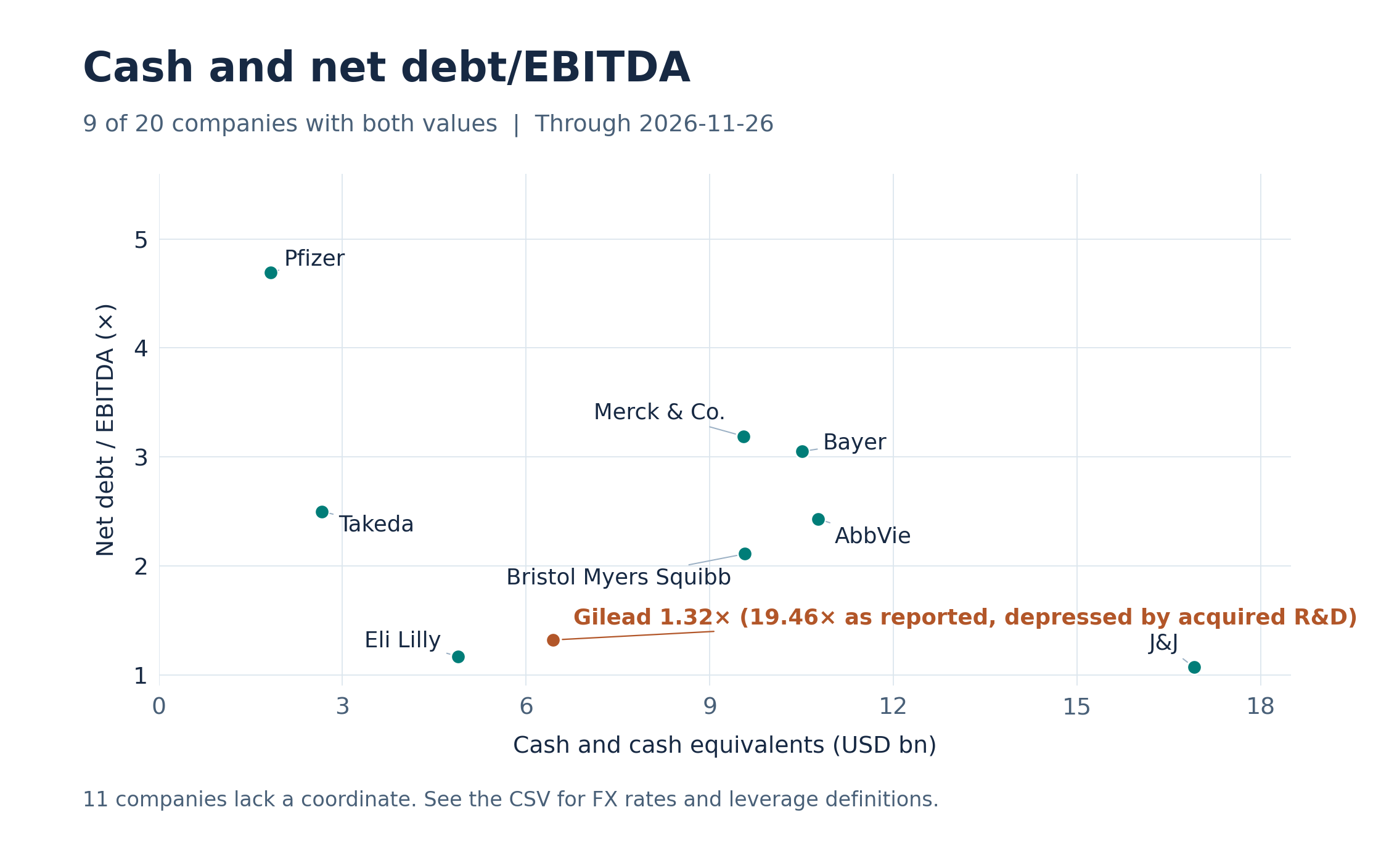
Nine of the 20 companies have a comparable net debt to EBITDA ratio.
| Company | Cash and equivalents ($bn) | Net debt / EBITDA (x) | $1bn+ acquisitions in 2026 | Verified exposure by 2030 |
|---|---|---|---|---|
| Johnson & Johnson | 16.91 | 1.07 | 2 | 9.3% |
| AbbVie | 10.77 | 2.43 | 1 | 7.4% |
| Bayer | 10.51 | 3.05 | 1 | 5.1% |
| BMS | 9.57 | 2.11 | 0 | 63.6% |
| Merck & Co. | 9.55 | 3.19 | 1 | 57.4% |
| Gilead (NASDAQ: GILD) | 6.44 | 1.32 (19.46 as reported) | 4 | Not found (7 products missing years) |
| Eli Lilly | 4.89 | 1.17 | 10 | Not found (5 products missing years) |
| Takeda (TSE: 4502) | 2.67 | 2.5 (company-adjusted) | 0 | Not found (2 products missing years) |
| Pfizer | 1.82 | 4.69 | 0 | 14.5% |
Johnson & Johnson has the most room: $16.9 billion of cash and net debt of 1.07 times EBITDA. Pfizer has the least: $1.8 billion of cash and a ratio of 4.69.
BMS sits at 2.11 times and could borrow more. Merck is at 3.19 because it has already been buying: Verona ($10.0 billion), Cidara ($9.2 billion) and Terns ($6.7 billion) between July 2025 and March 2026, about $25.9 billion in all.
Gilead's reported 19.46 times is a distortion. Its 2026 deals for Arcellx, Ouro, Tubulis and others ran acquired research and development costs through the income statement, cutting EBITDA to about $1.0 billion; adding those back gives 1.32 times.
03 | The busiest year in five, but the biggest buyer is not the neediest
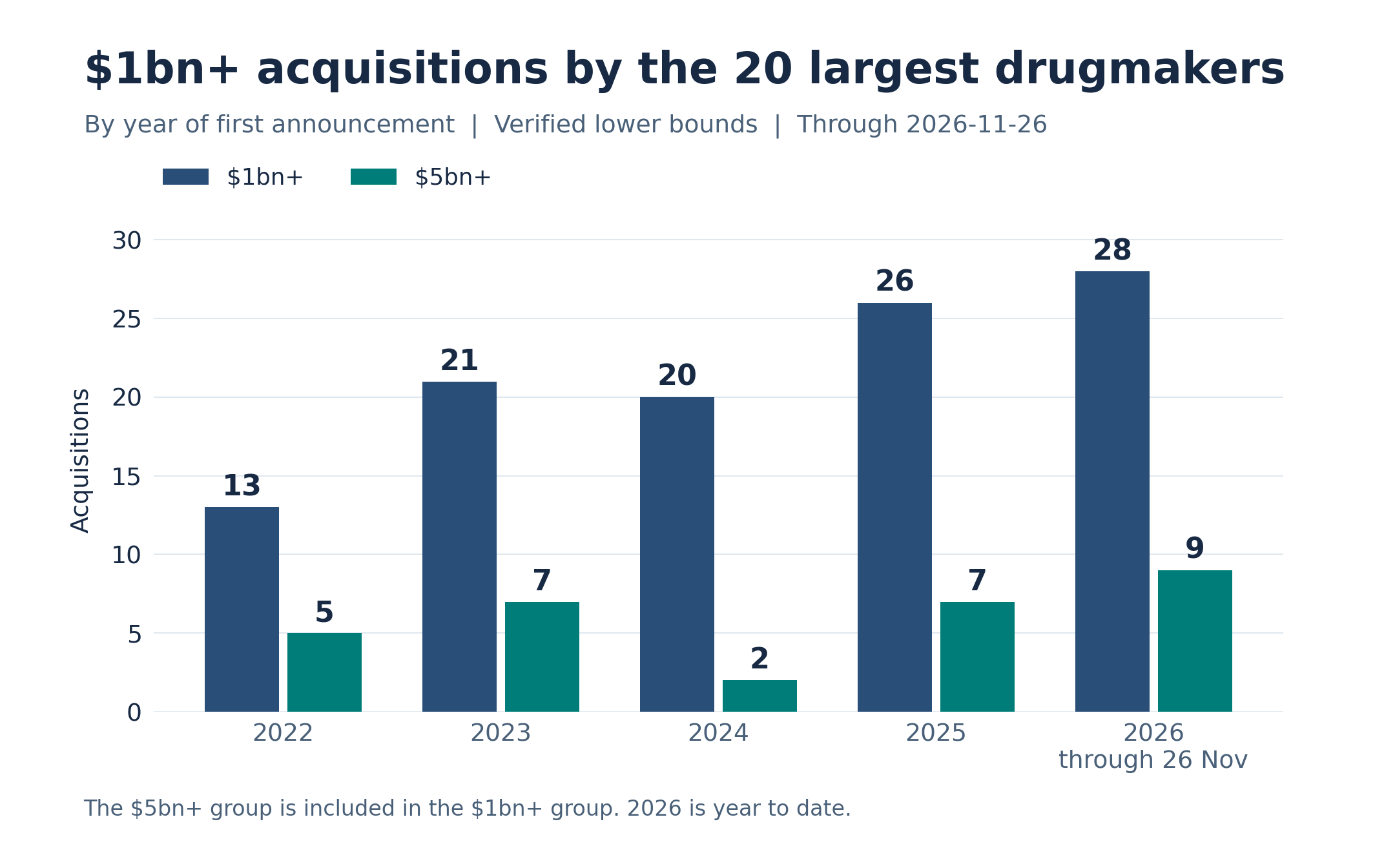
The 20 companies announced 13 acquisitions worth $1 billion or more in 2022, 21 in 2023, 20 in 2024 and 26 in 2025. By 26 November 2026 the count was already 28, including nine of $5 billion or more. Both are five-year highs.
Where the money went matters more than the total.
Of this year's 28, Eli Lilly accounts for ten, with combined headline value of about $31.9 billion including contingent payments. That is more than its seven such deals across 2022–2025. Gilead made four and Novartis three.
The two steepest cliffs: BMS zero, Merck one. BMS's last $1 billion-plus acquisition was Orbital Therapeutics ($1.5 billion) in October 2025.
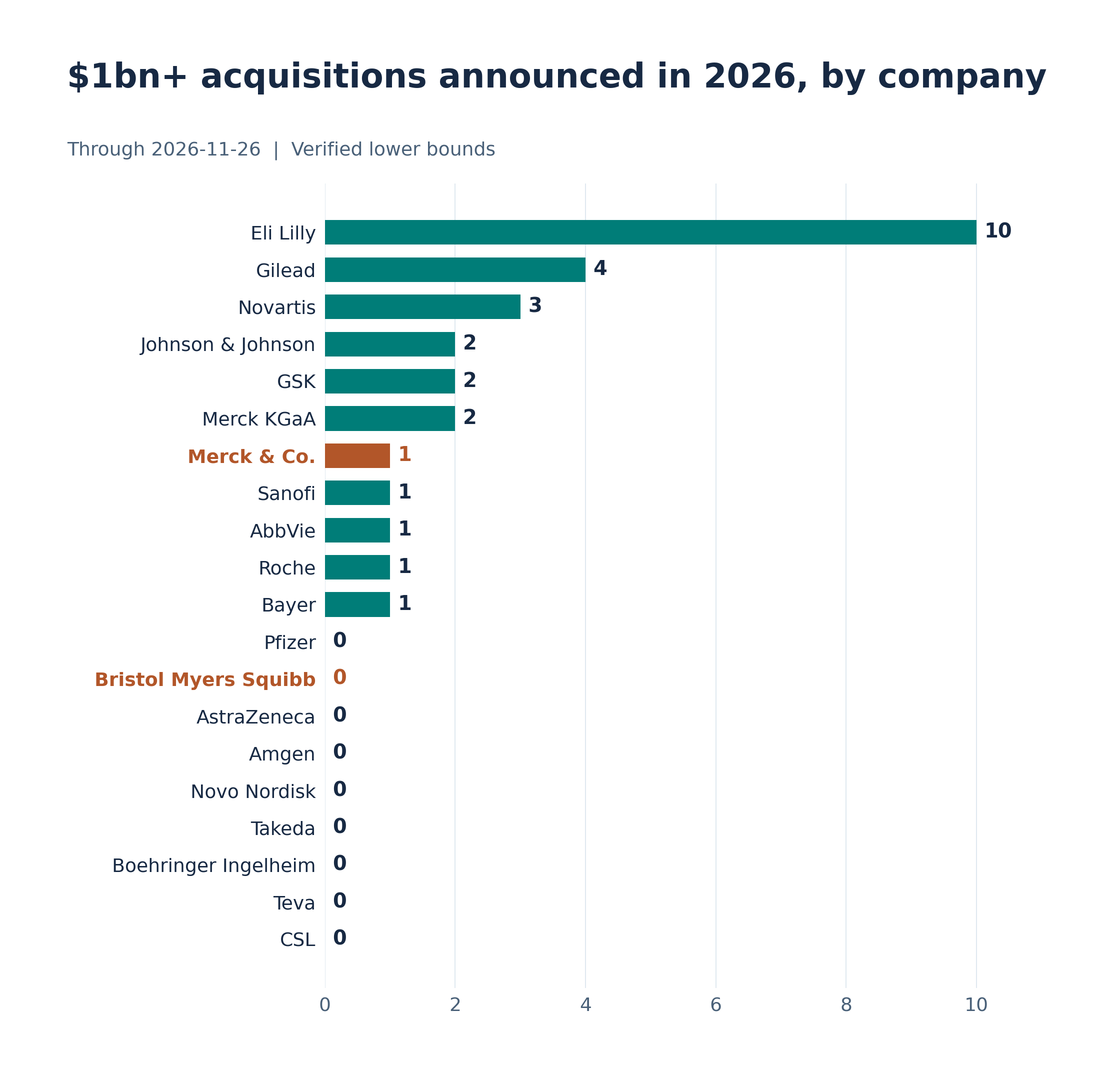
Lilly holds only $4.9 billion of cash, about half of BMS's. It buys on the strength of revenue that is still expanding: Mounjaro and Zepbound together sold $36.5 billion in 2025, 56% of the year's revenue; third-quarter 2026 revenue rose 39%, and full-year guidance was raised to $91–92 billion.
BMS and Merck are in the opposite position. Their largest products open to competition in two years, so every dollar they spend now comes out of revenue that is about to shrink.
04 | Cliff-heavy companies restock through licensing, and that is the door for Taiwan
Acquisitions are only one way to buy. In Drugnews' 19 November review of Asian out-licensing, the three companies with the steepest cliffs all appear among the large upfront payers to Chinese partners this year:
- BMS signed with Hengrui (SSE: 600276) in May and paid $600 million upfront, for a package with potential value of about $15.2 billion.
- Pfizer paid Innovent (HKEX: 1801) $650 million upfront in May for an oncology portfolio.
- Merck took global rights to SciBrunch's SPR2015 in September with a $400 million upfront payment, which its filing expects to pay in the fourth quarter.
The single largest upfront payment was AstraZeneca's $1.2 billion to CSPC (HKEX: 1093) in January.
BMS's $600 million upfront to Hengrui is 4% of the package's potential value; the rest is tied to milestones and is never paid if the drugs fail. For companies whose revenue is about to shrink, this is a bet paid in instalments.
Taiwan has one example: OBI Pharma (TPEx: 4174) disclosed in November an ADC platform licence to Novartis with $30 million upfront and potential value above $2 billion.
The deals Taiwanese companies are most likely to win are licences from drugmakers with steep cliffs and few large acquisitions this year. The preparation that matters is making instalment bets easy: assets that can be licensed on their own, clearly drawn territories and clinical data that reconcile.
05 | Four judgments we will settle in public
These calls are logged in the Drugnews judgment ledger and will be settled in public when they fall due.
- BMS will announce at least one acquisition with headline value of $1 billion or more by 30 June 2027. Confidence: 70%. It has the steepest cliff, leverage of 2.11 times leaves room, and it averaged more than one such deal a year in 2022–2025 but has none in 2026. If no such deal is announced by the deadline, we were wrong.
- Merck & Co. will not announce an acquisition with headline value of $10 billion or more by 30 June 2027. Confidence: 70%. It has spent about $25.9 billion in eight and a half months and sits at 3.19 times; bolt-ons around $5 billion are more likely. If it announces a $10 billion-plus deal by the deadline, we were wrong.
- Between 27 November and 31 December 2026, the top 20 drugmakers will announce at least two more acquisitions worth $1 billion or more. Confidence: 60%. This year has averaged 2.5 a month, and past Decembers have not been empty despite the holidays. If the year ends with zero or one more, we were wrong.
- Pfizer will not announce an acquisition with headline value of $10 billion or more by 30 June 2027. Confidence: 80%. With $1.8 billion of cash and leverage of 4.69 times, it is the most stretched of the nine. If it announces one by the deadline, we were wrong.
Sanofi used borrowing plus cash to buy a marketed drug, Brinsupri, outright. The two companies with the steepest cliffs have not bought that way this year; their answer so far is written in licensing contracts. Whether BMS switches to buying companies is judgment 1, which settles on 30 June 2027.
Methods and limits
- Cliff: fiscal 2025 revenue for each company; the earliest year US generics or biosimilars may enter, as stated in company annual reports. Products whose entry year could not be confirmed are excluded, so shares are lower bounds. Non-dollar figures use period-end European Central Bank rates.
- Cash and leverage: latest quarterly balance sheet (mostly 30 September 2026). Net debt to EBITDA recomputed from the statements; Takeda uses its disclosed adjusted ratio and Bayer EBITDA before special items; Gilead is also shown with acquired research and development costs added back.
- Acquisitions: company or asset acquisitions with headline value (including contingent payments) of $1 billion or more, first announced by the 20 companies between 1 January 2022 and 26 November 2026; licensing deals excluded. Counts are verified lower bounds.
- Spot check: five deals drawn at random were checked against company press releases (Sanofi/Insmed, GSK/Nuvalent, AbbVie/Apogee, Merck/Terns, Lilly/Centessa); amounts and dates all matched.
- Row-level data are available for download: cliff products, cash and leverage, and the 108-deal acquisition ledger (CSV).
This report is industry and company analysis, not investment or medical advice.
References
- Sanofi to acquire Insmed | Sanofi | 2026-11-24 | https://www.sanofi.com/en/media-room/press-releases/2026/2026-11-24-06-30-00-3409002
- Bristol Myers Squibb Form 10-K FY2025 | SEC | 2026-02-11 | https://www.sec.gov/Archives/edgar/data/14272/000001427226000004/bmy-20251231.htm
- Merck & Co. Form 10-K FY2025 | SEC | 2026-02-24 | https://www.sec.gov/Archives/edgar/data/310158/000031015826000063/mrk-20251231.htm
- Bristol Myers Squibb Form 10-Q Q3 2026 | SEC | 2026-10-29 | https://www.sec.gov/Archives/edgar/data/14272/000001427226000024/bmy-20260930.htm
- Merck & Co. Form 10-Q Q3 2026 | SEC | 2026-11-04 | https://www.sec.gov/Archives/edgar/data/310158/000031015826000248/mrk-20260930.htm
- Pfizer Form 10-Q Q3 2026 | SEC | 2026-11-03 | https://www.sec.gov/Archives/edgar/data/78003/000007800326000127/pfe-20260927.htm
- Johnson & Johnson Form 10-Q Q3 2026 | SEC | 2026-10-21 | https://www.sec.gov/Archives/edgar/data/200406/000020040626000197/jnj-20260927.htm
- Eli Lilly Form 10-Q Q3 2026 | SEC | 2026-10-29 | https://www.sec.gov/Archives/edgar/data/59478/000005947826000108/lly-20260930.htm
- Gilead Sciences Form 10-Q Q3 2026 | SEC | 2026-10-30 | https://www.sec.gov/Archives/edgar/data/882095/000088209526000039/gild-20260930.htm
- GSK enters agreement to acquire Nuvalent | GSK | 2026-06-09 | https://www.gsk.com/en-gb/media/press-releases/gsk-enters-agreement-to-acquire-nuvalent-inc/
- AbbVie to Acquire Apogee Therapeutics | AbbVie | 2026-06-22 | https://news.abbvie.com/2026-06-22-AbbVie-to-Acquire-Apogee-Therapeutics%2C-Deepening-Immunology-Portfolio
- Merck to Acquire Terns Pharmaceuticals | Merck | 2026-03-25 | https://www.merck.com/news/merck-to-acquire-terns-pharmaceuticals-inc-expanding-its-hematology-pipeline-with-tern-701-a-novel-candidate-for-chronic-myeloid-leukemia-cml/
- Lilly to acquire Centessa Pharmaceuticals | Eli Lilly | 2026-03-31 | https://investor.lilly.com/news-releases/news-release-details/lilly-acquire-centessa-pharmaceuticals-advance-treatments-sleep
- Bristol Myers Squibb acquires Orbital Therapeutics | BMS | 2025-10-10 | https://news.bms.com/news/corporate-financial/2025/Bristol-Myers-Squibb-Strengthens-and-Diversifies-Cell-Therapy-Portfolio-with-Acquisition-of-Orbital-Therapeutics/default.aspx
- Asia biotech out-licensing 2026: what buyers actually paid | Drugnews | 2026-11-19 | https://drugnews.com.tw/reports/asia-out-licensing-2026.html
- Takeda FY2026 Q2 Earnings Presentation (Adjusted Net Debt / Adjusted EBITDA) | SEC 6-K | 2026-10-29 | https://www.sec.gov/Archives/edgar/data/1395064/000139506426000343/exhibit991_102926.htm
- Bayer Quarterly Statement Q3 2026 | Bayer | 2026-11-03 | https://reports.bayer.com/quarterly-statement-q3-2026/en/_assets/downloads/entire-bayer-ir326.pdf
- Obesity drugs, the next race: capacity, oral pills and who pays | Drugnews | 2026-11-19 | https://drugnews.com.tw/reports/obesity-drugs-next-race-2026.html