
Chapter 1 | Why the FDA looked beyond progression-free survival
For people whose lung cancer progresses after an EGFR-targeted drug, adding time with disease under control has value. HARMONi asked whether adding ivonescimab to chemotherapy delays progression and extends life. The randomized, double-blind global Phase III trial enrolled 438 participants. Both groups received chemotherapy, with the control group receiving placebo. The comparison measures the effect of adding ivonescimab in this treatment setting. A first-line trial that switches the immunotherapy component of an active combination asks a different clinical question. [2]
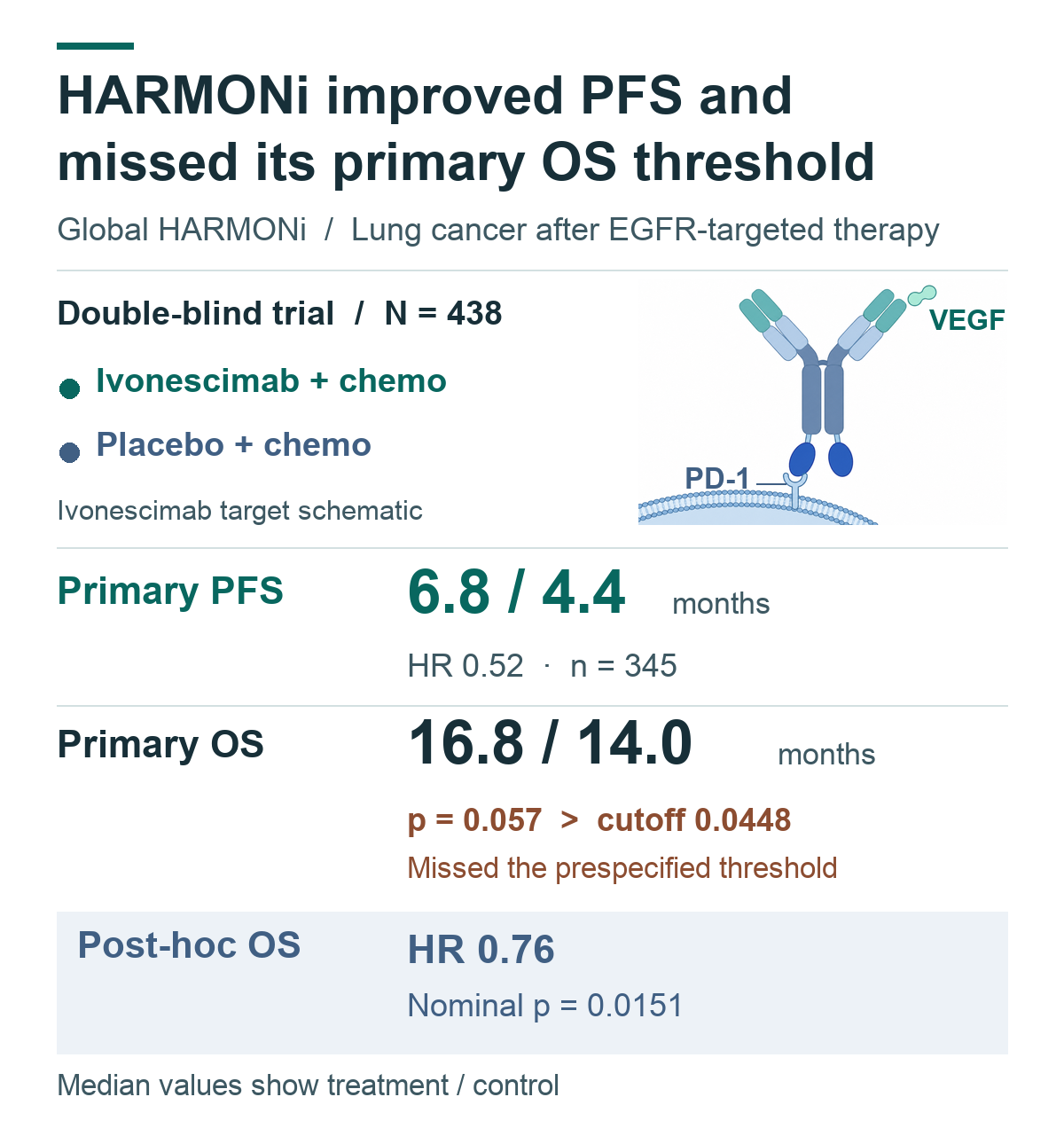
PFS records the time to progression or death. OS measures time to death from any cause. Patients may stop treatment, take another therapy, or experience toxicity in the period between the two endpoints. Delaying progression has its own clinical value. Assessing whether the delay translates into longer life requires enough death events and the test specified in the study plan. A progression curve supplies information about disease control. The survival curve and statistical plan determine what can be said about the full treatment course. [2][3]
In the 345-participant primary PFS analysis of HARMONi, median PFS was 6.8 months with ivonescimab plus chemotherapy and 4.4 months with placebo plus chemotherapy, with a hazard ratio (HR) of 0.52. In the primary OS analysis, median survival was 16.8 versus 14.0 months, with an HR of 0.79 and a 95% confidence interval of 0.62–1.01. The p-value of 0.057 exceeded the prespecified boundary of 0.0448. The medians describe points on the two survival curves. The hazard ratio and confidence interval help interpret the comparison over follow-up. The primary analysis established a PFS benefit, and the primary OS test fell short. [2][3]
Longer follow-up gives another view of the same trial. The post-hoc analysis with a June 2026 cutoff reported an OS HR of 0.76 in the global intention-to-treat population, with a nominal p-value of 0.0151. Asian data remained at the earlier cutoff. This analysis allows readers to assess whether the estimated effect persisted and examine its consistency across regions. The original conclusion is tied to the primary analysis, its event count and statistical boundary. Whenever the later p-value appears in a table, the designation “post-hoc” belongs in the same row. [4]
Survival goes together with treatment burden. In the HARMONi safety population, grade 3 or higher treatment-related adverse events occurred in 50.0% of patients in the experimental arm and 42.2% in the control arm. A reader needs the types of events, their severity, discontinuations and exposure alongside the rates. Where disease control improves and the primary survival test falls short, those details have particular weight in the benefit–risk assessment. [33]
Post-treatment care also matters to OS. Access to later therapies can vary by region, and different enrollment periods can leave regions with unequal follow-up. A multiregional analysis should make the death events and subsequent treatment in each arm visible, identify prespecified regional analyses and show where small groups limit interpretation. These details can explain why estimates differ across studies of the same drug and make the regulatory question more specific. [3][4]
According to Summit, the FDA concluded that the submission lacked substantial evidence of effectiveness in the absence of a statistically significant OS improvement and that the demonstrated PFS benefit did not support approval on the existing benefit–risk evidence. The FDA signed the complete response letter on November 13, 2026. Summit announced it on November 15. The exact receipt date is not disclosed. The published FDA letter notes that 257 of the 275 primary PFS events were from patients enrolled in China. The FDA recommends a new multiregional controlled trial showing a statistically significant and clinically meaningful improvement in OS, PFS, or another clinical benefit endpoint that outweighs the observed toxicity. [1]
The next trial also has to face a comparator that may have changed. A new standard regimen can raise the evidentiary threshold or make a trial more relevant to current practice. PFS speaks to disease control. The survival comparison, the size of the effect and the burden of treatment help determine which clinical claims and commercial commitments a program can support. [1][2][3]
Chapter 2 | Akeso's survival results answer several different questions
China's HARMONi-A is closest to the setting in the U.S. application. After prior EGFR-targeted treatment, it compared ivonescimab plus chemotherapy with placebo plus chemotherapy and used PFS as the primary endpoint. The final OS analysis reported medians of 16.8 and 14.1 months, an HR of 0.74 and a p-value of 0.019. This positive result belongs to the study that generated it. Patients enrolled in China in global HARMONi also participated in HARMONi-A. Reading it alongside global HARMONi can show where the estimates agree and where a regulatory assessment still has to consider population and trial differences. [5][3]
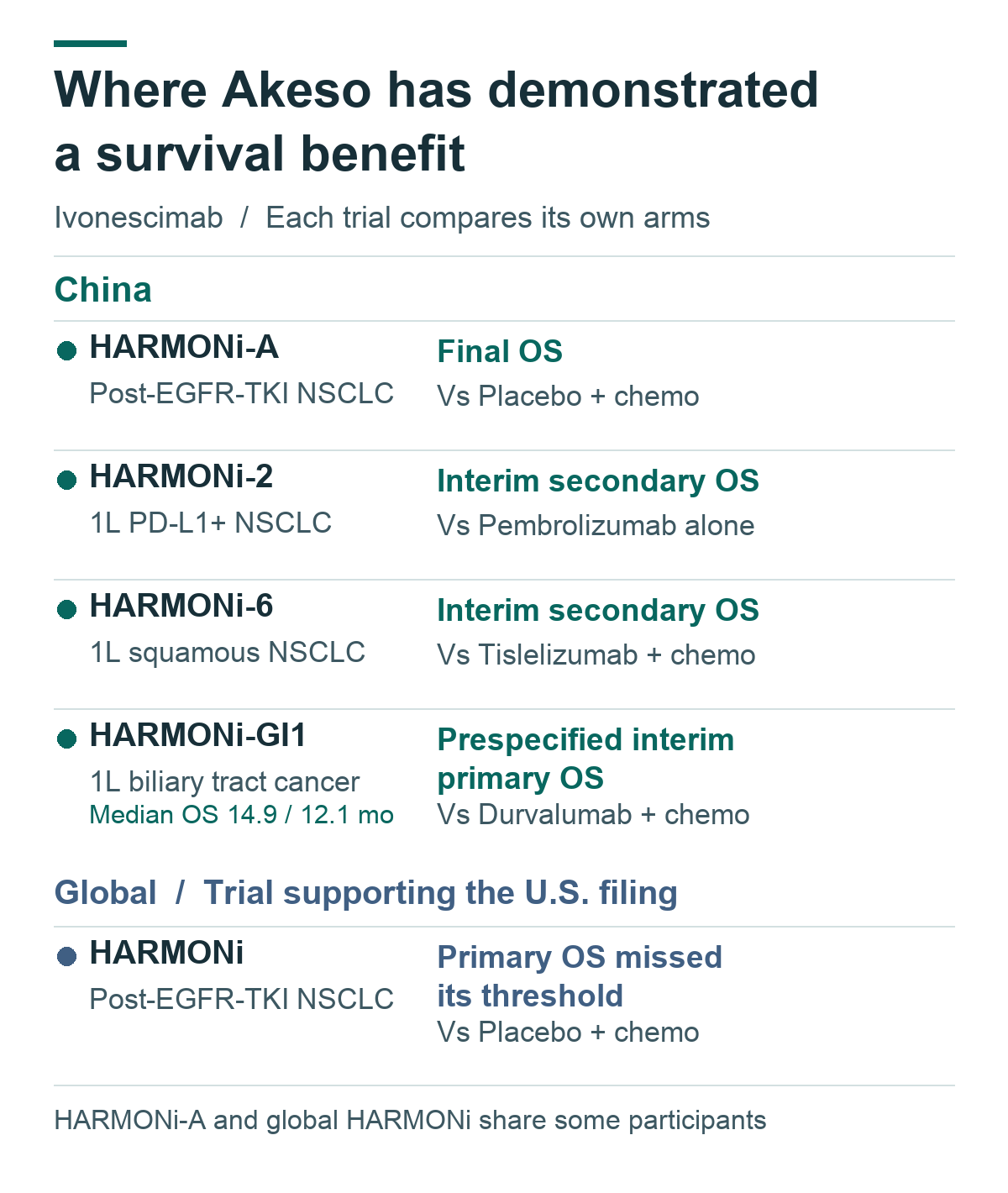
China's first-line NSCLC trials tested active immunotherapy comparators. In HARMONi-2, patients with PD-L1-positive disease received ivonescimab or pembrolizumab as a single agent. The HR for primary PFS was 0.51. The prespecified interim analysis of secondary OS produced an HR of 0.73 with p=0.009. In HARMONi-6, patients with first-line squamous disease received either ivonescimab or tislelizumab, each with chemotherapy. Interim OS was 27.89 versus 23.69 months, with an HR of 0.66 and p=0.0017. Relative effects apply within each randomized comparison. A size ranking across these two results would put a single-agent question and a chemotherapy combination question into the same column. [6][7]
Chinese lung cancer authorizations can be traced to the corresponding trials. The May 2024 authorization after an EGFR TKI followed HARMONi-A. The April 2025 first-line monotherapy authorization in PD-L1-positive disease followed HARMONi-2. The August 2026 first-line chemotherapy combination authorization in squamous NSCLC followed HARMONi-6. The approval and evidence each have an indication and a geography. Trial names also anchor the analysis stage and the particular standard of care used in the comparator group. [32]
Biliary tract cancer offers the clearest instance of a win on a primary survival endpoint. In China's HARMONi-GI1 trial, Akeso randomized patients receiving first-line treatment to ivonescimab or durvalumab, both with chemotherapy. Summit reported the top-line outcome on August 25, 2026, and Akeso presented detailed results on October 25, 2026. The prespecified interim primary OS analysis showed a median of 14.9 months versus 12.1 months, with an HR of 0.75 and p=0.0031. Secondary PFS also improved, at 8.4 versus 5.8 months. The first disclosure established that the endpoint was met. The later disclosure allowed readers to evaluate effect size. [8]
Using an existing immunotherapy plus chemotherapy regimen as the comparator makes the biliary result relevant to a real first-line treatment choice. The disease, comparator and geography differ from the HARMONi lung cancer application. Summit is participating in ECOG-ACRIN's EA2251, a Phase II/III first-line biliary tract cancer study with a primary OS endpoint. U.S. site activation was expected to begin in the fourth quarter of 2026. Site activation starts the collection of evidence. A public survival analysis will depend on accrual and follow-up. [8][11]
Different control groups also represent different clinical decisions. A placebo on top of chemotherapy measures what adding a drug contributes to a shared treatment. An active immunotherapy comparator measures the effect of switching between named regimens. When both groups receive chemotherapy, eligibility for that backbone also shapes the clinical decision. This distinction helps explain how similar relative effects in different trials can support different development paths. [2][5][6][7][8]
Akeso's lead consists of observable clinical results under several designs. The China studies can inform where to run a study in other regions and which regimen to choose as the control. Multiregional work can test how well the results travel across enrollment settings. Primary interim OS, secondary interim OS, final OS and extended post-hoc follow-up each have a place in that assessment. New evidence changes the lead when it addresses a missing population or treatment comparison. [3][4][5][7][8][11]
Chapter 3 | Summit has the earlier window as Pfizer takes on the same comparator
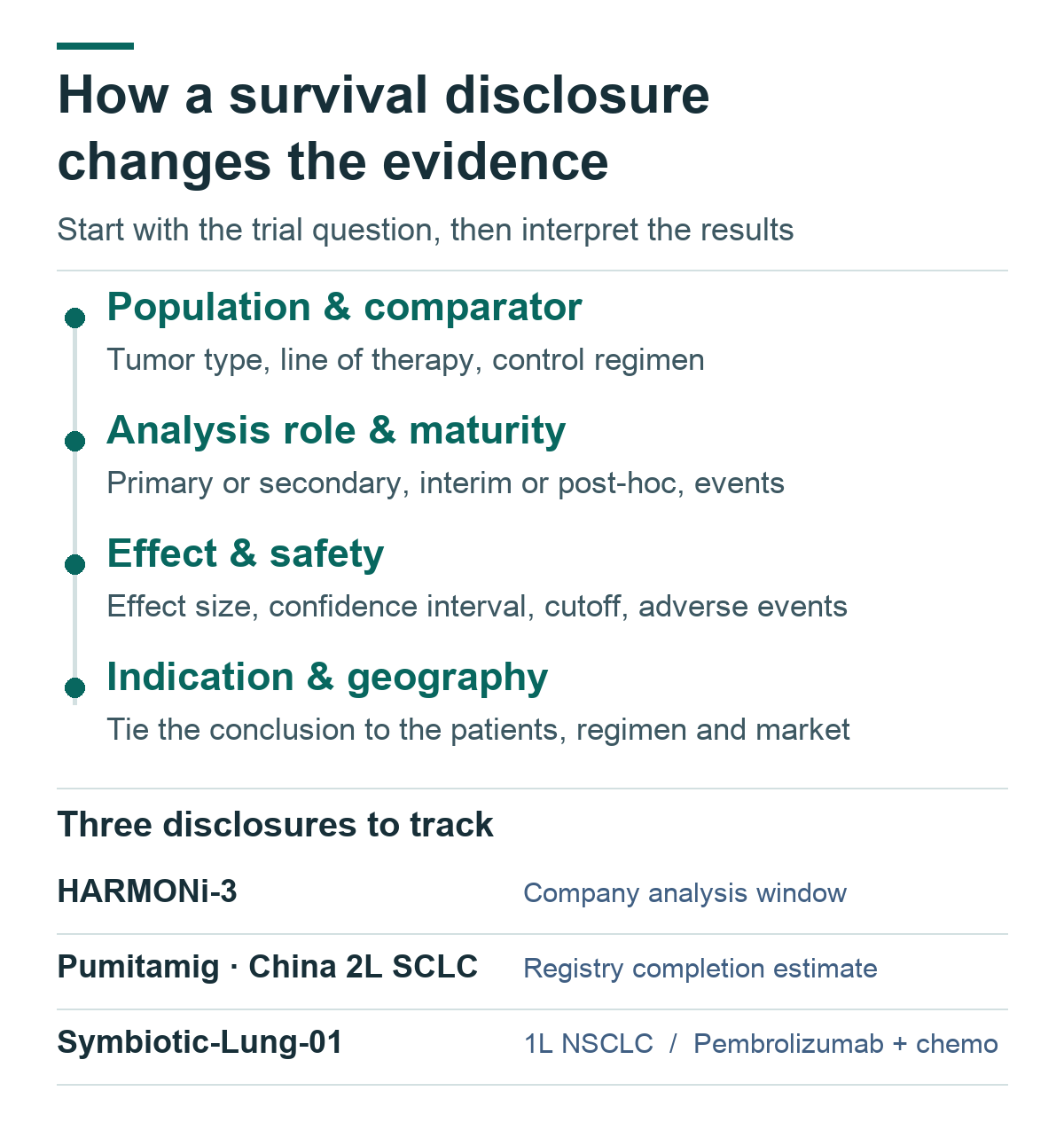
In global first-line non-small-cell lung cancer (NSCLC), the question is whether a new bispecific plus chemotherapy extends survival relative to pembrolizumab plus chemotherapy. Both Summit's HARMONi-3 and Pfizer's Symbiotic-Lung-01 use that comparator and put PFS and OS among the primary endpoints. Each bispecific is tested against its own control. An eventual comparison also needs histology, the chemotherapy backbone, the makeup of the PD-L1 subgroups, stratification and the maturity of the respective analyses. [9][12]
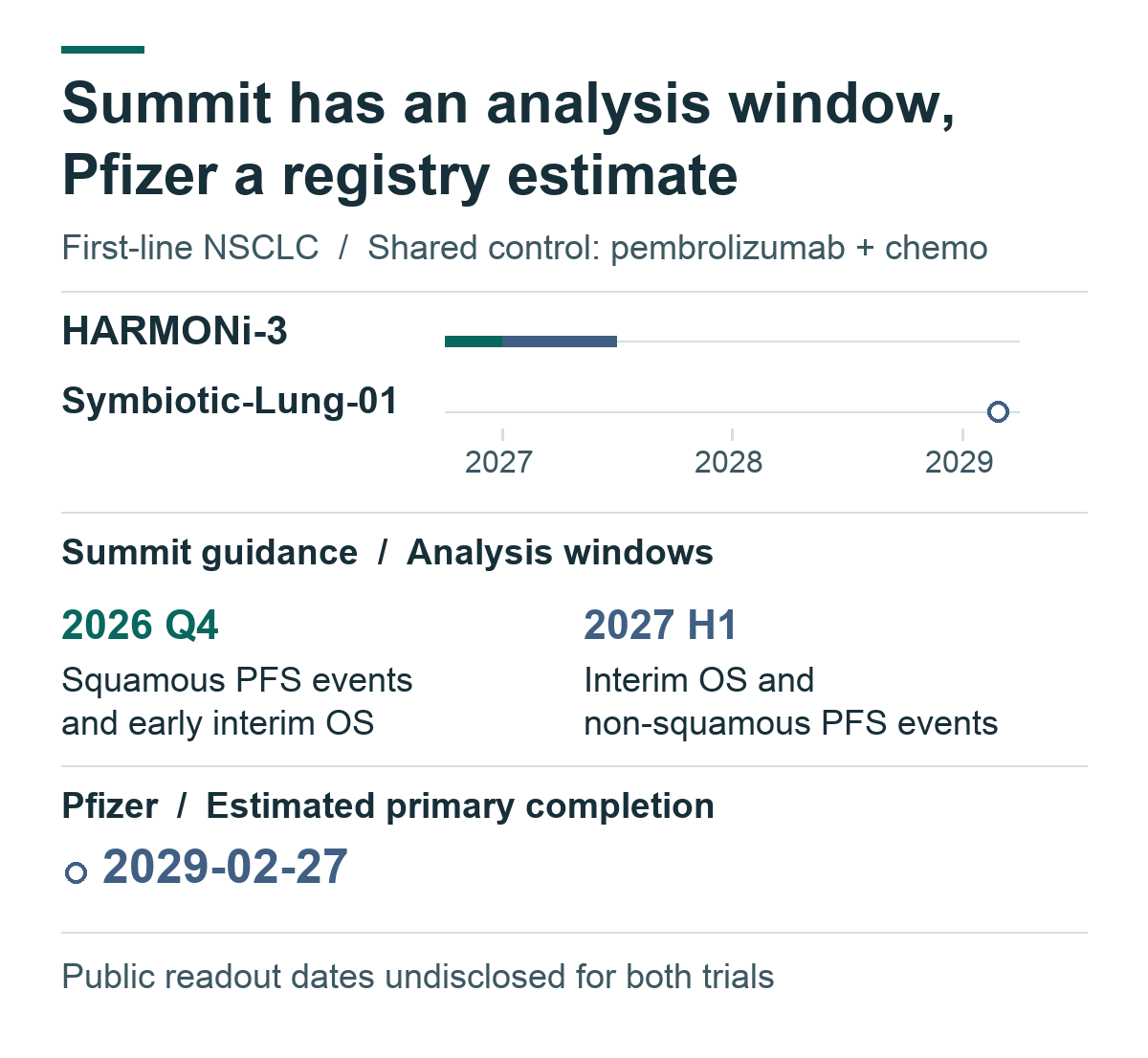
Summit's HARMONi-3 separates the analyses for squamous and non-squamous disease. The company expected enough squamous PFS events for the primary analysis in the fourth quarter of 2026, with a planned early interim OS analysis alongside it. It also plans a separate interim OS analysis independent of PFS in the first half of 2027, when it expects the required non-squamous PFS event count. This is the earliest identifiable sponsor-guided analysis window in the global first-line comparison. Event accrual, analysis and publication have separate dates. The public reporting date is not disclosed. [9]
An early interim result is useful when readers have enough information about event counts, statistical boundaries and follow-up. Crossing a prespecified boundary can change the ranking sooner if the effect, safety and population are interpretable. A disclosure of PFS alone, or an OS estimate without sufficient maturity, leaves the principal survival question open. If the two histologies report in stages, a conclusion initially applies to the histology analyzed. [9]
HARMONi-7 tests monotherapy in first-line NSCLC with high PD-L1 expression, comparing ivonescimab directly with pembrolizumab. Its registry lists an estimated 780 participants, PFS and OS as primary endpoints and an estimated primary-completion month of April 2028. It takes a question raised by China's HARMONi-2 into a narrower, multiregional population. Even if HARMONi-3 succeeds, monotherapy patients still need evidence on their own survival and treatment burden. [6][10]
Pfizer's Symbiotic-Lung-01 plans to enroll 1,410 participants across squamous and non-squamous advanced first-line NSCLC. It compares tivunatamig plus chemotherapy with pembrolizumab plus chemotherapy. OS and independently reviewed PFS are both primary endpoints. The estimated primary-completion date is February 27, 2029. The design makes Pfizer the most direct parallel global challenger in this comparison. Estimates of completion help readers track the study, while a public OS date is not disclosed. [12]
Chinese Phase II data support moving into the pivotal study. The 3SBio update reported median PFS of 13.6 versus 8.3 months in the squamous cohort and 13.8 versus 9.7 months in the non-squamous cohort, using tislelizumab plus chemotherapy as the comparator. A separate Chinese Phase III monotherapy trial in first-line PD-L1-positive disease compares tivunatamig with pembrolizumab and plans to enroll 420 participants. PFS is primary and OS secondary. Its June 24, 2025 registry update projected July 30, 2026 as primary completion. The date has elapsed and a public OS date remains unverified. The Chinese combination, Chinese monotherapy, and Pfizer global trials track different clinical questions. [13][14]
Meeting the entry criteria is one part of using a regimen. Treatment exposure, completion and discontinuations help a clinical center judge whether a favorable estimate is likely to matter in routine care. A mature result should give exposure and safety alongside survival. If survival improves while discontinuations or treatment-related interventions increase, the implications for practice depend on the histology and patients for whom the tradeoff is relevant. An early interim OS estimate should be understood within its analyzable population. [9][12][33]
Summit therefore has the earlier visible opportunity for a global first-line OS analysis. Pfizer has set up a parallel trial against the same immunotherapy and chemotherapy standard. If Summit discloses an interpretable result that meets the prespecified survival test, the first conclusion applies to the histology reported. If Pfizer provides a qualifying result sooner, the public evidence order changes. [9][12]
Chapter 4 | BMS, Merck and AbbVie are pursuing different kinds of answers
BioNTech and BMS are co-developing pumitamig, which targets PD-L1 on the checkpoint side. A Chinese Phase III study in second-line small-cell lung cancer (SCLC) compares pumitamig plus paclitaxel with chemotherapy and uses OS as its primary endpoint. The registry estimate is 404 participants and primary completion in May 2027. BioNTech has reported that enrollment stopped and follow-up continues. The planned sample size does not establish actual enrollment, and timing depends on the events accumulated in follow-up. If this study reports soon, its conclusion will concern second-line SCLC in China. [15]
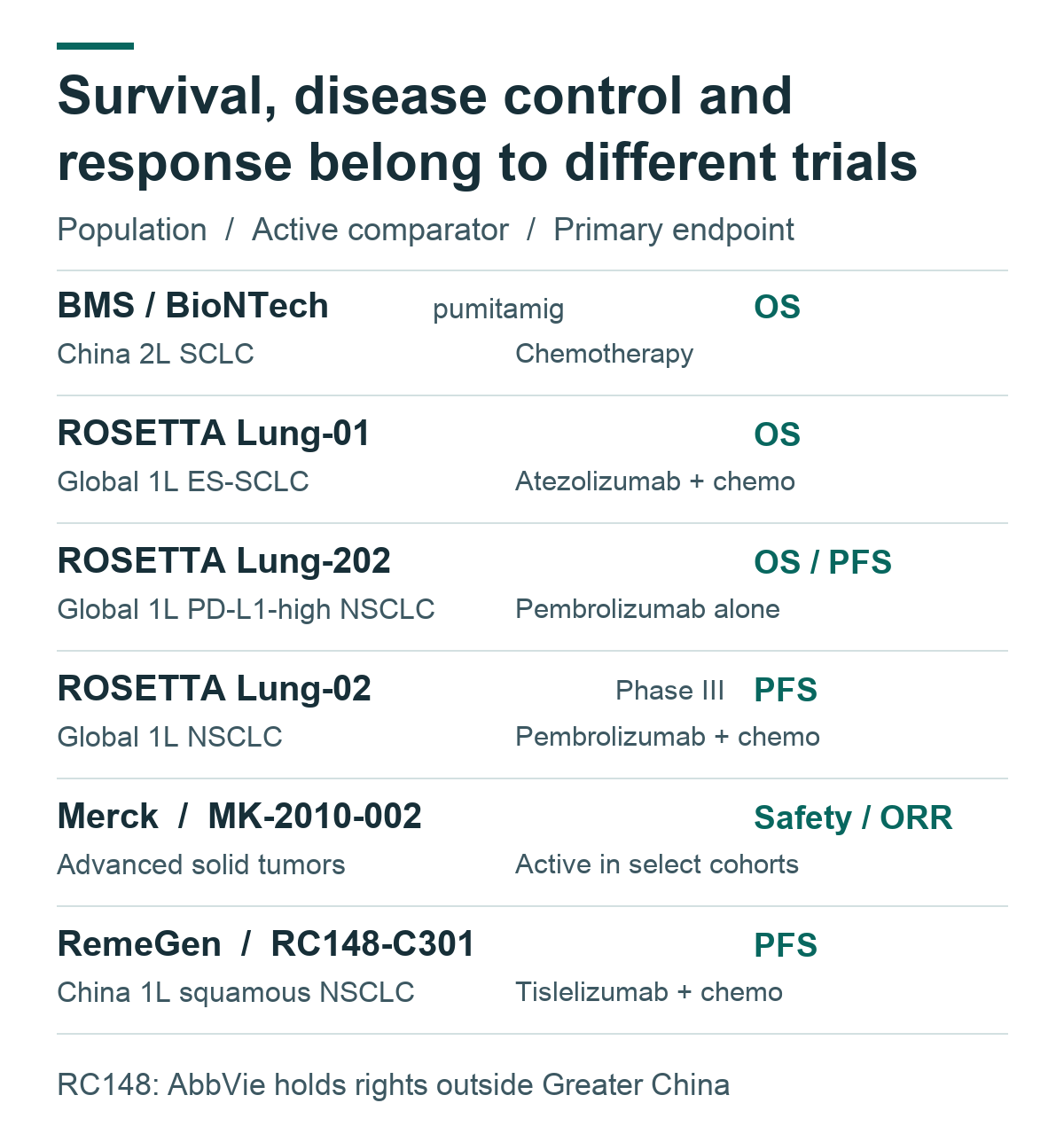
The partners also have a global monotherapy comparison in the high PD-L1 population. In Phase III ROSETTA Lung-202, patients with previously untreated advanced NSCLC and PD-L1 expression of at least 50% receive either single-agent pumitamig or pembrolizumab. PFS and OS are primary, with 750 planned participants and estimated primary completion on October 14, 2031. This is a parallel comparison for HARMONi-7. Both studies answer a different question from Pfizer’s chemotherapy combination trial. [10][34]
Global ROSETTA Lung-01 tests pumitamig plus chemotherapy against atezolizumab plus chemotherapy in first-line extensive-stage SCLC. It lists a primary OS endpoint, an estimated 621 participants and estimated primary completion in April 2029. ROSETTA Lung-02 is a Phase II/III first-line NSCLC study. The Phase III primary endpoint is PFS assessed by blinded independent central review, with primary completion estimated for January 2029. The program names and dates are similar. Endpoint and patient population are what distinguish the answers. [16][17]
ROSETTA Breast-01, in first-line PD-L1-negative advanced triple-negative breast cancer, lists primary PFS and OS, estimated enrollment of 558, placebo plus physician’s choice of chemotherapy as the comparator, and estimated primary completion in December 2029. BioNTech has disclosed a plan to replace the chemotherapy backbone with sacituzumab govitecan, subject to regulatory approval. Until the registry changes, the amendment and the currently registered scheme should appear as separate statuses. A change in background therapy matters to the clinical question that the study will answer. [18]
Merck acquired global rights to LaNova's MK-2010 and is evaluating how to use it as a single agent or in combinations across solid tumors. MK-2010-002 is a Phase II study with an estimated 480 participants. Some cohorts use pembrolizumab plus FOLFOX as a comparator. The primary outcomes center on adverse events, adverse events leading to discontinuation, dose-limiting toxicities, and objective response rate (ORR). Estimated primary completion is September 26, 2028. A separate Phase II study with sac-TMT estimates 200 participants and primary completion on September 30, 2031, also with safety and response as the primary measures. These studies can identify settings and regimens to take forward. The registry dates concern those Phase II endpoints. [19][20][27]
RemeGen's Chinese Phase III RC148 study in first-line squamous NSCLC estimates 574 participants and compares RC148 with tislelizumab, both with chemotherapy. PFS is primary, with primary completion estimated for December 31, 2027. The comparator makes the study's question relevant to HARMONi-6. Each effect estimate still belongs to its own randomization, population and data cutoff. AbbVie's rights outside Greater China create a separate pathway. Its eventual external-market comparator and public trial design will help establish how that pathway fits the global competition. [7][21][28]
The landscape contributes additional watch cases. Junshi's registered Phase III in first-line liver cancer compares JS207 plus JS007 with toripalimab plus bevacizumab, with PFS and OS as primary endpoints. The registry listed it as not yet recruiting and estimated primary completion for October 30, 2029. The representative HB0025 endometrial and SCTB14 lung cancer trials use primary PFS. Henlius's registered HLX37 Phase II/III program lists PFS and OS in the Phase III portion. Those registrations identify questions to track. They supply no comparative survival results on their own. [22][23]
BioNTech and BMS are building survival evidence across distinct tumors and treatment lines. Merck is identifying populations and combinations, while AbbVie licensed an asset that already has Chinese Phase III development. Each new announcement needs its endpoint and setting alongside the date. A change in the global first-line NSCLC comparison requires an update that answers that clinical question. [15][16][19][21][28]
Chapter 5 | What the partners have paid for
Upfront payments show what risk a partner has already assumed. Conditional payments show where the partners chose to defer it. Cash, equity, technology transfer, option premiums and scheduled collaboration payments buy different things. Before comparing deal values, identify the territory, the form of joint commercialization or license, and the event that can trigger each payment. [24][25][26][27][28]
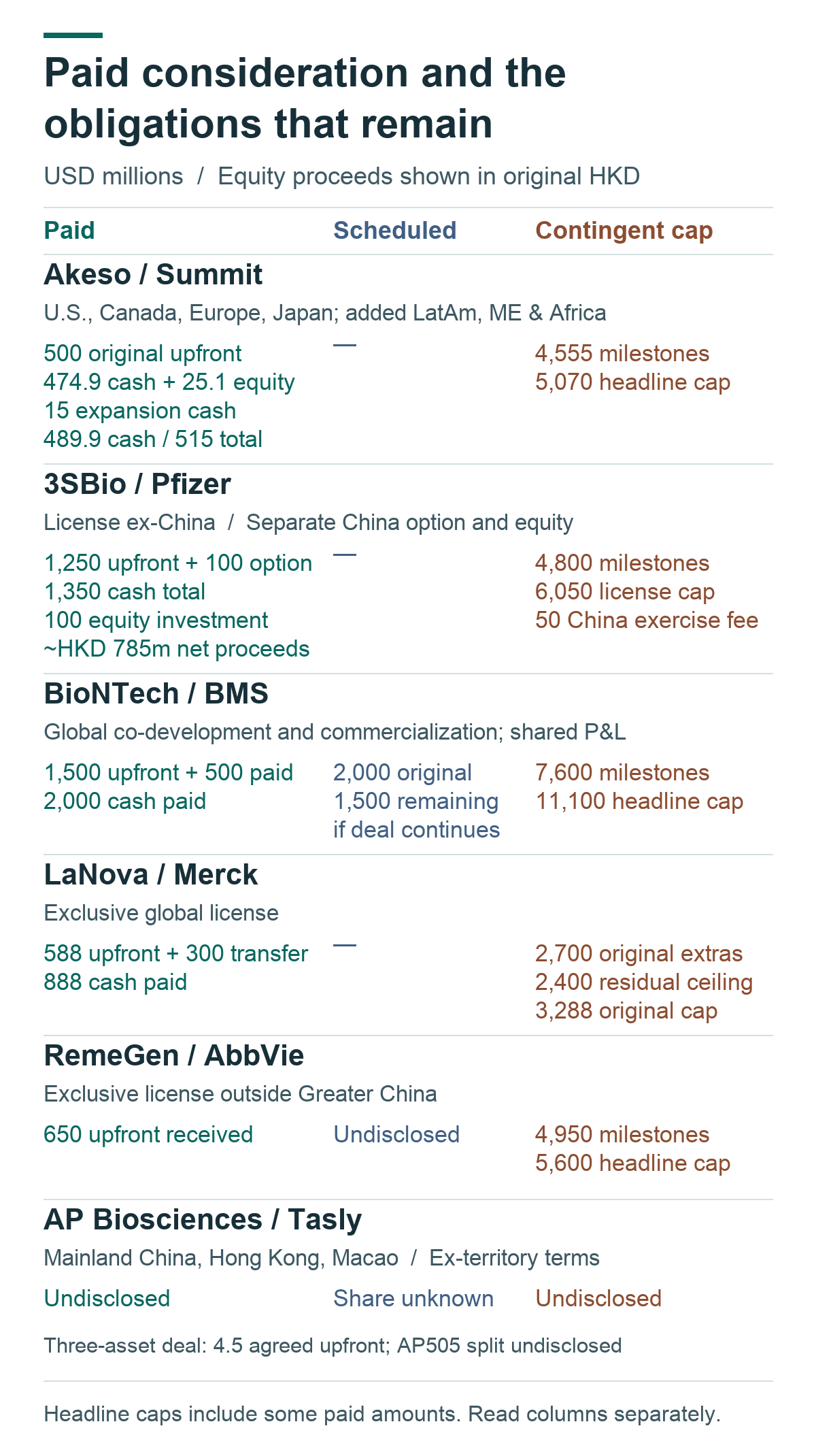
| Partners and rights | Documented payment | Scheduled or conditional portion and headline ceiling |
|---|---|---|
| Akeso / Summit. U.S., Canada, Europe and Japan originally. Latin America, Middle East and Africa added later. | Original US$500m upfront included US$474.9m cash and US$25.1m agreed equity consideration. Expansion added US$15m cash. Confirmed totals are US$489.9m cash and US$515m upfront consideration. | The Q3 2026 report lists up to US$4,555m in prospective milestones. Combined headline consideration reaches US$5,070m excluding royalties. [24] |
| 3SBio / Pfizer. Exclusive ex-China license, with a separate China rights option. | Pfizer confirms US$1,250m licensing upfront and US$100m option premium, totaling US$1,350m. The separate US$100m equity subscription closed, with about HK$785m in net proceeds. [35] | Up to US$4,800m in licensing milestones, for a US$6,050m license ceiling. The separate exercise fee is up to US$50m, with updated exercise status unverified. Royalties are additional. [25] |
| BioNTech / BMS. Global co-development and commercialization with equal sharing of profits and losses. | US$1,500m upfront received. BMS paid the first US$500m anniversary installment. Documented payments total US$2,000m. | US$2,000m originally scheduled in anniversary installments, with US$1,500m remaining on the disclosed payment basis and subject to contract continuation. Up to US$7,600m in conditional milestones. The headline ceiling is US$11,100m. [26] |
| LaNova / Merck. Exclusive global license. | US$588m upfront and US$300m for technology transfer, totaling US$888m in documented payments. | US$2,700m original additional ceiling included the transfer. Disclosed residual milestone categories total up to US$2,400m after transfer. A current payable balance is unverified. The original headline ceiling was US$3,288m. [27] |
| RemeGen / AbbVie. Exclusive rights outside Greater China. | RemeGen confirms receipt of US$650m upfront. | Up to US$4,950m in milestones, for a US$5,600m headline ceiling. Tiered double-digit royalties are separate. Further individual payments are not disclosed. [28] |
| AP Biosciences / Tasly. Original rights for mainland China, Hong Kong and Macao, plus a framework for out-licensing elsewhere. | AP505-specific upfront and aggregate payments are not disclosed. | The amendment covers revenue allocation and data and manufacturing rights. Revenue share, milestones and any new out-of-territory deal value are not disclosed. [29] |
The original Summit upfront included shares at an agreed value. The later cash payment bought more territories. An equity position's market value can change, while the contractual consideration records what was delivered under the agreement. AstraZeneca separately closed an equity investment in Summit on October 5, 2026, which Summit recorded at US$2,000m in gross proceeds. The cash went to Summit. Receipts at Akeso are reconciled against its license agreement. [36] New regulatory or sales milestones have to meet their own conditions. The U.S. complete response letter affects a specific application, so it cannot determine the fate of every market or future payment. [1][24]
Pfizer's filing separates the cash license upfront from the already paid option premium and the possible exercise fee. 3SBio reports front-end proceeds in aggregate, whereas the payer's filing allows a precise split. The completed subscription proceeds purchased shares. [35] Any eventual sales royalties follow contractual terms. Maintaining separate columns keeps these obligations comparable over time. [25]
The BMS collaboration spreads development and commercial outcomes across two partners. Merck's transfer payment reflects a delivered capability to advance the program. AbbVie's confirmed payment purchased regional license rights. These transactions embed distinct obligations. A meaningful price comparison requires the rights and development responsibilities attached to that price. Public terms in this report support a comparison of obligations and documented payments. They leave project net returns and asset present value undetermined. [26][27][28]
The form of payment also shows how the partners plan to work together. A regional license assigns development, regulatory and commercial work for a territory. A global collaboration distributes trial costs, arrangements for launch and proceeds across partners. A successful trial strengthens a clinical claim. Which party can realize the resulting value in each market depends on the agreement. An amendment that clarifies data and manufacturing rights can materially improve what a partner can take over. Progress then depends on delivery of usable data and supply. [24][26][28][29]
Further towards launch, payment prospects depend on the scope of the eventual label. Exclusive regional rights reserve an opportunity to launch. The population a drug can realistically serve depends on the approved cancer, treatment line and biomarker requirements. Reimbursement, the timing of competing products and treatment duration also shape realized sales. Given incomplete labels and pricing information, the deal table compares commitments already made and the terms that govern future payments. Each can be revised when the relevant payment or label changes. [24][25][26][28]
A scheduled anniversary installment and a possible regulatory milestone belong in separate parts of the unpaid column. Future filings can move individual items to the paid column and show whether they already form part of the original headline ceiling. That distinction lets clinical, investor relations and business-development teams update the same ledger without treating a restatement of the contract as fresh cash. [24][25][26][27][28]
Chapter 6 | How Taiwan's AP505 can turn regional data into a global program
AP Biosciences' AP505, also known as B1962, targets PD-L1 and VEGF. In 2019 the company granted Tasly development, manufacturing and commercial rights in mainland China, Hong Kong and Macao. On March 30, 2026, the companies finalized a supplement spelling out revenue allocation and obligations for data use, disclosure, confidentiality, manufacturing know-how and patents as AP Biosciences pursues opportunities beyond the original territory. A prospective partner can now ask which clinical data it could use, in what markets, and who would handle supply and development. [29]
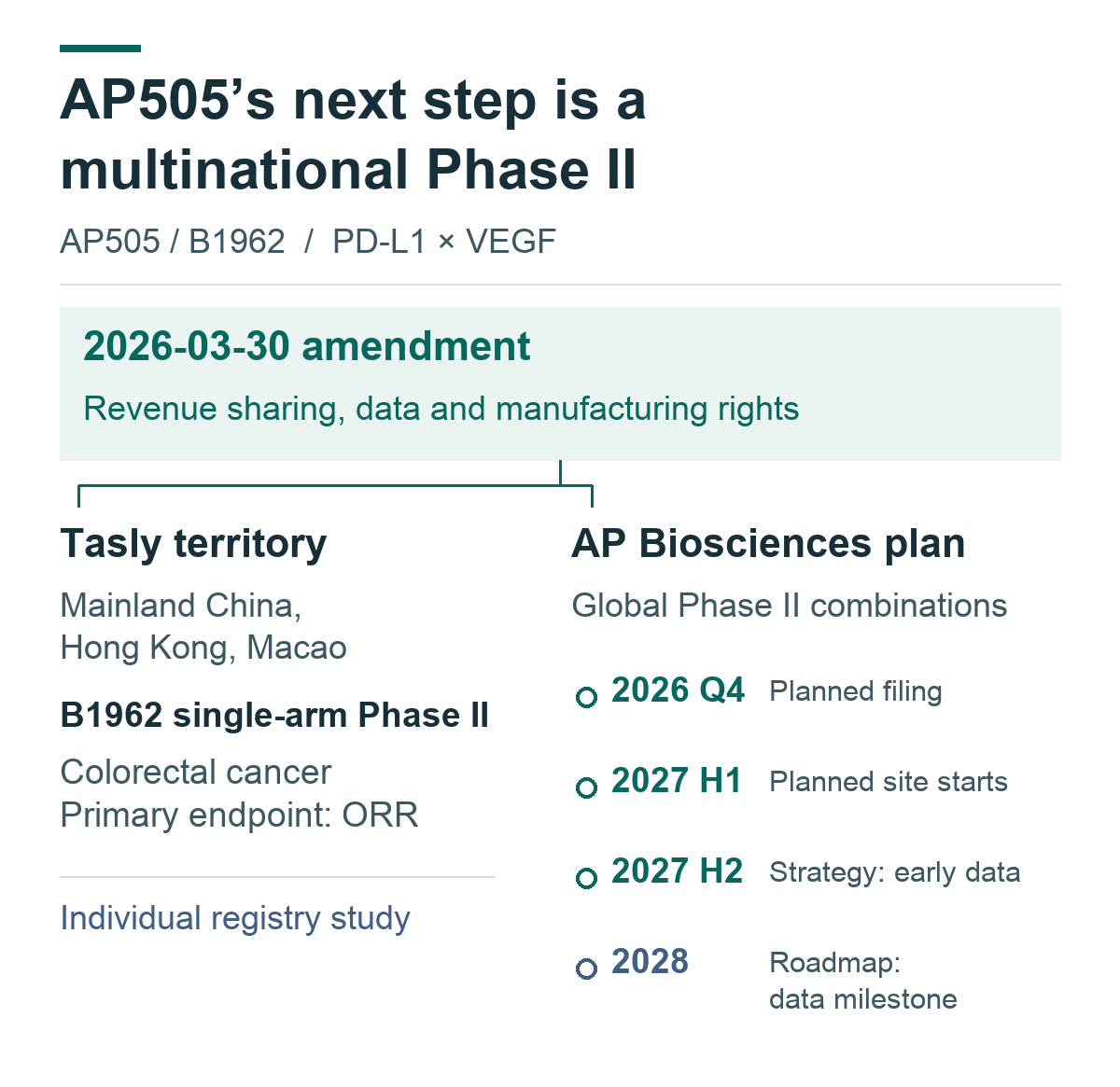
AP Biosciences reported completion of Phase I and ongoing Tasly-led Phase II development in the territory. The colorectal cancer record NCT06838546 describes an open-label, single-arm Phase IIb study, 80 planned participants, and ORR as the primary endpoint, with no active comparator. Its February 20, 2025 registry update still showed that particular study as not yet recruiting, with estimated primary completion on January 1, 2027. The company update is newer and covers the asset's broader progress. The two sources have different scope. Prospective partners need to confirm the status of the individual study before drawing conclusions about its dates. [29][30]
The November investor presentation outlines a staged global Phase II combination program in biliary tract and colorectal cancer. The plan uses dose and indication exploration followed by assessment of response and safety. The strategy slide calls for a filing in the fourth quarter of 2026, starts in Australia, Taiwan and South Korea in the first half of 2027, and early data in the second half. The overarching pipeline slide separately lists a global Phase II data milestone in 2028. Both statements should be checked against an eventual trial registration and an issuer announcement defining the data tranche. A public comparative OS date remains unverified. [31]
For a research team in Taiwan, the public trial registration is an observable handoff from an investor presentation to a program that sites, patients and prospective collaborators can examine. If the registered indication differs from the plan, revisit eligibility, regimens and primary endpoints. The completeness of these records determines whether partners can put AP505 into the same diligence matrix as other assets. Clinical positioning will shape which ex-territory rights and responsibilities make sense. [29][30][31]
A transferable dataset is valuable alongside early tumor responses. A partner will need to understand where patients enrolled, their treatment history, assessment schedule, and adverse-event reporting. An in-territory signal can help the ex-territory team select the combination, comparator and endpoint for its own study. The amendment deals with the sharing of rights and data. A registered protocol and data quality will determine how much clinical work a partner can build on. [29][30][31]
Akeso's biliary tract trial shows that an interpretable survival comparison is possible in a defined first-line setting. AP505's proposed global work initially explores later-line settings and combinations. The relevant lessons concern an appropriate standard regimen and a treatment setting in which outcomes can be compared. The effect on survival will have to come from AP505's own drug, study population and comparator. [8][31]
For Taiwan, the next material updates are a public study design and a signed out-of-territory agreement if one emerges. The study design would confirm that a filing plan has become a testable clinical program and clarify what comes after an ORR signal. The agreement would specify the rights, committed financing and milestones available for comparison. The territory collaboration and the development plan can be documented today. Verified amounts for upfront payments, cumulative payments and any new out-of-territory agreement remain unavailable. [29][30][31]
Chapter 7 | What would change the order?
The table separates the publicly described analysis windows from the estimated dates recorded in trial registries. Read each trial by population and primary endpoint, then use the deal table to identify the rights holder and its documented commitment.
| Asset and representative study | Design and comparator | Primary endpoints and timing |
|---|---|---|
| Ivonescimab / global HARMONi-3 | First-line NSCLC, squamous and non-squamous analyzed separately. Pembrolizumab plus chemotherapy. | PFS and OS. Estimated squamous PFS events and accompanying early interim OS analysis in Q4 2026. Separate interim OS planned for H1 2027. [9] |
| Ivonescimab / global HARMONi-7 | First-line high PD-L1 NSCLC. Pembrolizumab monotherapy. | PFS and OS. Registry estimate April 2028 for primary completion. [10] |
| Tivunatamig / Symbiotic-Lung-01 | Advanced first-line NSCLC. Pembrolizumab plus chemotherapy. | PFS and OS. Registry estimate February 27, 2029 for primary completion. [12] |
| Pumitamig / second-line SCLC in China | Pumitamig plus paclitaxel versus chemotherapy. | Primary OS. Registry estimate May 2027 for primary completion. Enrollment stopped and follow-up continues. [15] |
| Pumitamig / ROSETTA Lung-01 | First-line extensive-stage SCLC. Atezolizumab plus chemotherapy. | Primary OS. Registry estimate April 2029 for primary completion. [16] |
| Pumitamig / ROSETTA Lung-202 | Global first-line high PD-L1 NSCLC. Pembrolizumab monotherapy. | PFS and OS. Registry estimate October 14, 2031 for primary completion. [34] |
| MK-2010 / MK-2010-002 | Phase II in advanced solid tumors. Active comparator in some cohorts. | Safety and ORR. Registry estimate September 26, 2028 for primary completion. Public OS date not disclosed. [19] |
| RC148 / RC148-C301 | First-line squamous NSCLC. Tislelizumab plus chemotherapy. | Primary PFS. Registry estimate December 31, 2027 for primary completion. Public OS date not disclosed. [21] |
| AP505 / B1962 Phase II in China | Colorectal cancer. Single arm. | Primary ORR. Registry estimate January 1, 2027 for primary completion. Separate plans cover global Phase II. [30][31] |
A global active-controlled trial that reports a prespecified primary or interim OS analysis, along with its statistical boundary, event count, effect size and confidence interval, is the next benchmark. The first study to report a positive result under that test takes the lead in the clinical setting tested. Interpretable evidence from another region can help assess whether efficacy, subsequent therapy and safety hold across settings. A public filing or agency action updates the corresponding label. Each type of event changes a specific entry in the evidence table. [1][8][9][10][12]
Each PFS-led program can still strengthen its disease control and benefit–risk evidence. Where OS is also disclosed, the report should identify it as primary, secondary, interim or post-hoc and record the state of follow-up. Extended follow-up that narrows a confidence interval updates the strength of a previous observation. A positive prespecified OS test against an active comparator can move a particular indication into a stronger evidence category. [2][3][4][9][13][21]
Financial updates follow their own calendar. A filing or issuer disclosure of cash or equity transfer updates the paid column. A licensing announcement can update geographic rights and terms. For clinical, industry and business-development readers, the asset record should preserve the previous date and definition whenever the endpoint or payment terms change. That makes the next update traceable to a single document. [24][25][26][27][28][29]
Timing also helps prioritize the evidence watch. Around a sponsor-guided analysis window, look for event updates and scheduled scientific disclosures. Where only a registry estimate exists, confirm which primary endpoint it refers to and whether the record still describes the current trial. Retain prior dates when the record changes. An elapsed date requires separate checks for study activity and public results. An earlier positive result in another cancer does not settle first-line NSCLC. [9][12][14][15][30]
The same records can inform different decisions. Clinical development teams need a viable comparator and a route from early response data to a testable endpoint. Business development teams need to know which territories and datasets are available to a prospective partner. Readers following clinical practice need to know whether the population resembles the one they have in mind. Recording dates, protocol versions and payment confirmations makes it possible to pinpoint what a new disclosure changes before revisiting a conclusion. [9][12][24][29]
Akeso's Chinese studies have established longer survival in defined settings. In global first-line NSCLC, Summit has the earliest disclosed analysis window and Pfizer is running a parallel comparison. A PFS announcement keeps the main survival question open. A positive OS result that meets a prespecified test and applies to a readable patient population lets the report assign the lead to a named study. [6][7][8][9][12]
Sources and evidence date
Evidence through November 18, 2026. Trial findings come from investigators, sponsor disclosures, exchange filings and SEC exhibits. Trial design and estimated primary completion use ClinicalTrials.gov records. Paid consideration comes from filings and issuer payment confirmations. Each entry retains the date of its own source. Comparisons across studies and assessments of when evidence may emerge are editorial analysis. [1][2][8][12][24][25][28]
Updates and corrections
The initial draft incorporates the landscape and challenger fact packs and adds primary records for the HARMONi statistical analysis, Pfizer's paid consideration, RemeGen's confirmed receipt and the latest AP Biosciences investor guidance. Subsequent conference reports, registry amendments and financial disclosures should update the corresponding text, figure and evidence references in both languages. A correction to a published figure should retain the previous value, revised value, reason and original document. [2][3][25][28][31]
References
- Summit CRL announcement filed with the SEC|SEC EDGAR|2026-11-15|https://www.sec.gov/Archives/edgar/data/1599298/000159929826000092/ivonescimabcrlscenariopr.htm
- Summit HARMONi WCLC primary statistical analysis|SEC EDGAR|2025-09-07|https://www.sec.gov/Archives/edgar/data/1599298/000159929825000137/a2025_prx0907xwclcharmon.htm
- HARMONi primary analysis in The Lancet Oncology|The Lancet Oncology|2026-08-25|https://www.sciencedirect.com/science/article/abs/pii/S1470204526002822
- Summit HARMONi WCLC primary statistical analysis|SEC EDGAR|2025-09-07|https://www.sec.gov/Archives/edgar/data/1599298/000159929825000137/a2025_prx0907xwclcharmon.htm
- HARMONi primary analysis in The Lancet Oncology|The Lancet Oncology|2026-08-25|https://www.sciencedirect.com/science/article/abs/pii/S1470204526002822
- Summit HARMONi longer follow-up WCLC exhibit|SEC EDGAR|2026-09-15|https://www.sec.gov/Archives/edgar/data/1599298/000159929826000081/a2026_prx0915xharmoniltf.htm
- Summit Q3 Form 10-Q; clinical update and Note 4|SEC EDGAR|2026-11-04|https://www.sec.gov/Archives/edgar/data/1599298/000159929826000090/smmt-20260930.htm
- HARMONi-A final OS trial presentation at SITC|akesobio.com|2025-11-07|https://www.akesobio.com/media/2707/harmoni-a-ak112-301_sitc2025.pdf
- Summit Q3 Form 10-Q; clinical update and Note 4|SEC EDGAR|2026-11-04|https://www.sec.gov/Archives/edgar/data/1599298/000159929826000090/smmt-20260930.htm
- HARMONi-2 WCLC interim OS sponsor exhibit|SEC EDGAR|2026-09-13|https://www.sec.gov/Archives/edgar/data/1599298/000159929826000078/a2026_prx0913xharmoni-2o.htm
- Summit Q3 Form 10-Q; clinical update and Note 4|SEC EDGAR|2026-11-04|https://www.sec.gov/Archives/edgar/data/1599298/000159929826000090/smmt-20260930.htm
- HARMONi-6 interim OS Akeso HKEX filing|www1.hkexnews.hk|2026-06-01|https://www1.hkexnews.hk/listedco/listconews/sehk/2026/0601/2026060100005.pdf
- Akeso HARMONi-GI1 ESMO analysis|akesobio.com|2026-10-25|https://akesobio.com/en/media/akeso-news/20261025/
- Summit HARMONi-GI1 China topline SEC exhibit|SEC EDGAR|2026-08-25|https://www.sec.gov/Archives/edgar/data/1599298/000159929826000074/a2026_prx0825xharmoni-gi.htm
- Summit Q3 Form 10-Q; clinical update and Note 4|SEC EDGAR|2026-11-04|https://www.sec.gov/Archives/edgar/data/1599298/000159929826000090/smmt-20260930.htm
- Summit Q3 Form 10-Q; clinical update and Note 4|SEC EDGAR|2026-11-04|https://www.sec.gov/Archives/edgar/data/1599298/000159929826000090/smmt-20260930.htm
- HARMONi-7 ClinicalTrials.gov registry update|ClinicalTrials.gov|2026-09-18|https://clinicaltrials.gov/study/NCT06767514
- Summit Q3 Form 10-Q; clinical update and Note 4|SEC EDGAR|2026-11-04|https://www.sec.gov/Archives/edgar/data/1599298/000159929826000090/smmt-20260930.htm
- Akeso HARMONi-GI1 ESMO analysis|akesobio.com|2026-10-25|https://akesobio.com/en/media/akeso-news/20261025/
- Symbiotic-Lung-01 ClinicalTrials.gov registry update|ClinicalTrials.gov|2026-10-08|https://clinicaltrials.gov/study/NCT07222566
- 3SBio ESMO China phase II update|3sbio.com|2026-10-28|https://www.3sbio.com/news/details.aspx?id=349
- 3SBio China first-line monotherapy randomized phase III registry update|ClinicalTrials.gov|2025-06-24|https://clinicaltrials.gov/study/NCT06980272
- China second-line SCLC pumitamig registry update|ClinicalTrials.gov|2026-10-22|https://clinicaltrials.gov/study/NCT06616532
- BioNTech Q3 2026 report and pumitamig updates|biontechse.gcs-web.com|2026-11-03|https://biontechse.gcs-web.com/static-files/5248a6ea-b3c1-4985-95d4-a56e0aaa1e7a
- ROSETTA Lung-01 ClinicalTrials.gov registry update|ClinicalTrials.gov|2026-10-14|https://clinicaltrials.gov/study/NCT06712355
- ROSETTA Lung-02 ClinicalTrials.gov registry update|ClinicalTrials.gov|2026-11-02|https://clinicaltrials.gov/study/NCT06712316
- ROSETTA Breast-01 ClinicalTrials.gov registry update|ClinicalTrials.gov|2026-10-30|https://clinicaltrials.gov/study/NCT07173751
- BioNTech Q3 2026 report and pumitamig updates|biontechse.gcs-web.com|2026-11-03|https://biontechse.gcs-web.com/static-files/5248a6ea-b3c1-4985-95d4-a56e0aaa1e7a
- MK-2010-002 ClinicalTrials.gov registry update|ClinicalTrials.gov|2026-11-05|https://clinicaltrials.gov/study/NCT07793942
- MK-2010 plus sac-TMT ClinicalTrials.gov registry update|ClinicalTrials.gov|2026-10-15|https://clinicaltrials.gov/study/NCT07785609
- RC148-C301 ClinicalTrials.gov registry update|ClinicalTrials.gov|2026-07-14|https://clinicaltrials.gov/study/NCT07416474
- JS207 plus JS007 HCC ClinicalTrials.gov registry update|ClinicalTrials.gov|2026-09-16|https://clinicaltrials.gov/study/NCT07823348
- HB0025-C-0301 ClinicalTrials.gov registry update|ClinicalTrials.gov|2026-10-29|https://clinicaltrials.gov/study/NCT07902999
- SCTB14 first-line NSCLC ClinicalTrials.gov registry update|ClinicalTrials.gov|2026-01-23|https://clinicaltrials.gov/study/NCT07362459
- HLX37 first-line NSCLC ClinicalTrials.gov registry update|ClinicalTrials.gov|2026-10-08|https://clinicaltrials.gov/study/NCT07865910
- Summit Q3 Form 10-Q; clinical update and Note 4|SEC EDGAR|2026-11-04|https://www.sec.gov/Archives/edgar/data/1599298/000159929826000090/smmt-20260930.htm
- Pfizer 2025 Form 10-K; 3SBio in-licensing disclosure|SEC EDGAR|2026-02-26|https://www.sec.gov/Archives/edgar/data/78003/000007800326000026/pfe-20251231.htm
- Pfizer closing announcement; equity commitment and China option|pfizer.com|2025-07-24|https://www.pfizer.com/news/press-release/press-release-detail/pfizer-completes-licensing-agreement-3sbio
- 3SBio annual results release; aggregate rounded receipt and equity|3sbio.com|2026-03-30|https://www.3sbio.com/en/news/details.aspx?id=339
- BMS and BioNTech joint investor presentation|bms.com|2025-06-02|https://www.bms.com/assets/bms/us/en-us/pdf/investor-info/doc_presentations/2025/BioNTech-BMS-Partnership-Presentation.pdf
- BMS Q3 2026 Form 10-Q; first anniversary payment|SEC EDGAR|2026-10-29|https://www.sec.gov/Archives/edgar/data/14272/000001427226000024/bmy-20260930.htm
- BioNTech Q3 2025 report; upfront received|SEC EDGAR|2025-11-03|https://www.sec.gov/Archives/edgar/data/1776985/000177698525000065/bnt_2025q3ex99x1quarterlyr.htm
- Merck global LM-299 license release|merck.com|2024-11-14|https://www.merck.com/news/merck-enters-into-exclusive-global-license-for-lm-299-an-investigational-anti-pd-1-vegf-bispecific-antibody-from-lanova-medicines-ltd/
- Merck 2025 Form 10-K; payment and remaining milestone categories|SEC EDGAR|2026-02-24|https://www.sec.gov/Archives/edgar/data/310158/000031015826000063/mrk-20251231.htm
- Merck Q3 2026 Form 10-Q; technology transfer payment|SEC EDGAR|2026-11-04|https://www.sec.gov/Archives/edgar/data/310158/000031015826000248/mrk-20260930.htm
- RemeGen HKEX announcement of RC148 upfront cash receipt|HKEX|2026-04-15|https://www.hkexnews.hk/listedco/listconews/sehk/2026/0415/2026041500526.pdf
- AP Biosciences AP505 Tasly amendment announcement|apbioinc.com|2026-03-30|https://www.apbioinc.com/en/news-detail67.htm
- AP Biosciences Chinese material disclosure; AP505 data rights and revenue allocation|apbioinc.com|2026-03-30|https://www.apbioinc.com/news-detail67.htm
- AP Biosciences AP505 Tasly amendment announcement|apbioinc.com|2026-03-30|https://www.apbioinc.com/en/news-detail67.htm
- B1962 Phase IIb colorectal registry update|ClinicalTrials.gov|2025-02-20|https://clinicaltrials.gov/study/NCT06838546
- AP Biosciences investor presentation; AP505 clinical plan|apbioinc.com|2026-11-03|https://www.apbioinc.com/Upload/202611/investor_2026110317384008.pdf
- Summit Q3 Form 10-Q; clinical update and Note 4|SEC EDGAR|2026-11-04|https://www.sec.gov/Archives/edgar/data/1599298/000159929826000090/smmt-20260930.htm
- HARMONi WCLC conference slides filed with the SEC|SEC EDGAR|2025-09-07|https://www.sec.gov/Archives/edgar/data/1599298/000159929825000137/a20250905wclcupdatecallp.htm
- ROSETTA Lung-202 ClinicalTrials.gov registry update|ClinicalTrials.gov|2026-10-23|https://clinicaltrials.gov/study/NCT07361510
- Pfizer closing announcement; equity commitment and China option|pfizer.com|2025-07-24|https://www.pfizer.com/news/press-release/press-release-detail/pfizer-completes-licensing-agreement-3sbio
- 3SBio annual results release; aggregate rounded receipt and equity|3sbio.com|2026-03-30|https://www.3sbio.com/en/news/details.aspx?id=339
- 3SBio confirms completion of Pfizer equity subscription|www1.hkexnews.hk|2025-08-01|https://www1.hkexnews.hk/listedco/listconews/sehk/2025/0801/2025080102502.pdf
- Summit Q3 Form 10-Q; clinical update and Note 4|SEC EDGAR|2026-11-04|https://www.sec.gov/Archives/edgar/data/1599298/000159929826000090/smmt-20260930.htm