
Summary and Core Thesis
Pluvicto posted $674 million in Q3 net sales. Telix’s imaging-related business grew, while Lantheus’s PYLARIFY sales remained slightly below the prior year. All three companies must connect product demand to usable manufacturing, distribution and treatment slots. [R-NVS] [R-TLX] [R-LNT]
Core assessment 1 | Treatment expansion is measured in delivered care. Novartis primarily attributed Q3 Pluvicto demand to the existing mAPMR setting. Patient starts, treatment completion and wait times in the newly approved setting need separate tracking. [R-NVS]
Core assessment 2 | A shared target supports distinct businesses. Growth in Telix’s Precision Medicine segment and the performance of Lantheus’s PYLARIFY diverged. Imaging supply, customer adoption and treatment revenue each need their own measures. [R-TLX] [R-LNT]
Core assessment 3 | The integration strategies have diverged. Telix is pursuing upstream isotope capacity through ITM. While the Curium deal is under review, Lantheus separately signed an agreement to sell its CDMO site and secure long-term supply. Closing comes before any assessment of qualified release and deliverable doses. [R-ITM] [R-FTC] [R-PLG]
01 After Label Expansion, What Type of Capacity Needs to Increase?
Between a batch of drugs delivered to a hospital and a patient completing therapy lies batch release, scheduling, testing, and qualified personnel. For the next phase of growth in PSMA radiopharmaceuticals, the key question worth asking is: at which stage will newly added demand stall, and who can align all these operational links on the exact same day?
On July 31, 2026, the FDA approved Pluvicto in combination with an androgen receptor pathway inhibitor (ARPI) for PSMA-positive metastatic androgen pathway-manipulated naive or sensitive prostate cancer, abbreviated on the label as mAPMN/S and previously commonly referred to as mHSPC. This moves Novartis's therapeutic positioning further forward into earlier disease stages; Pluvicto also maintains its indication for the post-ARPI mAPMR population. The new event here is an expansion of the eligible disease stage; first-half revenue from this year cannot be taken as reflecting the performance of this late-July approval. [S01, S02]
The choices made by three companies make this issue even more compelling. Novartis has already scaled PSMA therapeutics into a major blockbuster; Telix operates PSMA imaging while simultaneously advancing its own therapeutics pipeline and manufacturing network; Lantheus has prioritized capital allocation toward diagnostics and faces a proposed consolidation with Curium. Under the exact same target, clinical evidence, delivery networks, and capital allocation can be held by entirely different companies. [S06, S09, S12, S14]
The assessment of this article is: when clinical and reimbursement conditions allow more patients to receive therapy, whether qualified supply and hospital-side scheduling capacity can be expanded synchronously will dictate how much newly added demand can successfully convert into revenue. This is not a declaration that the entire US is currently suffering from a shortage of treatment slots. Rather, Novartis's publicly disclosed on-time administration data provides counterevidence: the existing network may actually be operating quite well. What genuinely requires observation is the marginal capacity post-expansion, rather than directly translating "radiopharmaceuticals decay" into "radiopharmaceuticals will inevitably run out of stock." [S07]
In its October earnings release, Novartis confirmed that China had approved Pluvicto with an ARPI for PSMA-positive mAPMN/S during Q3. Clarity subsequently reported FDA Breakthrough Therapy designation for Cu-64 SAR-bisPSMA in suspected biochemical recurrence. The designation concerns development and review. [R-NVS] [R-CLA]
02 The Same PSMA Target Generates Two Streams of Revenue
PSMA PET uses radiolabeled molecules to visualize lesions; Pluvicto delivers Lu-177 radiation to PSMA-expressing cells and their surrounding microenvironment. The transaction unit for the former is close to a single imaging scan, whereas the latter requires scheduling multiple dosing sessions. Pluvicto’s current label mandates patient selection using Locametz or another approved PSMA PET product, and does not lock imaging revenue into any single proprietary brand. [S02, S03, S05]
This open patient-selection gateway allows diagnostic companies the opportunity to benefit from the widespread adoption of therapeutics, while simultaneously constraining the inference that "selling diagnostics well guarantees winning in therapeutics." Finding the target via imaging still requires a separate set of clinical trial data to demonstrate the therapeutic's safety and efficacy profile. Furthermore, approved indications vary across imaging formulations; one cannot transplant the third indication of their package inserts onto each other simply because they are all categorized under PSMA PET.
Table 1 PSMA Products and Development Landscape
| Company and Product | Role | Approved Indications or Phase | Next Commercial Question |
|---|---|---|---|
| Novartis Pluvicto | Lu-177 therapeutic | US approved for mAPMN/S + ARPI; also has post-ARPI mAPMR indication per label taxane criteria | Whether earlier disease stages can increase the actual number of patients receiving treatment |
| Telix Illuccix | Ga-68 PET diagnostic | US package insert includes suspected metastasis prior to initial definitive therapy, suspected recurrence, and patient selection per therapeutic product labeling | Protecting existing scan demand while expanding the diagnostic gateway |
| Telix Gozellix | Ga-68 PET diagnostic | Official current link 4/2025 package insert lists two indications: suspected metastasis and suspected recurrence | Whether higher preparation activity and conditional longer usable shelf-life can improve distribution |
| Lantheus PYLARIFY TruVu | F-18 PET diagnostic new formulation | Approved 3/6/2026; 7/1 DailyMed version lists suspected metastasis and suspected recurrence | How the new formulation will execute site transfers across manufacturing facilities, reimbursement updates, and customer conversions |
| Telix TLX591-Tx | Lu-177 antibody-based therapeutic candidate | ProstACT Global Phase 3; Part 1 safety and dosimetry data do not equate to randomized efficacy success | Whether the two-dose administration design can be validated in a randomized trial |
| Telix TLX597-Tx | Lu-177 small-molecule therapeutic candidate | Phase 2; includes OPTIMAL-PSMA and earlier-stage OPTIMAL-e | Generating usable clinical evidence across different disease stages rather than merely growing the pipeline count |
| Lantheus PNT2002 | PSMA therapeutic candidate | SPLASH Phase 3 data; as of the verification date, marketing approval has not been identified | Subsequent regulatory and capital allocation decisions cannot be treated as near-term pre-launch revenue |
Table 1 Sources: S01 – S05 , S10 , S11 , S13 . All reflect verifiable U.S. indications or company-disclosed clinical development stages as of the verification date, not cross-trial efficacy rankings. mAPMR is newly labeled disease staging terminology; historical company reports still frequently use mCRPC. TruVu is not equivalent to all existing PYLARIFY formulations.
Telix's two extension pathways each address different questions. In ProstACT Global Part 1, TLX591-Tx adopts an antibody-based regimen of two doses administered 14 days apart; if subsequent randomized data support its clinical value, fewer administrations may alter patient travel and center scheduling. However, its molecule, patient population, and study design differ from those of Pluvicto, and a "two versus six" comparison cannot currently be used to determine superior efficacy, greater safety, or lower hospital-side costs. [S10]
The other pathway introduces diagnostics earlier into the clinical workflow. Telix's BiPASS study evaluates combining Ga-68 PSMA PET with MRI prior to biopsy; the company announced completion of Phase 3 enrollment on September 2 and further announced obtaining FDA Fast Track designation on September 30. If ultimately approved, the applicable clinical pathway could extend further to suspected patients prior to biopsy. However, Fast Track is a development and review mechanism, and pre-biopsy use cannot currently be characterized as commercialized. [S20 , S25]
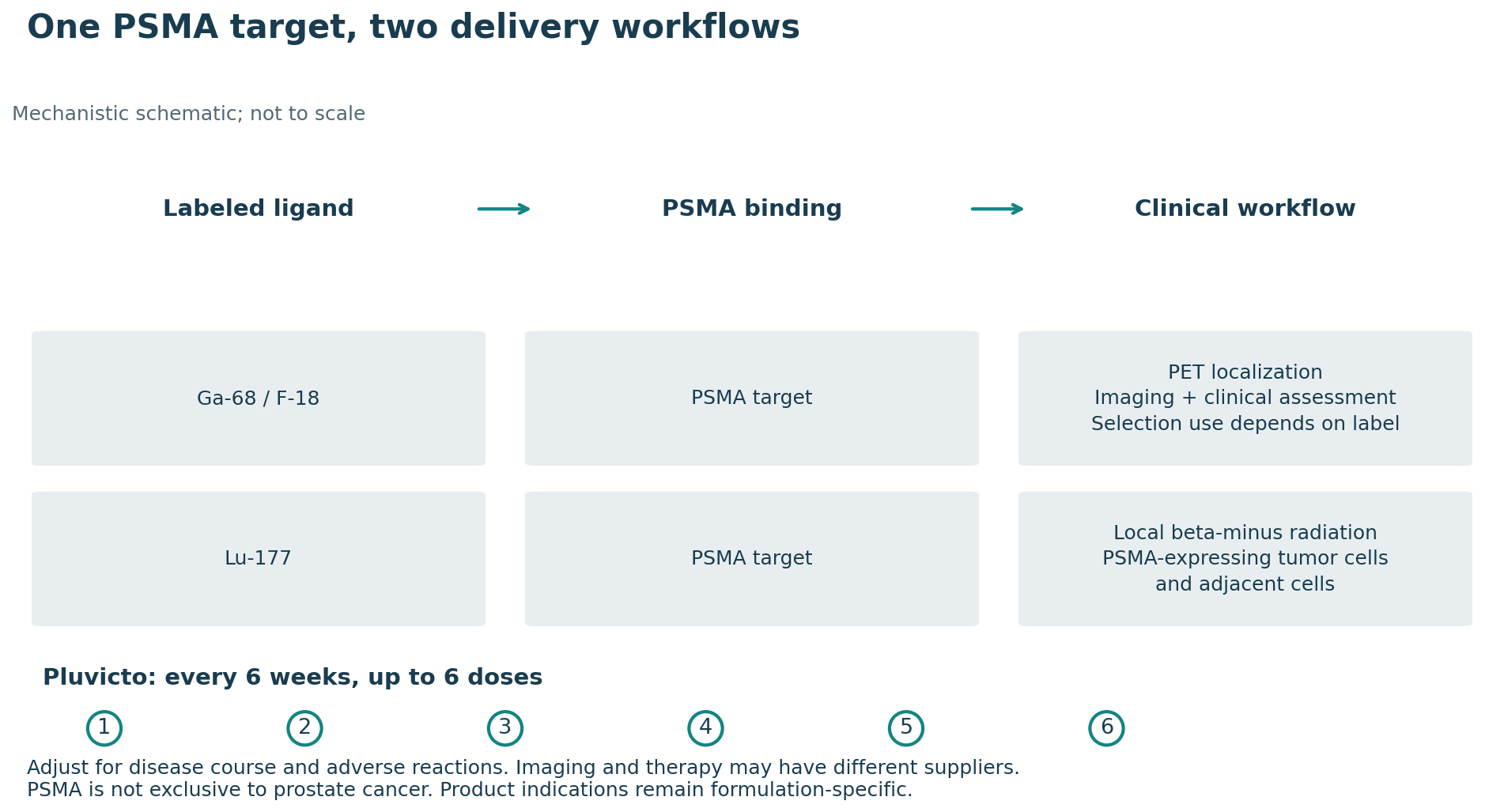
PSMA can be leveraged jointly for imaging and therapy, but individual formulations still retain their respective approved indications. Ga-68/F-18-labeled ligands are used for PET localization; whether they can be used for therapeutic patient selection must depend on the respective formulation and therapeutic product labels, combined with clinical assessment. Following PSMA binding by Lu-177 formulations, their β− radiation can act on PSMA-expressing cells and adjacent cells. The Pluvicto illustration reflects the current U.S. label schedule of every 6 weeks for up to 6 doses, which in practice may be delayed, reduced, or discontinued due to disease progression or adverse reactions. Imaging agents and therapeutic agents may be supplied by different companies, which does not imply that imaging procedure fees accrue entirely to the formulation supplier. PSMA is not exclusive to prostate cancer; molecules, cells, radiation, and imaging signals are all non-proportional schematic representations, and six open circles do not indicate that every patient will necessarily complete six doses.
Mechanism Steps
- Diagnostic agents and therapeutic agents sharing the PSMA target does not equate to sharing approved indications or having the same supplier.
- Diagnostics: Ga-68- or F-18-labeled ligand → PSMA binding → PET localization; patient selection is subject to individual agent labels.
- Therapeutics: Lu-177-labeled ligand → PSMA binding → localized β− radiation acting on target cells and adjacent cells.
- Pluvicto: Every 6 weeks, up to 6 doses; adjusted according to disease condition and adverse reactions.
Scope of Evidence:
03 Beyond Half-Life, There Are Also Formulation Expiration Limits
The radioisotope first determines how fast the clock runs. According to current labels, the physical half-life of Ga-68 is approximately 68 minutes, F-18 is approximately 109.8 minutes, and Lu-177 is 6.647 days. Comparing only physical decay from the same starting activity, after four hours approximately 8.7% of Ga-68 remains, and approximately 22.0% of F-18 remains; after 48 hours, approximately 81.2% of Lu-177 remains. These figures explain why PET drugs often require proximate preparation and distribution networks, whereas Lu-177 therapy can utilize a different regional layout. [S02 – S05 ; Model A]
Formulation engineering alters a different clock. Illuccix must be used within four hours after radiolabeling; the official package insert for Gozellix stratifies the shelf life by prepared radioactivity: four hours for less than 2,590 MBq, and six hours for 2,590–18,500 MBq. The latter does not mean every vial can be held for an additional two hours, nor does it alter the half-life of Ga-68 itself. [S03 , S04]
TruVu provides another example. Its package insert allows use within ten hours from the end of synthesis; Lantheus explained that the new formulation improves stability at higher radioactive concentrations, aiming to enhance batch size and service radius. Any commercial upside, if realized, is likely to stem from greater distribution margins from the same manufacturing site, rather than scans discovering a new target. Whether this is achieved will still depend on approved manufacturing sites, batch sizes, distribution success, and net selling price. [S05 , S13]
While the physical half-life of Pluvicto exceeds six days, the current formulation shelf life is 120 hours from the time of calibration. Half-life describes atomic decay, whereas package insert expiration also incorporates product quality and validation conditions; upon delivery to the hospital, the activity must be checked again at the actual time of administration. Therefore, "80% remaining activity" cannot be interpreted as "80% of vials meeting specifications," nor can the initial number of vials be multiplied by the decay ratio to estimate patient numbers. [S02]
04 Manufacturing Capacity Must Be Compared by Usable State
A radiopharmaceutical order must pass through at least four handoffs: usable radioisotopes entering preparation, finished products meeting quality requirements, shipments arriving at the hospital within the time window, and the hospital administering the dose when the patient is fit to receive treatment. Kilograms of raw materials, facility floor area, nominal batch sizes, and administered doses are not the same kind of capacity; to compare three companies, one must first identify which stage they are expanding.
Quality release is particularly prone to omission from supply chain diagrams. The package insert for Illuccix lists not only preparation sources but also requires activity measurement and quality control. Switching the source to another cyclotron or increasing starting activity does not mean output can be scaled up without validation. The short half-life requires testing, documentation, distribution, and scheduling to proceed synchronously, and release cannot be treated as a zero-time check box. [S03]
Table 2 From Announced Investment to Deliverable Capacity
| Company | Approved Existing Capacity | Unfinished Expansions | Commercial Interpretation |
|---|---|---|---|
| Novartis | Three operational RLT plants in the US: Millburn, Indianapolis, and Carlsbad; the company states overall RLT capacity exceeds 250,000 doses | Denton expected operational in 2028; Winter Park expected in 2029 | Geographic redundancy and regional distribution increase flexibility; 250,000 doses cannot be regarded as verified actual Pluvicto production |
| Telix | Illuccix / Gozellix commercial network and RLS; Seneffe has completed the first GMP production of a Lu-based therapeutic candidate | Continued investment in the therapeutic supply chain; ITM combination transaction pending satisfaction of conditions | Diagnostic distribution, GMP batches, and commercial therapeutic capacity must be stratified and cannot be merged into a single completion rate |
| Lantheus | Existing PYLARIFY supply; TruVu approved, with TPT and permanent HCPCS codes effective 10/1 | Tech transfer and approvals across PET manufacturing sites, incorporation of codes into payer systems, customer adoption, and phased regional rollout | Reimbursement mechanisms have progressed, but site-by-site supply and actual payments still require separate verification |
Table 2 Sources: S07 – S09 , S12 , S15 – S17 , S22 – S24 . Planned timelines represent company expectations, not completion dates. Novartis's figure of over 250,000 doses reflects the company's disclosed scope across its RLT network and cannot be fully allocated to PSMA. TPT is the US hospital outpatient Transitional Pass-Through payment mechanism and does not mean all payers have completed implementation.
Here is a counterexample that should be retained positively. Novartis's Florida announcement stated that over 99% of doses were administered on the scheduled day. This supports that existing delivery arrangements are already considerably reliable, and the construction of two new facilities cannot be used to infer extensive delays today. It did not simultaneously disclose all patients waiting to enter scheduling, nor did it provide open appointment slots for each center; the on-time rate and wait times for new patients answer two different questions. [S07]
Telix, on the other hand, shifts the boundary upstream. The September 21 formal transaction announcement proposed a business combination with ITM, with upfront consideration of US$1.65 billion on a cash-free, debt-free basis, arranged through shares and debt assumption, plus up to US$700 million in milestones. If completed, Telix will simultaneously manage an in-house therapeutics pipeline and a third-party radionuclide supply business, where supply coordination could become an asset; it must also manage integration, financing, and external customer trust. The announcement remains subject to shareholder, regulatory, and other conditions, with completion expected before year-end, and these capabilities cannot be prematurely incorporated into first-half results. [S15 , S16]
Telix’s meeting notice schedules the vote on resolutions related to the ITM deal for December 1. Lantheus’s Q3 report still lists technology transfer, FDA approval for each TruVu PET manufacturing site and a phased rollout as work to execute. Actinium reported that construction of its New York facility was nearing completion. Its target for operations is Q4 2026, with a focus on clinical supply of Ac-225 drug candidates. [R-ITM] [R-LNT] [R-ACT]
Taiwan's Entry Point: Connecting Global Products to Local Delivery
In Taiwan's participation in the radiopharmaceutical industry, what is most worth tracking is who can connect products, qualified manufacturing, and hospital demand. Local delivery capability carries its own commercial value; it represents an asset distinct from new drug intellectual property, and its revenue sources and development risks must also be evaluated separately.
G-Chen Biotech (Emerging Stock 7762) provides a case study of an existing drug supply network extending into PSMA therapeutics. Its official website lists eight approved drug licenses covering FDG, FBB, NaF, and I-131, alongside Xinzhuang and Luzhu manufacturing and supply hubs; Lu-177 PSMA I&T falls under special-case project manufacturing. The observation focus is how existing manufacturing and distribution experience translates into reproducible therapeutic supply; special-case manufacturing cannot be directly counted as routine commercial products. [TW01 , TW02 , TW09]
Its consolidated revenue for the first half of 2026 was NT$127.768 million, of which "marketed radiopharmaceuticals" accounted for NT$122.975 million, or 96.25%. This classification covers marketed radiopharmaceuticals as a whole and cannot be treated as revenue from a single category such as PSMA, diagnostics, or therapeutics; because Liman has been included in consolidated results since July 2025, year-over-year growth also cannot be entirely attributed to organic growth. [TW10]
Primo's pathway combines contract manufacturing, clinical supply, and proprietary development. In July 2025, the company announced GMP/GDP qualification for its facility, licensing from ABX, and that Radelumin had begun clinical supply in June of the same year. However, the July 2026 formal press release still stated that PB01 was undergoing licensure, while an undated pipeline page listed it as Marketed; the chronology and licensing status between the two statements remain to be clarified, and the July undergoing-licensure status cannot be directly extended to the October state. In industry terms, what needs to be tracked is whether regulatory approval, actual supply, and revenue can corroborate one another. [TW03 – TW06]
Taiwan Shin Ji Mei Shuo represents the local landing of a global product. In December 2025, this wholly foreign-owned subsidiary announced that POSLUMA had received TFDA approval, along with authorization from Blue Earth Diagnostics to manufacture and market it in Taiwan. This serves as a localization case study for an F-18 PSMA diagnostic product; the scheduled supply timeline in the announcement must still be separated from actual shipments. [TW07]
Commercial comparisons can unfold along three lines: existing customer and manufacturing networks for drug supply, product opportunities following clinical translation, and local services for overseas-licensed products. How much revenue and gross margin each can retain must ultimately be verified against contract rights, costs, and actual supply.
All three pathways could affect the pace of introducing new products into Taiwan. The next step worth comparing is qualified release volume, on-time hospital delivery rate, hospitals actually supplied, and external revenue. G-Chen already has public consolidated financial statements, whereas Primo and Taiwan Shin Ji Mei Shuo still lack comparable financials for the same period; comparable figures for delivery metrics across the three companies are also not yet available. To assess industry impact, one should track whether newly added capabilities genuinely increase usable doses.
The Taipei Exchange approved Pet Pharm Biotech’s listing application on October 28. For capacity and deliveries, the milestones to track are qualification and release at the Zhunan site and actual shipments. [R-TPE]
05 Hospital-End Capacity Is a Sequence of Reproducible Services
PSMA positivity is only part of patient selection. Pluvicto's label also requires blood count and renal function monitoring, and adverse effects may cause dosing delays, reductions, or discontinuation. The EANM/SNMMI procedure guidelines further list authorized personnel, physical space, radiation protection, and waste and contamination management as facility prerequisites for therapy. Possessing a PET scanner is not equivalent to already having radiopharmaceutical therapy services of the same scale. [S02 , S18]
Follow-up visits turn new patients into continuously occupied time slots. In a purely arithmetic example, if 10 new patients enter each week and each completes 6 doses according to the label, an average of 60 administrations per week must be served once enrollment and follow-up visits reach a steady state, assuming no dropouts or delays. This does not mean 60 slots are required in the first week, nor does it represent the actual average course of treatment; it reminds operators that recruiting new patients and reserving slots for subsequent follow-up visits must be calculated together. [S01 ; Model A]
Therefore, the number of centers and map coverage can only first answer "whether there is a facility nearby." To determine whether new demand can be absorbed, one also needs the available weekly slots per center, waiting times for initial appointments, cancellation rates due to drug non-delivery and patient health status, as well as subsequent completion rates for initiated courses of treatment. As of the audit date, market-wide comparable figures for these denominators have not been obtained; thus, this article does not fabricate utilization rates, nor does it estimate market valuation by multiplying the number of hospitals by an arbitrary revenue per hospital.
This also raises a new commercial question for pipeline design: if a therapy achieves competitive benefit and risk profiles with fewer administrations in an appropriate patient population, it may increase the number of patients that the same center can serve; however, if each treatment requires more monitoring, hospitalization, or supportive care, the saved time slots may be offset. What is worth following regarding TLX591-Tx’s two-dose regimen is this complete set of conditions, rather than looking solely at the fewer number of administrations. [S10 , S18]
06 Three Companies Are Purchasing Different Growth Options
In Q3, global Pluvicto net sales were $674 million, up 20% at constant exchange rates. Novartis identified mAPMR as the main source of demand. Telix group revenue reached $245 million, up 19%. Its Precision Medicine segment reached $201 million, up 30%, driven by Gozellix and Illuccix. Lantheus reported $389.9 million in worldwide revenue. PYLARIFY sales were $238.9 million, down 0.7% year over year. The table below uses first-half figures. [R-NVS] [R-TLX] [R-LNT]
Revenue reflects recognized commercial results, whereas cash flow separately tracks actual inflows and outflows of funds. Below, the same January–June 2026 period is cut across all three companies, all converted to millions of US dollars; company totals and product/segment figures are listed separately. Diagnostic revenue and therapeutic revenue are not aggregated into a single PSMA market.
Table 3 Revenue and Funding Sources for the Same Period
| Metric 1H 2026 (USD Millions) | Novartis | Telix | Lantheus |
|---|---|---|---|
| Company revenue scope | Net sales 27,521; Other revenues 954 | Revenue from contracts with customers 477.350 | Revenues 765.513 |
| Products or segments relevant to this article | Pluvicto 1,293 | Precision Medicine 388.633, primarily from Illuccix/Gozellix, including royalties | PYLARIFY 481.290 |
| YoY change for relevant product or segment | Pluvicto +56.7%, recalculated based on original USD values | Precision Medicine +27.1% | PYLARIFY −5.3% |
| Company gross profit | 21,306, including scope under Other revenues | 260.349; gross margin 54.5% | 472.777; gross margin 61.8% |
| R&D expenses | 5,587 | 123.828 | 77.581 |
| Net cash flows from operating activities | 9,558 | 23.036 | 217.330 |
| Cash and cash equivalents at end of period 6/30 | 7,616 | 251.910 | 593.3, rounded per announcement |
| Items that should not be conflated with product revenue | Group cash is not dedicated funding for Pluvicto | Initial receipt of 40 from Regeneron, classified as other income and included in OCF | Proposed Curium acquisition consideration is not Lantheus revenue |
Table 3 Sources: S06 , S09 , S12 , S13 ; see Model Notes for recalculation methodology. Original tables for Telix and Lantheus were disclosed in thousands of US dollars and converted to millions of US dollars. Gross margins are gross profit / respective company revenue, unadjusted for accounting, product mix, or segment scope; no cross-company profitability ranking is performed. Novartis' gross profit includes Other revenues, so it is not divided by net sales to avoid mixing non-comparable bases. Telix Precision Medicine is not a product-by-product breakdown.
Novartis' existing advantage is the concurrent presence of therapeutic evidence and revenue: Pluvicto generated $1.293 billion in revenue in the first half of the year, which does not yet reflect the new approval at the end of July. This shifts the question regarding new manufacturing sites from "will there be a product" to "which regions will require more buffer capacity in the future." However, the group’s $9.558 billion in operating cash flow supports multiple therapeutic areas and cannot be used to estimate the cash return of the radiopharmaceutical segment. [S01 , S06]
Telix’s diagnostic business provides a visible commercial starting point, while therapeutics continue to consume resources to generate evidence. Its Precision Medicine segment generated $388.6 million in revenue in the first half of the year; the manufacturing segment had an additional $57.543 million in intersegment transactions, which were eliminated upon consolidation. Adding the latter back to group revenue would double-count the internal transfer amount for the same dose of drug. Whether manufacturing investments create value should be evaluated by external revenue, reliable delivery, and cost improvements, rather than merely an increase in segment transaction volume. [S09]
Cash provides a sharper test. Telix’s operating cash flow for the first half of the year was positive, but included a $40 million initial collaboration receipt from Regeneron. Financial reports clearly treat the counterparty as a partner sharing R&D risk; this receipt is classified under other income, not revenue from contracts with customers, nor sales of diagnostic agents. While it did increase available funds for the current period, one cannot infer from this single period alone that diagnostic cash flow will be sufficient to cover all development and supply chain investments over the long term. [S09]
Lantheus provides a more direct comparison: in the first half of the year, PYLARIFY revenue decreased 5.3% year-over-year, yet the group still generated $217.3 million in operating cash. In an industry with growing demand, individual brands can simultaneously experience declining revenue; pricing, competition, product switching, and customer adoption still determine how much the company captures. Its 2026 strategy explicitly lists prioritizing diagnostics and seeking alternative value realization pathways for therapeutic assets. [S12 , S13]
PNT2002 illustrates how concrete this choice once was. Lantheus had paid a $250 million upfront payment for the asset. May filings once stated that it did not plan to submit an NDA or invest further at that time; the August 10-Q still discussed the confounding of the SPLASH overall survival analysis by cross-over treatment, but no longer reiterated that statement. This version difference should be preserved: existing diagnostic networks have not eliminated clinical and capital allocation risks for therapeutics, and the latest filing decisions cannot be automatically extrapolated from older statements. [S13 , S19]
Lantheus shareholders adopted the Curium merger agreement on October 14. The FTC issued a Second Request on October 21. The deal remains subject to antitrust review and closing conditions. Separately, PharmaLogic signed an agreement to acquire Lantheus’s CDMO business and Springfield facility, with Agilera contracted to manufacture lutetium Lu-177 dotatate for Lantheus under a long-term supply agreement. Terms were undisclosed and closing is pending. Lantheus received approval for BRAVNETSA in September and described launch preparations in November. Its PSMA candidate PNT2002 is a separate asset. [R-FTC] [R-PLG] [R-LNT]
07 Examining Doses and Cash Separately Using Two Models
Model A asks: Does building more manufacturing plants necessarily translate into completing more treatments? Consider a hypothetical Lu-177 therapy network, with units standardized as "administered doses" per week that meet activity specifications at the time of injection. Isotope supply, manufacturing release, effective delivery, hospital appointment slots, and eligible demand each constitute separate constraints. The minimum of these five is the theoretical upper limit of the network; if locations and schedules cannot be matched with each other, the actual volume will be even lower.
The baseline assumptions are: isotope supply of 1,200 dose-equivalents, pre-release output of 1,050 doses, release yield rate of 96%, deliverable capacity of 970 doses, 880 hospital slots with an availability rate of 95%, and eligible demand of 1,100 doses. The corresponding released volume is 1,008 and effective hospital slots are 836, setting the upper limit for administration at 836 doses per week. These are all illustrative inputs, none of which should be taken as the actual capacity of Novartis, Telix, or Lantheus.
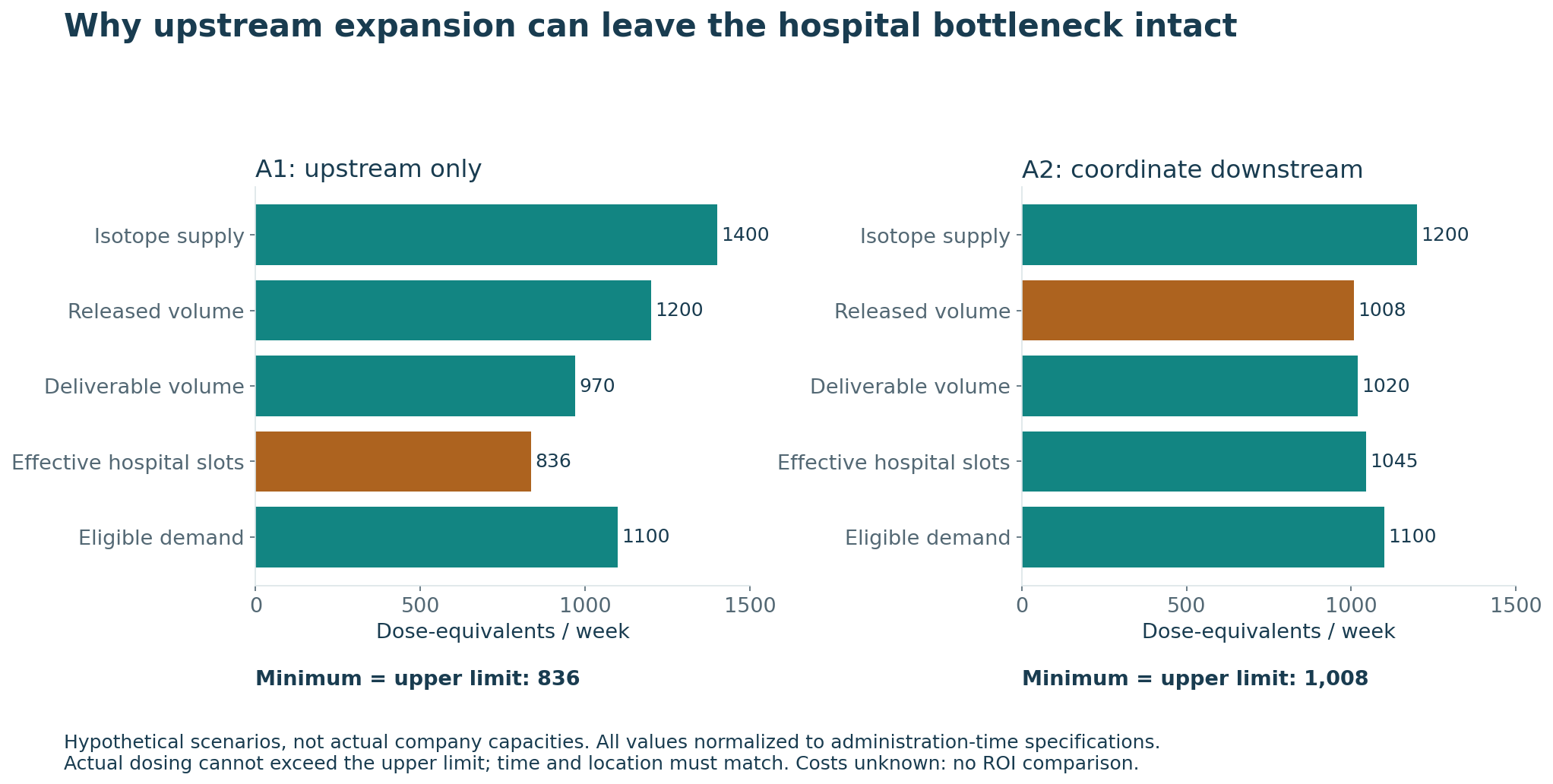
Scenario A1 adds only upstream capacity: isotope supply increases to 1,400 dose-equivalents, pre-release output increases to 1,250 doses, while other factors remain unchanged; the upper limit remains 836. Scenario A2 coordinates the downstream: keeping baseline isotope and manufacturing conditions, delivery capacity increases to 1,020 and hospital slots increase to 1,100 with availability maintained at 95%; only then does the upper limit reach 1,008, 20.6% higher than the baseline. At this point, the constraint shifts to the released volume. This difference does not compare return on investment because the costs of both expansions have not yet been factored in; it first establishes "which node to expand" as a testable question.
Physical decay is calculated in an independent sub-model: remaining activity fraction = 2 raised to the power of negative (elapsed time / half-life). It is not multiplied directly into the dose counts above because capacity inputs are already standardized to injection-time specifications. Multiplying it again would double-count the same decay deduction. A true scheduling model must still confirm batch-by-batch shelf-life limits, geographic routes, and patient appointment slots.
Model B asks: How much of Telix's positive operating cash flow relies on collaboration receipts in the current period? Reconstructing the financial statements as-is first: beginning cash of 141.866, plus operating cash of 23.036, minus investing activities of 33.717, plus financing activities of 118.427, plus foreign exchange impact of 2.298, equals ending cash of 251.910, all in millions of US dollars. [S09]
Next, modifying only a single item: B1 retains the received Regeneron 40; B2 assumes that this receipt was absent in the current period, with all other expenses, taxes, financing, and working capital completely unchanged. Under B2, operating cash becomes −16.964, and ending cash is 211.910. This is a single-variable stress test, not a "normalized cash flow" announced by the company, nor does it estimate how expenses might change if the entire partnership were removed.
Examining operating cash flow minus capital expenditures and lease principal payments, B1 is 4.641 and B2 is −35.359. The calculation deducts only fixed-asset expenditures of 14.456 and lease principal of 3.939, without further deducting R&D expenses; related operating expenditures are already reflected in cash flows, and accounting R&D expenses do not equal an equivalent amount of cash. Other investment expenditures, contingent/deferred acquisition payments, and borrowings are kept separately in the cash bridge, avoiding conflating "positive EBITDA," "ending cash increase," or "collaboration receipts" as synonymous with one another. [S09]
Taken together, these two models illustrate the dual requirements for expansion. A company must both acquire the capacity to reach patients and possess sufficient capital to operate that capacity reproducibly; acquiring more upstream assets does not necessarily increase administrations immediately, and positive cash flow in the current period does not necessarily mean that all expansions can be self-funded.
Hypothetical Lu-177 therapy network, not actual capacity of any company. All five metrics represent administered doses per week meeting injection-time specifications, indicating independent capacity constraints rather than vial loss across stages. The five baseline items are isotope supply 1,200, released qualifying doses 1,008, deliverable capacity 970, effective hospital capacity 836, and eligible demand 1,100, yielding an upper limit of 836. A1 adds only upstream, increasing supply and release to 1,400 and 1,200, with the upper limit still constrained by hospital capacity at 836. A2 retains baseline upstream, increasing delivery and effective hospital capacity to 1,020 and 1,045, shifting the upper limit to released volume at 1,008. The minimum of the five is merely a theoretical upper limit assuming locations, batches, timing, and patients can be matched; actual administration could be lower. Inputs are already converted to injection-time specifications and are not multiplied by physical decay again; costs of both scenarios are unknown, precluding return on investment comparisons. · Chart language: zh-Hant ·
Key information
A1 upper limit 836; A2 upper limit 1,008. The minimum is the upper limit under the matchable assumption; actual volume may be lower. Costs unknown, not an ROI comparison.
Unit
Administered doses/week, injection-time specifications
Period
Hypothetical weekly scenario prepared on 2026-10-11; does not correspond to company observation periods.
Subject
Hypothetical Lu-177 therapy network; all capacities at identical time-point specifications and units, not actual performance of Novartis, Telix, or Lantheus.
08 What Evidence Going Forward Would Warrant Revising Judgments
Table 4 Follow-up Questions Within 90 Days from the Verification Date
| Target and trigger point | Information needed to see | Which outcome supports this article | Which outcome requires revising judgment |
|---|---|---|---|
| Novartis next-period results and new indication progress | New treatment start volume, actual dose counts, waiting times, with reasons for cancellation listed separately | When demand grows, expansion in release, delivery, or hospital capacity brings more actual administrations | Supply and slots are abundant; primary constraints lie in reimbursement or clinical adoption |
| Telix Next-Period Results and 11/4 Capital Markets Day | Separate diagnostic revenue, TMS external revenue, collaboration receipts, operating cash | Diagnostics and external services continue to fund R&D, with delivery metrics improving in tandem | Revenue growth relies primarily on non-recurring items or internal definitions, increasing cash pressure |
| Telix ITM Transaction Terms and Expected General Meeting | Formal meetings, approvals, financing, and closing filings; new corporate perimeter | Quantified evidence of post-closing supply and cash synergies | Delays, cost of capital, or customer attrition offset integration benefits |
| Lantheus 10/14 Vote and TruVu Introduction | A vote does not equal closing; site-by-site manufacturing approvals, payer system implementation, and customer conversion | New formulation increases usable batch sizes or service range, maintaining customer economics | Conversion delays or net price declines prevent efficiency gains from translating into visible revenue |
| TLX591-Tx, TLX597-Tx, BiPASS | Primary trial results, regulatory filings, and real-world workflow burden | Effective, deliverable differentiation that alters patient or center choices | Early differences disappear in randomized data, or workflow burden offsets convenience |
Table 4 Sources: S10 , S11 , S14 – S16 , S20 , S21 , S24 , S25 ; observation horizon through 2027/1/9. Unconfirmed earnings dates are not filled in with fabricated schedules; ninety days represents the information tracking window of this report, not a claim that all trials will read out during this period, nor an automated monitoring commitment.
PSMA competition is crystallizing into three recognizable positions: Novartis needs to link earlier-treatment clinical opportunities into its established delivery infrastructure; Telix is attempting to transition from imaging cash flow into therapeutics, and then connect upstream to radionuclides via the proposed ITM transaction; Lantheus demonstrates that a diagnostic network can serve as an independent value center or be integrated into a larger system. Who ultimately creates more value will depend on exactly which constraint the newly acquired assets remove.
The next threshold can therefore be stated very concretely: within evidence-supported patient populations, can qualified doses be repeatedly placed into genuinely available treatment time slots? If subsequent data demonstrate that delivery and site capacity remain consistently ample, the competitive focal point should shift back to efficacy, reimbursement, and clinical adoption. This judgment is falsifiable, which is precisely why it is more suitable for tracking companies than a total radiopharmaceutical market figure lacking a denominator.
Track the Telix shareholder vote and the Curium antitrust review separately. At Springfield, watch for closing and initial commercial supply. ITM and Lumara reported a COMPETE dose-response analysis. A U.S. launch of ITM-11 still requires resolution of the issues in the FDA’s complete response letter. Commercial supply also depends on approved manufacturing sites, product release and actual deliveries. [R-ITM] [R-FTC] [R-PLG] [R-EAN] [R-CRL]
Model Recalculation Notes
Model Notes: Inputs, Formulas, and Results
Verification date: 2026-10-11. All monetary figures in US$ millions; all capacities in weekly administerable doses. Original earnings report values retain source precision and are rounded only after calculation.
A. Hypothetical Deliverable Capacity Scenarios
This is an arithmetic example designed to identify bottlenecks, not an actual production volume, site utilization rate, or demand forecast for any company. Each stage has already been converted into doses meeting activity specifications at the time of administration, and therefore cannot be multiplied by a physical decay factor a second time.
Inputs are as follows:
Baseline: Radionuclide supply equivalent 1,200; output pending release 1,050; release pass rate 96%; distribution ceiling 970; total site slots 880; slot availability rate 95%; eligible demand 1,100.
A1, Upstream expansion only: Radionuclide supply equivalent 1,400; output pending release 1,250; release pass rate 96%; distribution ceiling 970; total site slots 880; slot availability rate 95%; eligible demand 1,100.
A2, Coordinated distribution and site capacity: Radionuclide supply equivalent 1,200; output pending release 1,050; release pass rate 96%; distribution ceiling 1,020; total site slots 1,100; slot availability rate 95%; eligible demand 1,100.
Release ceiling = Output pending release × Release pass rate.
Effective site slots = Total site slots × Slot availability rate.
Theoretical weekly administration ceiling = MIN(Radionuclide supply equivalent, Release ceiling, Distribution ceiling, Effective site slots, Eligible demand).
Relative change vs. baseline = Scenario theoretical ceiling ÷ Baseline theoretical ceiling − 1.
Baseline: Release 1,008; Site 836; MIN(1,200, 1,008, 970, 836, 1,100) = 836.
A1: Release 1,200; Site 836; MIN(1,400, 1,200, 970, 836, 1,100) = 836, an increase of 0% vs. baseline.
A2: Release 1,008; Site 1,045; MIN(1,200, 1,008, 1,020, 1,045, 1,100) = 1,008, an increase of 20.6% vs. baseline.
This ceiling assumes that locations and time slots can be adequately matched; actual administered volume may be lower. Each stage represents available capacity, not an attrition rate multiplied step-by-step. The example excludes expansion costs and does not represent a comparison of returns on investment. Another example of steady-state scheduling is: 10 new patients per week × 6 doses per patient = 60 administrations per week; this requires waiting for individual course cohorts to accumulate and assumes no dropouts, postponements, or adjustments, rather than reaching 60 administrations in the first week. [Assumptions and Calculations]
Physical decay calculated separately
Remaining activity fraction = 2^(−elapsed minutes ÷ half-life minutes). Describes physical activity only; cannot substitute for release quality, shelf life, efficacy, or qualified delivered doses.
Ga-68: Half-life 68 minutes; 8.6605% after 240 minutes; 2.5487% after 360 minutes.
F-18: Half-life 109.8 minutes; 21.9792% after 240 minutes; 10.3043% after 360 minutes.
Lu-177: Half-life 6.647 days = 9,571.68 minutes; 81.1753% after 2,880 minutes (48 hours); 59.3690% after 7,200 minutes (120 hours). [S02 – S05]
B. Single-Factor Sensitivity of Telix Cash Sources
Period is H1 2026. B1 uses disclosed cash receipts; B2 removes only the 40 initial collaboration receipt, holding all other taxes, expenditures, financing, and foreign exchange rates constant. This is not a normalized cash flow, nor is it a forecast assuming the entire collaboration never occurred.
B1 Operating cash flow = Receipts from customers 442.884 + Receipts from collaborations 40.000 − Payments to suppliers and employees 439.037 − Operating contingent consideration 1.250 − Income taxes paid 14.806 + Interest received 2.222 − Interest paid 6.977 = 23.036.
Investing cash flow = Investment in financial assets −1.000 + Net cash from acquisitions 0 − Intangible assets 0.332 − Other non-current assets 4.509 − Property, plant, and equipment 14.456 − Investing contingent consideration 8.808 − Deferred consideration 4.612 = −33.717.
Financing cash flow = Proceeds from borrowings 587.453 − Repayment of borrowings 466.453 − Principal elements of lease payments 3.939 + Equity proceeds 1.366 = 118.427.
B1 Ending cash = Beginning cash 141.866 + Operating 23.036 − Investing net outflow 33.717 + Financing 118.427 + Effect of exchange rate changes 2.298 = 251.910.
B2 Operating cash flow = 23.036 − 40.000 = −16.964.
B2 Ending cash = 141.866 − 16.964 − 33.717 + 118.427 + 2.298 = 211.910.
The self-defined metric in this article, "Operating cash flow less capital expenditures and principal elements of lease payments": B1 is 23.036 − 14.456 − 3.939 = 4.641; B2 is −16.964 − 14.456 − 3.939 = −35.359. This is not the company-disclosed free cash flow definition. R&D expenses of 123.828 are not deducted a second time from these cash flows. [S09]
Recalculation Basis for Financial Ratios
Year-over-year (YoY) = H1 2026 original value ÷ H1 2025 original value − 1.
Pluvicto: 1,293 ÷ 825 − 1 = 56.7273%, reported in the body text as 56.7%.
Telix Precision Medicine: 388.633 ÷ 305.835 − 1 = 27.0728%, reported in the body text as 27.1%.
PYLARIFY: 481.290 ÷ 508.296 − 1 = −5.3130%, reported in the body text as −5.3%.
Gross margin = Gross profit of the respective company ÷ Revenue of the respective company: Telix is 260.349 ÷ 477.350 = 54.5405%; Lantheus is 472.777 ÷ 765.513 = 61.7595%.
Novartis' gross profit of 21,306 includes other revenues of 954; therefore, this article does not divide it by net sales of 27,521 to mix it into a same-basis ranking. The relevant businesses across the three companies are individual products or segments with distinct accounting and portfolio compositions; the ratios listed above do not represent market share comparisons. [S06 , S09 , S12 , S13]
Appendix | Taiwan and Overseas: Which Companies Can Serve as Equity Research Entry Points?
The following distinguishes between tradable issuers and companies without a verified public trading entry point. The verification date for trading information is October 11, 2026; financial figures are uniformly presented for H1 2026, with original currencies and revenue classifications retained across all entries. This is a research list; it does not assess real-time stock prices or valuations, nor does it provide buy-side rankings.
| Company | Trading Entry Point | Business Revenue Basis and Period | Researchable Questions | Key Limitations |
|---|---|---|---|---|
| Novartis | SIX: NOVN common shares; NYSE: NVS ADS, each unit representing one common share [E01] | H1 2026, USD millions: Pluvicto 1,293 / Group net sales 27,521 = 4.70% [E02] | How will earlier-line therapy indications translate into actual administration and product revenues? | The investment is in a multi-therapeutic pharmaceutical company; 4.70% represents only Pluvicto's share, not the entire radiopharmaceutical business. Both trading venues correspond to the same issuer. |
| Telix | ASX: TLX ordinary shares; Nasdaq: TLX ADS, each unit representing one ordinary share [E03] | H1 2026, USD millions: Precision Medicine 388.633 / Group revenue from contracts with customers 477.350 = 81.41%; TMS external revenue is separately 88.717 [E04] | Can diagnostic operations support therapeutic R&D, and can the manufacturing network generate external revenues? | 81.41% is a segment proportion, not a single-product figure for Illuccix; TMS internal revenues have been eliminated. The USD 40 million collaboration payment from Regeneron is classified under other income; the proposed ITM combination remains subject to the satisfaction of closing conditions [E04, E05]. |
| Lantheus | Nasdaq: LNTH common stock; as of the verification date, the Curium acquisition has not closed [E06, E07] | H1 2026, USD millions: PYLARIFY 481.290 / Group revenue 765.513 = 62.87% [E06] | How do diagnostic product transitions, reimbursement, and manufacturing site ramp-ups impact revenue? | 62.87% represents a single-product share, not the entire radiopharmaceutical business; the acquisition closing and conditional CVRs require separate evaluation. The maximum consideration cannot be treated as a guaranteed recovery amount or a target price. |
| Kirin Biopharma | Emerging Stock Board: 7762 common shares; commenced trading on 2024-07-25 [E08] | H1 2026, NTD millions: "Marketed radiopharmaceuticals" 122.975 / Consolidated revenue 127.768 = 96.25% [E09] | How can local radiopharmaceutical manufacturing and distribution be extended into PSMA therapeutics and CDMO services? | Emerging Stock Board is not equivalent to TWSE (listed) / TPEx (OTC); 96.25% covers overall marketed radiopharmaceuticals, not exclusively PSMA, diagnostics, or therapeutics. Liman was consolidated in July 2025, so YoY growth cannot be entirely attributed to organic growth; additionally, Emerging Stock Board liquidity must be considered. |
| Prime Healthcare | No directly tradable public stock ticker has been verified | No verifiable comparable financials obtained for the H1 2026 period | Can licensed manufacturing, clinical supply, and proprietary R&D establish sustainable commercial supply? | Inconsistencies exist between the official July PB01 release and the undated pipeline page, requiring verification of the current license status; routine commercial launch cannot be presumed from clinical supply [E10]. |
| Taiwan GMS | Wholly owned subsidiary of GMS; no independent public stock trading entry point verified [E11] | No verifiable comparable financials obtained for the Taiwan subsidiary for the H1 2026 period | How will the overseas-licensed POSLUMA diagnostic agent be rolled out via manufacturing and distribution in Taiwan? | Company approval announcements and scheduled supply timelines cannot substitute for actual shipments, hospital coverage, and revenue; nor can they serve as evidence of Taiwan-origin innovative drug IP [E11]. |
The numerators of the percentages in the table represent individual products, divisions, or product categories, respectively; they cannot be used to rank "radiopharmaceutical purity" or profitability levels, nor do they reflect share price sensitivity to radiopharmaceutical growth. Because matching contemporaneous share prices, diluted share counts, and net debt figures were not obtained, this report does not calculate valuation multiples, target prices, or cheap-versus-expensive rankings. Once a research target is selected, product pipeline progress must still be analyzed separately from the price, liquidity, and trading conditions of the security itself.
Sources and Data Dates
S01 · FDA approves lutetium Lu 177 vipivotide tetraxetan with androgen recep
Publication/Version Date: 2026-07-31; Event or Data Period: 2026-07-31. Approval and announcement occurred on the same day.
Reference Location: First paragraph and Efficacy and Safety
S02 · Label: PLUVICTO- lutetium lu 177 vipivotide tetraxetan injection, solution
Publication/Version Date: 2026-08-12; Event or Data Period: 2026-07. SPL updated 8/12, package insert revised 7/2026; not the April version.
Reference Location: §1, 2, 5, 11.1, 16
S03 · Label: ILLUCCIX- kit for the preparation of gallium ga 68 gozetotide injection kit
Publication/Version Date: 2026-06-15; Event or Data Period: 2026-01. DailyMed updated 6/15; package insert revised 1/2026.
Reference Location: §1, 2.4 to 2.9, 11.2, 16
S04 · Gozellix Official Website Current Link USPI
Publication/Version Date: 2025-04; Event or Data Period: 2025-04. Directly accessed via "Full Prescribing Information" on the official website on 10/11; the December in the path is not the revision date.
Reference Location: §1 PDF p2; §16 Table 9 PDF p22
S05 · Label: PYLARIFY TRUVU- piflufolastat f-18 injection
Publication/Version Date: 2026-07-01; Event or Data Period: 2026-03. SPL 7/1 version; approval date separately verified via S17.
Reference Location: §1, 11.2, 16
S06 · Novartis H1 Q2 2026 Interim Financial Report
Publication/Version Date: 2026-07-21; Event or Data Period: 2026-01-01/2026-06-30. Publication date separately verified via official quarterly-results portal.
Reference Location: Printed pages 3, 9, 18, 24, 37, 39, 47, 50, 52
S07 · Novartis to add radioligand therapy manufacturing facility in Winter Park, Florida, fourth in US to serve patients and advance $23 billion investment
Publication/Version Date: 2026-01-09; Event or Data Period: 2026-01-09. Expected operational in 2029; not yet an existing facility.
Reference Location: Main text sections on new facility and on-time administration
S08 · Novartis to build new radioligand therapy site in Denton, Texas, delivering more next‑generation treatments to patients
Publication/Version Date: 2026-02-25; Event or Data Period: 2026-02-25. Expected operational in 2028; announced plan, not completion.
Reference Location: Main text paragraphs 1 to 3
S09 · Telix H1 2026 Full Financial Report SEC
Publication/Version Date: 2026-08-20; Event or Data Period: 2026-01-01/2026-06-30. Financial report date 8/20; SEC retrieval shows relative date is not separately treated as event date.
Reference Location: Printed pages 15, 19; Notes 3, 4.1, 4.4
S10 · ProstACT Global Phase 3 Study (Part 1) Achieves Primary Objectives - Telix Pharmaceuticals Limited | Telix Pharmaceuticals Limited
Publication/Version Date: 2026-03-10; Event or Data Period: 2026-03-10. Company disclosure, not regulatory approval.
Reference Location: Main text study design; About ProstACT Global
S11 · Telix H1 2026 Presentation SEC
Publication/Version Date: 2026-08-20; Event or Data Period: 2026-06-30. Certain pipeline milestones updated to presentation date.
Reference Location: Slides 5, 7, 24–26
S12 · Lantheus Reports Second Quarter 2026 Financial Results | Lantheus Holdings, Inc.
Publication/Version Date: 2026-08-06; Event or Data Period: 2026-01-01/2026-06-30. Announcement separately notes 8/3 Curium transaction signing, separated from reporting period.
Reference Location: Consolidated Statements; Revenue by product; FCF reconciliation; balance sheet
S13 · Lantheus Q2 2026 Form 10-Q
Publication/Version Date: 2026-08-06; Event or Data Period: 2026-01-01/2026-06-30. Latest reviewed quarterly report; sentence deletions compared to Q1.
Reference Location: Strategic Program; PNT2002, printed page 43; Risk Factors
S14 · Lantheus October 2 Merger Form 8-K
Publication/Version Date: 2026-10-02; Event or Data Period: 2026-10-02. 9/8 proxy; 10/14 is the future shareholder meeting.
Reference Location: Item 8.01, signature date
S15 · Telix and ITM Join Forces to Create a Radiopharmaceutical Powerhouse - Telix Pharmaceuticals Limited | Telix Pharmaceuticals Limited
Publication/Version Date: 2026-09-21; Event or Data Period: 2026-09-21. Main text Australian date 9/21; homepage listing 9/20, event uses main text date.
Reference Location: Deal Terms and closing conditions
S16 · Telix ITM Announcement Original SEC Filing
Publication/Version Date: 2026-09-21; Event or Data Period: 2026-09-21. Cross-checked against the same event as the company announcement, not considered an independent factual source.
Reference Location: Deal Terms
S17 · Lantheus Reports First Quarter 2026 Financial Results and Provides Business Update | Lantheus Holdings, Inc.
Publication/Version Date: 2026-05-07; Event or Data Period: 2026-03-06/2026-Q4. 3/6 approval; Q4 regional launch is the plan announced on 5/7, with tech transfer work ongoing in Q2.
Reference Location: Business Highlights
S18 · EANM SNMMI LuPSMA Procedure Guideline
Publication/Version Date: 2023; Event or Data Period: 2023-04-25. PDF acceptance date 4/25, exact online publication date not verified; 2026 indications superseded by latest label.
Reference Location: PDF p5 Facility and personnel prerequisites
S19 · Lantheus Q1 2026 Form 10-Q Historical PNT2002 Statements
Publication/Version Date: 2026-05-07; Event or Data Period: 2026-03-31. Only supports the strategy at that time; see S13 for latest Q2 differences.
Reference Location: PDF p43 PNT2002; p52 risk
S20 · Telix Granted FDA Fast Track Designation for BiPASS Pre-Biopsy Prostate Cancer Imaging - Telix Pharmaceuticals Limited | Telix Pharmaceuticals Limited
Publication/Version Date: 2026-09-30; Event or Data Period: 2026-09-30. Main text Australian date 9/30; listing 9/29; exact designation FDA decision date not disclosed.
Reference Location: Main text sections on enrollment completion and Fast Track
S21 · Telix to Host Capital Markets Day in Melbourne on November 4, 2026 - Telix Pharmaceuticals Limited | Telix Pharmaceuticals Limited
Publication/Version Date: 2026-10-09; Event or Data Period: 2026-11-04. Main text Australian date 10/9; homepage 10/8.
Reference Location: Main text event date
S22 · Novartis is championing patient access to radioligand therapy (RLT)
Publication / Version Date: unknown; Event or Data Period: 2026. Footer 4/26; website accessed on the same day; operational data is company data on file
Reference Location: "active manufacturing sites" and "production capacity" sections
S23 · Telix Official H1 2026 Results Announcement
Publication / Version Date: 2026-08-20; Event or Data Period: 2026-01-01/2026-06-30. Some research progress updated through the announcement date
Reference Location: PDF p3 TMS
S24 · Lantheus Announces CMS Grants Transitional Pass-Through Status for PYLARIFY® TruVu (piflufolastat F 18) | Lantheus Holdings, Inc.
Publication / Version Date: 2026-09-30; Event or Data Period: 2026-10-01. Announcement date is separated from reimbursement status effective date
Reference Location: Main text: TPT/HCPCS; Risk section: PMF and payer systems
S25 · Telix Completes Enrollment in Phase 3 BiPASS Study, Aligns with FDA on NDA Pathway - Telix Pharmaceuticals Limited | Telix Pharmaceuticals Limited
Publication / Version Date: 2026-09-02; Event or Data Period: 2026-09-02. Enrollment completion announcement predates the 9/30 Fast Track announcement
Reference Location: Main text, paragraphs 1 to 4
MODEL-A | Model A of This Report: Author's Hypothetical Inputs, Formulas, and Recalculated Results |
Publication / Version Date: 2026-10-11; Event or Data Period: Hypothetical weekly scenario. Does not correspond to company observation periods or actual production capacity.
Reference Location: Recalculation Notes for Model A in this report
TW01 | Chi Sheng Product Page |
Publication / Version Date: Undated; Event or Data Period: Accessed on 2026-10-11. Access date: 2026-10-11.
Reference Location: Product list and drug license scope
TW02 · CRO & CDMO SERVICES - PET Pharm Biotech Co., Ltd
Publication / Version Date: Undated; Event or Data Period: Accessed on 2026-10-11. Access date: 2026-10-11.
Reference Location: Production and supply nodes
TW03 · Primo Biotechnology Secures A Funding and Targets 2026 IPO to Strengthen Global Radiopharmaceutical Strategy - Primo Biotechnology
Publication / Version Date: 2025-07-02; Event or Data Period: June 2025 clinical supply; July 2025 announcement. Access date: 2026-10-11.
Reference Location: GMP/GDP, ABX licensing, and Radelumin clinical supply
TW04 | Primo Biotech Taiwan Biotechnology Award and Pipeline Progress Announcement (Chinese) |
Publication / Version Date: 2026-07-07; Event or Data Period: 2026-07. Access date: 2026-10-11.
Reference Location: PB01 regulatory approval and PBT01 development stage
TW05 · Primo Biotechnology Wins 2026 Taiwan BIO Award, Eyeing Radiotheranostics Market with Primo-X Platform - Primo Biotechnology
Publication / Version Date: 2026-07-16; Event or Data Period: 2026-07. Access date: 2026-10-11.
Reference Location: PB01 regulatory approval and PBT01 development stage
TW06 · Primo Biotechnology - Pipeline
Publication / Version Date: Undated; Event or Data Period: Accessed on 2026-10-11. Access date: 2026-10-11.
Reference Location: "Marketed" status listed on the PB-01 page; chronological relationship with the July official release remains unclarified
TW07 | Taiwan Shin Ji Mei Shuo: POSLUMA Approval and Manufacturing/Distribution in Taiwan Announcement |
Publication / Version Date: 2025-12-15; Event or Data Period: 2025-12. Access date: 2026-10-11.
Reference Location: Company-announced approval, licensing, wholly-owned subsidiary status, and scheduled supply timeline
Identical content official PDF
TW08 · Primo Biotechnology - Delivering
Publication / Version Date: Undated; Event or Data Period: Accessed on 2026-10-11. Access date: 2026-10-11.
Reference Location: Contracted transportation services
TW09 · TPEx: Chi Sheng Biotech 7762 Emerging Stock Trading Announcement
Publication / Version Date: 2024-07-17; Event or Data Period: Emerging stock trading commenced on 2024-07-25. Access date: 2026-10-11.
Reference Location: Emerging stock common shares and trading commencement date; not construed as formal TPEx mainboard listing
Company history and trading information
TW10 · Chi Sheng Biotech Q2 2026 Consolidated Financial Statements
Publication / Version Date: Unspecified publication date; Event or Data Period: 2026-01-01 to 2026-06-30. "Marketed radiopharmaceuticals" is a pharmaceutical commercialization classification, not a securities listing status.
Reference Location: Note 6(17) and Consolidated Statement of Comprehensive Income
E01 · Novartis 2025 Form 20-F and Shareholder FAQ
Publication / Version Date: 2025 Annual Report; FAQ undated; Event or Data Period: Accessed on 2026-10-11. Access date: 2026-10-11.
Reference Location: Item 9.A and ADR description
Company Shareholder FAQ
E02 · Novartis delivered sales growth in Q2 and further advanced the pipeline; Full-year guidance reaffirmed
Publication / Version Date: 2026-07-21; Event or Data Period: H1 2026. Access date: 2026-10-11.
Reference Location: Group net sales and Pluvicto revenue
E03 · Telix ADSs Commence Trading on Nasdaq - Telix Pharmaceuticals Limited | Telix Pharmaceuticals Limited
Publication / Version Date: 2024-11-14; Event or Data Period: 2024-11-14. Access date: 2026-10-11.
Reference Location: ASX ordinary shares, Nasdaq ADSs, and 1:1 representation ratio
E04 · Telix Official H1 2026 Financial Report
Publication / Version Date: 2026-08-20; Event or Data Period: H1 2026. Access date: 2026-10-11.
Reference Location: Notes 3 / 4.1; segment revenue, consolidation eliminations, and collaboration revenue
E05 · Telix and ITM Join Forces to Create a Radiopharmaceutical Powerhouse - Telix Pharmaceuticals Limited | Telix Pharmaceuticals Limited
Publication / Version Date: 2026-09-21; Event or Data Period: 2026-09-21. Access date: 2026-10-11.
Reference Location: Shareholder and other closing conditions
E06 · Lantheus Reports Second Quarter 2026 Financial Results | Lantheus Holdings, Inc.
Publication / Version Date: 2026-08-06; Event or Data Period: H1 2026. Access date: 2026-10-11.
Reference Location: Group and PYLARIFY revenue; cash and contingent CVR
E07 · Lantheus SEC Form 8-K
Publication / Version Date: 2026-10-02; Event or Data Period: 2026-10-14 scheduled shareholder meeting date. Access date: 2026-10-11.
Reference Location: Nasdaq LNTH common stock and shareholder meeting arrangements
E08 · TPEx Chi Sheng Biotech Emerging Stock Announcement and Company History
Publication / Version Date: 2024-07-17; Event or Data Period: Trading commenced on 2024-07-25. Access date: 2026-10-11.
Reference Location: Emerging Stock Board 7762; this does not serve as a basis to confirm an official TPEx listing
Corporate History
E09 · Chi Sheng Biotech Q2 2026 (ROC Year 115) Consolidated Financial Report
Publication/Version Date: No publication date stated; Event or Data Period: 2026-01-01 to 2026-06-30. Date Accessed: 2026-10-11.
Reference Location: Note 6(17) and Consolidated Statement of Comprehensive Income
E10 | Primo July Chinese and English Announcements and Current Pipeline Page |
Publication/Version Date: 2026-07-07 / 2026-07-16; Pipeline page undated; Event or Data Period: Accessed on 2026-10-11. Date Accessed: 2026-10-11.
Reference Location: PB01 regulatory approval and "Marketed" designation; timeline and licensing/approval status still subject to verification
Official English Announcement
Current Pipeline Page
E11 | Taiwan Shin-Ji-Mei-Shuo POSLUMA Official Announcement |
Publication/Version Date: 2025-12-15; Event or Data Period: 2025-12. Date Accessed: 2026-10-11.
Reference Location: Wholly-owned subsidiary status, corporate approval announcement, licensing, and scheduled supply
R-ACT · Actinium Form 10-Q
2026-11-16
R-CLA · Clarity breakthrough designation announcement
2026-11-12
R-CRL · FDA complete response letter for ITM-11
2026-08-07
R-EAN · ITM and Lumara EANM disclosures
2026-10-20
R-FTC · Lantheus Form 10-Q
2026-11-05
R-ITM · Telix shareholder meeting notice (SEC filing)
2026-10-30
R-LNT · Lantheus Q3 results
2026-11-05
R-NVS · Novartis Q3 results
2026-10-27
R-PLG · PharmaLogic acquisition announcement
2026-11-09
R-TLX · Telix Q3 business update
2026-10-21
R-TPE · Taipei Exchange listing application release
2026-10-28
Updates and Corrections
2026-10-11
First public release of the full report; data as of October 11, 2026.
2026-10-11
Added the Taiwan supply chain, along with public trading venues, business revenue recognition scopes, and research limitation comparisons across six companies in Taiwan and overseas; retained original international analyses, charts, and recalculable models.
2026-11-19
Added Q3 sales and China label developments. Updated the Telix–ITM, Curium–Lantheus and Springfield transactions and the Pet Pharm Biotech listing application. Distinguished marketing approval, review designations, facilities and delivery.