
The 2026 Lasker–DeBakey Clinical Medical Research Award recognizes an invention that changed the treatment of hemophilia A: Hemlibra, a bispecific antibody that can be injected under the skin.
Share this analysis
Send this article to readers who follow biotech, company strategy, and capital-market signals.
Chugai announced on September 9 that the honorees were three researchers: Kunihiro Hattori, Takehisa Kitazawa and Tomoyuki Igawa. Their achievement changed more than coagulation measurements. It also changed how patients could organize their lives.
For people who need long-term bleed prevention, treatment has never been simply a matter of having a medicine. Preparing supplies, finding a vein and scheduling injections all take time; school, work and family life must fit around them. Pain and impaired mobility from repeated joint bleeds can make that burden last even longer.
Hemlibra does not cure hemophilia. Its breakthrough was to let a different kind of molecule take on part of the work of a protein that previously had to be repeatedly replaced. Following that turn helps explain how a tiny molecular “bridge” reached the stage of a major medical award.
When Replacement Runs into a Barrier, Can the Job Be Done Another Way?
In hemophilia A, factor VIII, or FVIII, is insufficient or does not function properly. It normally acts as a coordinator, helping two partners in the clotting reaction work together effectively. Without that coordination, patients may bleed repeatedly.
Traditional treatment replaces FVIII directly. The approach is intuitive and can help prevent bleeding, but it faces a difficult barrier: some patients develop antibodies that neutralize FVIII. These “inhibitors” make replacement treatment harder to use effectively.
Even without inhibitors, regular prophylaxis with standard-half-life factor products often requires frequent intravenous administration. Every treatment needs venous access, and drug activity, bleeding risk and daily routines must continue to be managed together.
Hemlibra took a different route. Rather than making a new FVIII, it focused on the job FVIII performed: putting clotting partners in a position where they could cooperate.
More precisely, activated FVIII, or FVIIIa, is a cofactor that helps activated factor IX, FIXa, and factor X, FX, work together on the platelet phospholipid surface. FIXa is the enzyme and FX is its substrate. FIXa performs the actual activation of FX into FXa.
Emicizumab, the active ingredient in Hemlibra, uses two different Fab antibody arms to bind FIXa and FX respectively. By bridging them, it mimics part of FVIIIa’s cofactor function. The antibody coordinates their positioning; FIXa still does the catalytic work.
This design also avoids the way anti-FVIII inhibitors block replacement factor. The problem of “putting it in, only to have it blocked” therefore gained another route. The treatment does not repair the FVIII gene. It reorganizes how molecules cooperate.
That is what makes this invention compelling. A breakthrough need not come from making the original thing stronger. It can come from understanding its job, then finding another way to do it.
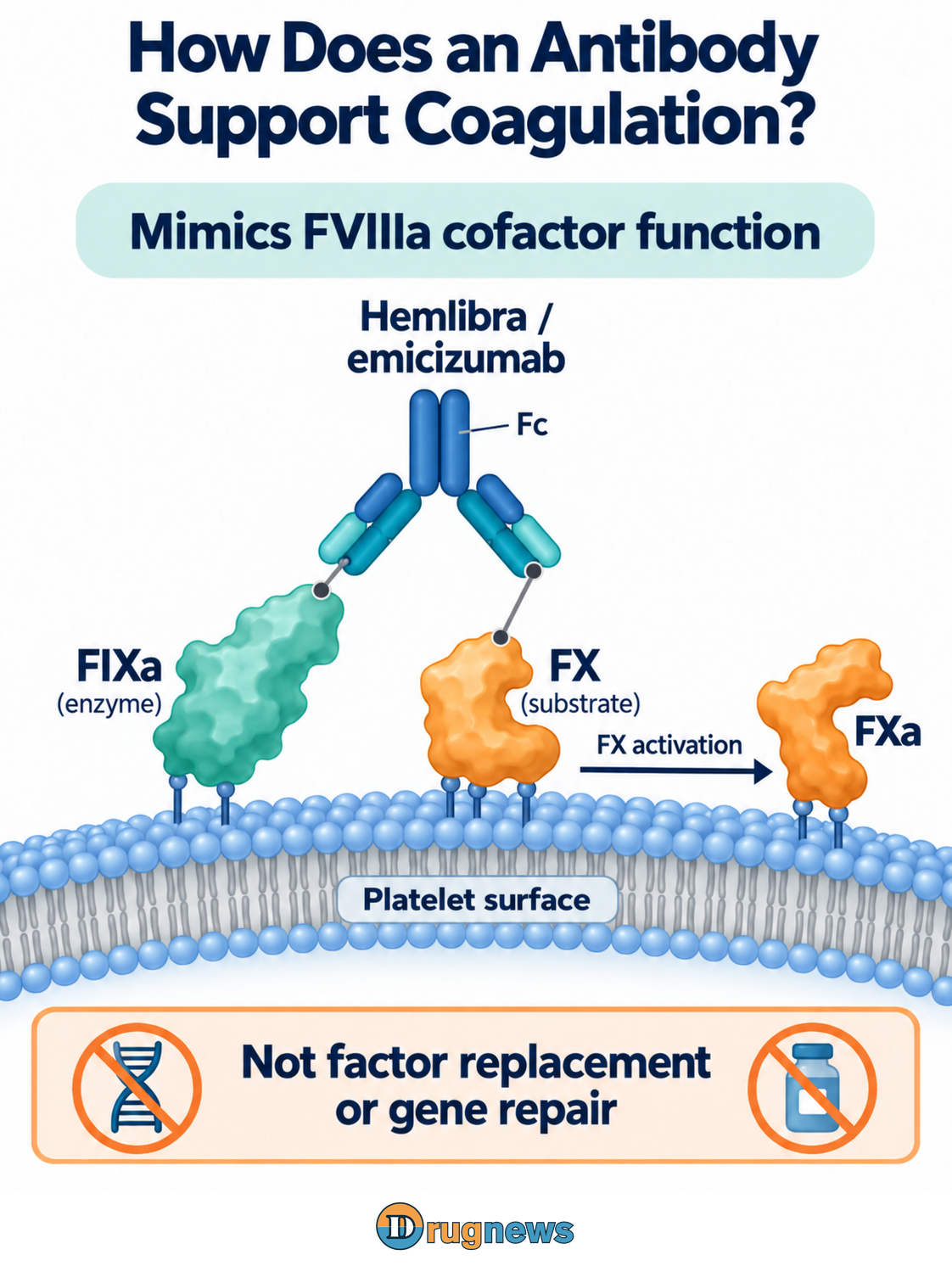
Figure 1 | Emicizumab binds FIXa and FX with its two Fab arms, supporting FX activation at the platelet phospholipid surface. The soluble antibody’s Fc region remains free.
A Beautiful Idea Still Has to Fit into a Syringe
An “antibody bridge” is easy to sketch on paper. Turning it into a medicine that can be manufactured reliably and delivered to patients is another matter.
A bispecific antibody combines two binding functions in one molecule, but its chains can assemble incorrectly. Once it has been made, the desired product must be separated from by-products. For subcutaneous injection, the formulation must also fit enough medicine into a small volume. Having an active molecule alone is not enough.
The original engineering study published in 2013 records the work that helped turn this idea into a product.
The researchers used a common light chain to reduce assembly complexity on the two sides of the antibody. They then adjusted charge characteristics so chromatography could separate the desired bispecific antibody from by-products. Activity, pharmacokinetics and solubility were optimized together, making both a high-concentration formulation and adequate exposure in the body development goals.
These were not incidental details in a paper. Assembly had to be correct, purification had to work, and the concentrated product had to remain usable before it could leave the laboratory. A common light chain is not, by itself, a shortcut to longer duration of action. The molecule, process and formulation have to come together.
For patients, that engineering ultimately produces a concrete difference: regular prophylaxis can be administered under the skin, without first finding a vein every time.
The US label revised in July 2025 specifies a loading period of weekly dosing for the first four weeks. Depending on the individual regimen, maintenance treatment is then given weekly, every two weeks or every four weeks, all by subcutaneous injection. Patients and caregivers still need training and must follow the body-weight-based dose and prescribed regimen.
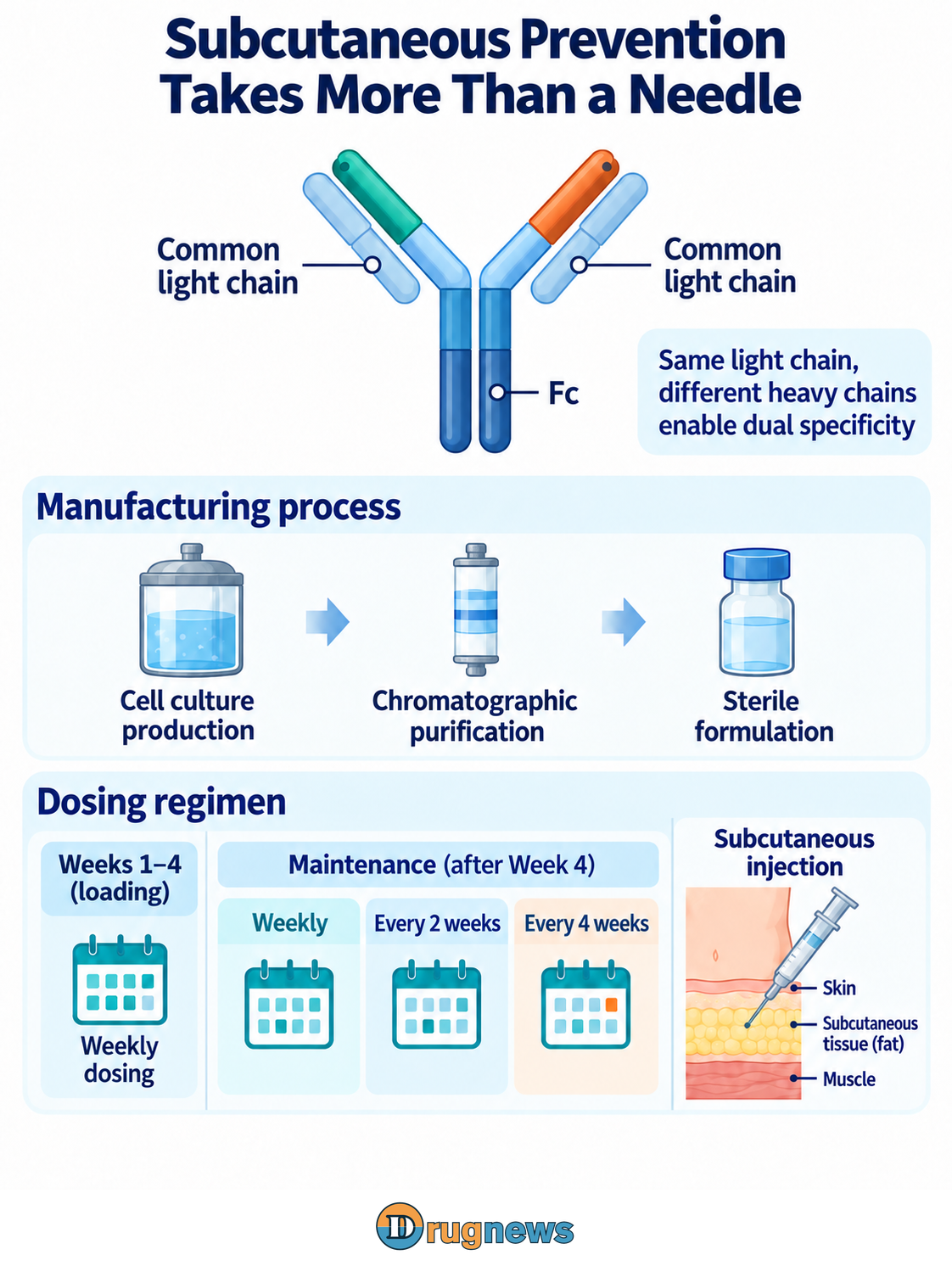
Figure 2 | Common-light-chain, purification and formulation engineering support a subcutaneous product. The three maintenance frequencies following loading are options selected for the individual regimen.
The value of a medical product often lies in these engineering details. For developers, the issues are assembly, purification and solubility. For a long-term user, the result may be prevention that is easier to plan and sustain. Science has not completed that transition if it stops at a mechanism diagram.
Less Searching for Veins Must Also Mean Less Bleeding
Easier administration does not, by itself, answer the question patients care about most. The next question is whether this approach to prophylaxis actually reduces bleeding.
HAVEN 1, published in 2017, enrolled 109 males aged 12 or older with FVIII inhibitors. The main randomized comparison involved 53 participants who had previously used bypassing agents only when bleeding occurred: 35 received weekly emicizumab prophylaxis, while 18 received no prophylaxis but could still receive hemostatic treatment when they bled.
With a primary assessment plan of at least 24 weeks, the model-estimated annualized rate of treated bleeds was 2.9 versus 23.3 events per patient-year, a relative reduction of 87%. During observation, 22 of 35 participants in the prophylaxis group had no treated bleeds, compared with one of 18 in the control group.
The significance of that result is that the convenience of subcutaneous prophylaxis had evidence of bleed control behind it. It was not merely a more appealing way to inject a drug.
ABR annualizes events from follow-up data; it does not mean every participant was observed for a full year. “No treated bleeds” also does not mean no bleeding of any kind. The 87% result becomes interpretable when the population, comparator and event definition are kept together.
HAVEN 3, published in 2018, then examined severe hemophilia A without FVIII inhibitors, enrolling 152 males aged 12 or older. Among participants previously treated with on-demand FVIII who entered the randomized comparison, treated-bleed ABRs were 1.5 and 1.3 with weekly and every-two-week emicizumab prophylaxis respectively, versus 38.2 events per patient-year without prophylaxis.
The two studies address different patient populations; their numbers cannot be used to rank them against each other. These randomized comparisons were also not head-to-head trials against regular FVIII prophylaxis. What moved forward was evidence that subcutaneous prophylaxis reduced treated bleeding in each population, giving patients another long-term option to discuss.
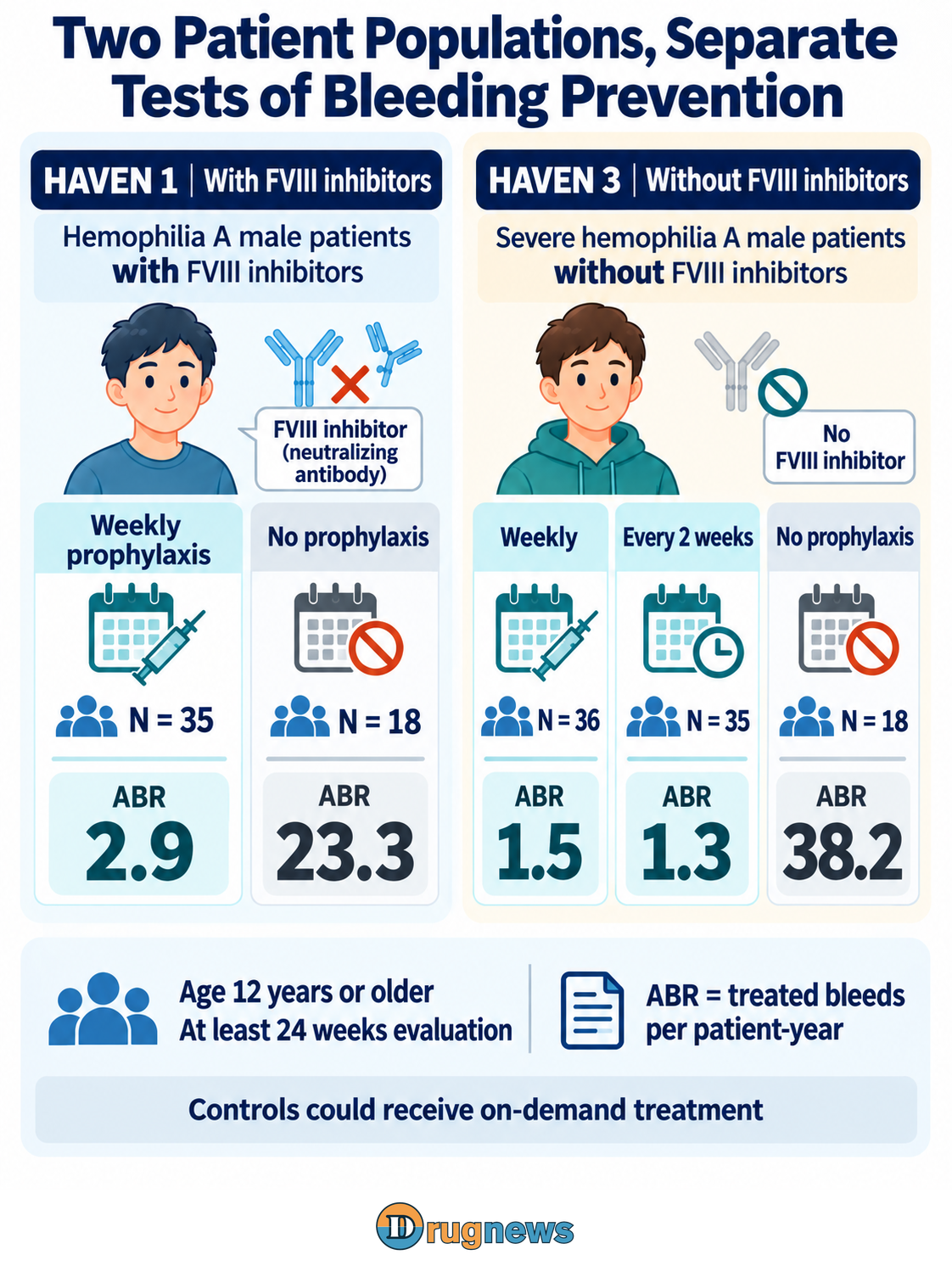
Figure 3 | Both studies enrolled males aged 12 or older. HAVEN 1 involved FVIII inhibitors; HAVEN 3 involved severe disease without inhibitors. ABR counts treated bleeds, and controls could receive on-demand hemostatic treatment.
Removing one treatment step does not immediately remove the disease from daily life. But when prevention is easier to carry out and reduces treated bleeding, patients and caregivers may be able to put more attention back into learning, work and activity, rather than only planning the next injection.
Care still has to cover particular situations. People receiving Hemlibra prophylaxis may have breakthrough bleeding or need surgery, requiring a separate hemostatic plan. Injection-site reactions, headache and joint pain are also common adverse reactions listed in the product information.
Thrombosis and thrombotic microangiopathy have occurred with sustained use of activated prothrombin complex concentrate, or aPCC, at high cumulative doses. The US label carries a boxed warning. The medicine also excessively shortens aPTT and interferes with aPTT-based FVIII activity and inhibitor assays, so clinical teams must choose appropriate testing methods.
Thus, “no routine monitoring of drug activity” means one management burden is reduced, not that follow-up stops. Joint status, other medicines, breakthrough bleeding and surgical care remain part of long-term prophylaxis.
When Daily Life Becomes Easier, the Market Uses a Different Yardstick
Treatment has to work within patients’ lives, and commercial value has to take shape there too. A product intended for long-term use must do more than work in a trial. Patients have to be able to start it and continue it.
Taiwan first approved Hemlibra on August 28, 2018, for routine bleed prophylaxis in hemophilia A with FVIII inhibitors. In 2026, a change in access came through National Health Insurance reimbursement.
The revision announced by the National Health Insurance Administration on February 13 and effective March 1 retained conditional reimbursement for patients with inhibitors. It also removed the previous additional use criteria for patients with severe disease, FVIII below 1%, and no inhibitors. More eligible patients could enter the reimbursed population.
At the same time, the approved reimbursement price per milligram fell from NT$2,375 to NT$1,728, about 27.2%. This is an NHI payment price, not the manufacturer’s realized net price or a measure of its profit decline.
The exchange is straightforward: a smaller unit payment base, but a wider eligibility pool. The commercial outcome depends on whether more actual users, body-weight-related consumption and sustained treatment can make up for the price reduction. The announcement itself does not provide the answers on additional patients or revenue.
Expanded reimbursement is therefore more than another population to multiply by a unit price. Whether patients can begin treatment smoothly, sustain their regimen and receive the necessary care determines how much actual use emerges from the new opening.
The revision to section 4.2.7 announced on July 15 and effective August 1 retained prior authorization for initial use and added a reimbursement restriction against use together with fitusiran. Patients on an every-four-week maintenance regimen must return to the hospital every four weeks to collect the medicine, receive the injection and undergo observation and follow-up. Taiwan’s reimbursement arrangements cannot simply be described as a monthly injection at home for everyone.
For later competitors, Hemlibra has also changed the question. When patients are already stable on prophylaxis, a new product seeking to attract them cannot merely establish that it “works too.” It has to explain what more it offers: better joint protection, physical function or a lower overall care burden.
A longer dosing interval can be part of that answer. If it also introduces more complex management of special situations and higher costs, however, it may not be enough to persuade patients and payers. Competition in long-term treatment extends from how patients live to how the healthcare system pays.
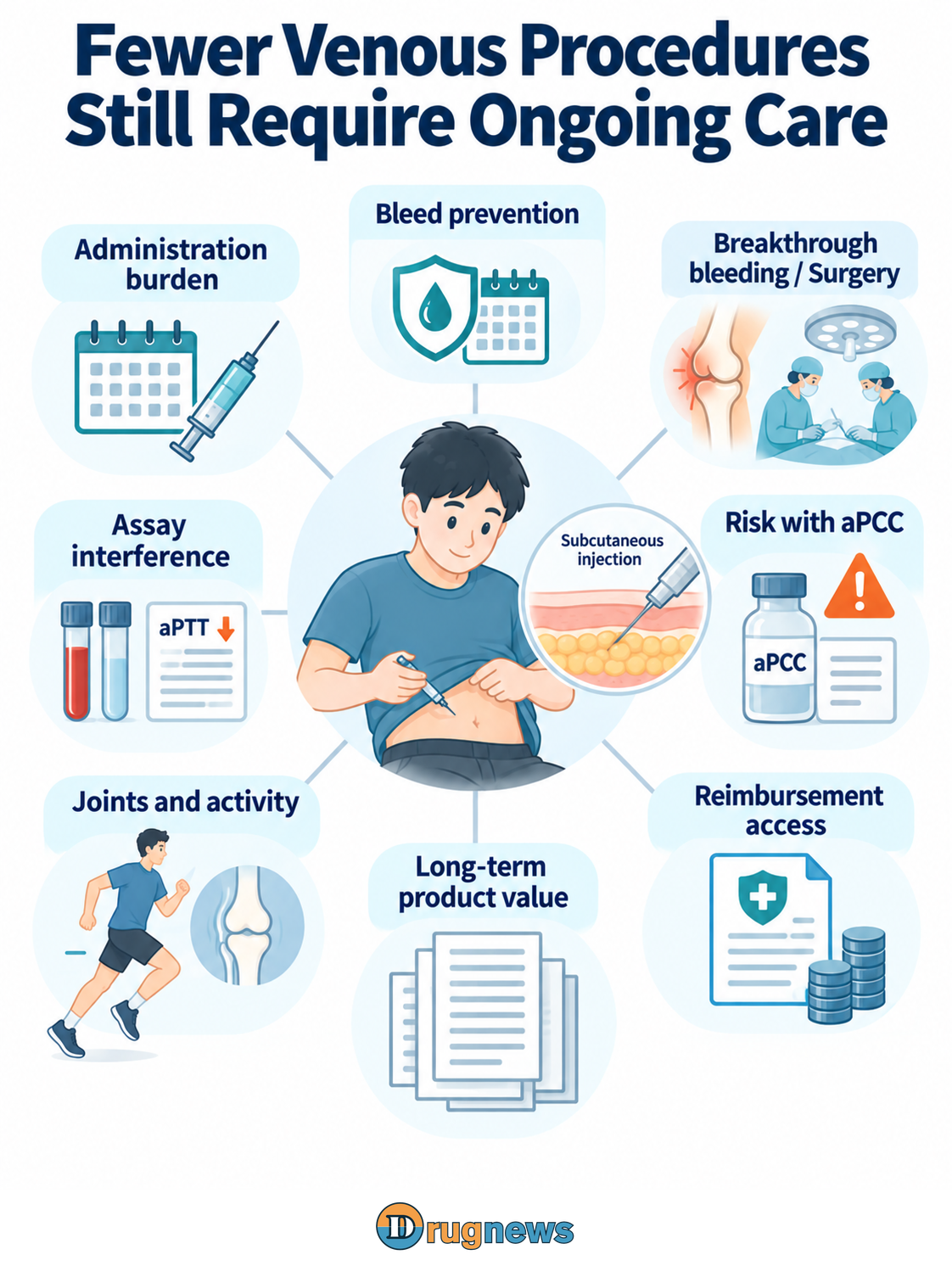
Figure 4 | Bleed prevention, administration burden, breakthrough-bleed and surgical care, testing, joint activity and reimbursement access are parallel dimensions of long-term product value.
Following Taiwan’s reimbursement expansion, the questions worth tracking are whether more people can sustain prophylaxis, maintain joint health and reduce the burden across their care. Can a lower payment per milligram thereby deliver broader, longer-lasting treatment benefits and steady usage?
This article provides industry information and commercial analysis. It is not individualized medical or investment advice.
References
| Research or material | What it supports | Journal or official source |
|---|---|---|
| Lasker Foundation award page | The three 2026 honorees and the development story | Lasker award page |
| Chugai award announcement | September 9, 2026 announcement, researchers and award | Chugai announcement |
| Original FIXa/FX bridging study | FVIIIa cofactor mimicry and bridging mechanism; 2012 | PubMed abstract |
| Bispecific antibody engineering paper | Common light chain, charge, purification and formulation; 2013 | PLOS ONE study |
| Original HAVEN 1 paper | Randomized comparison in patients with inhibitors; 2017 | HAVEN 1 abstract |
| Original HAVEN 3 paper | Comparison in severe disease without inhibitors; 2018 | HAVEN 3 abstract |
| US Hemlibra prescribing information | July 2025 revision; dosing, clinical data and warnings | Prescribing information |
| EMA product information | Safety, assays and care; accessed September 27, 2026 | EMA product information |
| TFDA initial approval review | Taiwan’s initial approval on August 28, 2018 | TFDA review |
| World Federation of Hemophilia guidelines, third edition | Venous access, prophylaxis and long-term care; 2020 | WFH guidelines |
| NHI reimbursement and payment adjustment notice | Announced February 13, 2026; effective March 1 | March notice |
| Payment-price adjustment appendix | NT$2,375 to NT$1,728 per milligram; effective March 1, 2026 | NHI payment appendix |
| March reimbursement comparison table | Removal of additional criteria for severe disease without inhibitors | Reimbursement comparison |
| Fitusiran and section 4.2.7 revision notice | Announced July 15, 2026; effective August 1 | August notice |
| August section 4.2.7 provisions and follow-up form | Initial authorization, four-week hospital visits and concomitant-use reimbursement restriction | Provisions and follow-up appendix |
Cite this article
For decks, research notes, or media references, cite Drugnews with the canonical article URL.
Drugnews Editorial Team. "One Less Search for a Vein, a Little More Freedom in Life with Hemophilia." Drugnews, Oct 03, 2026. https://drugnews.com.tw/articles/2026-10-03-hemlibra-hemophilia-lasker-2026-en.html