
Novartis’s heart medicine Entresto recorded a 50% year-on-year sales decline in US dollars in the second quarter of 2026. In September, pelacarsen and del-desiran, previously listed for expected submissions over the next two years, both reported missed Phase 3 primary endpoints. Revenue erosion is already in the financial statements, while the filing assumptions for those two candidates need reassessment.
Share this analysis
Send this article to readers who follow biotech, company strategy, and capital-market signals.
Revenue lost from an older medicine will not wait until its successors are ready. Marketed products such as Kisqali and Kesimpta are adding sales, and internally discovered remibrutinib has positive Phase 3 results; Novartis does have successors in development. The pressure comes from a timing gap: revenue erosion already in the accounts meets setbacks in programs previously expected to file over the next two years.
Revenue Is Still Growing, but the Handover Pressure Has Already Arrived
Entresto’s second-quarter global sales were US$1.181 billion, down US$1.176 billion from US$2.357 billion a year earlier. The company primarily attributed the decline to US generic competition, while sales continued to grow outside the United States.
Group net sales in the same quarter were US$14.408 billion, up 3% in US dollars and 1% excluding currency effects. Breast-cancer medicine Kisqali and multiple-sclerosis medicine Kesimpta grew by 43% and 32%, respectively, at constant currencies, already carrying part of the handover.
Using the same quarter’s US-dollar sales for comparison, Kisqali added US$518 million year on year and Kesimpta added US$347 million. Their combined increase of US$865 million was smaller than Entresto’s US$1.176 billion decline. This compares only three brands, not a revenue shortfall for the entire group. Other products were also rising or falling, and the group still grew during the quarter.
Larger increments would ease the pressure while new medicines are awaited. Slower growth would make the handover more dependent on other products and new indications. Assessing profit or cash contributions also requires considering market-expansion costs.
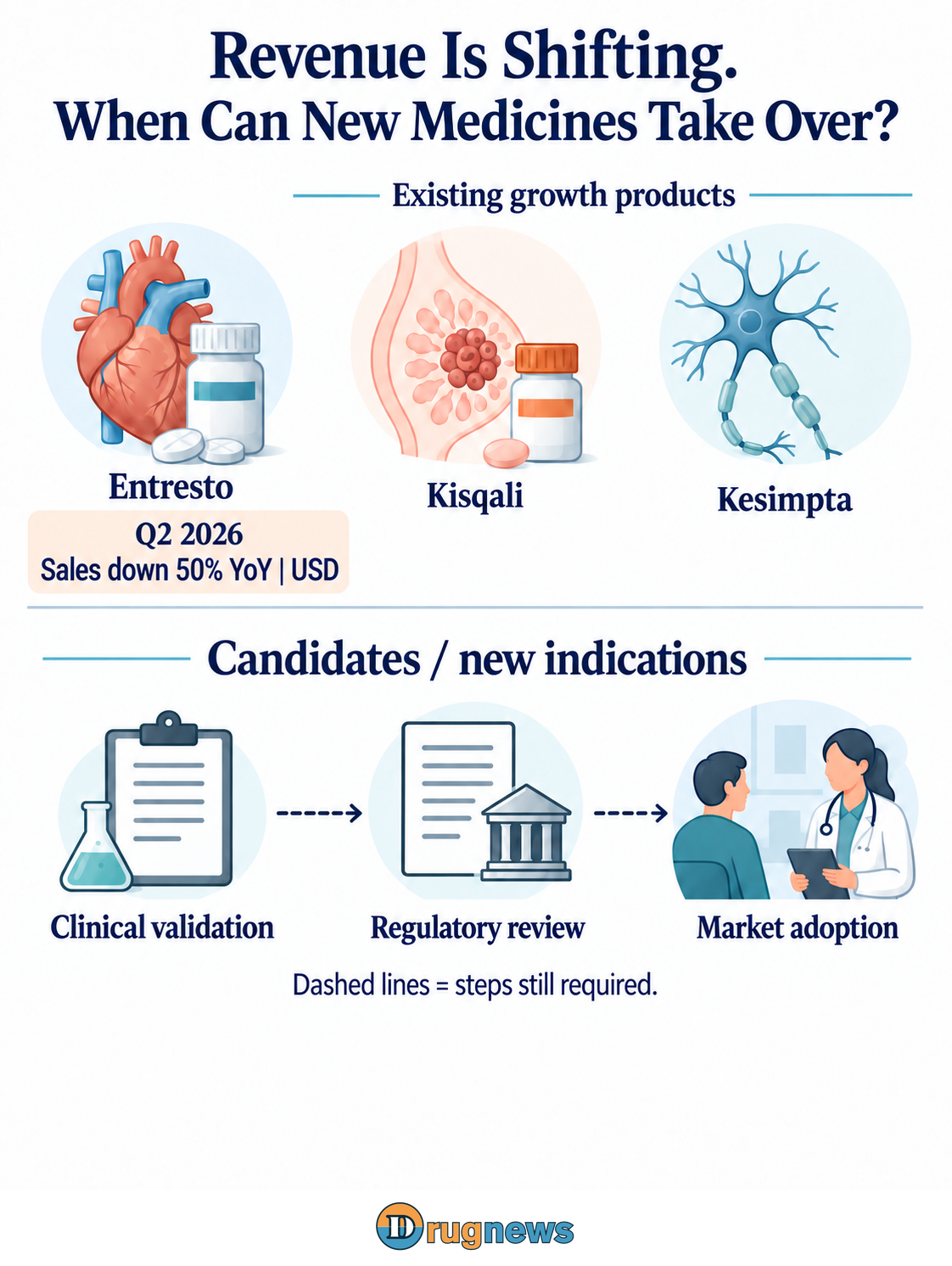
Figure 1 | The upper tier shows marketed products in Q2 2026, with Entresto’s 50% year-on-year sales decline measured in US dollars. The clinical-validation, regulatory-review and market-adoption pathway in the lower tier refers to candidates or new indications.
Pelacarsen Puts the Previous Filing Timetable Back Under Review
On September 4, Novartis reported the Lp(a)HORIZON results in 8,323 patients with established cardiovascular disease and elevated lipoprotein(a). Pelacarsen is an antisense oligonucleotide designed to reduce lipoprotein(a) production, licensed from Ionis. The study did achieve lower Lp(a) levels, but did not demonstrate a reduction in cardiovascular-event risk in the overall study population and missed its primary endpoint.
Lower circulating biomarker levels show activity against the target. Yet in patients already receiving standard cardiovascular treatment, this study did not establish an additional event benefit. The result cannot be generalized to invalidate the entire Lp(a)-lowering mechanism, and biomarker improvement cannot substitute for the clinical endpoint.
The July investor presentation had listed pelacarsen among expected 2026 submissions. That timetable assumed successful development; the September result requires the subsequent filing plan to be reassessed.
As of September 27, the company announcement used here did not provide complete effect estimates, confidence intervals or event tables. If the full analysis supports redefining the population or conducting another confirmatory study, additional time and spending will be required. Until then, investment forecasts should revise the original filing assumption rather than assign a new launch year.
Buying a Late-Stage Pipeline Still Leaves Clinical Validation Risk
Novartis completed the Avidity acquisition on February 27, 2026. Its half-year report confirmed approximately US$12 billion in cash consideration for the muscle-directed antibody-oligonucleotide conjugate (AOC) platform and multiple programs. The transaction brought late-stage progress into Novartis and transferred the corresponding development risk to it.
One of those programs, del-desiran, targets myotonic dystrophy type 1 (DM1). An abnormal repeat expansion in the DMPK gene can generate RNA that disrupts cellular function. The candidate uses an antibody binding transferrin receptor 1, or TfR1, to help deliver small interfering RNA into muscle, with the aim of reducing toxic DMPK messenger RNA. It acts on RNA rather than replacing the normal gene. Early human research showed changes in molecular pathology; functional improvement required separate testing.
On September 8, the Phase 3 HARBOR announcement reported no statistically significant improvement over placebo in the primary measure, video hand opening time (vHOT), within a 54-week study framework. The measure assesses difficulty relaxing muscles after contraction, connecting molecular activity with patients’ hand function.
The company described activity in secondary and exploratory analyses and is analyzing the complete dataset and will discuss next steps with regulators. The announcement did not provide complete effect estimates or confidence intervals. Those signals can help select the next research direction but are insufficient to establish functional benefit.
The July presentation had listed an expected 2027 submission for del-desiran. If further studies are needed, the investment case must account for both their cost and a later revenue stream. Assessing the acquisition’s return requires replacing the old filing timetable with a new path supported by data and regulatory discussions.
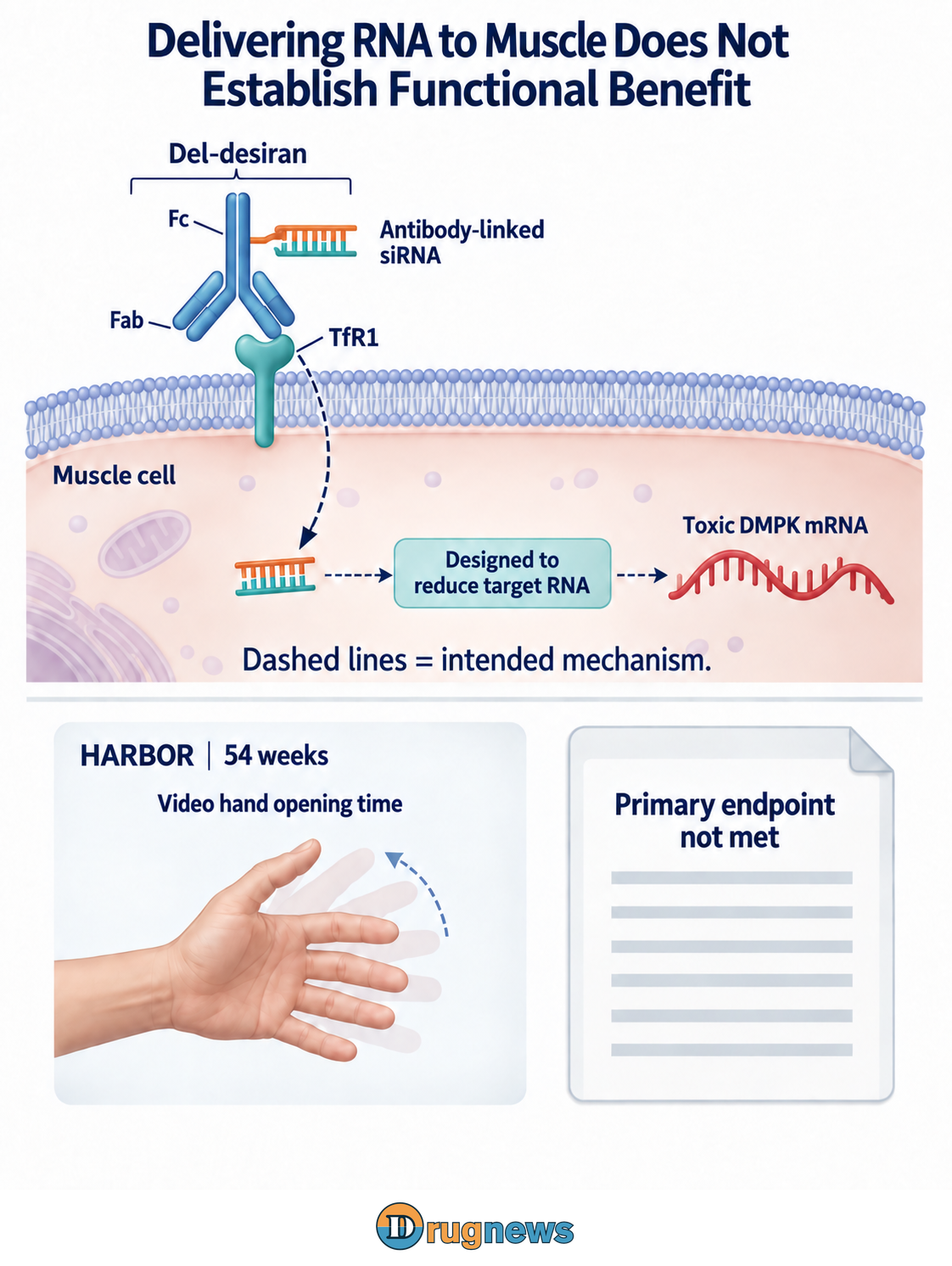
Figure 2 | Del-desiran uses a TfR1-directed antibody to deliver small interfering RNA, aiming to reduce toxic DMPK messenger RNA. HARBOR missed its primary hand-function endpoint. Mechanistic design and patient benefit are separate layers of evidence.
Positive Internal Research Is Advancing Too—but How Much Would It Add?
On September 1, internally discovered oral BTK inhibitor remibrutinib met the primary annualized-relapse-rate endpoint versus teriflunomide in two Phase 3 REMODEL studies. It inhibits signaling involved in B-cell and innate immune-cell activation. The study population consisted of patients with relapsing multiple sclerosis.
This is a positive development milestone against an active comparator. The company plans to present data at MSToronto2026 and seek approval; the current announcement remains a topline report. The molecule is already used as Rhapsido for chronic spontaneous urticaria, while the new multiple-sclerosis use requires its own regulatory review.
There is also an internal commercial question: Novartis already has Kesimpta for multiple sclerosis. A new oral option could reach patients who prefer another route of administration, but it could also replace some existing treatment. Attracting mainly users of competing products or patients with unmet needs would create a different increment for the group than switching patients from its own product.
Complete relapse, disability-progression and safety data will influence where physicians position the new treatment. Estimating incremental revenue requires distinguishing new patients, product switching and achievable pricing. Oral convenience alone is insufficient to estimate how much net sales the product could add to the group.
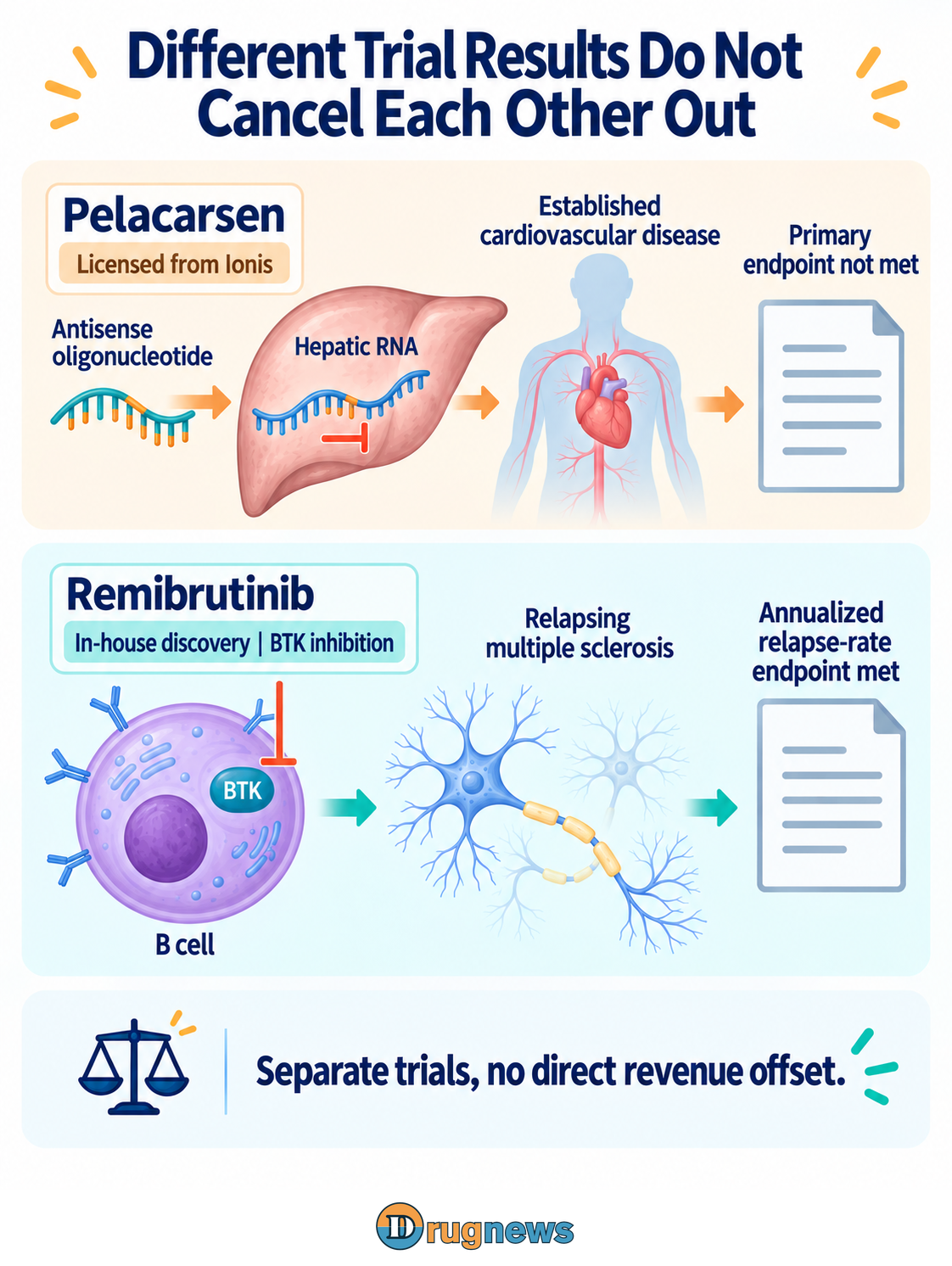
Figure 3 | Pelacarsen and remibrutinib involve different patients, mechanisms and endpoints. The former missed its primary endpoint; the latter met the annualized-relapse-rate endpoint. Each result affects its own development path and product positioning.
The Approximately US$7.5 Billion DM1 Asset Puts Concentration Risk in Perspective
Page 26 of the half-year report attributes approximately US$7.5 billion to the DM1 in-process research and development intangible asset in the preliminary purchase-price allocation. This is a preliminary allocation of asset value at acquisition, not the cost of the HARBOR trial and not an impairment already recognized following the September result. The allocation itself may change as the valuation work is finalized.
Although the approximately US$12 billion acquisition covers a platform and multiple programs, DM1 is therefore a significant concentration within the preliminary asset valuation. Other programs on the platform continue to advance, but they cannot supply DM1’s missing evidence of functional benefit.
Longer development, a smaller addressable market or a changed probability of success could affect expected cash flows and asset valuation. Whether an impairment is recognized, and its size, depends on a subsequent formal assessment. An impairment is an accounting adjustment, not another payment of the acquisition price. The cash needed for additional clinical research is a separate decision.
The expected return underlying the approximately US$7.5 billion DM1 asset is now a capital-allocation question. Additional research has a concrete purpose if it can identify a benefiting population and establish functional effects. If it simply extends an ambiguous signal for another round, a high acquisition price already paid does not make the next trial a better investment. Completion of the acquisition is a historical fact; continued spending is a choice that still has to be made today.
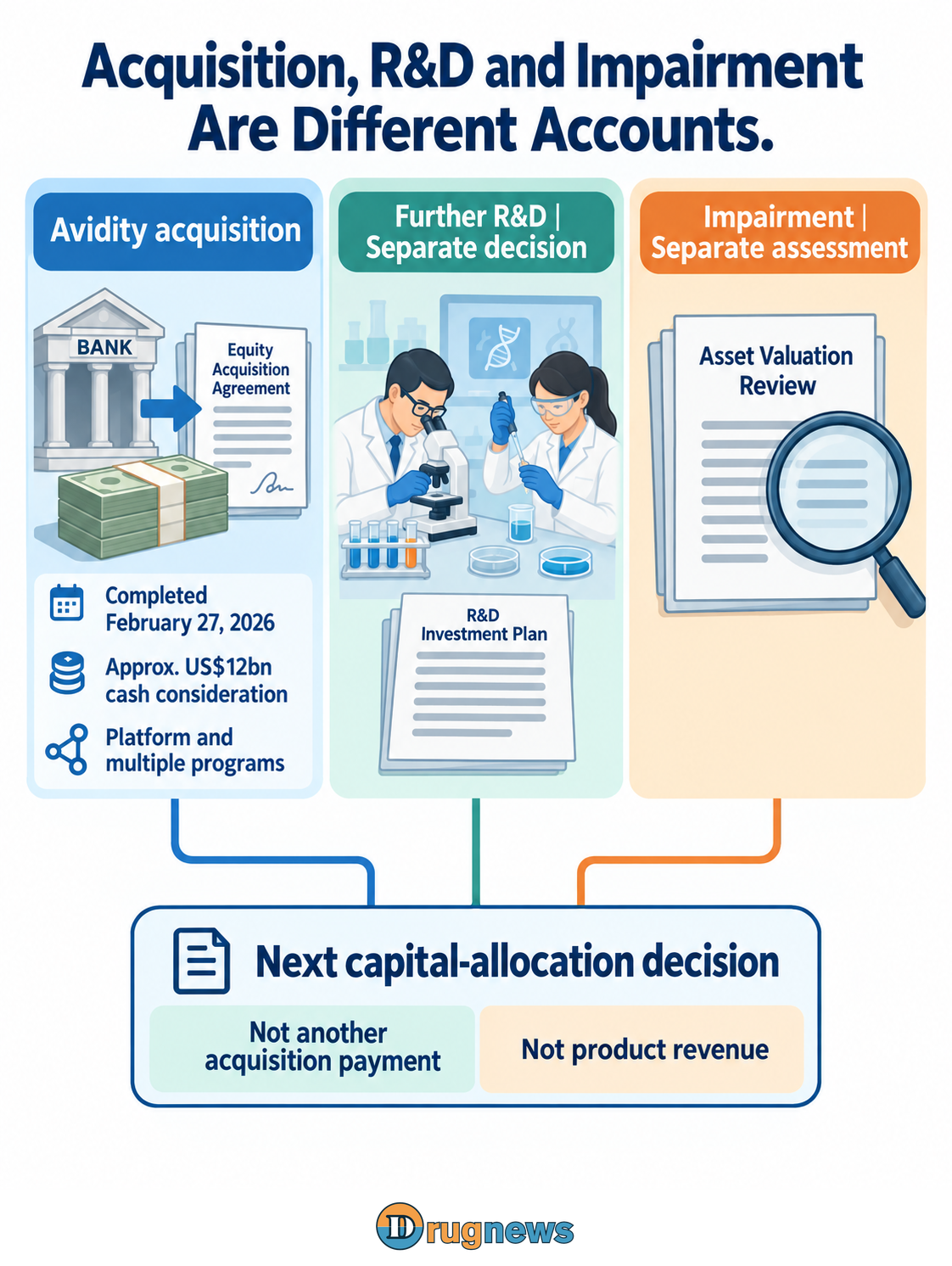
Figure 4 | Cash acquisition consideration, subsequent research spending and impairment assessment must be kept separate. A completed transaction does not establish product revenue, and a trial setback does not mean the full consideration flows out again.
Which Revenues Need to Arrive on Time for the 5–6% Growth Target?
On September 8, Novartis maintained its guidance for a 5–6% sales compound annual growth rate over 2025–2030, measured at constant currencies. This is a five-year group target, not a requirement for 5–6% growth in every quarter. The second quarter’s 1% growth therefore does not, by itself, establish that the five-year target will be missed.
Revenue added by Kisqali and Kesimpta gives Novartis some room during the handover, while remibrutinib offers another option with a positive clinical milestone. What needs redrawing is not whether the entire company has a future, but when and by what path pelacarsen and del-desiran might enter its product portfolio. The old filing schedules, which assumed successful development, can no longer be carried forward unchanged.
If existing brands keep adding more revenue and evidence-supported new indications launch on time, the medium-term target retains observable support. If late-stage programs need additional confirmatory studies, other products must deliver larger contributions in a shorter period. September’s results increase that requirement, but two trials alone do not determine the growth outcome for the entire company.
The third-quarter results on October 27 are the next announced milestone. Management's question moves from how many new medicines it has to which revenue streams can arrive when. DM1's asset valuation and additional research budget after HARBOR form one concrete page of that timetable.
This article provides industry information and business analysis and does not constitute individualized medical or investment advice.
Sources
Novartis Financial Results Q2 2026 — Media Release https://www.novartis.com/sites/novartis_com/files/q2-2026-media-release-en.pdf
Novartis Q2 2026 Condensed Interim Financial Report — Supplementary Data https://www.novartis.com/sites/novartis_com/files/q2-2026-interim-financial-report-en.pdf
Novartis announces Lp(a)HORIZON Phase III topline results for pelacarsen in patients with elevated Lp(a) and established cardiovascular disease (CVD) https://www.novartis.com/news/media-releases/novartis-announces-lpahorizon-phase-iii-topline-results-pelacarsen-patients-elevated-lpa-and-established-cardiovascular-disease-cvd
Novartis successfully completes acquisition of Avidity Biosciences, strengthening late-stage neuroscience pipeline and advancing xRNA strategy https://www.novartis.com/news/media-releases/novartis-successfully-completes-acquisition-avidity-biosciences-strengthening-late-stage-neuroscience-pipeline-and-advancing-xrna-strategy
Novartis provides update on delpacibart etedesiran (del-desiran) Phase III HARBOR study for the treatment of myotonic dystrophy type 1 (DM1) https://www.novartis.com/news/media-releases/novartis-provides-update-delpacibart-etedesiran-del-desiran-phase-iii-harbor-study-treatment-myotonic-dystrophy-type-1-dm1
Novartis remibrutinib, a high-efficacy oral BTK inhibitor, significantly reduces relapse rates and shows favorable safety profile in Phase III RMS trials https://www.novartis.com/news/media-releases/novartis-remibrutinib-high-efficacy-oral-btk-inhibitor-significantly-reduces-relapse-rates-and-shows-favorable-safety-profile-phase-iii-rms-trials
Novartis Q2 2026 Investor Presentation https://www.novartis.com/sites/novartis_com/files/q2-2026-investor-presentation.pdf
Novartis Financial Results — Q3 2026 https://www.novartis.com/events/novartis-financial-results-q3-2026
An Antibody-Oligonucleotide Conjugate for Myotonic Dystrophy Type 1 https://pubmed.ncbi.nlm.nih.gov/41707138/
Cite this article
For decks, research notes, or media references, cite Drugnews with the canonical article URL.
Drugnews Editorial Team. "Sales of a Star Heart Drug Have Halved. Can Novartis’s Next Medicines Take Over in Time?" Drugnews, Oct 06, 2026. https://drugnews.com.tw/articles/2026-10-06-novartis-growth-succession-capital-allocation-en.html