
Anyone who has done IVF remembers the shots.
For roughly two weeks, patients inject hormones into their own belly every day. The ovaries swell. Then comes a single egg retrieval, and often another round.
On October 27, Ferring Pharmaceuticals, a Swiss drugmaker that earns much of its growth from those shots, agreed to buy Gameto for up to $1.3825 billion.
Gameto's product, Fertilo, claims to cut the injections from two weeks to two or three days.
The company that sells the needles is paying for a way to use fewer of them.
This is an insurance policy, and the timing proves it.
Fertilo's US Phase 3 trial is benchmarked against old-style in vitro maturation, while standard IVF is left out of the comparison.
Fertilo will not win FDA approval before April 30, 2028. Until then, two weeks of hormone shots remain the global standard, and Ferring keeps selling them.
01 | Why the two weeks of shots never went away
An egg has to mature before it can be fertilized.
In a natural cycle, a woman usually ripens one egg a month. IVF wants several at once, so doctors use high-dose gonadotropins to push the ovaries into maturing a whole batch.
Gameto describes the standard protocol as 10 to 14 days of self-injection, often repeated across several cycles. Push too hard and patients risk ovarian hyperstimulation syndrome.
The shots are only part of the burden. Each cycle means blood tests, ultrasound visits and a calendar built around the clinic.
That is why patients ask the same question again and again: does it have to be this many injections?
That protocol supports a large business.
Ferring is a privately owned group founded in 1950 and based in Saint-Prex, Switzerland. It employs more than 7,500 people.
Its 2025 revenue topped €2.5 billion for the first time, up 10% at constant exchange rates.
The company said reproductive medicine growth was driven mainly by its flagship Menopur (menotropins).
Profit was thinner. Operating profit fell 13% to €167 million at actual exchange rates, which Ferring blamed on a weaker US dollar.
Rival Merck KGaA sold €1.457 billion of fertility products in 2025, led by Gonal-f. Organic growth was just 0.4%.
Fertility shots are a mature, steady, slow-growing business.
The field has long had a lighter option. In vitro maturation, or IVM, uses only a few injections, retrieves eggs before they are ripe and lets them finish maturing in a culture medium.
The catch has been results. Fewer IVM eggs mature and fewer usable embryos come out, so IVM has stayed a niche choice.
02 | Fertilo moves the ripening into a dish
Eggs do not mature on their own inside the ovary.
Each one is wrapped in support cells that feed it and send it signals, a bit like a nanny.
Standard IVF floods the ovary with hormones so it hires nannies for a whole batch. Old-style IVM takes the egg out early and leaves the nanny behind.
Fertilo builds an artificial nanny in the lab.
Gameto grows ovarian support cells from induced pluripotent stem cells (iPSCs) and places them in the dish with the immature eggs. The egg matures with company, and the patient needs only two to three days of shots.
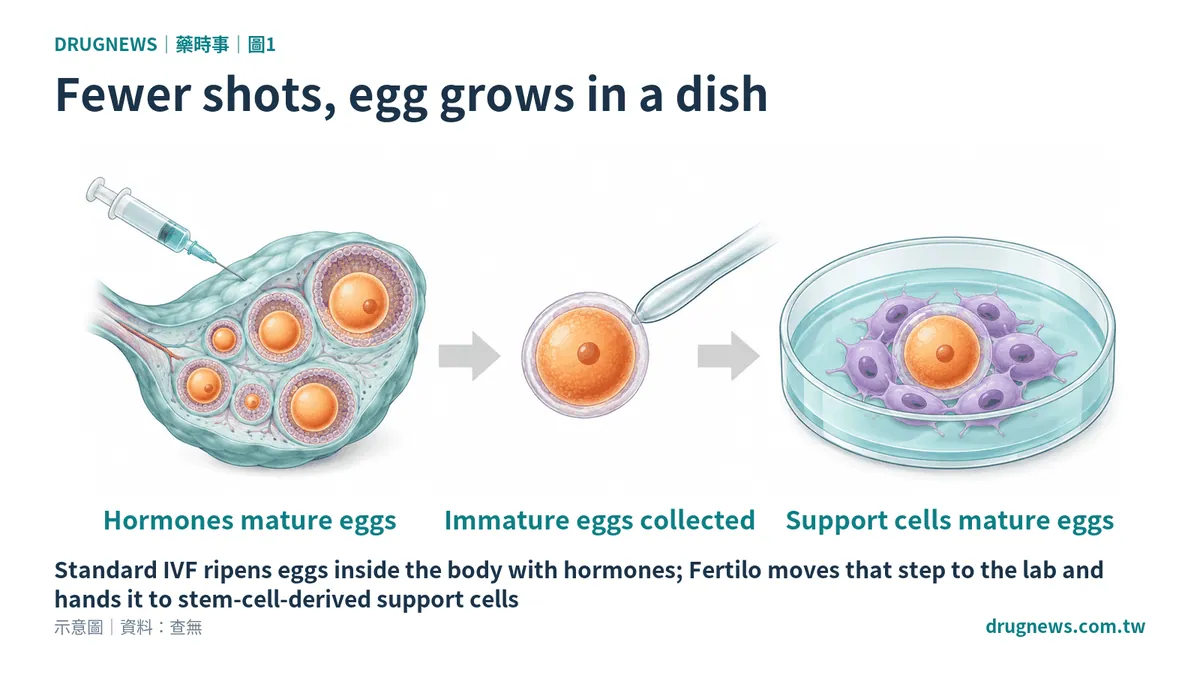
Fig. 1 | Standard IVF ripens eggs inside the body with hormones; Fertilo moves that step to the lab and hands it to stem-cell-derived support cells
The idea has a real origin story.
In 2020, Argentine entrepreneur Martín Varsavsky funded a Harvard fellowship named after his late father. The goal was to make human eggs in a lab. That goal was missed, but the work produced cells that help eggs mature.
The fellow, Christian Kramme, became Gameto's chief scientific officer.
Dina Radenkovic Turner joined in 2021 as co-founder and CEO. Gameto also runs Deovo, a lab model of the female reproductive system for drug discovery, and Ameno, a cell therapy meant to delay menopause.
Varsavsky has called IVF "brutal" and says Fertilo means about 80% fewer injections.
His family knows the process. His wife, Nina Varsavsky, says the couple's own IVF experience pushed them into the field, and she founded Prelude Fertility, a large US clinic network.
That network later became one of the US sites planned for the Phase 3 trial.
03 | Does it work for patients? Strong numbers, 40 patients
The most complete data so far come from Gameto's first-in-human study, posted on medRxiv in April 2025. It enrolled 40 patients in Mexico and Peru.
In the randomized part, with 10 patients per arm, 70% of Fertilo eggs matured versus 52% with old-style IVM. Ongoing pregnancy per cycle was 44% with Fertilo and 20% with old-style IVM.
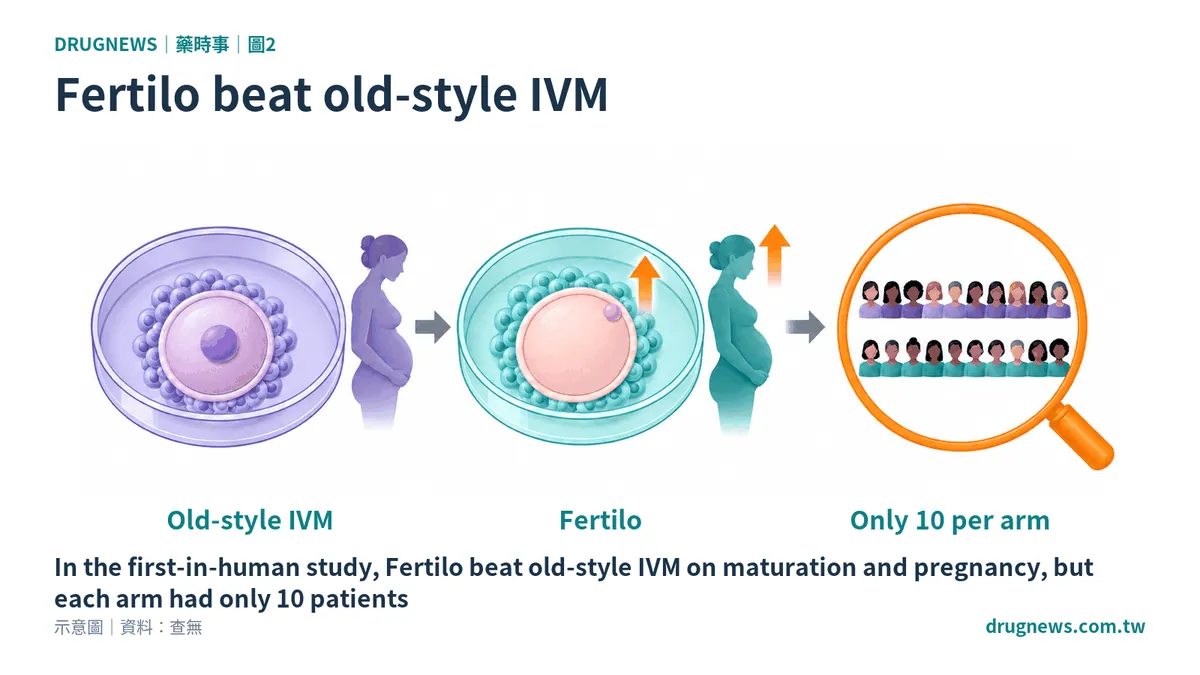
Fig. 2 | In the first-in-human study, Fertilo beat old-style IVM on maturation and pregnancy, but each arm had only 10 patients
The first Fertilo baby was born in Lima, Peru, on December 16, 2024.
By August 2025, Gameto reported five births and more than 20 pregnancies.
Regulators in Australia, Japan, Mexico, Peru, Argentina and other markets have cleared it.
The study is small, and it is a preprint. One extra pregnancy in a 10-patient arm moves the rate by 10 points.
The single-arm safety part of the same study, with 20 patients, reported a clinical pregnancy rate of 57% per embryo transfer and no Fertilo-related adverse events.
Those numbers look good. The question that matters is who Fertilo is racing in its US Phase 3 trial.
The ClinicalTrials.gov record for the FIRST trial is clear.
It plans to enroll 500 patients in a randomized, quadruple-blind design.
The control arm is MediCult IVM, an existing old-style IVM system that the registry calls currently approved.
The primary endpoint is cumulative ongoing pregnancy at 12 weeks or later, across up to two embryo transfers.
Patients in the protocol get up to two days of hormone injections. They must have at least one year of infertility.
The control arm is IVM, and standard IVF is absent.
Even a big win in FIRST would prove that Fertilo beats old-style IVM. It would leave open the question patients care about most: can three days of shots match the success rate of two weeks?
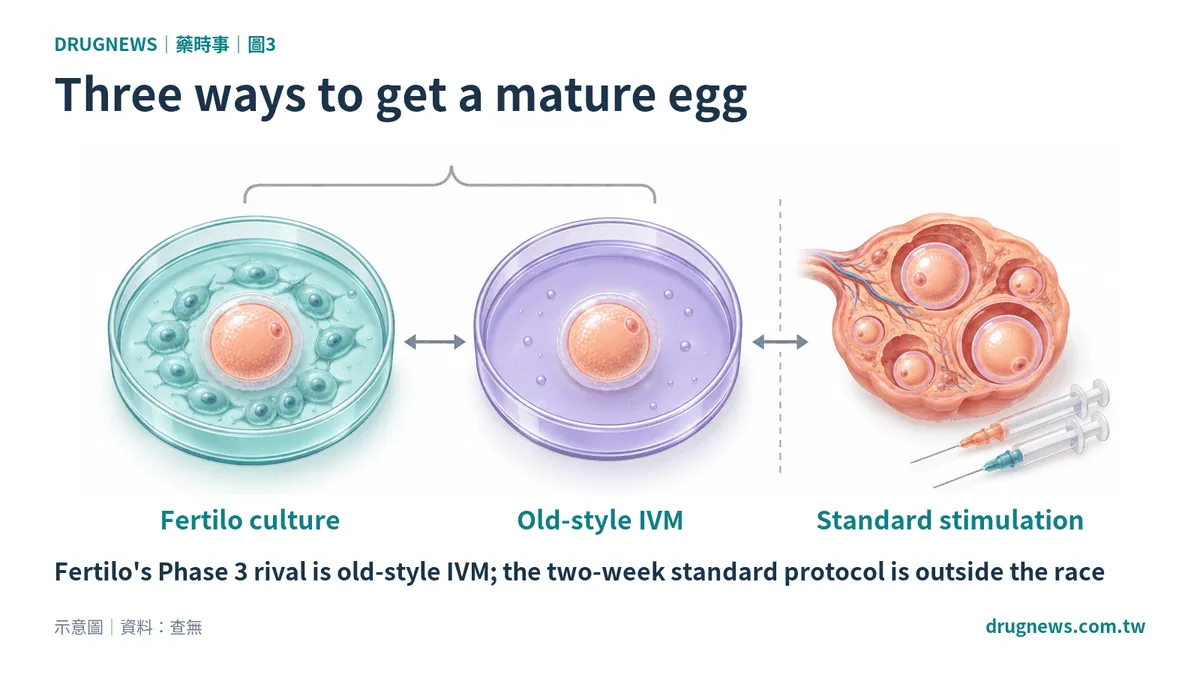
Fig. 3 | Fertilo's Phase 3 rival is old-style IVM; the two-week standard protocol is outside the race
04 | Why Ferring would buy a threat to its own business
Start with the calendar.
FIRST enrolled its first patient on April 17, 2025.
The registry estimates primary completion in May 2027 and study completion in January 2028.
Gameto said in 2025 that an interim readout was expected in late 2026. An interim look is not a filing.
After the final data come the biologics filing and the FDA review, which typically takes most of a year on its own.
So US patients will not get Fertilo before April 30, 2028.
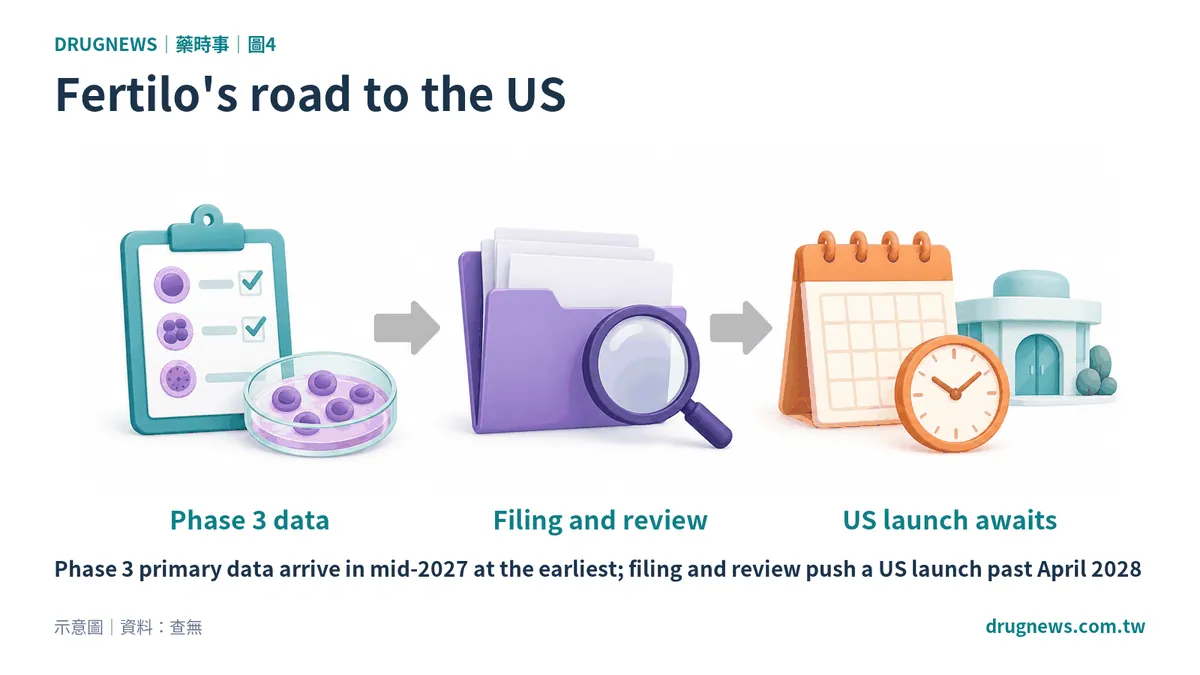
Fig. 4 | Phase 3 primary data arrive in mid-2027 at the earliest; filing and review push a US launch past April 2028
The deal terms show Ferring's math.
The headline of up to $1.3825 billion is tied to development, regulatory and commercial milestones.
Ferring has not disclosed the upfront payment.
Gameto had raised $127 million since its 2020 founding, so the ceiling is about 11 times the capital invested.
The two companies will run independently until the deal closes.
Ferring pays in full only if Fertilo reaches the market. In the meantime it holds the seat and waits for data.
What would prove this call wrong? An FDA approval for Fertilo announced before April 30, 2028, or a change in the FIRST registry that swaps the control arm for standard IVF.
Neither shows up in any filing or registry today.
Seen another way, this is a defensive card.
If a three-day protocol ever matches the two-week one, demand for fertility shots would fall sharply. That card is safer in Ferring's hand than in Merck KGaA's or anyone else's.
The market could also grow.
Bloomberg data cited by Infobae show IVF accounts for under 3% of US births, versus more than 10% in Denmark, South Korea and Spain.
Fewer shots and a shorter process could bring more people into treatment, and the company selling the lab step still gets paid.
Merck KGaA has the most to watch. Its fertility line barely grew in 2025, and it now faces a rival that owns both the shots and the alternative.
05 | What it means for Taiwan, an IVF-heavy market
Taiwan leans on IVF more than most places.
In 2023, Taiwan recorded 58,557 assisted reproduction treatments, which produced 11,658 babies.
Taiwan had 135,571 births that year, so about one newborn in 12 came from assisted reproduction.
That share is close to the 10%-plus levels of South Korea and Denmark.
The success rate is not high. In 2023 data for Taiwanese couples using their own eggs and sperm, the live birth rate after a single-embryo transfer was 36.9%.
That is why many patients go through the two weeks of shots more than once.
The government keeps adding money.
Its IVF subsidy program 3.0 took effect on April 1, 2026, with a cap of NT$150,000 for women under 39.
The estimated budget rises from NT$1.79 billion to NT$2.58 billion a year.
Under the old 2.0 plan, the subsidy covered about 53% of treatment costs. Version 3.0 covers an average of 77%, and up to 84% for women under 39.
In other words, Taiwan's taxpayers now pay for most of each two-week cycle, including the hormone drugs.
By April 12, 2026, the subsidy program had helped deliver 34,219 babies.
Fertilo is not sold in Taiwan. As a stem-cell-derived product, it would fall under Taiwan's two regenerative medicine acts, which took full effect on January 1, 2026.
The new law has a fast lane.
After Phase 2 shows safety and early efficacy, a product can seek conditional approval for up to five years.
That lane is reserved for life-threatening or severely disabling conditions, and infertility does not qualify.
Fertilo would need full Phase 3 data and a standard review.
Until then, Taiwanese patients will follow the same protocol, and the subsidy will keep paying for two weeks of shots.
For now, two weeks of shots is still two weeks.
What has changed is the direction.
Ferring, which grows on fertility shots, is spending real money on fewer of them.
Whether three days can replace two weeks will start to show in FIRST data in mid-2027. After that, someone will have to test Fertilo head-to-head against standard IVF.
If skipping 11 days of injections cost a few points of success rate, which protocol would you pick?
This article is industry and company analysis, not investment or medical advice.
References
- Ferring Pharmaceuticals and Gameto sign agreement for proposed acquisition|Ferring Pharmaceuticals|2026-10-27|https://ferringusa.com/?press=ferring-pharmaceuticals-and-gameto-sign-agreement-for-proposed-acquisition
- Ferring to acquire next-gen IVF startup Gameto for up to $1.4B|BioPharma Dive|2026-10-27|https://www.biopharmadive.com/news/ferring-gameto-acquire-ivf-fertilo-womens-health/872904/
- Un magnate argentino vendió su sexto unicornio por más de USD 1.380 millones|Infobae|2026-10-27|https://infobae.com/economia/2026/10/27/un-magnate-argentino-vendio-su-sexto-unicornio-por-mas-de-usd-1380-millones-la-emotiva-historia-que-inspiro-el-negocio
- Fertilo In Vitro Research Study and Trial (FIRST, NCT06858111)|ClinicalTrials.gov|2026-10-07|https://clinicaltrials.gov/study/NCT06858111
- Gameto's $44M Series C as first patients recruited for pivotal stem cell Phase 3 trial|BioSpace|2025-08-13|https://www.biospace.com/press-releases/gametos-44m-series-c-to-help-redefine-reproductive-care-as-first-patients-recruited-for-pivotal-stem-cell-phase-3-trial
- Gameto Announces FDA IND Clearance for Fertilo|BioSpace|2025-01-30|https://www.biospace.com/press-releases/gameto-announces-fda-ind-clearance-for-fertilo-the-first-ipsc-based-therapy-to-enter-u-s-phase-3-clinical-trials
- Fertilo first-in-human study preprint (DOI 10.1101/2025.04.02.25324702)|medRxiv|2025-04-03|https://www.medrxiv.org/content/10.1101/2025.04.02.25324702v1
- Gameto Reports Positive Results for IVF Alternative Technology That Reduces Hormone Treatments|Femtech Insider|2025-04-08|https://femtechinsider.com/gameto-reports-positive-results-for-ivf-alternative-technology-that-reduces-hormone-treatments
- For the First Time, Ferring Reports Revenue of Over €2.5 Billion in 2025|Ferring Pharmaceuticals (BioSpace)|2026-03-10|https://www.biospace.com/press-releases/for-the-first-time-ferring-reports-revenue-of-over-2-5-billion-in-2025
- Merck KGaA, Darmstadt, Germany: Guidance for 2025 Delivered, Growth Foundation in Place|Merck KGaA|2026-03-05|https://www.emdgroup.com/en/news/q4-2025-05-03-2026
- 人工生殖增幅緩 專家:對象飽和、缺乏生育意願 (Taiwan 2023 assisted reproduction data)|United Daily News (CNA)|2025-12-28|https://udn.com/news/story/7266/9230750
- 2023 年出生數跌破低推估值 14 萬 (Taiwan 2023 births)|TechNews|2024-01-10|https://cdn.technews.tw/2024/01/10/taiwan-number-of-births-2023
- 人工生殖補助新生兒突破3萬名 (Taiwan IVF subsidy 3.0)|United Daily News|2026-04-22|https://udn.com/news/story/7266/9457306
- 再生醫療雙法三讀 (Taiwan regenerative medicine acts pass)|The Reporter|2024-06-04|https://www.twreporter.org/a/regenerative-medicine-legislation-passed
- How Taiwan's Regenerative Medicine Acts Offer a Lifeline to Critically Ill Patients|GeneOnline|2026-09-02|https://geneonline.news/how-taiwans-regenerative-medicine-acts-offer-a-lifeline-to-critically-ill-patients-gct-month-007-sep-2026/
- 試管植入胚胎越多越好?國健署示警藏早產風險 (Taiwan 2023 IVF live birth rates)|Central News Agency|2026-05-07|https://www.cna.com.tw/news/ahel/202605070158.aspx
Share this analysis
Send this article to readers who follow biotech, company strategy, and capital-market signals.
Cite this article
For decks, research notes, or media references, cite Drugnews with the canonical article URL.
Drugnews Editorial Team. "IVF With 80% Fewer Shots: Ferring Buys Gameto." Drugnews, Oct 31, 2026. https://drugnews.com.tw/articles/2026-10-31-ferring-gameto-fertilo-ivf-fewer-hormone-injections-en.html