
On October 26, BioNTech hit its own brakes on a breast cancer ADC.
It licensed the drug from DualityBio in a deal worth up to $1.6 billion. The Phase 3 trial met its goal, yet the company said the potential benefit "would be limited."
A week earlier, Roche paid Hansoh Pharma $400 million upfront for ADCs that have never been tested in people. The headline value tops $15 billion.
Hansoh kept the Taiwan rights for itself.
Same drug class. One side gets bid up, the other gets marked down by its own owner.
Taiwan has seven companies on this road. OBI Pharma is furthest ahead with a novel drug.
The first Taiwanese ADC to reach a pivotal trial, and the most likely to win approval first, will be TSY-110. It is a Kadcyla biosimilar from Formosa Pharmaceuticals and EirGenix.
01|ADC buyers only pay for what others cannot build
An antibody-drug conjugate works like a guided missile.
The antibody is the missile. A chemotherapy drug is the warhead. A chemical linker ties them together.
The antibody finds a marker on the cancer cell surface. The cell swallows the package, and only then is the warhead released inside.
Healthy cells take fewer hits. Cancer cells take more of the drug.
The idea is easy. The details are hard.
How many warheads ride on each antibody matters. So does where they attach, and whether they fall off early in the bloodstream.
Those choices decide whether an ADC is a good medicine or a toxic one. They are also where a company can build something rivals cannot copy.
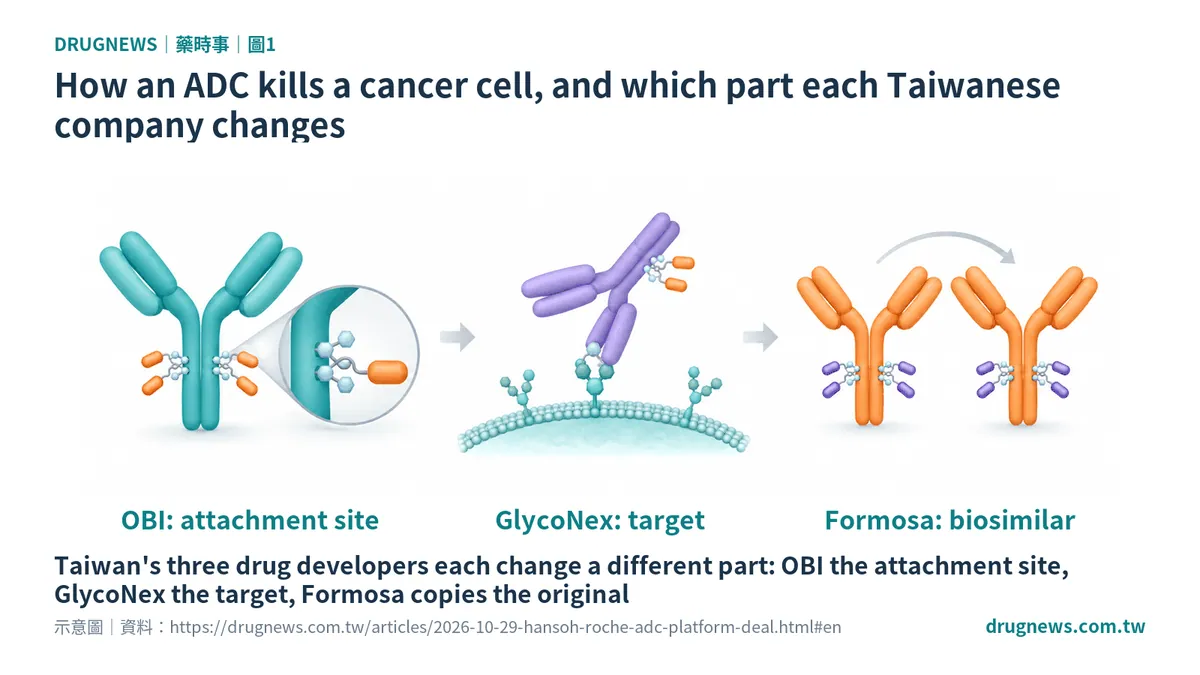
Fig. 1|Taiwan's three drug developers each change a different part: OBI the attachment site, GlycoNex the target, Formosa copies the original
BioNTech's drug, trastuzumab pamirtecan, targets HER2.
The Phase 3 study, DYNASTY-Breast02, tested it in HR-positive, HER2-low metastatic breast cancer.
The drug delayed tumor progression, but only modestly, and the data were too early to show a survival benefit.
Its rival is Enhertu, which won the first approval in HER2-low breast cancer in 2022. About three years later, Enhertu was also cleared for tumors with "ultralow" HER2.
With a bar that high, even a positive Phase 3 makes BioNTech's drug just another HER2 ADC.
Rates of lung inflammation were also higher than in earlier testing. Severe and fatal events occurred in a small share of patients.
BioNTech and DualityBio said they will discuss the data and decide next steps. The drug is still in a late-stage study in HER2-positive endometrial cancer.
The lesson is blunt. A new ADC aimed at a well-served target has to beat the leader, not just the old standard of care.
Roche paid in a very different way.
It bought Hansoh's design engine: two preclinical programs plus a set of new molecules aimed at targets Roche picks.
A further $110 million comes on the first anniversary. Hansoh keeps mainland China, Hong Kong, Macau and Taiwan.
Hansoh also holds an option to pick up to two programs to develop outside its home territory.
This is the second deal between the two companies; an October 2025 colorectal cancer pact was reported at up to $1.45 billion.
Roche, in other words, is renting a research team. It is paying for the ability to make many good ADCs, not for one finished drug.
Our earlier analysis of the Roche–Hansoh deal walked through that math.
The money flows to platforms and to real differences.
That gives us a ruler for Taiwan.
02|One ruler: how far each Taiwan ADC company has come
The ruler is simple: how close is each company to patients?
The table lists drug codes, targets, latest stage and a primary source for each company, as of October 27, 2026.
| Company (ticker) | Drug / role | Target | Latest stage | Date | Source |
|---|---|---|---|---|---|
| OBI Pharma (4174) | OBI-992 | TROP2 | Phase 1/2; recommended Phase 2 dose found, enrollment closed | First patient 2024-06 | ClinicalTrials.gov |
| OBI Pharma (4174) | OBI-902 | TROP2 (glycan site-specific) | Phase 1/2 enrolling in the US and Taiwan | IND cleared 2025-04 | OBI pipeline |
| GlycoNex (4168) | GNX1021 | Glycan antigen bLeB/Y | Phase 1; first patient enrolled in Japan | 2026-08-03 | Commercial Times |
| Formosa Pharmaceuticals (6838) | TSY-110 (EirGenix code EG12043) | HER2; Kadcyla biosimilar | EU clinical trial application filed | 2026-08-28 | BioPharm International |
| EirGenix (6589) | TSY-110 co-developer and antibody supplier; ADC CDMO | HER2 | 29.6 kL total capacity, still expanding | 2026-10 | GeneOnline |
| Formosa Laboratories (4746) | ADC conjugation and manufacturing for TSY-110 | — | Part of an all-Taiwan supply chain | 2026 | Formosa TSY-0110 |
| Mycenax (4726) | ADC CDMO platform ConjuMX | — | Cross-border chain with KriSan and Japan's SPERA PHARMA | 2026-07 | GeneOnline |
| Chia-Cheng Biotech (private) | Antibody-radiation conjugate (ARC) | — | Plans a US IND filing in 2026 | 2026-01-19 | TechNews |
The seven companies play three different games.
OBI, GlycoNex and Chia-Cheng make novel drugs. They bet on molecules nobody else has.
Formosa Pharmaceuticals makes a biosimilar. It bets on speed.
Formosa Laboratories, Mycenax and EirGenix are contract manufacturers. They earn fees from the global ADC boom, whoever wins the drug race.
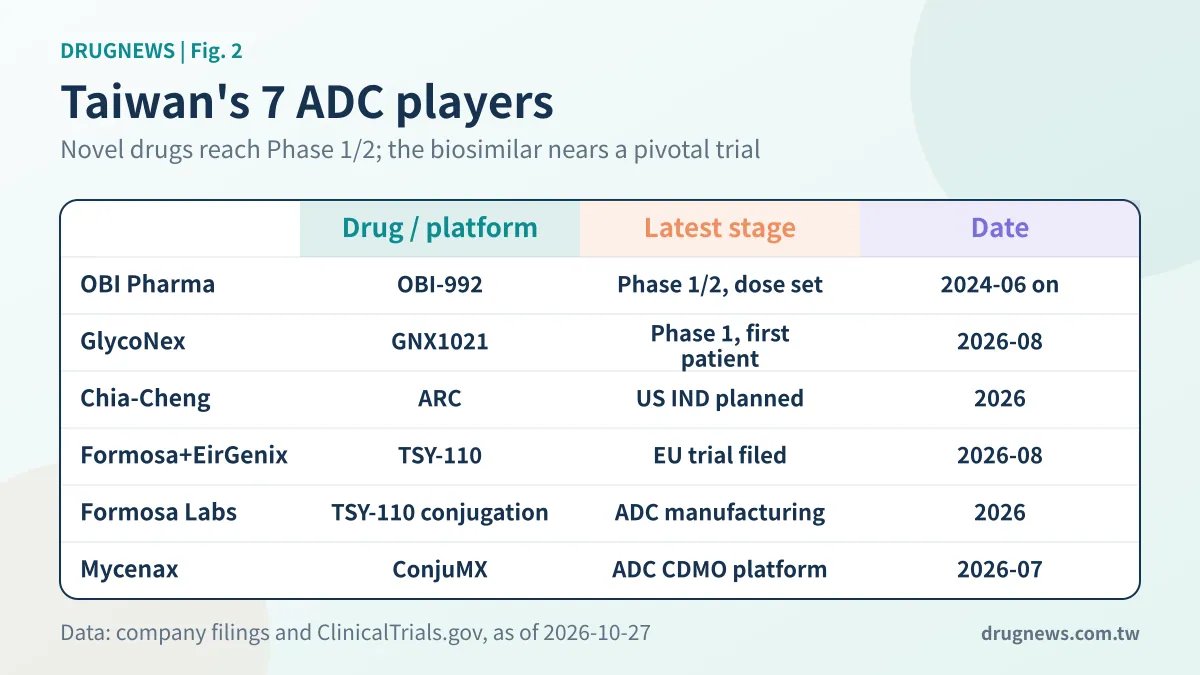
Fig. 2|Novel drugs have reached Phase 1/2 at most; the biosimilar is lining up at the pivotal-trial door
03|OBI Pharma is furthest ahead, and its platform already earns
OBI-992 is the Taiwan-owned ADC closest to patients.
It carries a topoisomerase I inhibitor as its warhead, with four warheads per antibody.
Its Phase 1/2 trial began on June 12, 2024, at six US sites and two in Taiwan. The study planned to enroll about 117 patients.
OBI has found a recommended Phase 2 dose and closed enrollment.
At its December 2025 investor conference, OBI reported partial tumor responses in three patients.
The FDA had granted OBI-992 an orphan drug designation in gastric cancer in August 2024.
The second drug, OBI-902, is the first human test of OBI's own conjugation technology.
Most ADCs hang their warheads on cysteine sites on the antibody, which yields a mixed product.
OBI's GlycOBI platform attaches them to the antibody's sugar chains at fixed positions. It can carry from 2 to 16 warheads per antibody.
Two more tools sit behind it: an enzyme called EndoSymeOBI that trims the sugar chains, and a water-loving linker called HYPrOBI meant to keep the drug stable in the blood.
The FDA granted OBI-902 orphan drug designations in cholangiocarcinoma in November 2025 and in gastric cancer in December 2025.
The catch is that TROP2 is a crowded lane.
The protein sits on many solid tumors, from lung to breast to stomach. Nearly every big drugmaker has a TROP2 bet, and Gilead's Trodelvy is already on the market.
On October 25 at ESMO, Merck and Kelun's sac-TMT posted a major progression-free survival benefit in a Phase 3 lung cancer study.
OBI's answer is to sell the technology first.
On December 19, 2025, OBI licensed global rights to a glycoprotein-targeting ADC built with GlycOBI to US-based TegMine Therapeutics.
OBI receives an upfront payment, milestones and royalties. The amounts are confidential.
In the third quarter of 2025, OBI's standalone revenue jumped 289% from the prior quarter. ADC technology collaborations drove the increase.
This is the Hansoh model in miniature: the drugs are in Phase 1, and the platform is already earning.
Partner Biosion holds the rights in mainland China, Hong Kong and Macau. OBI holds them everywhere else.
OBI-992's Phase 2 data will set how fast OBI moves from selling technology to selling medicines.
04|GlycoNex and Chia-Cheng bet on targets no one else is mining
GlycoNex's GNX1021 takes a different path. It keeps a standard design and swaps the target.
Cancer cells often wear an abnormal sugar coat. GNX1021 aims at one of those sugar chains, called bLeB/Y.
The marker is abundant in gastric and other digestive cancers and rare in normal tissue. That gap is what lets the warhead hit tumors and spare the rest of the body.
On August 3, 2026, GlycoNex said the first patient had been enrolled in Japan.
The trial runs in Japan and Taiwan. It tests safety, tolerability and pharmacokinetics first, then looks for early signs of tumor response.
Gastric cancer weighs heaviest in Asia. Starting in Japan puts GlycoNex at the door of the market that needs it most.
Chia-Cheng Biotech goes one step further. It swaps the chemotherapy warhead for a radioactive isotope.
The company calls the result an antibody-radiation conjugate, or ARC.
In March 2023, Chia-Cheng paid NT$690 million to license ADC technology from Taiwan's Development Center for Biotechnology.
On January 19, 2026, it signed a memorandum with radiopharmaceutical maker Ji-Sheng Biotech. The goal is a US IND this year, then human trials in the US and Taiwan.
Both companies are still finding the right dose. Their next milestone is Phase 1 safety data.
05|Taiwan's first ADC on the market will be a biosimilar
Kadcyla is Roche's HER2 breast cancer ADC, launched in 2013.
Its global sales reached about $2.5 billion in 2025. That is the market a biosimilar wants to share.
TSY-110 is Formosa Pharmaceuticals' copy of Kadcyla. The work is split across an all-Taiwan supply chain.
Formosa leads development. EirGenix supplies the antibody. Formosa Laboratories handles conjugation and manufacturing.
Under a March 2022 alliance, Formosa can receive up to $30 million in upfront and milestone payments from EirGenix, in exchange for profit-sharing rights.
EirGenix's antibody comes from its own trastuzumab biosimilar, EG12014. It was approved in Taiwan in June 2023 and in the EU in November 2023, and is under US review.
On August 28, 2026, Formosa filed a clinical trial application in Europe.
TSY-110 links trastuzumab to the same payload as Kadcyla, mertansine.
Formosa reports that preclinical tests showed a consistent drug-to-antibody ratio and plasma behavior comparable to the original.
A clinical trial application allows testing in people. The pivotal trial itself is what has to show the copy matches.
In 2026 Formosa also held a biosimilar development meeting with the FDA. The meeting confirmed the trial design and manufacturing strategy.
A biosimilar wins because it does not have to prove from scratch that the drug works.
A novel drug must run Phase 1, 2 and 3 and show that patients live longer.
A biosimilar needs one pivotal trial showing its pharmacokinetics and safety match the original. TSY-110's pivotal trial compares it head to head with Kadcyla.
The ceiling is high. About 197,000 new HER2-positive breast cancer cases occurred worldwide in 2020, and Formosa projects nearly 230,000 by 2030.
GlobalData projects that Kadcyla and Enhertu together will reach $13.3 billion by 2031.
Formosa wants TSY-110 to be the first Kadcyla biosimilar launched in the US and Europe.
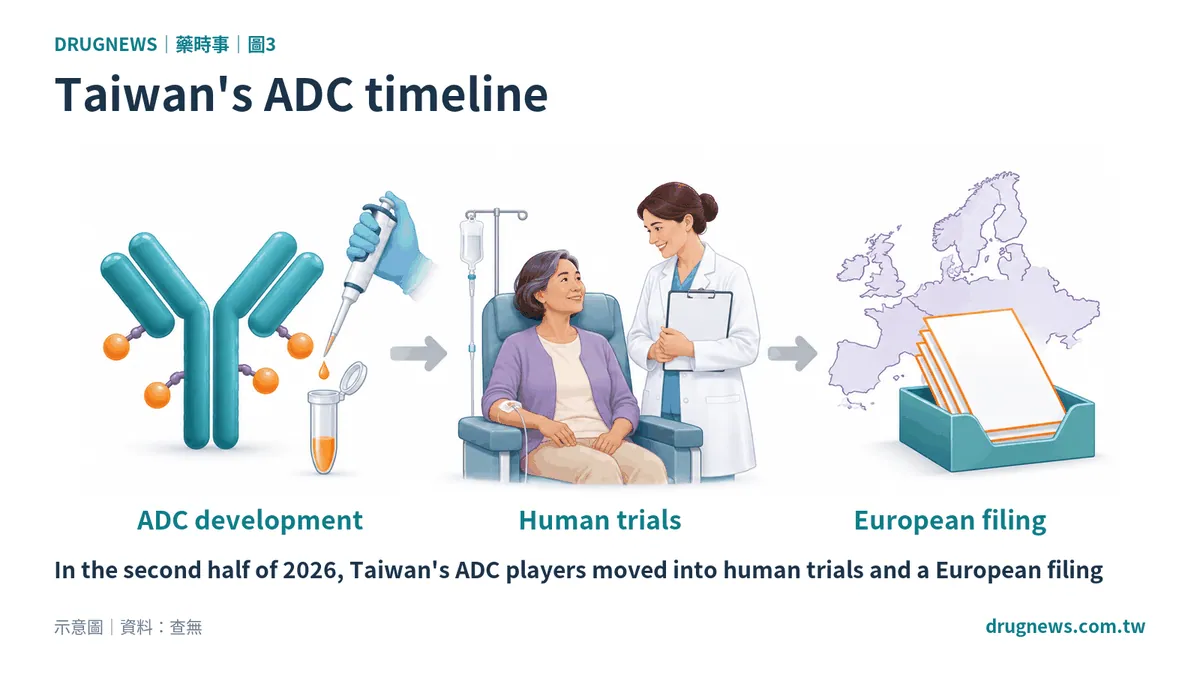
Fig. 3|In the second half of 2026, Taiwan's ADC players moved into human trials and a European filing
The manufacturing layer is earning money now.
EirGenix has 29.6 kL of total capacity, including 12 mammalian cell reactors of 2,000 liters each. It holds GMP inspection records from US, EU and Japanese regulators.
At CPHI Milan this month, EirGenix named ADCs as one of its two priority areas.
Its second microbial plant in Zhubei opened in mid-September, lifting microbial fermentation capacity to 1,500 liters.
Mycenax's ConjuMX platform turns complex conjugation conditions into controllable settings.
Its in-house linker supports 4 to 8 warheads per antibody and can carry two different payloads at once.
With a plasmin-cleavable linker licensed from Japan's RIN Institute, Mycenax reported overall recovery rising from 60% to 80%.
The same linker reached eight warheads per antibody and stayed stable for six months at 2–8°C in liquid form, according to the company.
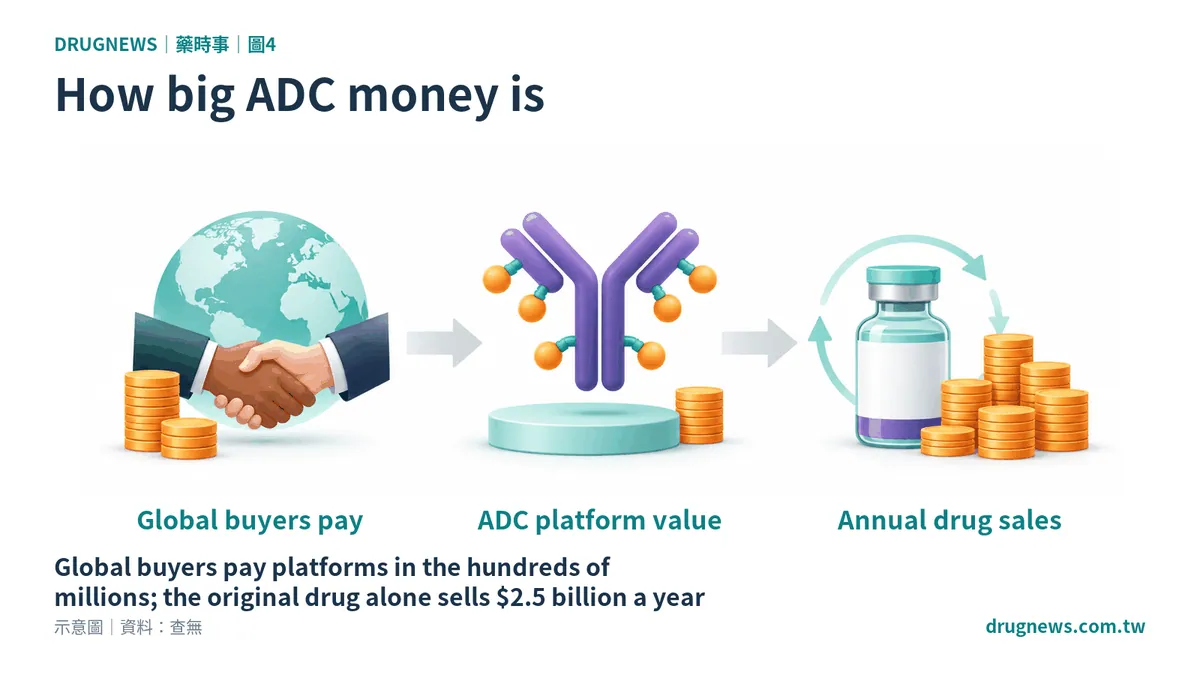
Fig. 4|Global buyers pay platforms in the hundreds of millions; the original drug alone sells $2.5 billion a year
Global ADC buyers have used $400 million to tell the market something simple. The molecules can come later. The platform has to come first.
Taiwan's first winner will be TSY-110.
By June 30, 2027, Formosa Pharmaceuticals will announce the first patient dosed in the European pivotal trial.
That will make TSY-110 the first Taiwanese ADC in pivotal development.
If OBI lands a regional OBI-992 licensing deal with a disclosed value first, the ranking changes.
Taiwan stock angle
Formosa Pharmaceuticals (6838), EirGenix (6589) and Formosa Laboratories (4746) are tied to the same drug, TSY-110.
They will move into view together when the European trial starts.
For OBI Pharma (4174), watch OBI-992's Phase 2 data and the next platform license. For GlycoNex (4168), watch GNX1021's dose escalation.
Follow Drugnews for the business logic behind one major global pharma story every day.
This article is industry and company analysis, not investment or medical advice.
References
- BioNTech, DualityBio say ADC had 'modest' benefit in breast cancer study|BioPharma Dive|2026-10-26|https://www.biopharmadive.com/news/biontech-dualitybio-modest-results-adc-breast-cancer/839574/
- Hansoh Pharma enters $15 billion collaboration and license agreement with Roche|Pharmaceutical Executive|2026-10-19|https://www.pharmexec.com/view/hansoh-pharma-15-billion-collaboration-license-agreement-roche
- A Phase 1/2 Study of OBI-992 in Subjects With Advanced Solid Tumors (NCT06480240)|ClinicalTrials.gov|2024-06-12|https://clinicaltrials.gov/study/NCT06480240
- Pipeline overview|OBI Pharma|2026-10-27|https://www.obipharma.com/what-we-do/pipeline-overview/
- OBI Pharma investor conference: ADC platform commercialization, three partial responses for OBI-992|Commercial Times|2025-12-18|https://www.ctee.com.tw/news/20251218701436-430504
- OBI Pharma signs glycoprotein ADC license with TegMine Therapeutics|Wantrich (China Times)|2025-12-19|https://wantrich.chinatimes.com/news/20251219900409-420101
- Merck's sac-TMT posts major PFS benefit in PD-L1-negative NSCLC|Fierce Pharma|2026-10-25|https://www.fiercepharma.com/pharma/merck-kelun-workhorse-adc-posts-major-tumor-progression-benefit-pd-l1-negative-nsclc
- GlycoNex GNX1021 enrolls first patient in Japan|Commercial Times|2026-08-03|https://www.ctee.com.tw/news/20260803700603-430504
- Ji-Sheng and Chia-Cheng form alliance on antibody-radiation conjugates|TechNews|2026-01-19|https://technews.tw/2026/01/19/arc/
- Chia-Cheng licenses ADC technology from Taiwan's biotech center for NT$690 million|Mirror Media|2023-03-13|https://www.mirrormedia.mg/story/20230313ind006
- Formosa Pharmaceuticals files EU application for trastuzumab emtansine biosimilar TSY-110|BioPharm International|2026-09-03|https://www.biopharminternational.com/view/formosa-pharmaceuticals-eu-trastuzumab-emtansine-biosimilar-tsy-110
- Kadcyla Biosimilar|TSY-0110|Formosa Pharmaceuticals|2026-10-27|https://www.formosapharma.com/tsy-0110/
- CPHI Milan 2026: EirGenix shows dual-engine CDMO capacity and global reach|GeneOnline|2026-10-21|https://geneonline.news/cphi-milan-2026-eirgenix-event-034-oct-2026/
- Mycenax builds a cross-border ADC CDMO ecosystem|GeneOnline|2026-08-21|https://geneonline.news/mycenax-emerging-biologics-summit-asia-adc-034/
Share this analysis
Send this article to readers who follow biotech, company strategy, and capital-market signals.
Cite this article
For decks, research notes, or media references, cite Drugnews with the canonical article URL.
Drugnews Editorial Team. "Taiwan ADC companies: OBI leads, biosimilar first." Drugnews, Oct 30, 2026. https://drugnews.com.tw/articles/2026-10-30-taiwan-adc-companies-landscape-obi-tsy110-en.html