
On November 9, the U.S.
FDA ordered every GLP-1 drug to carry a new warning about NAION, a rare eye condition in which the front of the optic nerve loses blood flow and vision in one eye drops suddenly, sometimes for good.
The list runs from Novo Nordisk's Ozempic and Wegovy to Eli Lilly's Mounjaro and Zepbound.
It even includes Foundayo, Lilly's small-molecule weight-loss pill approved in April, which shares a target with the injections but not a structure.
A day later, Taiwan's Food and Drug Administration (TFDA) said it would re-evaluate the safety of the whole class.
Taiwan's own label change, made in June, covered only semaglutide.
Our call: the warning will not dent GLP-1 prescription volume. What it shifts is the balance in U.S. litigation. And Taiwan will extend the same warning to Mounjaro and every other GLP-1 by the end of June 2027, without narrowing the weight-loss indication.
If the TFDA keeps the warning limited to semaglutide by then, or instead requires an eye exam before treatment, this call is wrong.
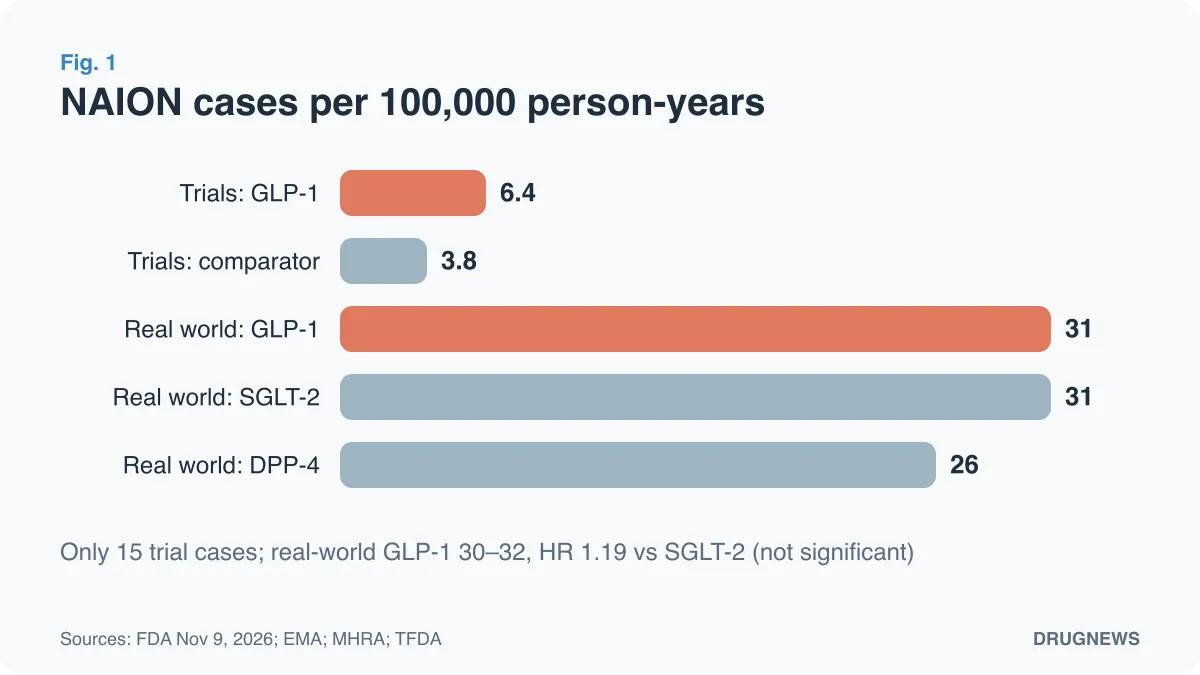
Fig. 1: NAION incidence per 100,000 person-years, from FDA's pooled analysis of 126 randomized trials and its Sentinel real-world cohort. Source: FDA Drug Safety Communication, Nov 9, 2026.
01 · The "1.7x risk" rests on 15 cases
Headlines in Taiwan led with "risk up 1.7 times." That ratio comes from FDA's own meta-analysis of 126 randomized trials and 134,253 participants: 6.4 NAION cases per 100,000 person-years on a GLP-1, versus 3.8 on comparators.
The entire analysis found 15 probable cases.
Ten were on a GLP-1, five on placebo, none on other diabetes drugs.
With counts that small, one or two cases swing the ratio a lot.
In absolute terms, the gap is 2.6 extra cases per 100,000 person-years.
That is roughly one additional case for every 38,000 people treated for a year.
Background rates matter too.
Among adults over 50, NAION already occurs at 2.3 to 10.2 cases per 100,000 people a year.
Patients typically wake up with a dark or missing patch in one eye.
It is painless, and there is no proven treatment.
FDA also checked real-world data.
Its Sentinel system followed adults with type 2 diabetes who started treatment between 2019 and 2024.
GLP-1 users had 30 to 32 cases per 100,000 person-years; SGLT-2 inhibitor users had 31; DPP-4 inhibitor users had 26.
Most coverage skipped this line.
Against SGLT-2 inhibitors, the hazard ratio was 1.19 and not statistically significant.
Only against DPP-4 inhibitors, at 1.43, did the difference hold up.
The scare began with a 2024 single-center study in JAMA Ophthalmology that put semaglutide users' risk at four to seven times higher.
Two years later, national data shrank the ratio to between 1.2 and 1.4.
02 · FDA moved last, and went widest
FDA flagged NAION as a potential GLP-1 signal in its report for the fourth quarter of 2024, with the status "evaluating the need for regulatory action."
Other regulators moved first.
The European Medicines Agency concluded in June 2025 that NAION is a "very rare" side effect of semaglutide, about one extra case per 10,000 person-years in diabetes patients.
The WHO issued a notice the same month.
Britain's MHRA followed in February 2026, and Taiwan in June 2026.
All four acted on semaglutide only.
The MHRA said other GLP-1s were still under review, and noted just three suspected UK reports against about 10.2 million packs dispensed over five years.
FDA waited almost two years, then covered the whole class, tirzepatide included.
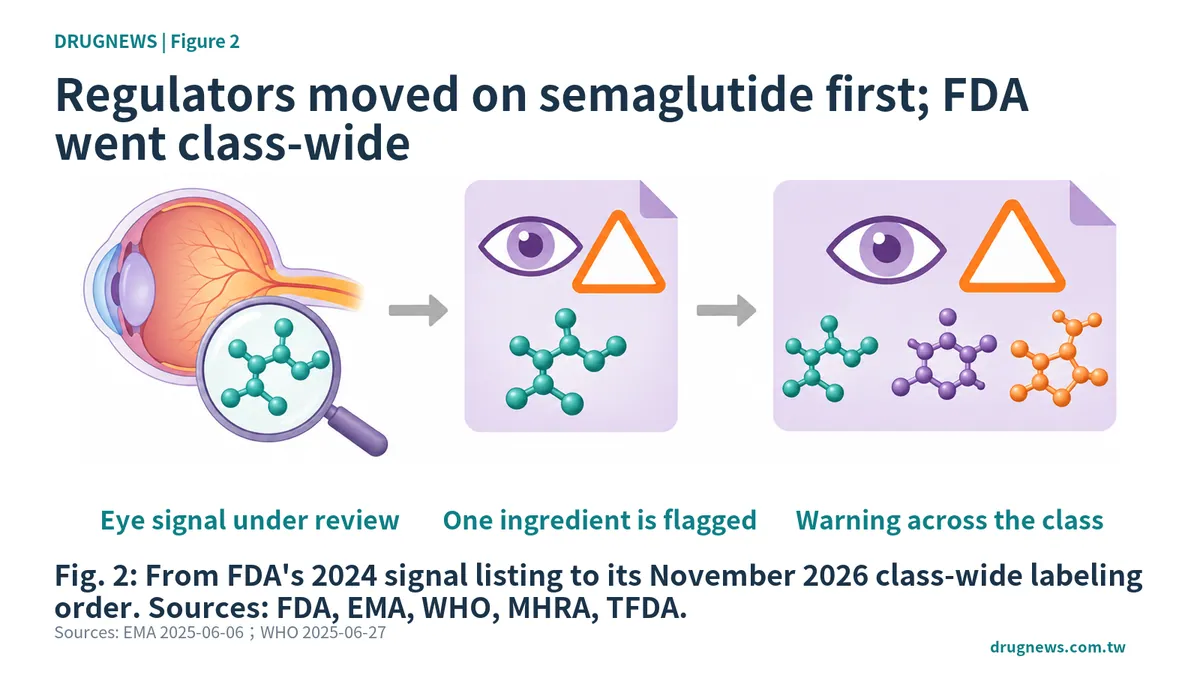
Fig. 2: From FDA's 2024 signal listing to its November 2026 class-wide labeling order. Sources: FDA, EMA, WHO, MHRA, TFDA.
That looks odd until you read FDA's reason: NAION cases have been reported for every GLP-1 on the market.
Patients switch brands often.
Labeling one ingredient would tell someone moving from Wegovy to Mounjaro that the new drug is clear, and FDA's data do not support that.
The same agency did the opposite in January.
On January 13, using a 91-trial meta-analysis of 107,910 patients and a Sentinel cohort of 2.24 million new users, it found no increased risk of suicidal ideation and asked Saxenda, Wegovy and Zepbound to drop their long-standing suicide warnings.
Same tools, opposite answers. That suggests the NAION warning was driven by data, not by headlines.
03 · A boxed warning never slowed sales; this one won't either
The best yardstick for a new warning is how earlier warnings on the same drugs played out.
GLP-1 labels have long carried a boxed warning about thyroid C-cell tumors seen in animals.
Mounjaro still sold $10.72 billion in the third quarter of 2026, up 65%.
The suicide warning sat on Wegovy and Zepbound through exactly the years their sales took off.
The eye has a precedent of its own.
In the 2016 SUSTAIN-6 trial, diabetic retinopathy complications ran 3.0% on semaglutide versus 1.8% on placebo.
That went into the label, and Novo built Ozempic and Wegovy on the same molecule anyway.
Citi analysts also expect little effect on adoption.
Novo said current data do not establish a causal link.
This week's numbers point the same way.
On November 4, Novo reported about 3.6 million U.S. prescriptions for the Wegovy pill in the third quarter and raised its full-year outlook for the third time.
On November 9, the very day of the FDA warning, Lilly reported that Foundayo cut sleep apnea severity by 43.8% in a Phase 3 trial versus 6.3% on placebo, with a filing planned by year-end.
On volume, we side with consensus. The disagreement is about where the cost lands.
04 · How the business changes: courts, eye clinics and Lilly's pill
Litigation shifts first.
In December 2025, U.S.
GLP-1 vision-loss cases were centralized as MDL No. 3163 in the Eastern District of Pennsylvania before Judge Karen S.
Marston.
By September, reports counted hundreds of NAION suits, mostly against Novo, with Lilly also named.
One plaintiff, a 63-year-old man, started Ozempic for diabetes in 2023.
About four months later he woke up unable to see from one eye.
Not knowing why, he kept taking the drug and lost sight in the other eye in 2024.
He is now legally blind.
These suits turn on a failure to warn.
Before November 9, the U.S. label said nothing about NAION.
Pending plaintiffs now have FDA's own "potential increased risk" language.
For anyone starting treatment after November 9, the companies can say they warned.
The cost curve is front-loaded: more settlement pressure on old cases, a higher bar for new ones.
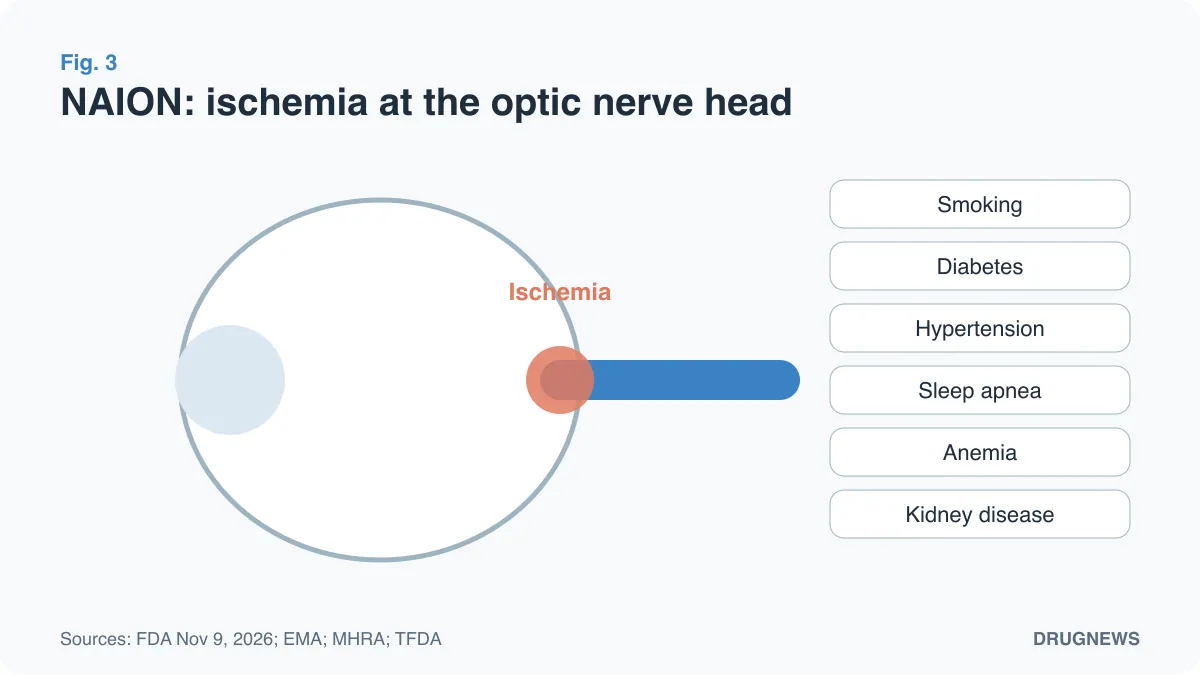
Fig. 3: Reduced blood flow where the optic nerve enters the eye causes sudden, painless vision loss in one eye. FDA's listed risk factors overlap heavily with common GLP-1 comorbidities. Source: FDA, Nov 9, 2026.
The clinic changes next.
The American Optometric Association has recommended eye exams for patients starting a GLP-1 since 2025.
FDA now tells prescribers to refer sudden one-eye vision loss to an ophthalmologist promptly, to consider stopping the drug if NAION is confirmed, and to note that prior NAION raises the risk of recurrence.
The least noticed change hits Lilly's pill.
Foundayo is a small molecule, and Lilly has marketed it as free of Wegovy pill's fasting rules.
Inside a class-wide warning, it is hard to claim a different safety profile.
Worse, FDA's list of NAION risk factors includes sleep apnea, the very indication Lilly is about to file.
The deeper GLP-1s move into these patients, the harder it becomes to separate disease from drug.
05 · Taiwan: Wegovy's label is done, Mounjaro is waiting
Taiwan moved earlier than the U.S.
The TFDA issued a semaglutide risk communication in June 2025, asked hospitals and license holders to step up monitoring in March 2026, and in June 2026 required semaglutide labels to add NAION.
Tirzepatide was not mentioned.
In Taiwan that matters: Ozempic entered the island's top 10 drugs by sales in 2025 with cumulative sales near NT$2 billion, and Mounjaro, launched in May 2025, has already outsold it.
On November 10, TFDA official Liu Chia-ping said that because the U.S. warning covers all GLP-1s, the agency would re-evaluate the whole class.
Local reporting will not settle it.
Taiwan received 63 suspected GLP-1 adverse-event reports this year, 39 involving weight loss, mostly gastrointestinal events, hypoglycemia and injection-site problems.
None was described as visual.
So Taiwan's review will follow FDA's evidence.
Europe, Britain and Taiwan all did semaglutide first; FDA has now done the class-wide work.
Matching it is the path of least resistance.
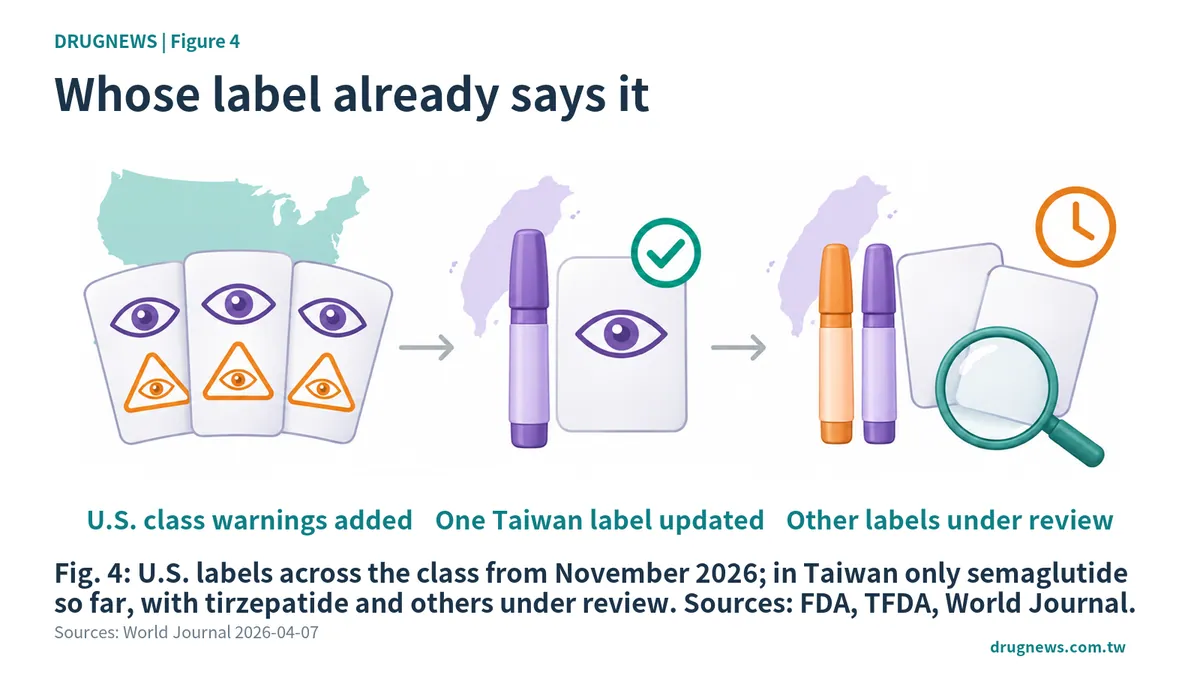
Fig. 4: U.S. labels across the class from November 2026; in Taiwan only semaglutide so far, with tirzepatide and others under review. Sources: FDA, TFDA, World Journal.
We expect Mounjaro, Trulicity, Saxenda and the rest to add NAION in Taiwan by the end of June 2027.
No major regulator has restricted the indication or required pre-treatment eye exams, so Taiwan has little reason to go further alone.
For self-paying patients in Taiwan's weight-loss clinics, the change is one more line of counseling.
Many already have diabetes, hypertension or sleep apnea. "If one eye suddenly blurs, see an eye doctor that day" will move from some doctors' habit to every prescription.
06 · Where we could be wrong
New data are the biggest risk.
FDA's evidence has three weak spots: very few trial cases, no mechanism in animals, and real-world results that depend on the comparator.
A prospective study pushing the ratio above two could upgrade this to a boxed warning, and that would touch volume.
Litigation is the second.
Large verdicts in MDL bellwether trials would push companies to change marketing on their own, a bigger effect than the label itself.
Third, the TFDA could be slower than we expect.
It took a full year to go from Europe's June 2025 conclusion to its own label order.
If Mounjaro's Taiwan label is unchanged at the end of June 2027, we were wrong.
What to watch: the TFDA's re-evaluation notice; Novo and Lilly's fourth-quarter reports in early 2027, for any safety-driven slowdown in prescriptions; and the bellwether schedule in MDL 3163.
This article is industry and company analysis, not investment or medical advice.
References
- FDA Requires Safety Labeling Changes for GLP-1 RAs Due to Potential Increased Risk of Rare But Serious Eye Condition · U.S. FDA · 2026-11-09 · https://www.fda.gov/drugs/drug-safety-communications/fda-requires-safety-labeling-changes-glucagon-peptide-1-receptor-agonists-glp-1-ras-due-potential
- FDA Requires Class-Wide GLP-1 RA Labeling Changes for Potential NAION Risk · Pharmacy Times · 2026-11-10 · https://www.pharmacytimes.com/view/fda-requires-class-wide-glp-1-ra-labeling-changes-for-potential-naion-risk
- FDA warns GLP-1 may raise optic neuropathy risk; TFDA to re-evaluate · Liberty Times · 2026-11-10 · https://news.ltn.com.tw/news/life/breakingnews/5636292
- TFDA launches safety re-evaluation · China Times · 2026-11-10 · https://www.chinatimes.com/realtimenews/20261110003523-260405
- FDA orders warning on GLP-1s · Commercial Times · 2026-11-11 · https://www.ctee.com.tw/news/20261111700138-439901
- October - December 2024 Potential Signals of Serious Risks · U.S. FDA · 2025-03-31 · https://www.fda.gov/drugs/fda-adverse-event-monitoring-system-aems/october-december-2024-new-safety-information-or-potential-signals-serious-risks-identified-fda
- PRAC concludes NAION is a very rare side effect of semaglutide · EMA · 2025-06-06 · https://www.ema.europa.eu/pt/news/prac-concludes-eye-condition-naion-very-rare-side-effect-semaglutide-medicines-ozempic-rybelsus-wegovy
- The use of semaglutide medicines and risk of NAION · WHO · 2025-06-27 · https://www.who.int/news/item/27-06-2025-27-06-2025-semaglutide-medicines-naion
- Semaglutide: risk of NAION · MHRA Drug Safety Update · 2026-02-05 · https://www.gov.uk/drug-safety-update/semaglutide-wegovy-ozempic-and-rybelsus-risk-of-non-arteritic-anterior-ischemic-optic-neuropathy-naion
- FDA Requests Removal of Suicidal Behavior and Ideation Warning from GLP-1 RAs · U.S. FDA · 2026-01-13 · https://www.fda.gov/drugs/drug-safety-communications/fda-requests-removal-suicidal-behavior-and-ideation-warning-glucagon-peptide-1-receptor-agonist-glp
- SUSTAIN-6 · New England Journal of Medicine · 2016-11-10 · https://www.nejm.org/doi/full/10.1056/NEJMoa1607141
- Lilly's Foundayo significantly reduced obstructive sleep apnea severity · Eli Lilly · 2026-11-09 · https://investor.lilly.com/news-releases/news-release-details/lillys-foundayo-orforglipron-significantly-reduced-obstructive
- Novo Nordisk lifts 2026 outlook as Wegovy pill surges · TimesLIVE / Reuters · 2026-11-04 · https://www.timeslive.co.za/news/world/2026-11-04-novo-nordisk-lifts-2026-outlook-as-wegovy-pill-surges/
- Lilly Q3 2026: price down, volume up · Drugnews · 2026-11-02 · https://drugnews.com.tw/articles/2026-11-02-lilly-q3-2026-glp1-price-cut-volume-novo.html
- Federal court creates new MDL for GLP-1 vision loss · Levin Papantonio (press release) · 2025-12-17 · https://business.mammothtimes.com/mammothtimes/article/gnwcq-2025-12-17-levin-papantonio-federal-court-creates-new-mdl-for-ozempic-and-other-glp-1-drugs-linked-to-vision-loss-naion
- Hundreds of lawsuits allege GLP-1s caused permanent vision loss · WCAX / Gray News · 2026-09-22 · https://www.wcax.com/2026/09/22/hundreds-lawsuits-allege-glp-1s-like-ozempic-wegovy-mounjaro-caused-permanent-vision-loss/
- GLP-1 Drugs Under Scrutiny as Lawsuits Allege NAION Risk · Review of Optometry · 2026-09-22 · https://www.reviewofoptometry.com/article/glp1-drugs-under-scrutiny-as-lawsuits-allege-naion-risk
- Taiwan's top 10 best-selling drugs · World Journal · 2026-04-07 · https://www.worldjournal.com/wj/story/121221/9425242
Share this analysis
Send this article to readers who follow biotech, company strategy, and capital-market signals.
Cite this article
For decks, research notes, or media references, cite Drugnews with the canonical article URL.
Drugnews Editorial Team. "FDA adds a vision-loss warning to every GLP-1." Drugnews, Nov 14, 2026. https://drugnews.com.tw/articles/2026-11-14-glp1-naion-vision-warning-fda-classwide-mounjaro-taiwan-en.html