
The worst of atopic dermatitis is the itch at night. Today's mainstay against it is Dupixent, an injection every two weeks. [7]
On November 23, Kymera reported results for KT-621, a pill taken once a day.
After 16 weeks, patients on the middle dose saw their skin scores fall by a mean 72%, and just over half reached the itch-response threshold. In Dupixent's own Phase 3 trials the reduction was 67% to 72%. [1][6]
The stock rose more than 30% that day. At 9:50 p.m. Eastern the same evening, Kymera priced 11,638,000 new shares at $150.37 each, raising $1.75 billion. [11]
The release leaves out several numbers. The most important: 11% to 20% of patients on the drug developed conjunctivitis, and the release does not say how many did on placebo. [1]
KT-621 is Dupixent in a pill: the same class of efficacy and the same side effect. Its edge is that it is not an injection, and the first drugs to lose patients to it will be today's oral options.
We will be wrong if the full data show a conjunctivitis rate of 7% or more in the placebo arm.
Dupixent blocks the door; KT-621 works inside the room
Dupixent is an antibody given under the skin. It binds the IL-4 receptor on the cell surface, so the inflammatory signals IL-4 and IL-13 cannot get in. [7]
KT-621 acts on the same pathway, further inside. Once the signal is through the door, a protein called STAT6 carries the order into the nucleus. KT-621 makes the cell break down its own STAT6. [1]
Think of one building: Dupixent stands at the door and lets no one in; KT-621 goes inside and removes the messenger.
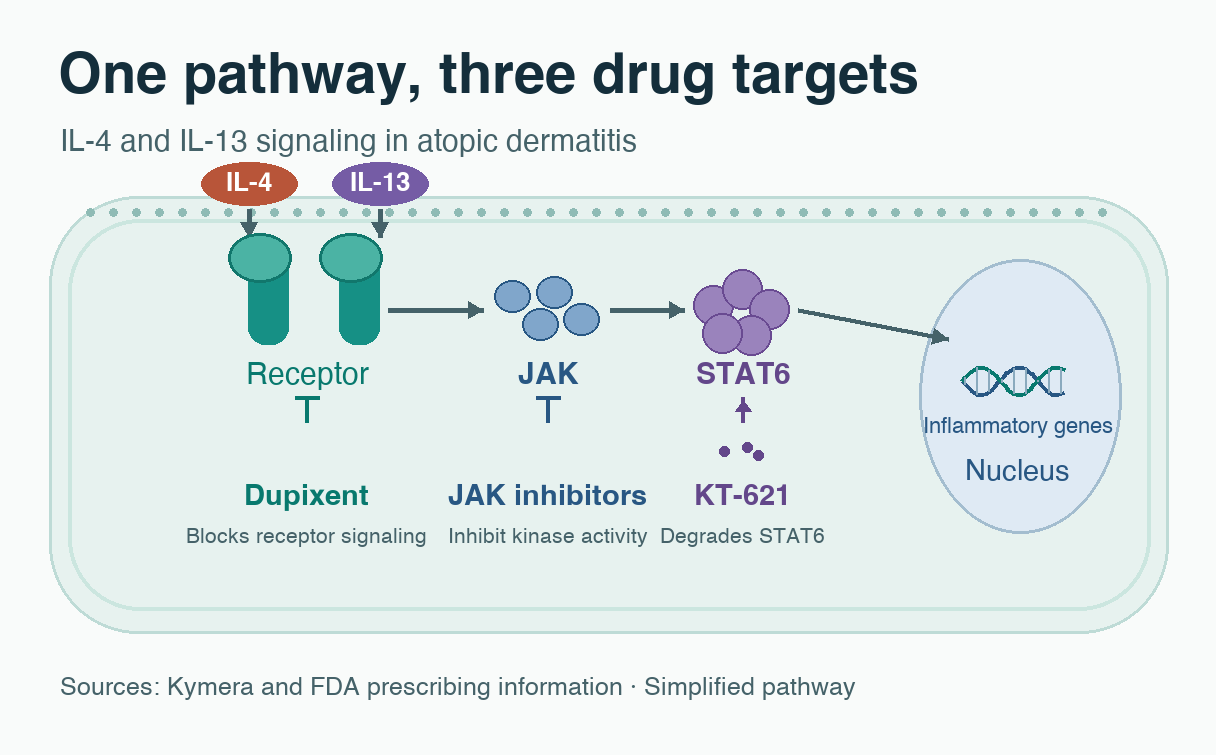
Dupilumab acts at the receptor, JAK inhibitors interfere with kinase signaling, and KT-621 targets STAT6 for degradation.
A Phase 1b study last December showed that the drug reaches its target. Twenty-two patients took it for 28 days at two doses, 100 mg and 200 mg. [4][13]
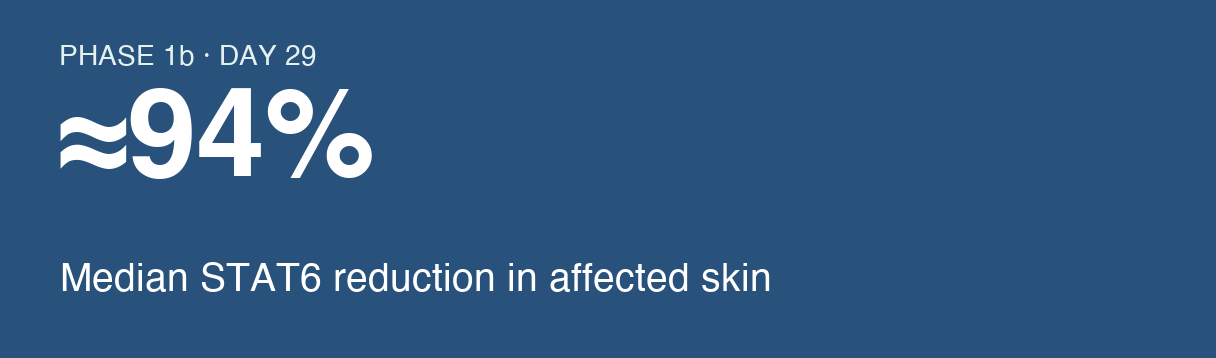
Median STAT6 fell by about 94% in skin and about 98% in blood. There was no placebo arm, so the study showed only that the drug hit its target. [4]
The 16-week scorecard: all three doses beat placebo, and the middle one did best
The Phase 2b trial, BROADEN2, enrolled 244 adults and adolescents with moderate to severe disease. A third had used a biologic before, and 38% had severe disease. [2]
Patients were randomly assigned to a low, middle or high dose or to placebo, once a day for 16 weeks. [2]
The primary measure was EASI, a score that combines how much skin is affected and how severe it is.
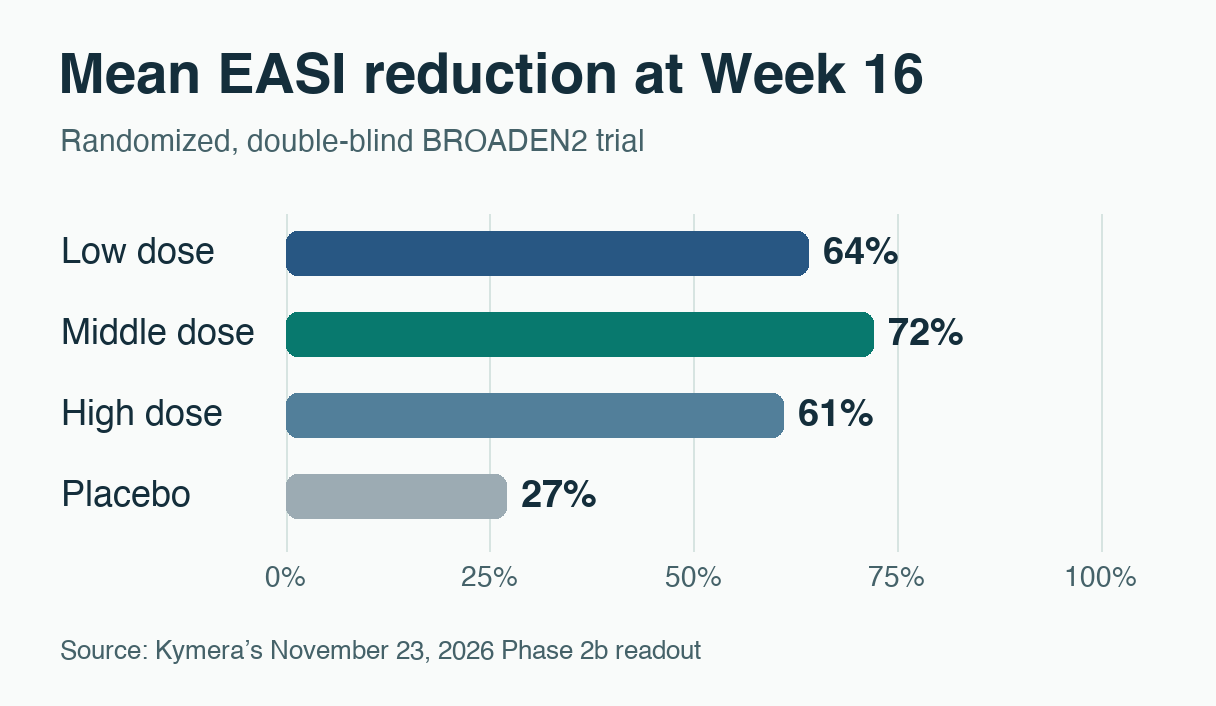
All three doses improved the primary endpoint relative to placebo. The middle dose produced the largest numerical effect.
- Low dose (61 patients): mean reduction of 64%
- Middle dose (61 patients): mean reduction of 72%
- High dose (63 patients): mean reduction of 61%
- Placebo (59 patients): mean reduction of 27%
All three doses clearly beat placebo. The middle dose cut EASI by 45 percentage points more than placebo, and the gap opened in the first week. [2]
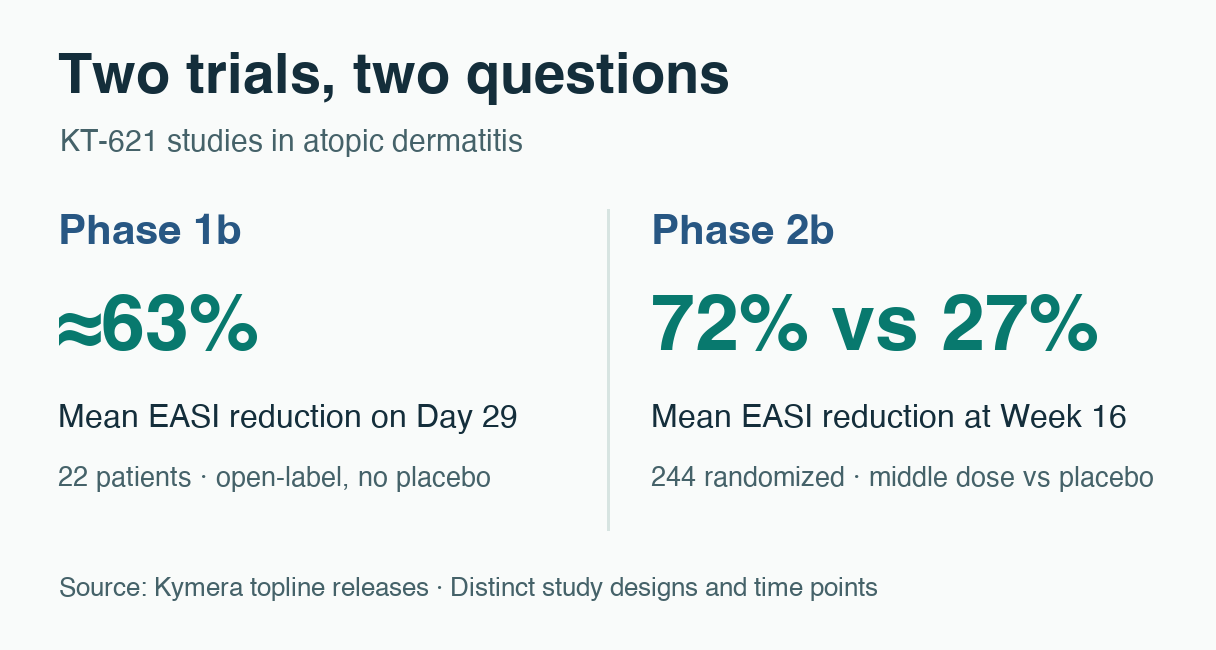
The earlier study had a shorter follow-up and no placebo arm.
Counted the way patients feel it: 62% on the middle dose improved by at least three quarters, against 22% on placebo. For an improvement of at least 90%, it was 43% against 10%. [2]
Physicians rated skin as clear or almost clear in 38% against 11%. [2]
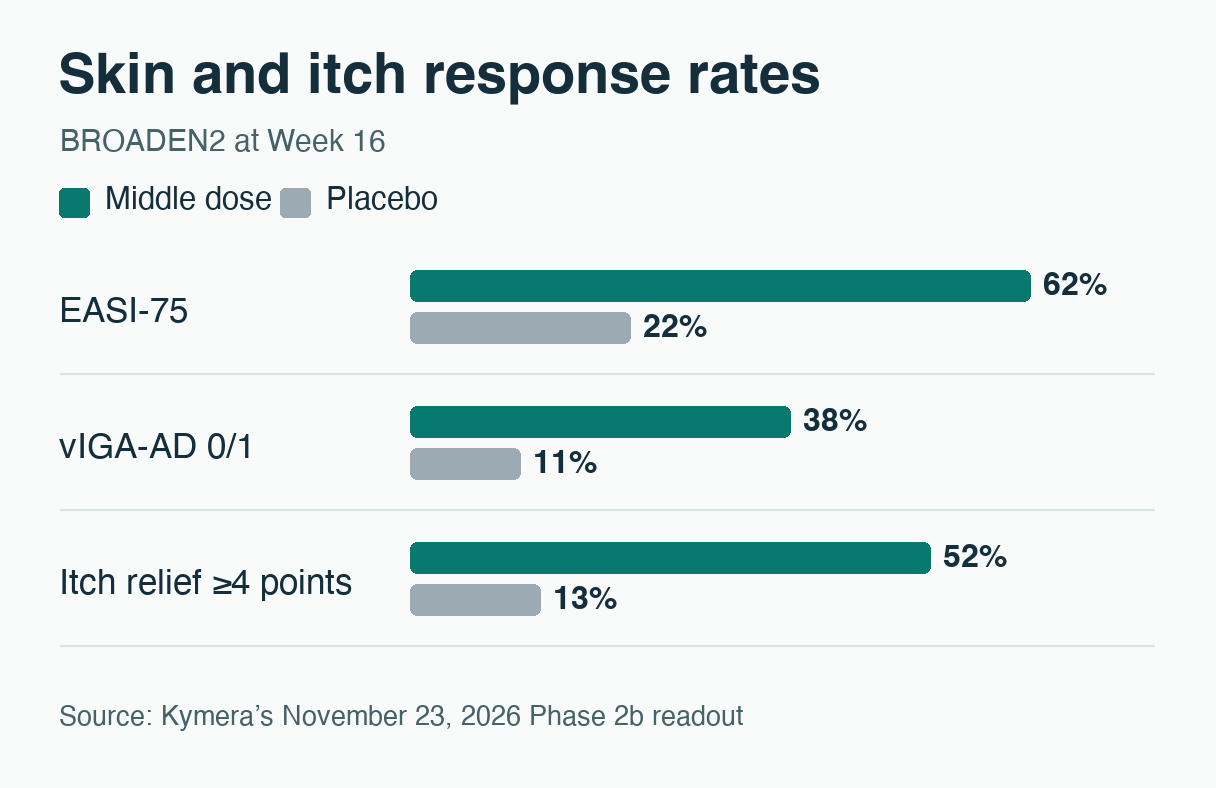
The percentages are response rates. Each endpoint uses its own threshold.
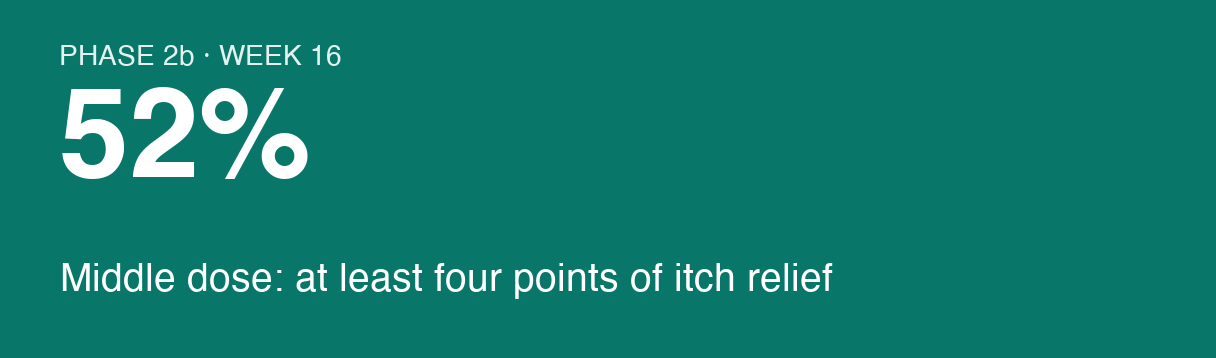
Itch is scored by the patients themselves. On the middle dose, 52% improved by 4 points or more, against 13% on placebo. [2]
Now Dupixent. In its two adult Phase 3 trials, SOLO 1 and SOLO 2, EASI fell by a mean 72.3% and 67.1%, against 37.6% and 30.9% on placebo. [6]
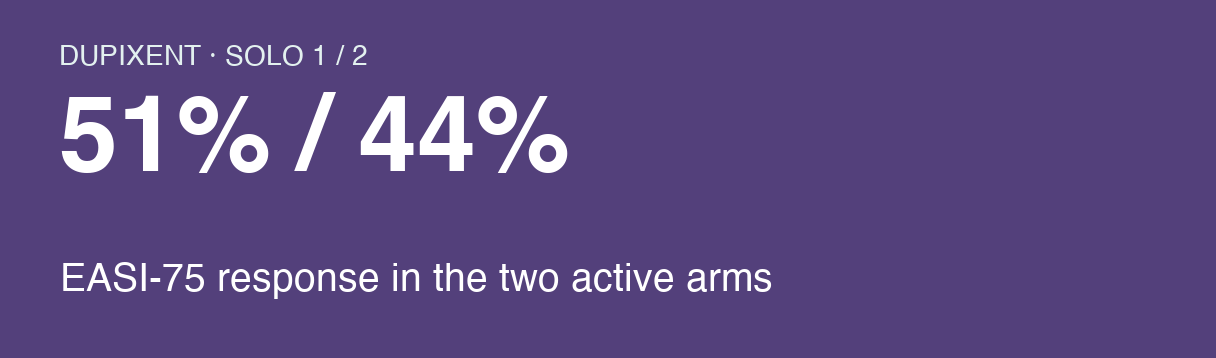
The share of patients improving by at least three quarters was 51% and 44% on Dupixent, against 15% and 12% on placebo. [7]
The trials differ, so these numbers are background only. Still, an oral drug that is not a JAK inhibitor has posted results in the same class as the injection.
Four numbers the release does not give
First, conjunctivitis on placebo.
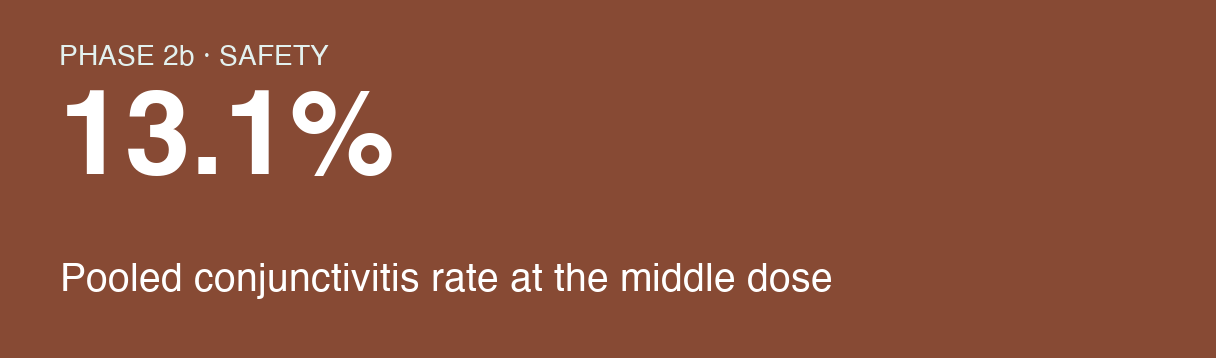
Pooled conjunctivitis rates were 19.7%, 13.1% and 11.1% in the low, middle and high dose arms. Kymera says all cases were mild to moderate and none led to discontinuation. [1]
The company adds that adverse events showed no meaningful imbalance between arms "with the exception of conjunctivitis." That concedes more conjunctivitis on the drug, without giving the placebo figure. [1]
Conjunctivitis is Dupixent's best-known side effect. Its US label reports 10% on the drug and 2% on placebo in atopic dermatitis trials. [7]
Why would two drugs acting at different points cause the same eye problem? Goblet cells in the conjunctiva secrete the mucus that protects the eye surface, and they depend on IL-13 and IL-4 to grow. [15]
In 2019 a team at University Medical Center Utrecht reported in the British Journal of Dermatology that patients who developed conjunctivitis on Dupixent had a median of 3.3 goblet cells per millimetre in conjunctival biopsies, against 32.3 in controls. [14][15]
STAT6, the protein KT-621 removes, is the step that carries the IL-13 signal into the nucleus.
Conjunctivitis is therefore likely not an accident of this drug but the other face of blocking IL-13: the skin calms down, and the eye loses mucus.
Second, response rates for the low and high doses. For the three-quarters skin improvement and the itch response, Kymera gave only the middle dose. [1]
Third, the doses in milligrams. The Phase 1b study named 100 mg and 200 mg. This release says only low, middle and high. [1][13]
Fourth, how many patients stopped because of side effects. Of 244 patients, 234 completed 16 weeks. The release does not say why the other 10 left. [2]
One more thing deserves a second look. The highest dose did not do better: 64%, 72%, 61%. And conjunctivitis was most frequent at the lowest dose.
With about 60 patients per arm, that ordering may be noise. The other explanation is that all three doses already remove nearly all the STAT6 there is, so a higher dose has nothing left to remove.
If so, the pathway has a ceiling for efficacy, and it sits at about the height of Dupixent.
What $1.75 billion buys
On the day of the Phase 1b data last December, Kymera's stock rose 41.6%, and the company then raised $602 million. [13]
This time it was Phase 2b. Data in the morning, a gain of more than 30%, and a priced offering that night: $1.75 billion, upsized from a planned $1.5 billion. [11]
In under a year: two data releases, two offerings, $2.35 billion in total.
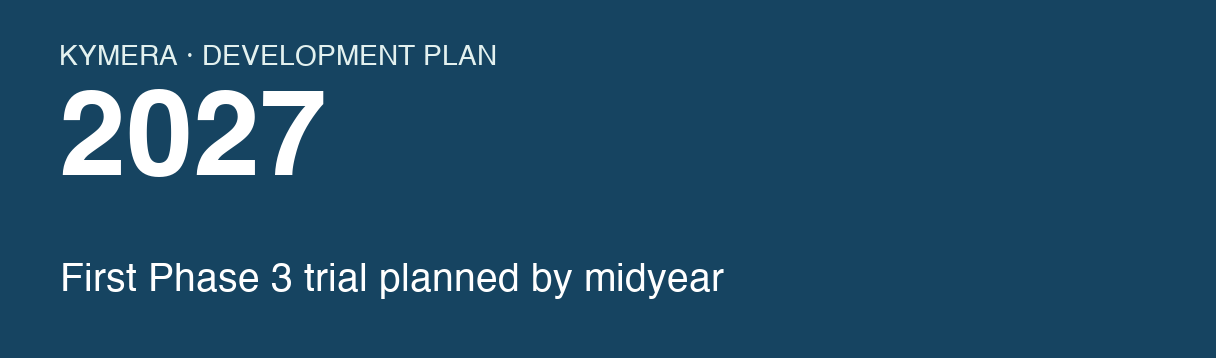
The money pays for Phase 3. Kymera plans to start its first Phase 3 trial in atopic dermatitis by mid-2027, and expects Phase 2b data in asthma in late 2027. [2]
Its target is one of the industry's biggest products. Dupixent sales reached €15 billion in the first nine months of 2026, up 34.5% at constant exchange rates, and were close to 40% of Sanofi's third-quarter sales. [12]
On the October results, Sanofi's chief executive said the company's priority is to protect earnings through Dupixent's loss of exclusivity. [12]
The first to feel the pressure, though, will be a different group of drugs: the oral JAK inhibitors.
AbbVie's Rinvoq (upadacitinib) is as effective as the injection. In its Phase 2b trial, two doses cut EASI by a mean 62% and 74%.
Its US label carries a boxed warning for serious infections, mortality, malignancy, major cardiovascular events and thrombosis. [8][9]
For patients who want a pill and not an injection, JAK inhibitors are the only modern option today. If KT-621 keeps its current safety profile through Phase 3, those patients will be the first to switch.
Taiwan: what is available now, and how long the pill will take
In Taiwan, Dupixent and Ebglyss are injections, and Rinvoq and Cibinqo are oral.
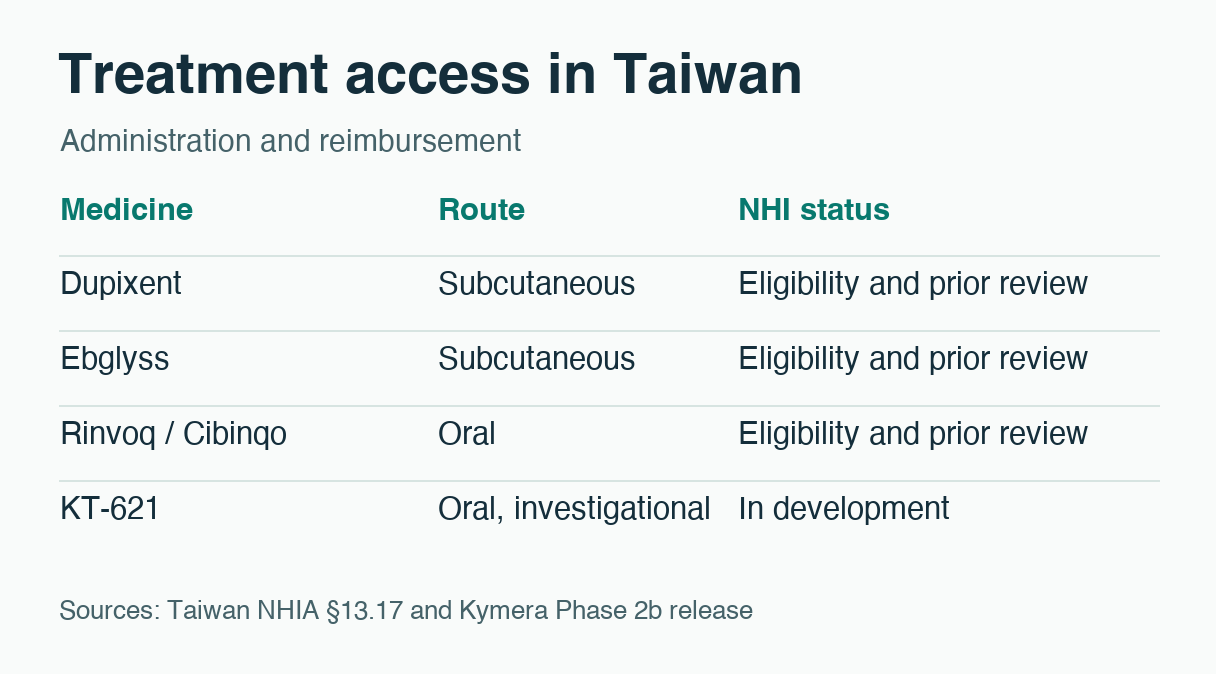
Approved medicines may qualify under Taiwan’s National Health Insurance criteria. The investigational treatment has no routine reimbursement.
All of them are reimbursed under conditions and prior authorization. Taiwan's National Health Insurance has provisionally covered Ebglyss since June 1 for patients aged 12 or older who weigh at least 40 kg. [10]
KT-621 is a long way off. Phase 3 starts in mid-2027 at the earliest, and on a typical development timeline a launch would come in 2029 or later.
That also marks the patients KT-621 cannot win. People who stopped Dupixent because of conjunctivitis are likely to hit the same problem on KT-621. Its real market is patients who dislike injections and are wary of the JAK boxed warning.
For anyone woken by the itch at night, a pill is good news. What it costs in return still depends on these numbers.
This article is industry and company analysis and does not constitute investment or medical advice.
References
- Kymera, November 23, 2026 — BROADEN2 Phase 2b results
- SEC, November 23, 2026 — Kymera Form 8-K
- ClinicalTrials.gov — BROADEN2, NCT07217015
- Kymera, December 8, 2025 — BroADen Phase 1b results
- Thaçi et al., Lancet, 2016 — Dupilumab Phase 2b
- Simpson et al., NEJM, 2016 — SOLO 1 and SOLO 2
- FDA, revised April 2026 — Dupixent label, Sections 6.1 and 14.1
- Guttman-Yassky et al., JACI, 2020 — Upadacitinib Phase 2b
- FDA, revised June 2026 — Rinvoq label and boxed warning
- Taiwan NHIA, May 15, 2026 — Ebglyss reimbursement decision
- Kymera, November 23, 2026 — Pricing of upsized $1.75 billion public offering
- Sanofi, October 30, 2026 — Third-quarter 2026 results
- Zacks via Nasdaq, December 9, 2025 — KT-621 Phase 1b data and share move
- Bakker et al., British Journal of Dermatology, 2019 — Goblet cell scarcity during dupilumab treatment
- American Academy of Ophthalmology EyeWiki — Dupilumab-associated ocular surface disease, checked November 24, 2026
Share this analysis
Send this article to readers who follow biotech, company strategy, and capital-market signals.
Cite this article
For decks, research notes, or media references, cite Drugnews with the canonical article URL.
Drugnews Editorial Team. "An Eczema Pill Closes In on Dupixent, Side Effect Included." Drugnews, Nov 27, 2026. https://drugnews.com.tw/articles/2026-11-27-kymera-kt621-broaden2-atopic-dermatitis-en.html