
──────────
Share this analysis
Send this article to readers who follow biotech, company strategy, and capital-market signals.
For people who need long-term medication to control hepatitis B, the question of whether treatment might one day end is deeply personal. It also changes how a new drug's value is measured: beyond suppressing the virus while treatment continues, how long can control last after the course is over?
On August 24, 2026, GSK announced that Hibsago (bepirovirsen) had been approved in Japan for eligible adults with chronic hepatitis B. The Phase III results supporting the approval had already been published in May; this development moves a finite course of treatment from trial evidence into a treatment option for a defined population.【1】【3】
Here, “functional cure” means sustained loss of hepatitis B surface antigen (HBsAg) and hepatitis B virus DNA (HBV DNA) below the limit of quantification for at least 24 weeks after stopping all treatment in the specified trial population; it does not mean that the viral reservoir cccDNA has been eradicated or that recurrence is ruled out for life.【3】
This takes the discussion one step further: which patients should be assessed for the new therapy? Why must the 24-week course, the week-48 assessment for stopping background treatment and the week-72 results be understood separately? And how might finite treatment change payment and care arrangements for patients, health systems and the manufacturer?
【01 | Identifying Suitable Patients Comes Before Assessing the Value of Finite Treatment】
According to GSK's Japanese approval announcement, eligible adults must have received at least six months of nucleos(t)ide analogue treatment before starting the new drug, with an initial hepatitis B surface antigen level no higher than 3,000 IU/mL and HBV DNA below 90 IU/mL. Nucleos(t)ide analogues are referred to below as NAs, and hepatitis B surface antigen as HBsAg.【1】
These conditions clarify the new drug's starting point: it follows existing antiviral treatment, with testing and clinical assessment identifying suitable patients. The total number of people with the disease and the population eligible for this therapy are separated by specific treatment histories and viral markers.
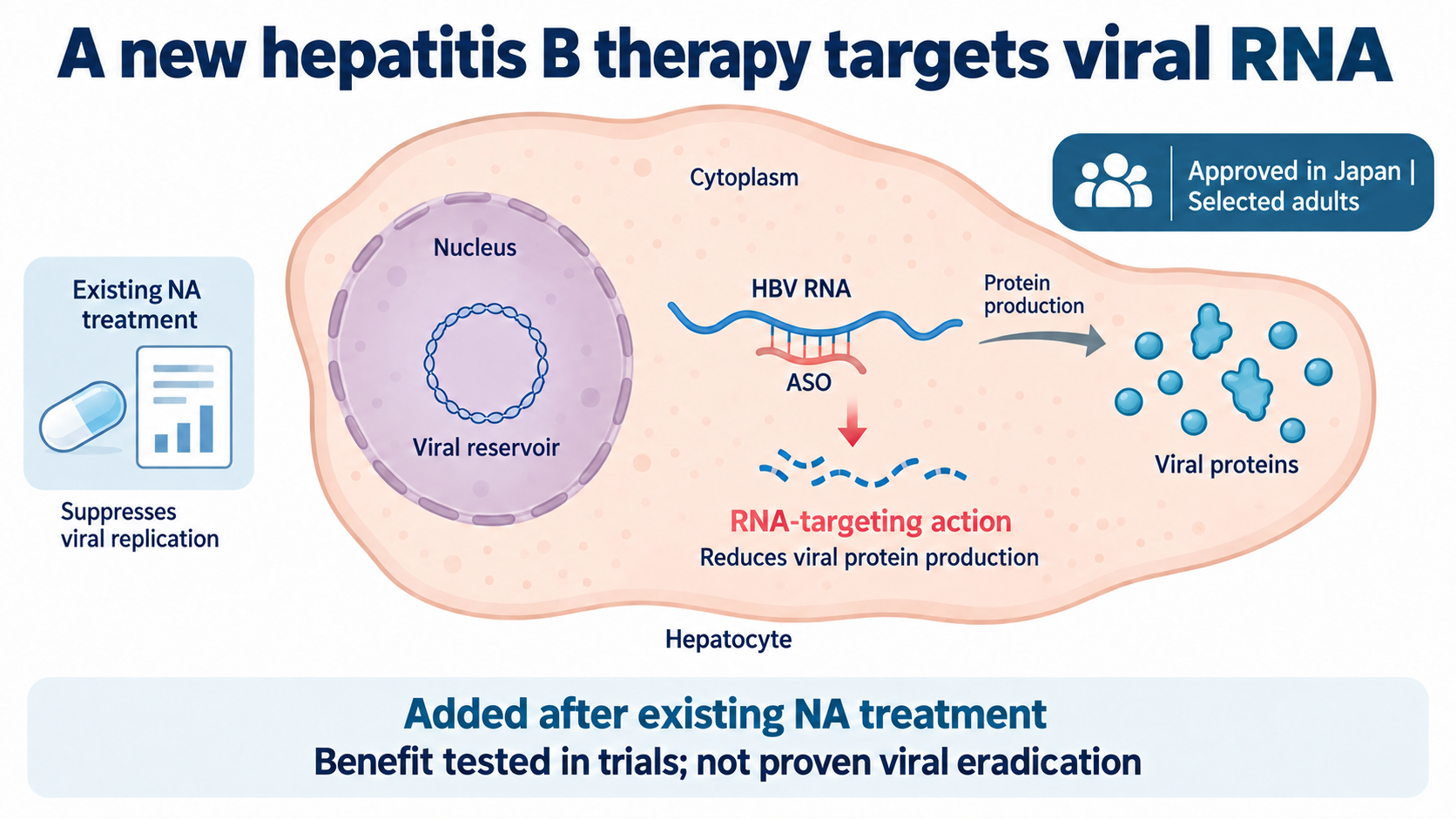
Bepirovirsen is an antisense oligonucleotide (ASO) that acts on hepatitis B virus-related RNA, reducing the production of relevant RNA and viral proteins and thereby lowering surface antigen burden. The therapeutic rationale is to extend the opportunity for viral control beyond the end of treatment; human trials determine how much can actually be achieved.【1】
This also moves testing from a supporting role to the center of treatment decisions: identifying patients at the outset, measuring changes during treatment and assessing whether control persists afterward. The drug's action, patient selection and follow-up arrangements need to be understood as parts of the same course of care.
【Figure 1 | A New Hepatitis B Therapy Acts on Viral RNA】
Bepirovirsen acts on HBV-related RNA to reduce production of viral RNA and proteins. This additional action must be considered alongside existing treatment, the eligible population and human trial results; it does not establish that the viral reservoir has been cleared.
【02 | Weeks 24, 48 and 72 Answer Three Different Questions】
B-Well 1 and B-Well 2 were randomized, double-blind, placebo-controlled Phase III trials in adults without cirrhosis who were receiving stable NA treatment and had baseline HBsAg levels above 100 and no higher than 3,000 IU/mL. These criteria define the trial population and serve a different purpose from the approval conditions described above.【2】【3】
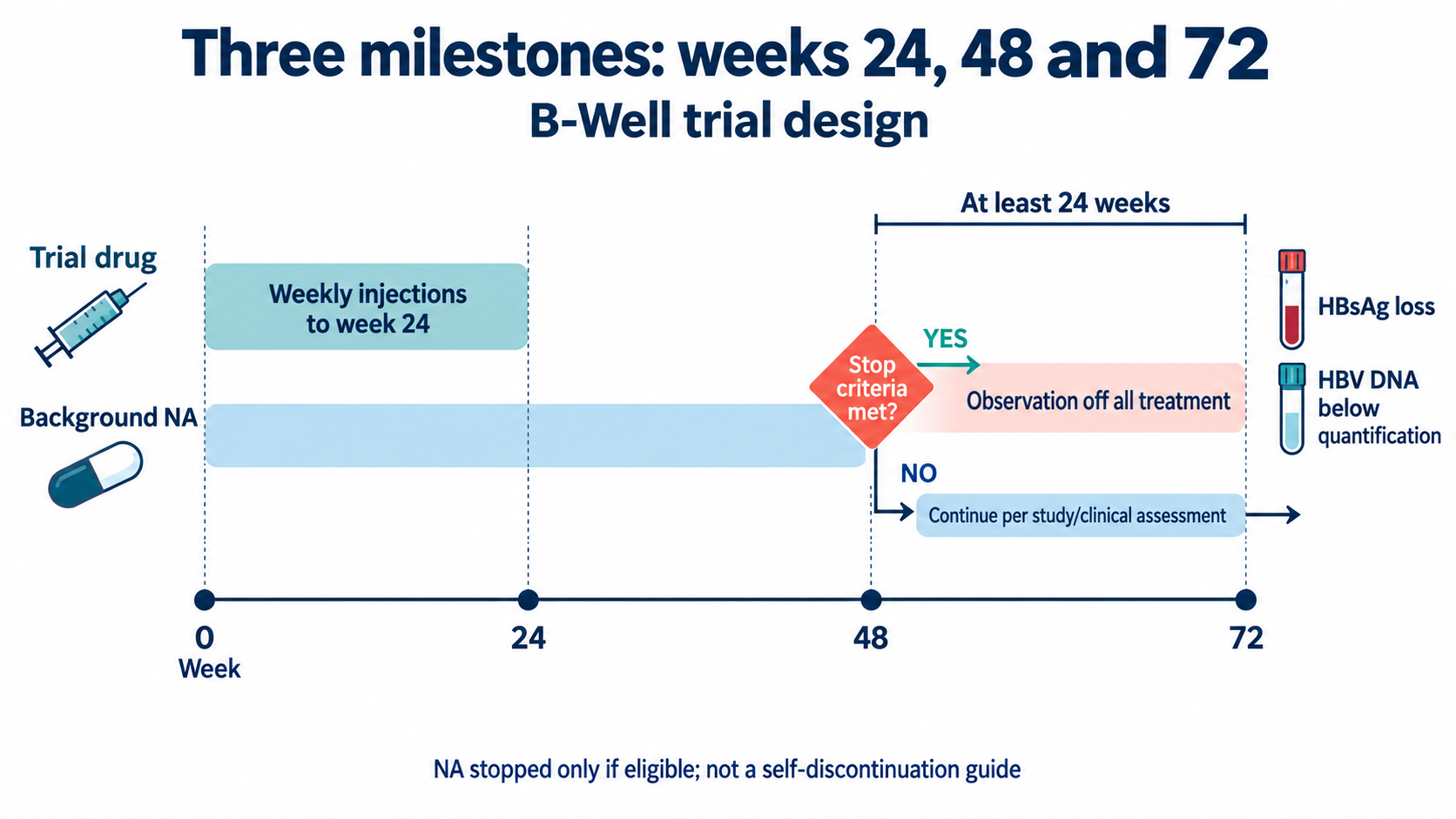
In the trials, bepirovirsen was given by weekly subcutaneous injection for 24 weeks, while existing NA treatment continued. At week 48, only patients who met the predefined criteria stopped their NA, with outcomes assessed at week 72.【2】【3】
The course therefore comprised treatment, conditional withdrawal of background medication and off-treatment observation. Week 24 marked completion of the study drug; week 48 was when qualifying patients stopped background treatment; and week 72 assessed their status after at least 24 weeks off all treatment.
These three time points explain why the promise of finite treatment requires follow-up. Treatment can end, but its effect has to be tested after medication is withdrawn. Completing the injections and achieving sustained control are two connected, sequential questions.
【Figure 2 | What Happens at Weeks 24, 48 and 72?】
After B-Well's 24-week study-drug course, assessment and background treatment continued. At week 48, qualifying patients stopped their NA; at week 72, testing assessed control after at least 24 weeks off all treatment. This schematic sequence is not drawn to scale and is not a timetable for stopping medication independently.
【03 | Off-Treatment Results Put the Magnitude of Benefit Against Clear Denominators】
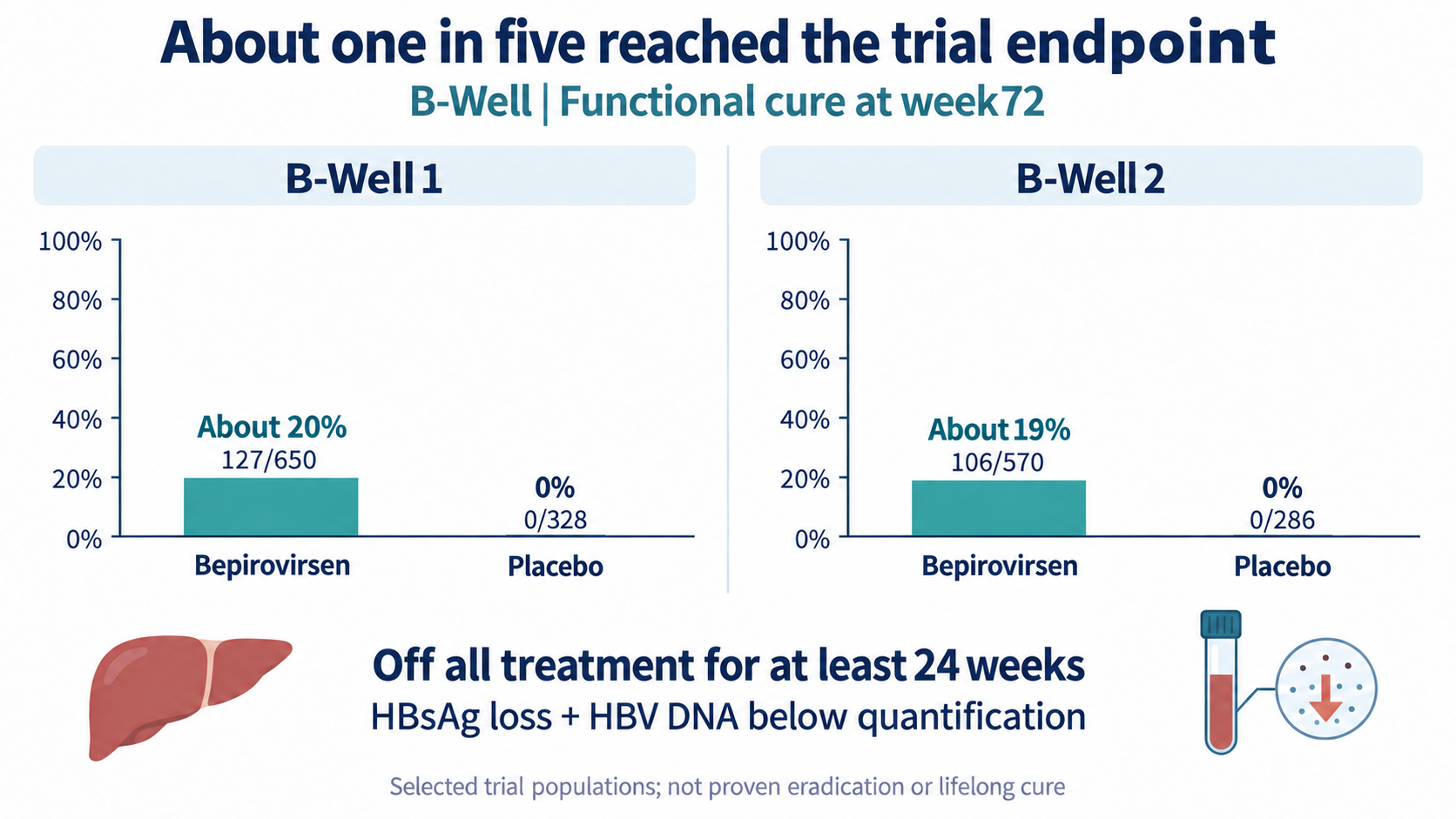
At week 72, the two trials reported the following results for the functional-cure endpoint.【3】
| Trial | Bepirovirsen group | Placebo group |
|---|---|---|
| B-Well 1 | 127/650, approximately 20% | 0/328 |
| B-Well 2 | 106/570, approximately 19% | 0/286 |
Functional cure here means sustained HBsAg loss and HBV DNA below the limit of quantification for at least 24 weeks after stopping all treatment. The definition measures off-treatment control; it does not establish complete clearance of cccDNA, the viral reservoir within liver cells, or guarantee that the disease will never recur.【3】
Patients with lower starting antigen levels merit separate consideration. In the pooled subgroup with baseline HBsAg no higher than 1,000 IU/mL, 200/768 patients in the bepirovirsen group, approximately 26%, reached the endpoint, compared with 0/393 in the control group. This is a defined subgroup result, not a replacement for the rates across the trial populations shown above. It points toward further study of which patients may be more likely to benefit from a finite course.【1】【2】
Risk is also part of that value assessment. The original paper's abstract reported grade 3 or higher adverse events during treatment in 16% versus 3%; common events included injection-site reactions and temporary liver enzyme elevations. Evaluating treatment therefore requires considering the chance of reaching the endpoint, safety and how long control subsequently lasts.【2】【3】
The two trials moved off-treatment control from a development goal to a measurable result, while also showing that most participants had not reached this endpoint. For next-generation therapies, the opportunity is to broaden the population that benefits and make those benefits last longer.
【Figure 3 | How Many Patients Achieved Functional Cure in the Two Trials?】
In the two B-Well Phase III trials, 127/650 and 106/570 patients, respectively, reached the functional-cure endpoint at week 72, compared with 0/328 and 0/286 in the placebo groups. These are trial-defined off-treatment outcomes, not the probability of cure for every individual patient.
【04 | Finite Treatment Changes the Payment Question and Reorganizes Care】
For patients, the appeal of finite treatment is the possibility of reducing the burden of long-term medication. For payers, the comparison concerns the resources and returns across the entire course of care: how much an additional treatment course, testing and follow-up require, and how many people achieve sustained off-treatment control.
An important commercial condition separates these perspectives: a finite course does not mean that every patient can stop all medication afterward. Valuing the therapy on the assumption that everyone will avoid years of treatment would overstate what the published results support. A sound analysis needs to account separately for those who reach the endpoint, those who do not and the follow-up that comes afterward.
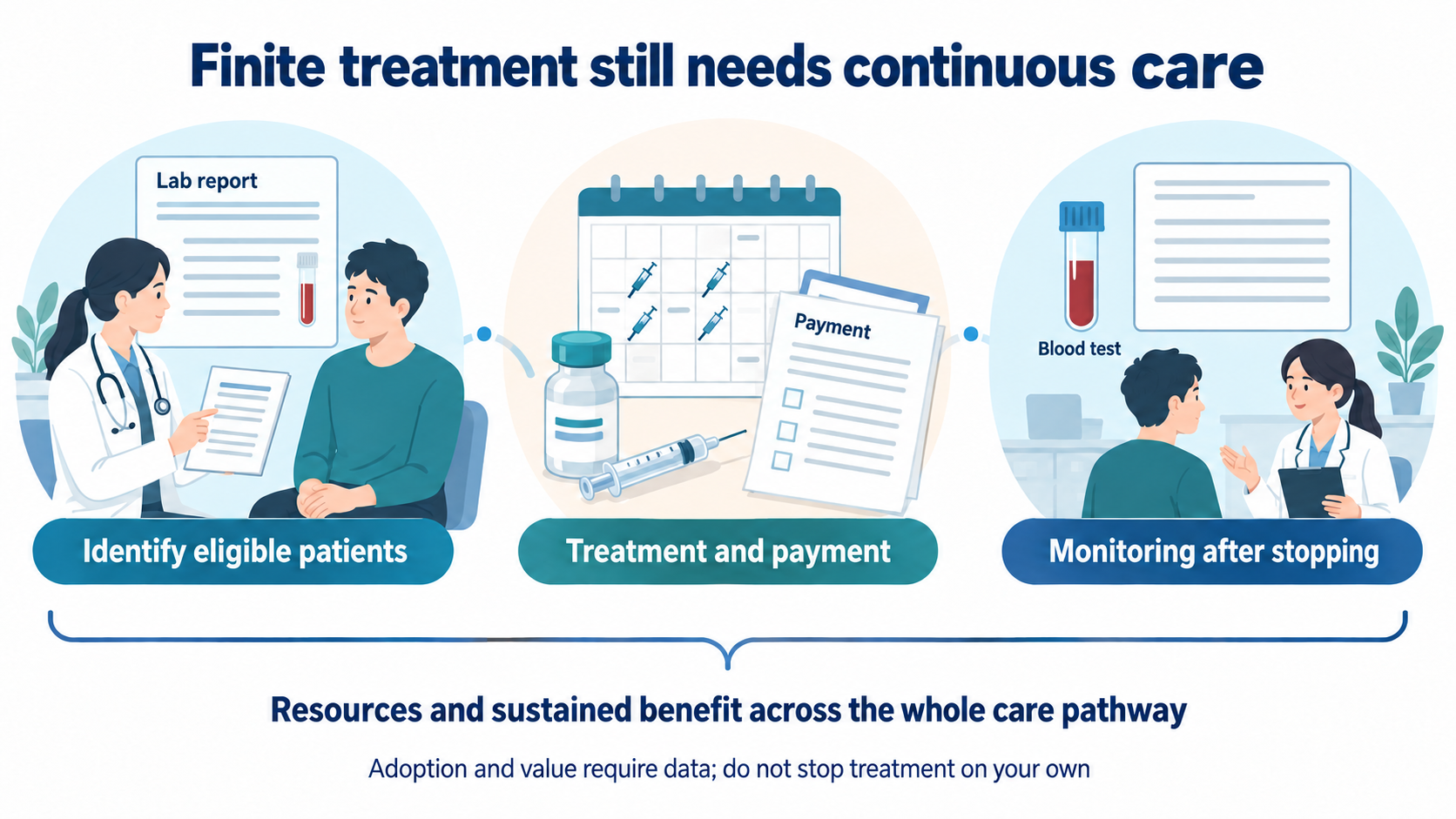
For GSK, post-approval execution will also take on a different emphasis. Finding eligible patients, completing the new course and confirming off-treatment outcomes are three connected but distinct stages. Hospitals need to coordinate medication, testing and follow-up visits; payment arrangements need to address the timing gap between the cost of a finite course and benefits realized over a longer period.
This is commercial analysis based on the trial and approval conditions, not a published cost-effectiveness result. The approval materials used here do not provide sufficient information to quantify the drug's price, actual reimbursement or speed of adoption, so this article does not estimate savings or sales. Approval in Japan also does not establish approval or reimbursement in Taiwan.
The commercial value of finite treatment ultimately has to be delivered through the full course of care: suitable patients can start, treatment can be completed and outcomes can be followed over time. Stopping medication does not sever the relationship with medical care; it partly shifts the work from continued dosing to conditional monitoring and management.
【Figure 4 | Finite Treatment Still Requires a Connected Course of Care】
The new therapy's practical value emerges through patient selection, treatment delivery and follow-up. Payment assessment must also consider the full course of care and how long benefits last. This diagram presents commercial analysis based on the approval and trial design, not a quantified cost-effectiveness result.
【05 | Next-Generation Treatment Designs Aim to Broaden the Chance of Sustained Control】
In its approval announcement, GSK said that it was continuing to develop subsequent sequential treatment strategies involving bepirovirsen. For such designs, the useful question is not how much adding another drug must increase the success rate, but whether different actions can deliver a verifiable increment in a clearly defined population and treatment sequence.【1】
B-Well provides a concrete starting point. The subgroup results in patients with lower baseline antigen levels make patient stratification an important research direction. Those who did not reach the endpoint leave questions about further antigen reduction, changes to treatment duration and improvements in sustained control. These directions need to be tested in the relevant combination trials, rather than converting complementary mechanisms directly into a predicted cure rate.
The “three Peaks” that originally prompted this discussion are Guangshengtang's names for its own development programs: Core has reported later-stage enrollment progress, Triple has announced its first Phase II patient, and Immune still has information gaps concerning its specific regimen and stage of human development. They provide identifiable development context, not evidence that the entire hepatitis B field has completed three breakthroughs, and GSK's results cannot be treated as efficacy evidence for those programs.【4】【5】
For investors, the value of further development lies in whether it can offer better clinical answers: which additional patients have a chance to benefit, what extra treatment burden is required and how long control persists after medication is stopped. The number of assets and names of combinations are starting points for research; results determine how much product value they can support.
【06 | A Concrete Taiwanese Capability: Hepatitis Testing and Treatment Monitoring】
Taiwan's General Biologicals Corporation (GBC) offers a concrete example of diagnostic capability. Its website describes a business that began with hepatitis test reagents and built immunodiagnostic and molecular-diagnostic research, development and manufacturing capabilities. Its current molecular-diagnostics catalog lists HBV RealQuant PCR for quantifying hepatitis B virus DNA and monitoring viral load. The company's investor page identifies its stock code as 4117.【6】【7】【8】
The connection between this capability and finite treatment begins with the clinical need to measure outcomes. Patient selection, changes during treatment and off-treatment follow-up all depend on reliable testing. However, this article has no evidence that GBC products have been designated for Hibsago, were used in B-Well or have secured a GSK partnership or orders.
The relevant questions for Taiwan's industry are therefore whether products meet the performance, regulatory and implementation requirements of a specific setting, and whether an actual partnership takes shape. Existing testing capabilities deserve recognition; a claim of confirmed commercial benefit requires another layer of evidence. Keeping the two separate reveals real capabilities rather than simply assembling a list of theme-linked stocks.
【Conclusion | Approval Opens a Choice; Long-Term Value Must Be Demonstrated Through Care】
Hibsago's approval in Japan gives finite treatment defined eligibility conditions and Phase III evidence. The significance is not that hepatitis B treatment can now be reduced to “six months of injections and it is over.” It is that sustained off-treatment control for a proportion of patients has become an option that can be assessed against evidence.
Patient benefit, payment arrangements and future treatment designs will now influence one another. Identifying suitable patients, completing treatment and continuing to collect follow-up results are what may turn the choice created by approval into value that patients and health systems can actually experience.
This article provides public medical and industry information and does not constitute individualized treatment or investment advice. Decisions to stop or adjust hepatitis B medication should be made by a medical team based on the individual's condition; patients should not apply a trial timetable on their own.
【Sources】
【1】GSK. Announcement of Hibsago approval in Japan, August 24, 2026. Approval conditions, mechanism concept, subgroup results and subsequent sequential-development directions. https://www.gsk.com/en-gb/media/press-releases/hibsago-bepirovirsen-approved-in-japan-as-first-and-only-functional-cure-for-chronic-hepatitis-b/
【2】GSK Japan. Announcement of bepirovirsen approval, August 24, 2026. B-Well populations, the 24/48/72-week timeline and related results. https://jp.gsk.com/ja-jp/news/press-releases/20260824-bepirovirsen/
【3】Hou et al. Original B-Well Phase III paper, NEJM, published online May 28, 2026. DOI: 10.1056/NEJMoa2515131. https://www.nejm.org/doi/full/10.1056/NEJMoa2515131
【4】Guangshengtang. Company announcement of the first Peak-Triple patient, dated September 4 and disclosed September 5, 2026. The original company attachment is hosted by Sina Finance and includes the company's plans for the three Peak programs. https://file.finance.sina.com.cn/211.154.219.97:9494/MRGG/CNSESZ_STOCK/2026/2026-9/2026-09-05/12585296.PDF
【5】Guangshengtang. Formal CNINFO disclosure, September 18, 2026. Relevant HG141 Phase III and Triple Phase II progress on page 8. https://static.cninfo.com.cn/finalpage/2026-09-18/1225570675.PDF
【6】GBC. About GBC; no page-wide update date stated, accessed September 21, 2026. Used for the company's hepatitis-testing history and research, development and manufacturing capabilities. https://gbc.com.tw/zh-hant/about/
【7】GBC. Molecular-diagnostics product page; no update date stated, accessed September 21, 2026. Used for HBV RealQuant PCR and its viral-load monitoring purpose as listed in the current catalog, not for a claim of designated companion-diagnostic status. https://gbc.com.tw/zh-hant/molecular-diagnostics/
【8】GBC. Investor relations page; no page-wide update date stated, accessed September 21, 2026. Used for company code 4117 as listed in the FAQ. https://gbc.com.tw/zh-hant/investors/
Cite this article
For decks, research notes, or media references, cite Drugnews with the canonical article URL.
Drugnews Editorial Team. "New Hepatitis B Drug Approved in Japan: About One in Five Treated Trial Patients Achieved a “Functional Cure”." Drugnews, Sep 27, 2026. https://drugnews.com.tw/articles/2026-09-27-hibsago-finite-hbv-care-en.html