
The same twice-yearly HIV prevention shot now has two prices.
In the United States, Gilead lists Yeztugo at $28,218 a year.
Across 120 low- and middle-income countries, an Indian generic will sell for about $40.
On November 2, the US Food and Drug Administration granted Dr. Reddy's Laboratories tentative approval for generic lenacapavir.
First supplies are due in those countries by the end of 2026.
The next large pool of money in long-acting HIV drugs is not prevention. It is treatment for people whose virus is already suppressed. TaiMed Biologics (4147.TWO) has one of the few antibody combinations big drugmakers could pair with without screening the virus first, and its year-end Phase 2b interim data are its ticket to a licensing deal.
The timing is concrete.
On November 3, TaiMed said key interim results from its Phase 2b trial are due by year-end, and that it is in talks with global drugmakers and the US National Institutes of Health on licensing, partnerships and joint research.
This call is wrong if the interim data show the antibody arm clearly trailing patients who stay on daily oral therapy.
01 | From a US price to an Indian price in 16 months
The FDA approved Yeztugo on June 18, 2025, as the first PrEP regimen given only twice a year.
Sixteen months later, a generic version has cleared FDA review.
Tentative approval means the originator's patents still block US sales, but the product's quality has been reviewed by the FDA and US government programs can buy it.
That speed was engineered, not competed for.
In October 2024, Gilead signed royalty-free voluntary licenses with six generic manufacturers: Dr. Reddy's, Emcure, Eva Pharma, Ferozsons, Hetero and Mylan.
In September 2025, Dr. Reddy's agreed the price with Unitaid, the Clinton Health Access Initiative (CHAI) and South Africa's Wits RHI.
The US list price is more than 700 times the generic price.
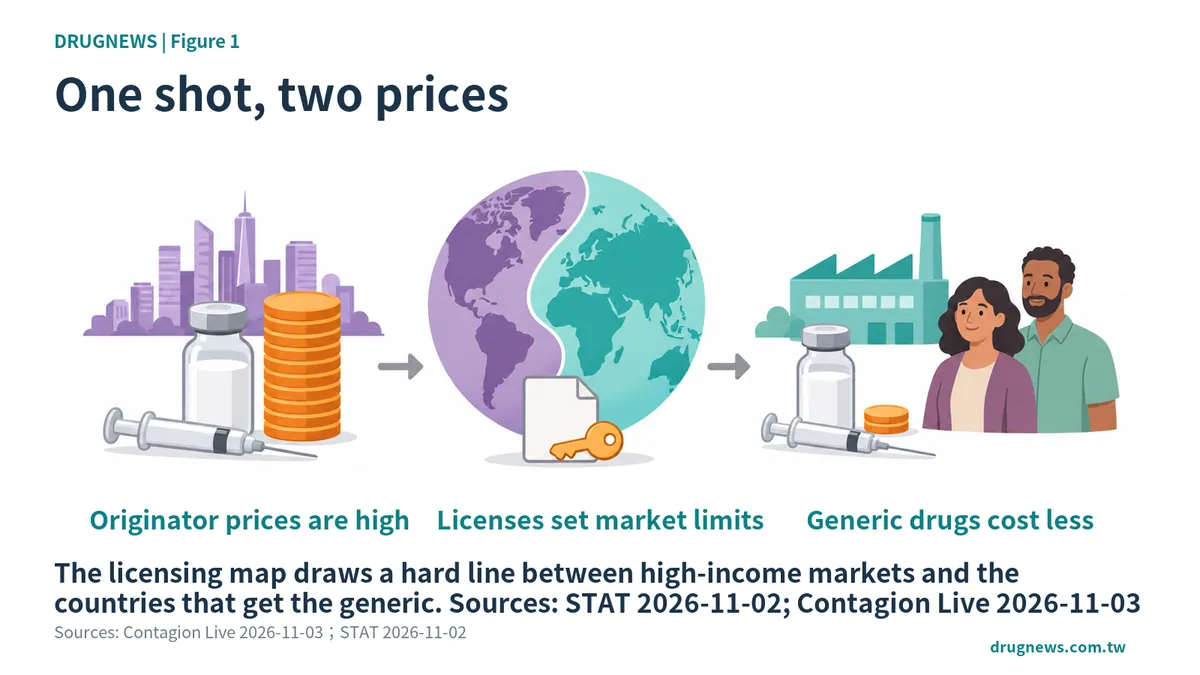
The licensing map draws a hard line between high-income markets and the countries that get the generic. Sources: STAT 2026-11-02; Contagion Live 2026-11-03
CHAI chief executive Neil Buddy Shah said more than 125,000 people in Africa have already started lenacapavir, mostly through Gilead's no-profit supply.
In September, Gilead raised that program's ceiling to as many as 3 million people through 2028.
Once generics ship, the source of supply moves from Gilead's network to production lines in Hyderabad.
02 | Cheap abroad, profitable at home
It is tempting to read this as Gilead giving up margin. Its third quarter says otherwise.
Gilead reported HIV sales of $6.2 billion on October 29, up 18% from a year earlier, with prevention sales nearly doubling.
Yeztugo brought in $305 million, up 31% from the second quarter, and remains on track for about $1 billion in 2026.
Descovy, the older daily oral PrEP pill, still sold $1.0 billion, up 49%, with roughly 80% of use in prevention.
Together, the two products hold about half of the US PrEP market.
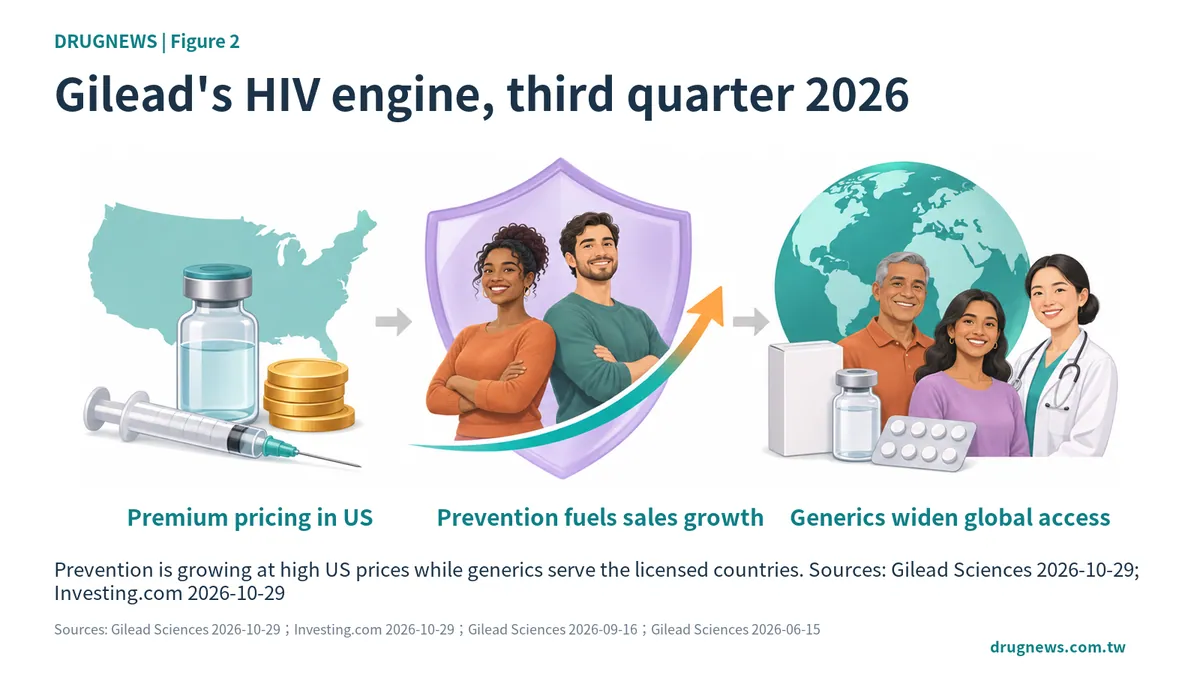
Prevention is growing at high US prices while generics serve the licensed countries. Sources: Gilead Sciences 2026-10-29; Investing.com 2026-10-29
The strength showed in guidance. Gilead raised its 2026 product sales forecast to $31.0 billion to $31.3 billion, from $30.1 billion to $30.4 billion.
It also lifted expected full-year HIV growth to about 12%, from 9% to 10% earlier in the year.
Gilead keeps pushing. The FDA has set February 2, 2027, as the decision date for a once-weekly oral Yeztugo pill.
A once-yearly injection is in the Phase 3 PURPOSE 365 trial, and Gilead has already extended the generic licenses to cover it.
Prevention is settled terrain: Gilead trades volume for public-health goodwill in poorer countries while keeping pricing power in rich ones.
A small company has no room there.
03 | Winners and losers
The clearest winners are Indian generic makers.
A shot that covers six months is lighter on logistics than a daily pill, and FDA tentative approval is the entry ticket to international procurement.
Gilead wins differently, using Yeztugo to take over the US prevention market from Descovy while building goodwill elsewhere.
ViiV Healthcare, majority-owned by GSK, is under the most pressure.
Its Apretude (cabotegravir) was the first long-acting PrEP injection, given every two months.
Two shots a year undercut that interval advantage. ViiV's answer has been to push harder into treatment.
04 | The real fight: freeing stable patients from daily pills
Treatment is the larger cash flow.
Gilead's Biktarvy sold $4.1 billion in the quarter and holds about 53% of the US treatment market.
It also carries a clock: Biktarvy was selected for the third round of Medicare drug price negotiation, and the negotiated price takes effect on January 1, 2028, about 14 months from now.
Gilead is already building what comes after. In August the FDA approved Bixlenvo, a single tablet of bictegravir and lenacapavir.
The Phase 3 DAYBREAK 1 and 2 trials test lenacapavir with two broadly neutralizing antibodies (bNAbs), aiming for treatment twice a year.
That is why the treatment race matters more than the prevention price war. Prevention buyers are mostly healthy people deciding whether to start. Treatment buyers are patients who will take something for decades.
A regimen that moves even a slice of them from daily pills to periodic shots reshapes the largest revenue line in HIV.
The target patients have controlled their virus with oral drugs.
Their problem is a lifetime of daily pills and the reminder each refill brings.
Whoever first moves these people to a shot every few months inherits the cash flow that follows Biktarvy.
05 | Both giants bet on antibodies, and both hit the same wall
Antibodies last a long time in the body and avoid many of the drug interactions that come with small molecules.
ViiV is furthest along.
At CROI in February, it reported 12-month results from the Phase 2b EMBRACE trial: the antibody lotivibart (N6LS) every four months plus monthly cabotegravir injections.
Viral suppression reached 94% with intravenous lotivibart, 82% with subcutaneous dosing, and 88% in patients who stayed on daily oral therapy.
The IV arm beat oral therapy. The subcutaneous arm, the convenient option patients would prefer, fell short.
Gilead's regimen pairs lenacapavir with the antibodies teropavimab and zinlirvimab and has reached Phase 3.
Both approaches aim their antibodies at the virus's envelope.
HIV mutates quickly, and virus that is less sensitive to a given antibody is the gap through which long-acting treatment fails.
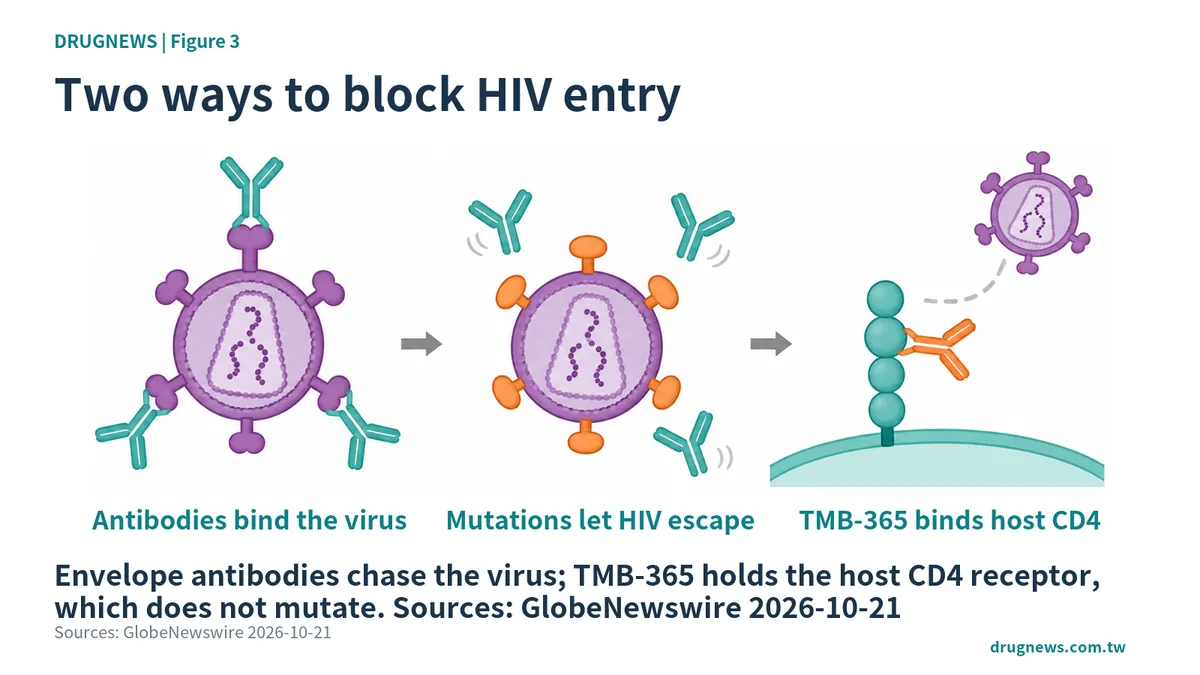
Envelope antibodies chase the virus; TMB-365 holds the host CD4 receptor, which does not mutate. Sources: GlobeNewswire 2026-10-21
06 | TaiMed's card: guard the host's door
TaiMed started from the other side.
Its marketed drug Trogarzo (ibalizumab) binds the CD4 receptor on human immune cells and blocks entry after the virus attaches.
It is used in heavily treatment-experienced adults with multidrug-resistant HIV.
TMB-365 is its second-generation antibody, binding domain 2 of the same receptor.
The virus changes every day. The receptor does not.
TaiMed's IDWeek 2026 laboratory data address the weakness described above.
Of 40 HIV pseudotypes tested, 20 had reduced susceptibility or resistance to TMB-380.
Nineteen of those 20 were still neutralized by TMB-365.
TMB-380 targets the CD4-binding site on the viral envelope, the same class as the big companies' antibodies.
Used together, one antibody chases the virus while the other guards the door.
Human data are building.
In a Phase 1 study of 25 people with HIV, a single TMB-365 dose cut viral load by up to 1.57 log10 copies/mL, with no serious adverse events and no anti-drug antibodies.
At the higher doses, receptor occupancy stayed at or above 80% for five to six weeks, and no resistance to TMB-365 or approved entry inhibitors was seen.
The pharmacokinetics support dosing every 8 to 12 weeks.
In Phase 2a, 20 core participants received the combination every eight weeks for 24 weeks; 16 of 17 participants with week-24 data (94%) maintained HIV-1 RNA <50 copies/mL, with no protocol-defined virologic failures among those who completed treatment.
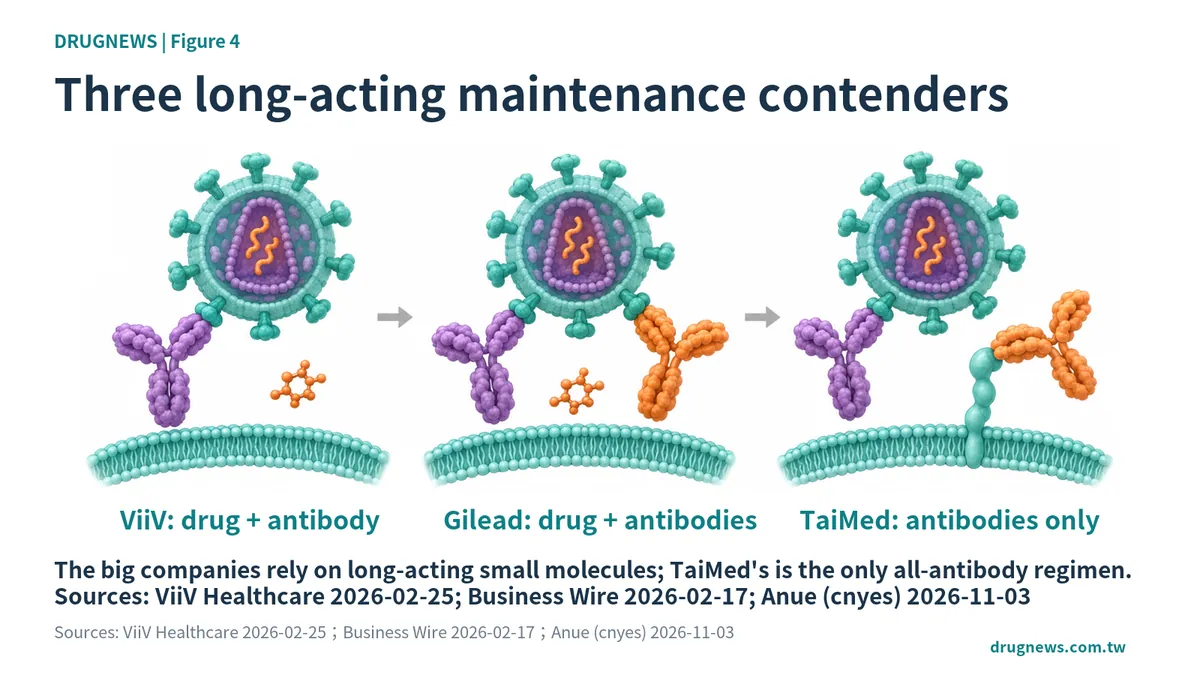
The big companies rely on long-acting small molecules; TaiMed's is the only all-antibody regimen. Sources: ViiV Healthcare 2026-02-25; Business Wire 2026-02-17; Anue (cnyes) 2026-11-03
The ongoing Phase 2b compares the antibody-only regimen with continued oral therapy.
It enrolled its first participant in December 2025 and is now fully enrolled with 88 people. The antibodies are given by intravenous infusion every eight weeks, and the primary analysis is listed for May 2027.
Its design mirrors EMBRACE, so the results can be read on the same scale.
An all-antibody regimen carries one more appeal: no small molecule means no small-molecule resistance or interaction burden, which matters for older people with HIV who take drugs for other chronic conditions.
07 | Why the big companies need an outside antibody
The logic for licensing sits in the big companies' own data.
In ViiV's EMBRACE, the same antibody reached 94% given intravenously and 82% given subcutaneously. The gap comes from the route and drug levels, not from the antibody itself.
Matching IV results with a shot under the skin is a hurdle every long-acting antibody faces, TaiMed's included.
The barrier that keeps patients out is a different one.
Envelope antibodies only work against virus that is sensitive to them, so Gilead's regimen screens virus before enrollment: in its early study, only 44% of 124 people screened, about 55, had virus sensitive to both antibodies.
In that screen, more than half of the candidates could not use the regimen at all.
TaiMed's Phase 2b enrolled 88 people, and the eligibility criteria listed in the US trial registry include no viral susceptibility screen.
An antibody that holds the CD4 receptor does not care which virus it meets, so it can pick up the half that envelope antibodies turn away. For Gilead and ViiV alike, it is a third layer that stacks onto their regimens.
That is the context for chief executive Jimmy Chang's remarks about more realistic paths to overseas licensing and co-development.
TaiMed has visited the NIH and presented at IDWeek and the International Society for Vaccines meeting.
The pool of partners is wider than Gilead and ViiV. Merck's once-weekly oral islatravir plus lenacapavir, developed with Gilead, is a small-molecule regimen that could use an antibody partner.
08 | Taiwan: record-low infections, rising long-term costs
Taiwan's Centers for Disease Control expected about 850 new HIV cases in 2025, the lowest since 2003, and credited publicly funded PrEP in part.
The PrEP quota rises from 8,000 to 9,500 people in 2026.
As of late November 2025, 36,494 Taiwanese nationals were living with HIV.
The CDC pays for the first two years of medication before National Health Insurance takes over.
Taiwan's main HIV cost has shifted from finding new infections to treating stable patients for life.
Once long-acting maintenance becomes standard in the US, the insurer will face the question of whether, and at what price, to pay for it.
Taiwan is not on the licensing list and cannot buy the Indian generic.
More long-acting options mean more negotiating room for the insurer, and local clinicians' experience with Trogarzo gives TaiMed a base for domestic trials and launch.
09 | What to read in the interim data
One question matters most: does the all-antibody arm keep viral suppression level with the oral-therapy arm, without excess confirmed virologic failures?
If it does, TaiMed has the data to negotiate.
The primary analysis is listed for May 2027, so the interim read is what partners will use to decide whether to move before final data.
The second is the dosing interval.
Moving from every eight weeks toward every 12 would put TaiMed in the same convenience tier as ViiV's four-month regimen.
The third is the route.
The Phase 2b uses an IV infusion at a clinic every eight weeks, less convenient than Gilead's twice-yearly shots or ViiV's four-month interval.
To win strong terms, TaiMed will need to show a longer interval or a subcutaneous form, and ViiV's data show that moving under the skin tends to cost efficacy.
10 | Where this call could fail
An interim analysis is small, and a good early read does not guarantee the final result.
More virologic failures in the antibody arm would delay any deal.
The big companies have their own routes.
If Gilead's weekly and yearly products reach the market around 2027 and treatment also moves toward long-acting oral options, the urgency for an antibody combination drops.
Price is the third risk.
The generic prevention price has set an expectation in global health programs that long-acting drugs should be cheap, which narrows treatment pricing outside the US.
TaiMed's own peak-sales estimate of $3 billion to $4 billion is a company figure. Partners will judge it by deal terms.
Long-acting HIV prevention has proven that demand is real and that large drugmakers will pay for longer intervals.
TaiMed now has to prove that the treatment layer is worth buying from a Taiwanese company.
This article is industry and company analysis, not investment or medical advice.
References
- FDA Tentatively Approves First Generic Lenacapavir PrEP for 120 LMICs | Contagion Live | 2026-11-03 | https://www.contagionlive.com/view/fda-tentatively-approves-first-generic-lenacapavir-prep-for-120-lmics
- FDA approves generic version of HIV prevention shot lenacapavir | STAT | 2026-11-02 | https://statnews.com/pharmalot/2026/11/02/lenacapavir-generic-version-approved-fda-hiv-prevention-dr-reddys
- Gilead Sciences Announces Third Quarter 2026 Financial Results | Gilead Sciences | 2026-10-29 | https://investors.gilead.com/news/news-details/2026/Gilead-Sciences-Announces-Third-Quarter-2026-Financial-Results/default.aspx
- Gilead Q3 2026 slides: HIV sales surge drives decade-best growth | Investing.com | 2026-10-29 | https://www.investing.com/news/company-news/gilead-q3-2026-slides-hiv-sales-surge-drives-decadebest-growth-93CH-4985434
- Gilead Accelerates Global Access Planning for Investigational Once-Yearly Lenacapavir | Gilead Sciences | 2026-09-16 | https://investors.gilead.com/news/news-details/2026/Gilead-Accelerates-Global-Access-Planning-for-Investigational-Once-Yearly-Lenacapavir-for-HIV-Prevention/default.aspx
- U.S. FDA Accepts Gilead's Application for Investigational Once Weekly Oral Yeztugo | Gilead Sciences | 2026-06-15 | https://www.gilead.com/news/news-details/2026/u-s--fda-accepts-gileads-application-for-investigational-once-weekly-oral-yeztugo-potentially-the-first-long-acting-pill-for-hiv-prevention
- FDA Approves First Twice-a-Year HIV Prevention Shot, Yeztugo | Drugs.com | 2025-06-20 | https://www.drugs.com/news/fda-approves-first-twice-year-hiv-prevention-shot-125459.html
- bNAb lotivibart (N6LS) maintains high levels of viral suppression | ViiV Healthcare | 2026-02-25 | https://viivhealthcare.com/en-us/media-center/news/press-releases/2026/february/bnab-lotivibart-n6ls-maintains-high-levels-of-viral-suppression/
- Gilead HIV research at CROI 2026 | Business Wire | 2026-02-17 | https://www.businesswire.com/news/home/20260217423823/en
- TaiMed Biologics Reports IDWeek 2026 Data Highlighting TMB-365 | GlobeNewswire | 2026-10-21 | https://www.globenewswire.com/news-release/2026/10/21/3385515/0/en/taimed-biologics-reports-idweek-2026-data-highlighting-tmb-365-and-its-potential-across-long-acting-hiv-combinations.html
- TaiMed advances long-acting HIV dual-antibody Phase 2b, interim results by year-end | Anue (cnyes) | 2026-11-03 | https://news.cnyes.com/news/id/6645221
- TaiMed targets year-end interim data, overseas partnerships progress | Economic Daily News | 2026-11-03 | https://udn.com/news/story/7241/9854710
- TaiMed Phase 2b enrollment passes 80% | uAnalyze | 2026-04-07 | https://uanalyze.com.tw/articles/7636350164
- Taiwan's new HIV cases hit record low; PrEP quota to rise to 9,500 | OCAC News (CNA) | 2025-12-30 | https://ocacnews.net/article/416432
- U.S. FDA Approves Gilead's Bixlenvo, a New Once-Daily Single Tablet Option for Virologically Suppressed Adults With HIV | Gilead Sciences | 2026-08-27 | https://gilead.com/news/news-details/2026/u-s--fda-approves-gileads-bixlenvo-a-new-once-daily-single-tablet-option-for-virologically-suppressed-adults-with-hiv-including-those-on-complex-regimens
- 4 key takeaways from the third round of drugs selected for Medicare drug price negotiation | Milliman | 2026-02-20 | https://www.milliman.com/en/insight/key-takeaways-third-medicare-drug-price-negotiation
- A Phase 2b Study of the Safety, Pharmacokinetics, and Efficacy of the Combination of TMB-365 and TMB-380 as Maintenance Therapy in HIV-1 Infected Individuals Suppressed With Combination Antiretroviral Therapy (NCT07215468) | ClinicalTrials.gov | 2026-11-05 | https://clinicaltrials.gov/study/NCT07215468
- Broadly neutralising antibodies may be partners for long-acting antiretrovirals | aidsmap (CROI 2024 report) | 2024-03 | https://www.aidsmap.com/news/mar-2024/broadly-neutralising-antibodies-may-be-partners-long-acting-antiretrovirals
Share this analysis
Send this article to readers who follow biotech, company strategy, and capital-market signals.
Cite this article
For decks, research notes, or media references, cite Drugnews with the canonical article URL.
Drugnews Editorial Team. "TaiMed Bets on HIV Treatment as PrEP Hits $40." Drugnews, Nov 08, 2026. https://drugnews.com.tw/articles/2026-11-08-taimed-long-acting-hiv-lenacapavir-generic-40-en.html