
Mounjaro and Wegovy have made weight-loss drugs part of everyday conversation, and Hengrui's ribupatide now has Chinese phase 3 results. The first questions behind its 17.7% weight-loss figure are who it was compared with and how long patients were treated.
Ribupatide has beaten placebo in a Chinese trial; global trials will determine its place alongside established weight-loss drugs. The licensing ceiling of $6.035 billion, meanwhile, covers the future of three drug programs.
GEMINI-1, published in JAMA on November 15, offers more than a headline number. Efficacy, safety, the trial's measurement framework and the licensing consideration belong in the same assessment.[1]
01 · Hengrui takes the dual-receptor route
Ribupatide activates GLP-1 and GIP receptors, the same dual-receptor direction as tirzepatide, the ingredient in Mounjaro. Semaglutide, the ingredient in Wegovy, acts on GLP-1 receptors. Mechanism identifies what a drug does; each drug's clinical data establish its results.[1–3]
Receptors can be thought of as switches that receive signals. A dual-receptor agonist activates two types, connecting to metabolism and appetite regulation. Molecular design, dose, tolerability and administration determine how those effects play out in people.
Shared targets still require each molecule to deliver its own results. The people treated, treatment duration and controlled outcomes establish weight loss; milligram doses carry their own meaning for each drug.
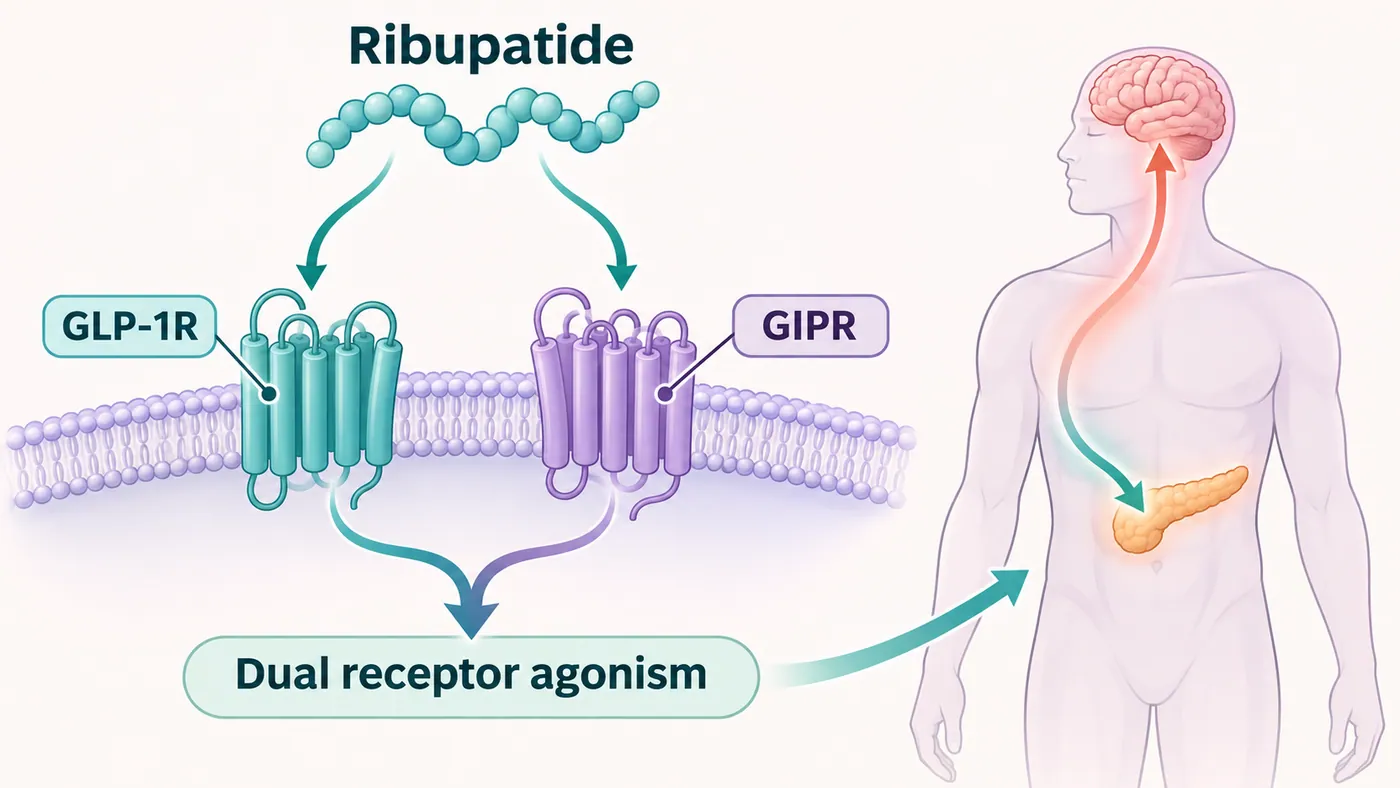
Figure 1 · Ribupatide activates GLP-1 and GIP receptors; its clinical effects are established by molecule-specific trial evidence.
GEMINI-1 randomized 567 Chinese adults with overweight or obesity and without diabetes to 48 weeks of treatment. All groups received lifestyle intervention. Mean baseline weight was 93.0 kg and BMI was 33.3, defining the population to which the results most directly apply.[1,4]
The trial asks whether weekly ribupatide adds more weight loss than placebo under those patient and care conditions. Comparisons involving other global populations and established drugs are the next development task.
At 48 weeks, mean weight change in the highest-dose 6 mg group was −17.7%, versus −1.4% with placebo, a difference of 16.3 percentage points. The 2 mg and 4 mg groups recorded −10.7% and −16.4%, respectively. Differences from placebo were statistically significant at each dose.[1]
These figures use the treatment-policy estimand, which incorporates events such as treatment discontinuation under the trial's defined strategy. The 17.7% result belongs beside its placebo result under that same framework; the estimand defines the question being answered.
Response distribution adds to the average. In the 6 mg group, an estimated 63.8% achieved at least 15% weight loss, versus 7.1% with placebo. At least 10% weight loss was achieved by 75.4%, versus 9.2%. These are proportions crossing thresholds, a different measure from average weight change.[1]
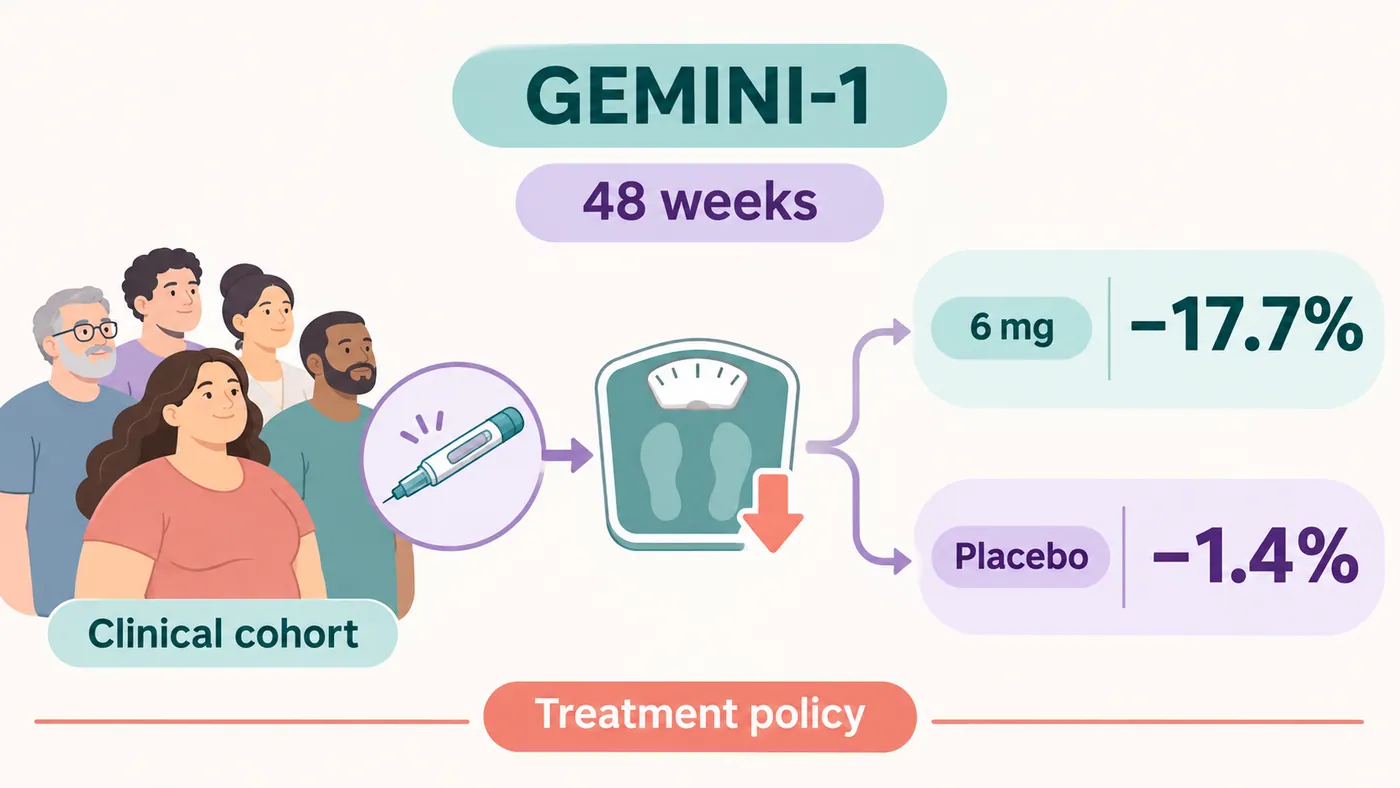
Figure 2 · Mean weight loss was 17.7% at 6 mg and 1.4% with placebo, using the same treatment-policy framework.
At least 5% weight loss was achieved by 88.0% at 4 mg and 85.7% at 6 mg. The 4 mg group had the higher response at this threshold; dose selection brings average change, response distribution and safety together.
Group averages provide an evidence base, while threshold responses show variation around it. Some participants exceed the average and others fall below it. Presenting both makes that distinction visible.
Lifestyle intervention is also part of the treatment strategy. The trial compares drug and placebo on top of that shared intervention, so the percentages describe the effects of the complete arrangement.
For readers following weight-loss drugs, the study adds a candidate with phase 3 evidence. How much weight people lost, how many reached targets and what discomfort accompanied treatment can now be assessed from data.
02 · Four trials, with their own timelines and patients
Comparing ribupatide with Mounjaro and Wegovy starts with treatment duration, baseline BMI and patient population. The table puts those conditions beside each result.[1–3,5]
| Drug | Trial / randomized participants | Assessment | Dose and mean weight change | Placebo | Baseline BMI |
|---|---|---|---|---|---|
| ribupatide | GEMINI-1 / 567 | 48 weeks; primary | 2/4/6 mg: −10.7/−16.4/−17.7% | −1.4% | 33.3 |
| tirzepatide | SURMOUNT-1 / 2,539 | 72 weeks; primary | 5/10/15 mg: −15.0/−19.5/−20.9% | −3.1% | 38.0 |
| semaglutide | STEP 1 / 1,961 | 68 weeks; primary | 2.4 mg: −14.9% | −2.4% | 37.9 |
| mazdutide | GLORY-1 / 610 | 48 weeks; secondary; primary at 32 weeks | 4/6 mg: −11.00/−14.01% | +0.30% | 31.1 |
The figures use each trial's treatment-policy or treatment-regimen framework, with differences in statistical handling. Mazdutide acts on GLP-1 and glucagon receptors. Its 48-week result also has a different endpoint status from the first three rows.[1–3,5]
Placebo belongs in the comparison too. It reflects lifestyle intervention, participant characteristics and other study conditions. Subtracting placebo gives a within-trial difference; populations and timepoints provide the coordinates for interpreting those differences.
GEMINI-1 and GLORY-1 both report Chinese 48-week data, with their own baseline BMI, primary endpoint timing and designs. An active-comparator study would answer how the two molecules perform in the same patients.
Duration is easy to lose behind a headline percentage. Longer follow-up provides more time to observe weight change and treatment discontinuation; shorter studies answer an earlier question. Keeping weeks beside percentages shows how far each result has traveled.
On November 4, Kailera projected global KaiNETIC phase 3 readouts in mid-2028. That is a key next step for ribupatide's global position. Chinese results provide an efficacy signal, while the global program takes on further population and comparison questions.[6]
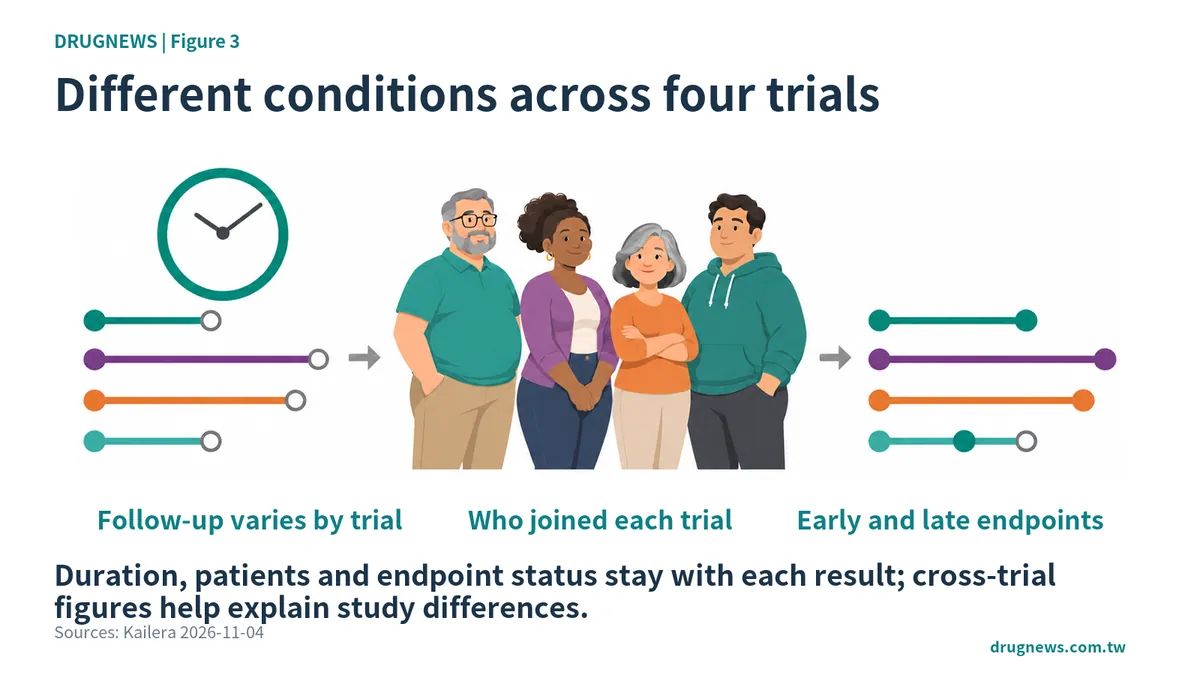
Figure 3 · Duration, patients and endpoint status stay with each result; cross-trial figures help explain study differences.
03 · Gastrointestinal events and discontinuation measure different things
Gastrointestinal events are central to ribupatide's tolerability profile. Rates of gastrointestinal-disorder adverse events at 2/4/6 mg were 47.9/58.2/63.1%, versus 23.1% with placebo. Alongside weight change, this is a difference patients would experience.[1]
Permanent discontinuation because of treatment-emergent adverse events was 0.7/0.7/1.4% across the three doses, versus 0% with placebo. Event incidence and permanent discontinuation describe different outcomes. The gap shows a clear difference between experiencing discomfort and permanently stopping treatment.
All-cause discontinuation uses a broader measure. A company study presentation reports treatment discontinuation in 40/424 pooled ribupatide participants, or 9.4%, versus 13/143, or 9.1%, with placebo. It includes other reasons and is distinct from leaving the entire study, completing the picture of treatment persistence.[4]
The pooled treatment group reported three cases each of cholecystitis and papillary thyroid cancer, each representing 0.7%. Investigators judged these events likely unrelated to treatment. Individual causality assessments and long-term risk evaluation serve different purposes; the latter needs larger, longer follow-up.[1]
The Chinese study provides 48-week efficacy and safety data, with broader populations and rare risks passing to global follow-up. Efficacy, tolerability and treatment persistence in that program will determine the molecule's position beyond the Chinese dataset.
Hengrui announced acceptance of its Chinese obesity application in September 2025, a step in the review process. GEMINI-1 is registered as NCT06396429, separately from the global program.[9,10]
04 · Conditional payments and Taiwan rights follow different paths
Hengrui's $6.035 billion licensing ceiling with Kailera covers three programs and agreed derivatives; a ribupatide-only price is undisclosed. Separating upfront, technology-transfer, clinical, regulatory and commercial payments shows where the risk sits.[7,8]
The payer confirms a $100 million upfront payment and a $10 million technology-transfer fee, totaling $110 million. Potential clinical and regulatory milestones reach $200 million, and commercial milestones reach $5.725 billion. Together, the four components make up the $6.035 billion ceiling.
The arithmetic is $110 million ÷ $6.035 billion × 100, or about 1.823% paid against the nominal ceiling. This is an undiscounted payment-structure ratio. Commercial milestones account for much of the total and depend on specified events; development probability is a separate question.
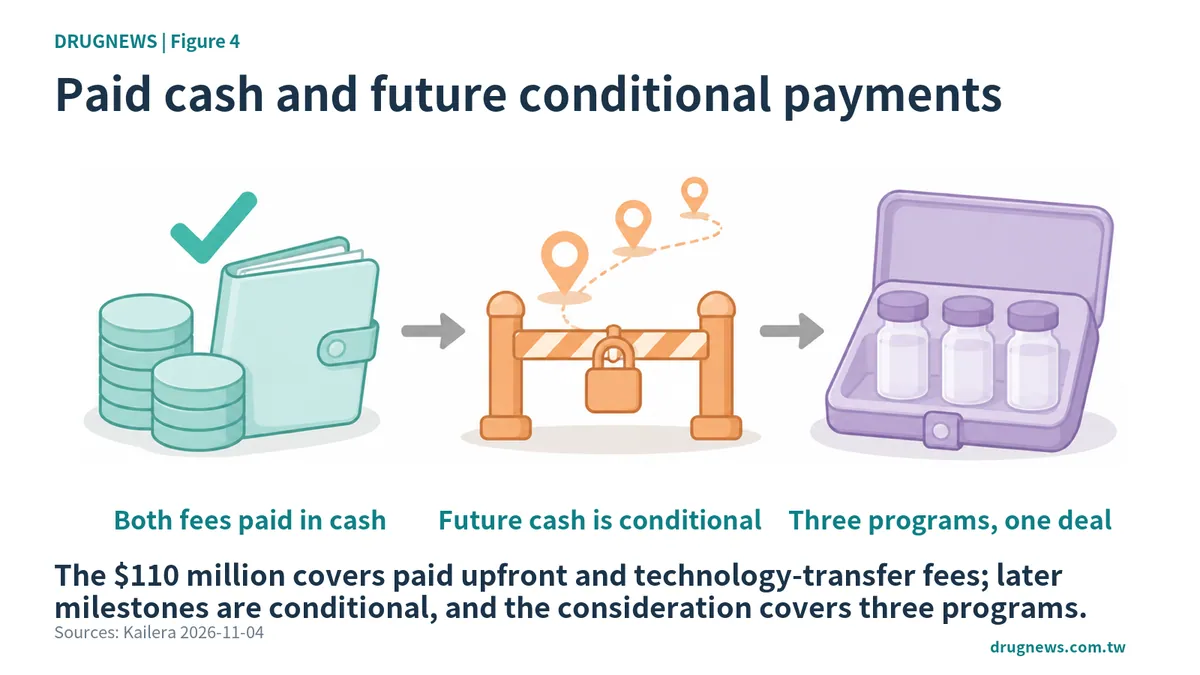
Figure 4 · The $110 million covers paid upfront and technology-transfer fees; later milestones are conditional, and the consideration covers three programs.
Royalties are tiered on net sales, with the SEC filing describing a range from mid-single-digit to low-double-digit percentages and leaving the full tiers undisclosed. Hengrui also obtained a 19.9% fully diluted equity interest at the time of licensing. That historical percentage and noncash consideration sit separately from the upfront payment.[8]
Upfront and technology-transfer fees have payment evidence; milestones connect later returns to development, review and commercial events; royalties connect them to net sales. Those cash flows arise under different conditions, so actual income is tracked component by component in disclosures.
Global trials turn development spending into testable product value. The licensor's later returns follow those results and commercial execution. The three-program package therefore represents a set of development opportunities, with individual molecule values understood within the package agreement.
Taiwan is excluded from Kailera's licensed territory. The overseas deal supplies global development resources, while local rights and regulatory processes are the next gates for access in Taiwan.[7]
For Taiwan readers, overseas development adds product evidence and local access follows verifiable domestic progress. Each has its own territorial responsibilities.
Hengrui received paid cash, equity and opportunities for later returns; Kailera obtained rights in agreed territories and responsibility for development and commercialization. GEMINI-1 has brought ribupatide to a point where phase 3 efficacy can be examined. For people seeking weight loss, the next useful answers concern durability, discomfort and where treatment ultimately becomes available.
This article is industry and company analysis, not investment or medical advice.
References
- Once-Weekly Ribupatide: GEMINI-1 · JAMA · 2026-11-15 · https://jamanetwork.com/journals/jama/fullarticle/2856795
- SURMOUNT-1 results · Eli Lilly · 2022-06-04 · https://investor.lilly.com/news-releases/news-release-details/lillys-surmount-1-results-published-new-england-journal-medicine
- Introduction to STEP program · Novo Nordisk · 2025 · https://www.scientific-exchange.com/content/dam/medical/scientific-exchange/ta/obesity/pharmacotherapies/resource-documents/intro-to-step-program-phase-3-chronic-weight-mgmt-studies.pdf
- HRS9531 Phase 3 Clinical Trial Results · Hengrui / Kailera · 2025-11 · https://www.kailera.com/wp-content/uploads/2025/11/Hengrui_ObesityWeek-2025_HRS9531_Phase_3_Clinical_Trial_Results.pdf
- Mazdutide in Chinese Adults with Overweight or Obesity · NEJM · 2025-05-25 · https://mediacenteratypon.nejmgroup-production.org/NEJMoa2411528.pdf
- Third Quarter 2026 Results and Business Updates · Kailera / SEC · 2026-11-04 · https://www.sec.gov/Archives/edgar/data/2096997/000119312526447232/ck0002096997-ex99_1.htm
- Form 10-Q, note 12 · Kailera · 2026-11-04 · https://investors.kailera.com/static-files/c21ffedd-0e44-4475-9653-057728910880
- Form S-1: Hengrui agreement · Kailera / SEC · 2026-03-27 · https://www.sec.gov/Archives/edgar/data/2096997/000119312526128952/d113532ds1.htm
- Source
- GEMINI-1 trial registration · ClinicalTrials.gov · accessed 2026-11-17; update date not asserted · https://clinicaltrials.gov/study/NCT06396429
Share this analysis
Send this article to readers who follow biotech, company strategy, and capital-market signals.
Cite this article
For decks, research notes, or media references, cite Drugnews with the canonical article URL.
Drugnews Editorial Team. "Ribupatide's Global Evidence Test." Drugnews, Nov 20, 2026. https://drugnews.com.tw/articles/2026-11-20-hengrui-ribupatide-weight-loss-en.html