
A depression drug has won a trial. Patients are still waiting for a new prescription.
Helus's HLP003 has won APPROACH, and the next test is EMBRACE, which the company expects in the fourth quarter of 2027. Reproducing efficacy in another pivotal trial would advance the program toward regulatory review with a complete benefit-risk dataset. Expectations for differentiation rest on that test.
Helus announced phase 3 APPROACH results on November 16 in adults who still had symptoms despite existing antidepressant treatment. The setting speaks to a familiar patient frustration: medication has begun, but everyday life has yet to recover.[1]
The announcement brings speed of improvement, symptom scores and remission together. The results provide an efficacy signal; the next task is turning it into a treatment pathway patients can complete.
01 · Subtract placebo to see the added effect
APPROACH measures the effect added by a new drug under controlled conditions. Participants continued their existing stable-dose antidepressants, with HLP003 added to that treatment. The design therefore asks what the new drug contributes alongside established medication.[1][2]
The registry also specifies manualized psychological support for each group.[2] Medication and that care arrangement together make up the study intervention.
That has practical development implications. If psychological support is part of the research process, the company must explain how staff are trained, how delivery stays consistent across sites and who handles assessment and care.
A treatment group's before-and-after change also captures background medication, study care, disease fluctuation and expectation. Randomization helps separate improvement shared by both groups from the drug's added contribution.
At week 6, the company reported a placebo-adjusted difference of −7.6 points on the MADRS depression scale. Lower scores indicate improvement. That difference is closer to the effect the study seeks to identify than the treatment group's total change from baseline.[1]
The −7.6 points measure symptom improvement as defined in the study. Returning to work, rebuilding relationships and maintaining everyday function are the life outcomes to follow next.
The company identified week 12 as a key secondary endpoint, with a placebo-adjusted difference of −7.0 points. That supplies a later signal of separation, extending the evidence beyond a brief change.[1]
It also raises questions about follow-up care and what happens when symptoms worsen again. The registered EXTEND study follows long-term safety and subsequent dosing, taking on those later treatment questions.[4]
Commercially, the answer shapes what the product is. Daily medication, repeated clinic treatment and intermittent dosing with prolonged follow-up consume different medical resources. An efficacy signal begins the work of delivering that service.
Earlier improvement matters to patients still living with depression. The developer's next job is translating the duration of improvement into a pathway clinicians can explain and patients can complete.
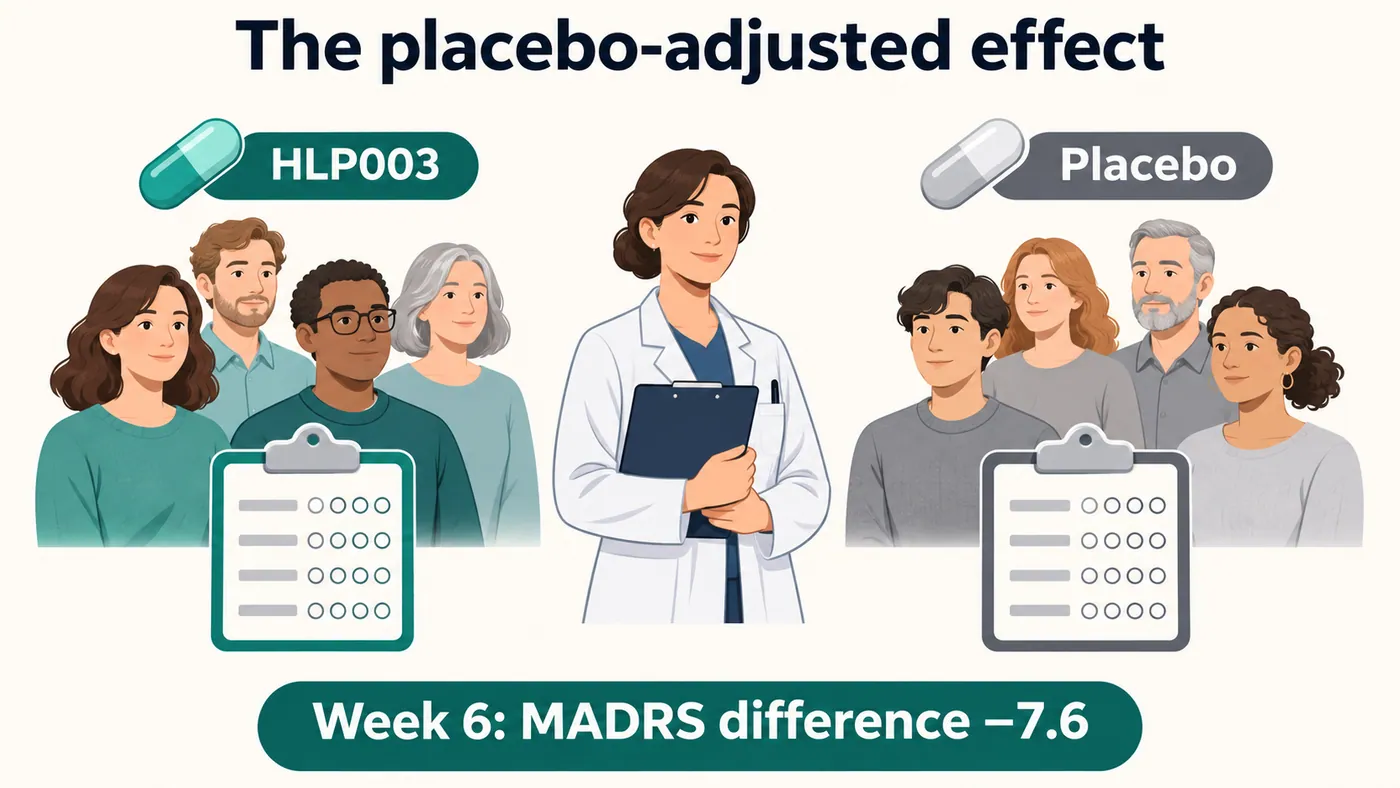
The week 6 group difference is the starting point for assessing added efficacy in APPROACH; the people shown are conceptual illustrations.
02 · Three companies at different stages of evidence
Competition with other rapid-acting treatments begins with patient population and delivery. Helus studies adjunctive treatment for major depressive disorder, while Compass's COMP360 focuses on treatment-resistant depression. Their prior-treatment requirements differ, so even MADRS results belong within their respective populations.[2][3][7]
Johnson & Johnson's SPRAVATO, or esketamine, offers an established reference. Its US label includes monotherapy or use with an oral antidepressant for adults with treatment-resistant depression. It already has defined administration and monitoring rules.[5][6][9]
For Helus's HLP003, the indication under study is adjunctive treatment for major depressive disorder. APPROACH topline results and the separate EMBRACE test form the evidence pathway, while psychological support, monitoring and later dosing shape delivery.[1][2][3]
Compass's COMP360 targets treatment-resistant depression. The company has reported pivotal research and extension follow-up, with supported administration and maintenance of effect as delivery questions.[7]
Johnson & Johnson's SPRAVATO is approved for adult treatment-resistant depression under its US label. Its use follows that label, including professional supervision and observation after administration.[5][6]
These examples show how far each product has progressed. They also show what clinics need to prepare.
SPRAVATO's US label requires at least two hours of observation after each treatment, including respiratory and blood-pressure assessment.[5] That extends competition from drug action to staffing, space and appointment schedules.
Those two hours are a SPRAVATO requirement; HLP003's monitoring duration will be determined through its own research and review. Delivery conditions become part of how an approved product is used.
Compass has reported COMP360 follow-up and discussed regulatory submission progress.[7] For Helus, the steps competitors have completed are more useful guides to the work ahead than an isolated cross-trial numerical difference.
The earlier review of antidepressant drug development mapped the development paths. The comparison now narrows to evidence and delivery work actually completed by each company.
HLP003 is deuterated psilocin, a serotonergic agonist in the company's pipeline. The connection between serotonin signaling and neuroplasticity is the mechanistic hypothesis behind this development route.[1]
Mechanism explains why a treatment is worth studying; clinical trials ask whether it works under specified conditions. Neural signaling and symptom improvement have separate evidentiary jobs.
Differentiation ultimately needs a testable form. A simpler pathway that maintains benefit could offer service value. The mechanistic difference must eventually connect to a change in the hospital's actual work.
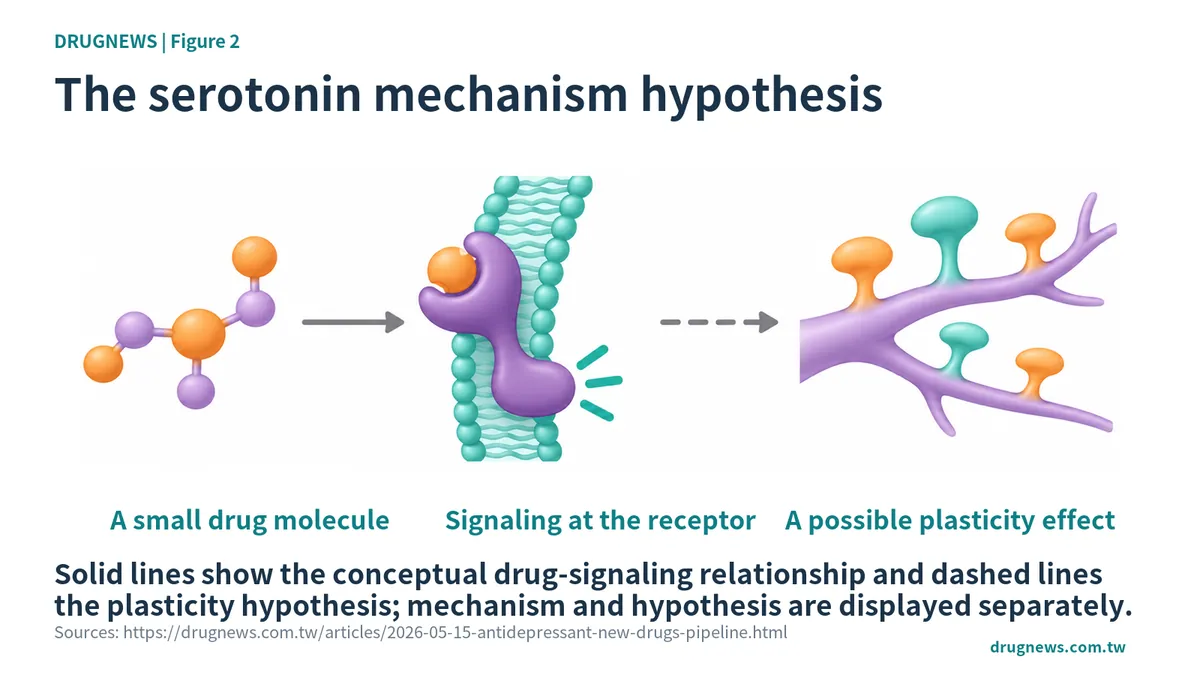
Solid lines show the conceptual drug-signaling relationship and dashed lines the plasticity hypothesis; mechanism and hypothesis are displayed separately.
03 · Remission looks promising; replication and safety come next
Converting the remission difference into a treatment count shows the study's scale of benefit. At week 6, the company reported remission of 50.9% versus 18.2%, an unadjusted absolute difference of 32.7 percentage points. Dividing 1 by 0.327 gives 3.058, rounded up to about four people.[1]
Remission was defined as a MADRS total score of 10 or lower.[1] That threshold and the amount of score reduction measure different things: crossing a defined boundary versus average improvement.
Under this trial's conditions and assessment time, treating about four people produced one additional person reaching study-defined remission compared with control. The count comes from group proportions and belongs to that population and timepoint. No separate confidence interval or adjustment for other variables was calculated; population, remission definition and follow-up define its scope.
SPRAVATO's studies have their own eligibility thresholds and background medication. Its remission rates belong within those complete designs.[5][6]
Psychoactive effects can lead participants to guess their allocation, while psychological support and expectations can influence ratings. FDA research guidance specifically addresses such design issues.[8] The company also reported three serious adverse events related to HLP003 treatment.[1] Full accounts of the events, attrition and maintenance of blinding are the next details to examine, while another pivotal trial tests replication.
EMBRACE therefore has a concrete role: testing whether the effect holds in a similar population and design. Extension research adds longer-term safety, persistence of benefit and further-treatment data.[3][4]
The company's projected timelines give funders milestones to follow. Product value will update as that evidence arrives.
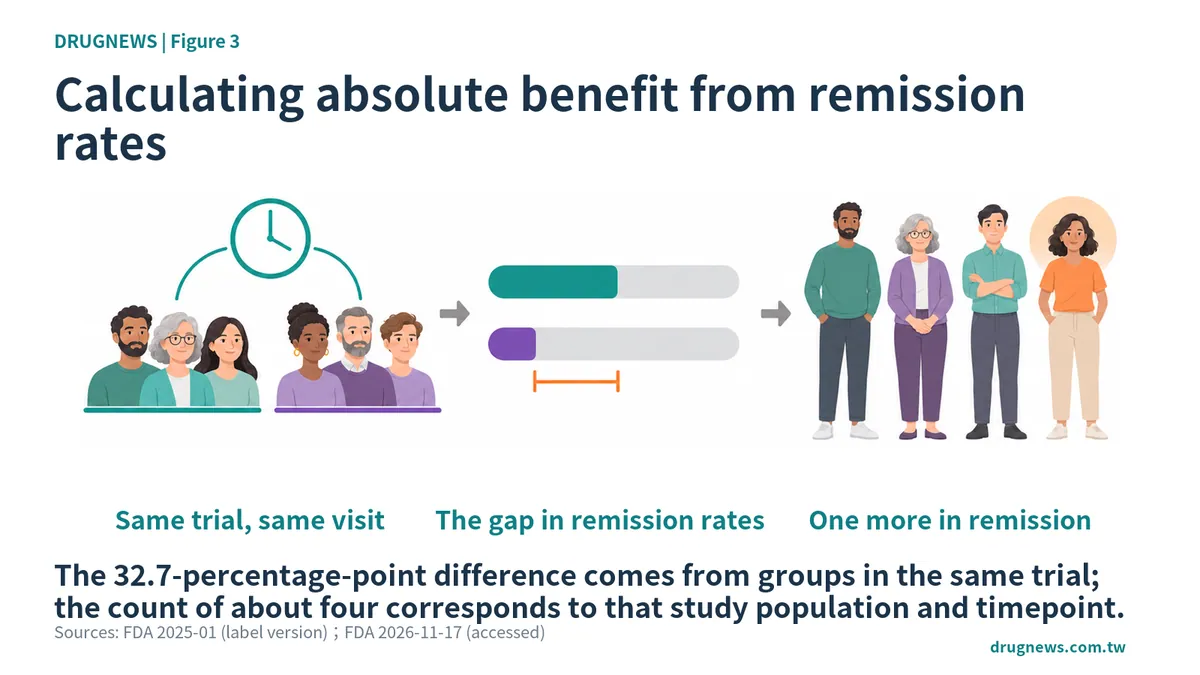
The 32.7-percentage-point difference comes from groups in the same trial; the count of about four corresponds to that study population and timepoint.
04 · Taiwan: from monitoring documents to local treatment
Taiwan's available SPRAVATO prescribing information describes supervised administration and risk management for sedation, dissociation and other effects, providing a documented monitoring reference.[9] HLP003's Taiwan approval, pricing, reimbursement and local care arrangements were undisclosed in the APPROACH announcement. Those details are needed to establish a local pathway and revenue case.[1]

Authorization, payment arrangements and clinical care jointly shape access; the figure illustrates delivery.
HLP003 has added phase 3 evidence worth following in adjunctive treatment for major depressive disorder. If EMBRACE reproduces the effect under a similar design when it reports in the company-projected fourth quarter of 2027, and follow-up care can be clearly specified, the program moves closer to a usable treatment. Failure to replicate would lower expectations for product differentiation.[1]
This article is industry and company analysis, not investment or medical advice.
References
- APPROACH positive topline results · Helus Pharma · 2026-11-16 · https://ir.helus.com/node/11511/pdf
- APPROACH record NCT06564818 · ClinicalTrials.gov · 2026-11-17 (accessed) · https://clinicaltrials.gov/study/NCT06564818
- EMBRACE record NCT06793397 · ClinicalTrials.gov · 2026-11-17 (accessed) · https://clinicaltrials.gov/study/NCT06793397
- EXTEND record NCT06605105 · ClinicalTrials.gov · 2026-11-17 (accessed) · https://clinicaltrials.gov/study/NCT06605105
- SPRAVATO prescribing information · FDA · 2025-01 (label version) · https://www.accessdata.fda.gov/drugsatfda_docs/label/2025/211243s016lbl.pdf
- SPRAVATO monotherapy announcement · Johnson & Johnson · 2025-01-21 · https://www.jnj.com/media-center/press-releases/spravato-esketamine-approved-in-the-u-s-as-the-first-and-only-monotherapy-for-adults-with-treatment-resistant-depression
- COMP360 second Phase 3 follow-up · Compass Pathways · 2026-07-07 · https://ir.compasspathways.com/News--Events-/news/news-details/2026/Compass-Pathways-Announces-Six-Month-Data-from-Second-Phase-3-Trial-Confirming-Rapid-and-Durable-Profile/default.aspx
- Psychedelic Drugs: Considerations for Clinical Investigations · FDA · 2026-11-17 (accessed) · https://www.fda.gov/regulatory-information/search-fda-guidance-documents/psychedelic-drugs-considerations-clinical-investigations
- SPRAVATO Taiwan prescribing document · Kaohsiung Municipal Kai-Syuan Psychiatric Hospital · 2026-11-17 (accessed) · https://ksph.kcg.gov.tw/7/dfiles_pdf/Spravato.pdf
- Medication safety · Taiwan Ministry of Health and Welfare · 2026-11-17 (accessed) · https://www.mohw.gov.tw/cp-88-216-1.html
- National Health Insurance pharmaceutical inclusion and payment rules · Taiwan Laws and Regulations Database · 2026-08-24 (amended) · https://law.moj.gov.tw/LawClass/LawAll.aspx?pcode=L0060035
Share this analysis
Send this article to readers who follow biotech, company strategy, and capital-market signals.
Cite this article
For decks, research notes, or media references, cite Drugnews with the canonical article URL.
Drugnews Editorial Team. "Depression Trial Success Faces a Replication Test." Drugnews, Nov 21, 2026. https://drugnews.com.tw/articles/2026-11-21-helus-hlp003-depression-phase3-en.html