
On November 20, 2026, Merck (NYSE: MRK) said the global Phase 3 TroFuse-015 trial of sacituzumab tirumotecan (sac-TMT, MK-2870, SKB264) met its primary endpoint of overall survival in 473 patients with gastroesophageal adenocarcinoma who had already failed two or more lines of therapy. The drug was invented by Chengdu-based Kelun-Biotech (HKEX: 6990), which Merck paid $47 million upfront in 2022 for rights outside Greater China. For Western BD teams and investors, this is now the clearest test case of what a China-origin ADC looks like after four years inside a big pharma development machine: two positive global Phase 3 survival readouts in a month, an FDA filing under priority review, and a licensor that still owns China.
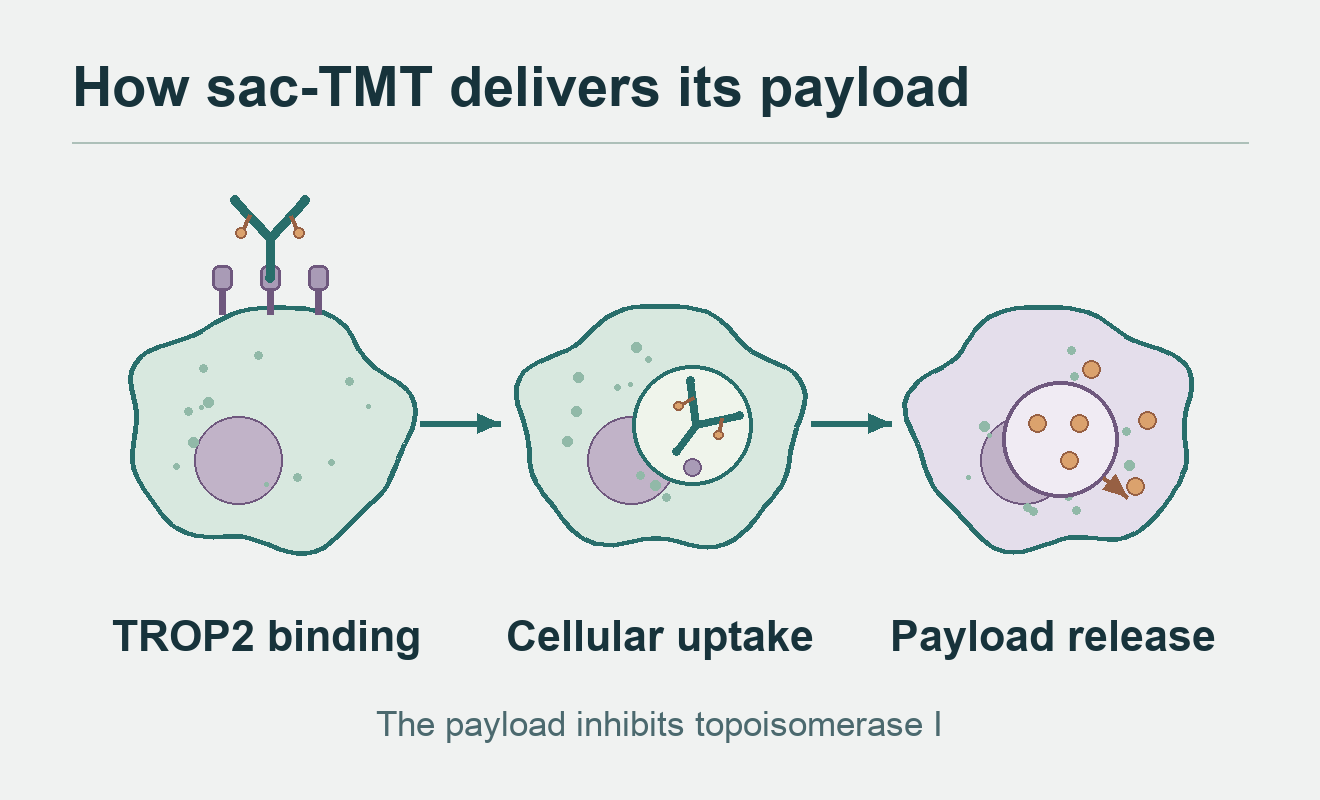
After binding to TROP2, sac-TMT enters the cell and can release its payload.
What Merck reported, and what it held back
TroFuse-015 compared sac-TMT with the physician's choice of four standard late-line agents. Merck called the survival gain statistically significant and clinically meaningful, and said it held across subgroups regardless of TROP2 expression. It did not give a hazard ratio or median survival. The data will go to a medical meeting and to regulators.
| Item | TroFuse-015 (NCT06356311) |
|---|---|
| Patients randomized | 473, global, open-label |
| Setting | Gastric, gastroesophageal junction or esophageal adenocarcinoma after 2 or more prior lines |
| Biomarker | TROP2 not required; used as a stratification factor |
| Experimental arm | sac-TMT 4 mg/kg on days 1, 15 and 29 of a 6-week cycle |
| Control arm | Trifluridine/tipiracil, irinotecan, paclitaxel or docetaxel |
| Primary endpoint | Overall survival: met at final analysis |
| PFS (blinded central review) | Not met |
| Objective response rate | Nominally favored sac-TMT; not formally tested |
| Hazard ratio, median OS | Not disclosed |
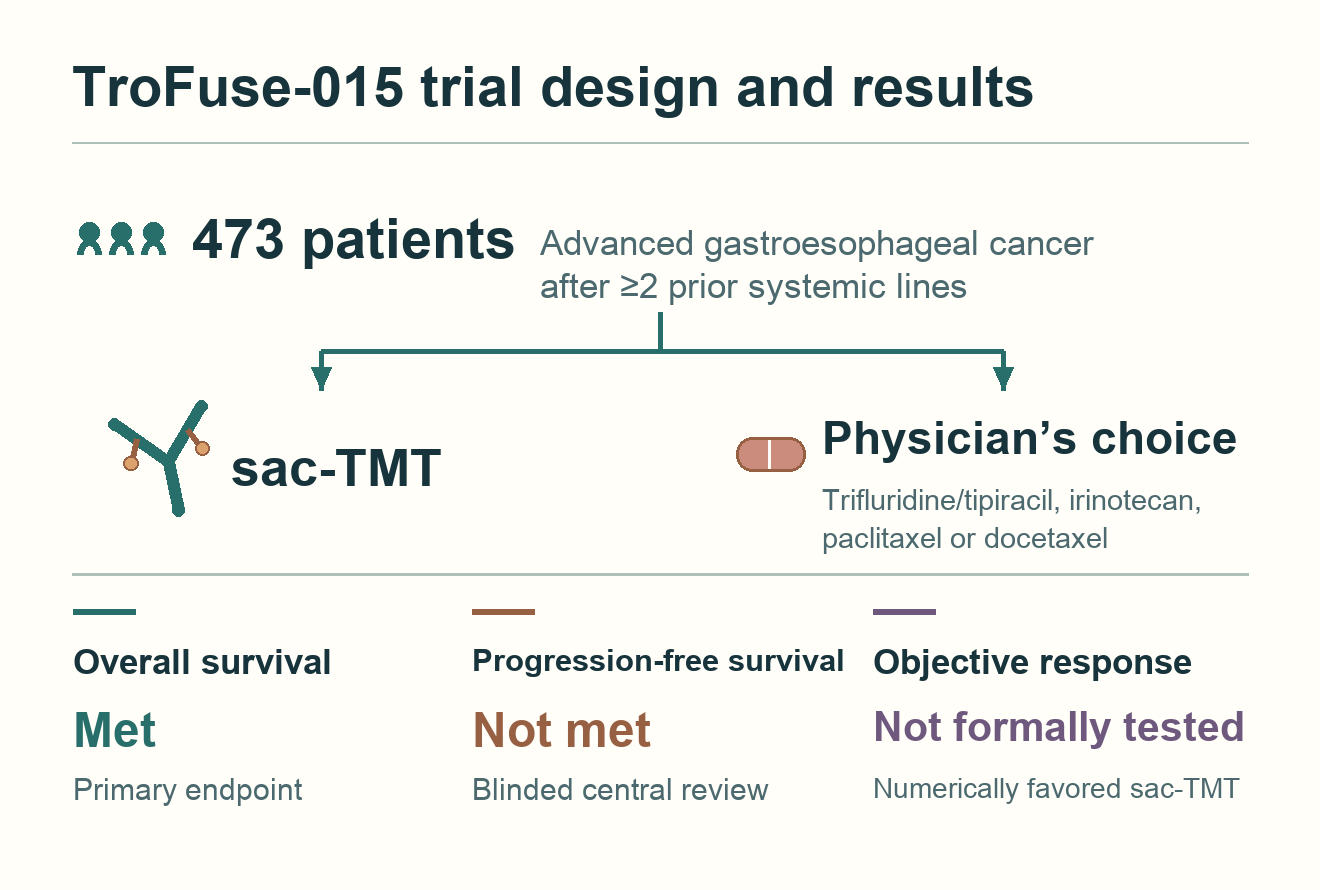
The trial met its primary overall-survival endpoint and missed its progression-free survival endpoint.
The missed progression-free survival endpoint matters. In late-line gastric cancer a drug that extends survival without clearly delaying progression usually wins by a modest margin, often through better tolerance or post-progression benefit rather than deep tumor control. The open-label design makes the overall survival result the only clean endpoint, which is why Merck made it primary.
The deal behind the drug
Kelun's economics on sac-TMT were set before the asset had any Phase 3 data, and they show how cheaply Western buyers could still get Chinese ADCs in 2022.
| Term | Kelun-Merck sac-TMT license (May 2022) |
|---|---|
| Upfront | $47 million, of which $17 million had already been paid under an earlier collaboration |
| Milestones | Up to $1.36 billion in development, regulatory and sales milestones |
| Royalties | On net sales outside Greater China; rates not disclosed |
| Merck territory | Worldwide excluding mainland China, Hong Kong, Macau and Taiwan |
| Kelun territory | Greater China, where sac-TMT is already approved, including for EGFR-mutant NSCLC after TKI therapy |
| Paid vs unpaid | Upfront fully paid; receipts that can be tied to this asset, including the signing payments, total at least $152 million; a complete paid-versus-unpaid tally cannot be built from disclosures |
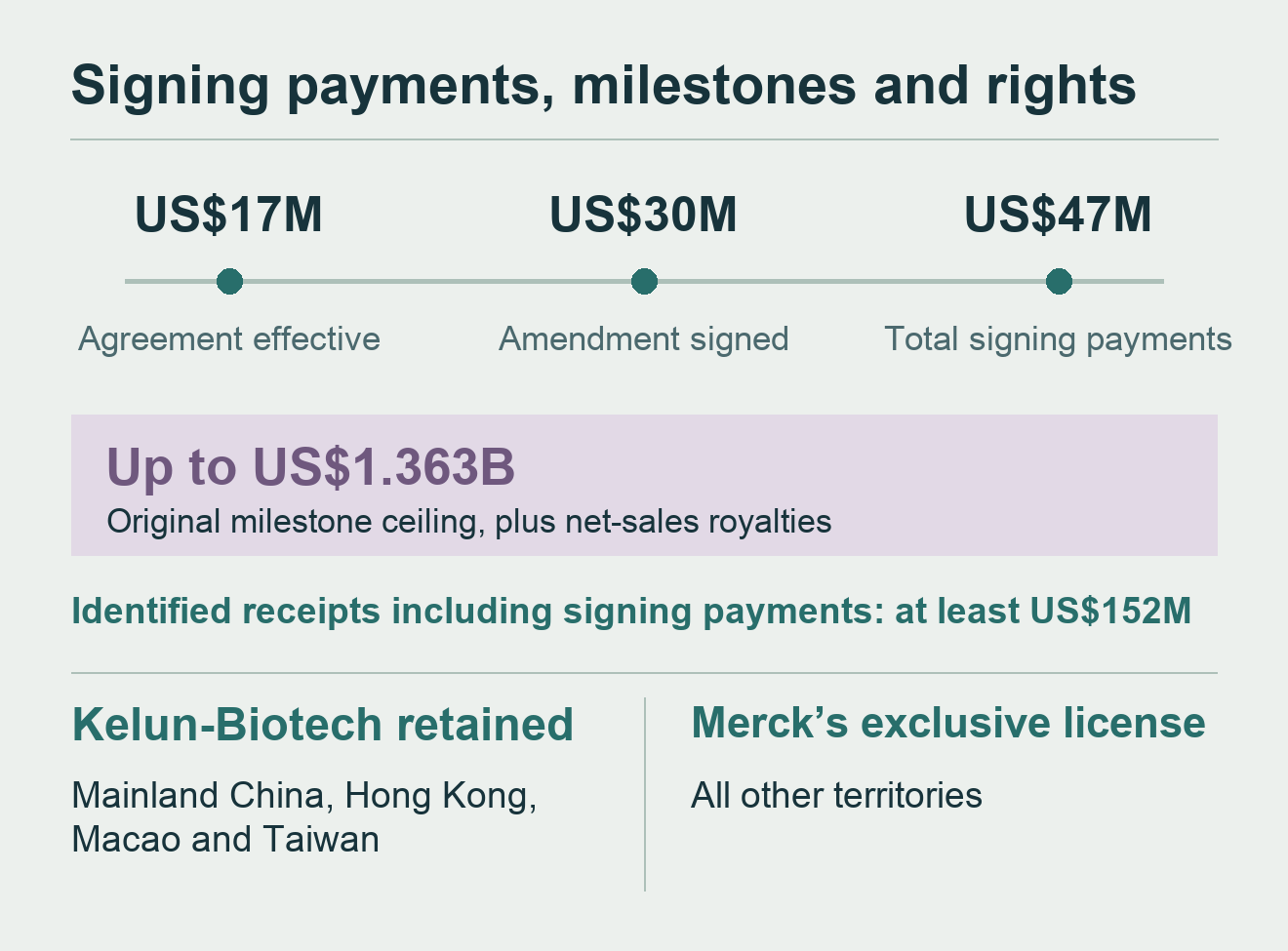
Kelun received the upfront in two installments and retained rights in mainland China, Hong Kong, Macao and Taiwan.
Merck added a much larger Kelun deal in December 2022 covering seven other ADC candidates, but sac-TMT remains the one with the late-stage evidence. Its first global Phase 3 win, TroFuse-005 in previously treated endometrial cancer, showed median overall survival of 19.0 versus 12.1 months (HR 0.68). The FDA has accepted that filing under priority review with a June 15, 2027 target date. Each further approval moves Kelun up the milestone ladder and widens the royalty base.
Same yardstick: Daiichi Sankyo's Enhertu in third-line gastric
The fairest comparison is the other Asian-invented ADC that won on survival in this exact setting: Daiichi Sankyo's trastuzumab deruxtecan (Enhertu). In DESTINY-Gastric01, run in Japan and South Korea, Enhertu was tested against physician's choice of irinotecan or paclitaxel in HER2-positive patients after two or more prior regimens. Median overall survival was 12.5 versus 8.4 months, with a hazard ratio of 0.59, in 187 patients.

Both trials measure overall survival against investigator-chosen chemotherapy in patients who have exhausted two lines. That is where the similarity ends:
- Enhertu was tested only in HER2-positive tumors, roughly a fifth of gastric cancers; TroFuse-015 enrolled all comers. A biomarker-selected trial almost always shows a larger effect.
- DESTINY-Gastric01 was an Asia-only, 2:1 randomized Phase 2; TroFuse-015 is a global Phase 3 with Western patients, who tend to have different disease biology and treatment histories.
- Gastric treatment has moved since 2020: most patients now receive a PD-1 inhibitor and many a Claudin 18.2 drug earlier, so the late-line population is more heavily pretreated.
The useful conclusion is commercial rather than numerical. Enhertu carved out a HER2-defined slice of late-line gastric cancer. Sac-TMT, if approved, would be the first ADC for the much larger HER2-negative remainder, competing mainly with trifluridine/tipiracil, whose own pivotal TAGS trial gave a 2.1-month median survival gain over placebo.

Why this matters for Asian assets
The signal for Western buyers is that the TROP2 race is now being decided by a Chinese molecule. AstraZeneca and Daiichi Sankyo's datopotamab deruxtecan and Gilead's sacituzumab govitecan have no positive Phase 3 survival result in gastric cancer. Merck describes sac-TMT as the first TROP2 ADC to improve survival in a global Phase 3 in this disease, with 18 ongoing global Phase 3 trials in the program.
For Kelun, the result validates a strategy of keeping China and licensing the rest early. The cost of that strategy is also visible: a $47 million upfront for what is becoming a multi-indication global asset. Chinese ADC developers negotiating today, with sac-TMT as a precedent, should be able to argue for far higher upfronts, and recent deals show they are getting them. See our Asia ADC leaders ranking and the ADC topic page for how Chinese, Japanese and Taiwanese programs stack up, and our Kelun-Biotech company page.
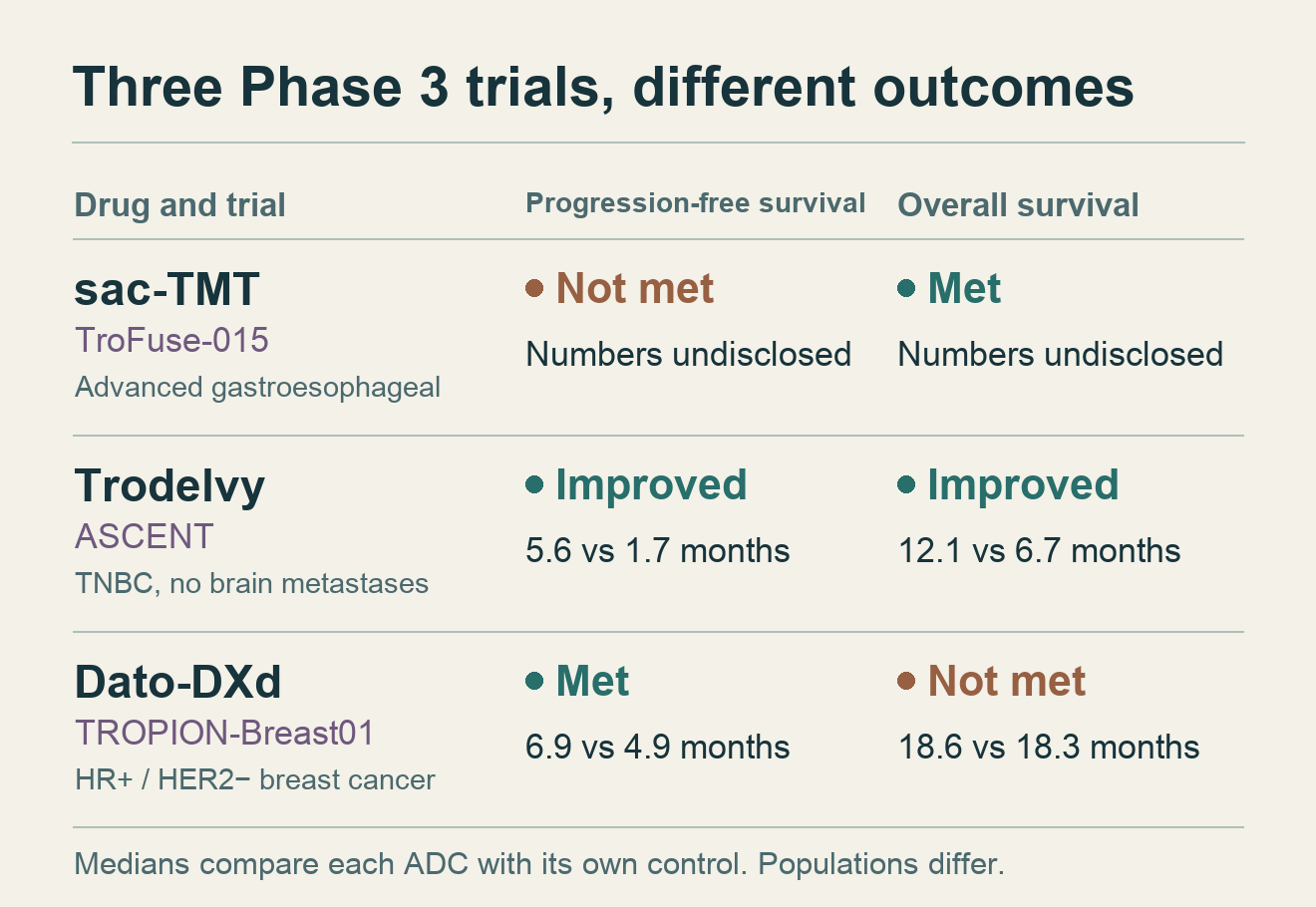
The trials cover different cancers and populations. The comparisons apply within each trial.
What evidence is still missing
The size of the survival gain is the first gap: without a hazard ratio and medians, nobody can judge whether this is a 6-week or a 3-month benefit. Second is the TROP2 subgroup data; "consistent regardless of TROP2" is a claim that needs a forest plot. Third is regional consistency, since Asian gastric cancer patients often do better on chemotherapy than Western ones, and the trial stratified by region. Fourth is safety in a frail population: stomatitis and neutropenia from the belotecan-derived payload will weigh more in a third-line setting where control drugs are oral or weekly. Finally, there is no public sign yet of whether Chinese patients were enrolled in large enough numbers for Kelun to use these data in a Greater China gastric filing.
Our call
Merck will present TroFuse-015 at a medical meeting before June 30, 2027 with an overall-survival hazard ratio between 0.70 and 0.85, and will submit a US application for third-line gastroesophageal adenocarcinoma before the end of 2027: a real but modest win that adds a label, not a new first-line strategy in gastric cancer.
What to watch
- The full TroFuse-015 presentation, likely at ASCO GI or ASCO 2027, and whether Merck reports TROP2 and regional subgroups.
- The FDA decision on endometrial cancer by June 15, 2027, the first US approval for a China-originated TROP2 ADC.
- Kelun's disclosure of milestone income tied to these readouts in its 2026 annual results.
- Whether any Chinese TROP2 ADC licensed in 2025 or 2026 starts a late-line gastric trial using TroFuse-015 as its benchmark.
Sources
- Sac-TMT Meets OS End Point in Pretreated Gastroesophageal Adenocarcinoma (CancerNetwork, Nov 20, 2026), summarizing Merck's November 20 news release
- Merck TROP2 ADC Meets Survival End Point in Gastroesophageal Cancer (BioPharm International)
- TroFuse-015 trial registration, NCT06356311 (ClinicalTrials.gov)
- Merck snaps up cancer drug from China's Kelun in $1.4bn deal (pharmaphorum, May 2022)
- Merck and Kelun-Biotech announce license agreement for seven ADC candidates (Merck, Dec 2022)
- Third indication for Kelun-Biotech's sac-TMT approved by NMPA (Kelun-Biotech, Oct 2025)
- Shitara K, et al. Trastuzumab Deruxtecan in Previously Treated HER2-Positive Gastric Cancer (DESTINY-Gastric01). N Engl J Med 2020;382:2419-2430.
- Related: Gastric cancer's Claudin 18.2 ADC race (Drugnews) and Daiichi Sankyo company page
This article is industry and company analysis, not investment or medical advice.
Share this analysis
Send this article to readers who follow biotech, company strategy, and capital-market signals.
Cite this article
For decks, research notes, or media references, cite Drugnews with the canonical article URL.
Drugnews Editorial Team. "Kelun's TROP2 ADC wins on survival in late-line gastric cancer: the China-made asset Merck keeps cashing." Drugnews, Nov 21, 2026. https://drugnews.com.tw/articles/2026-11-21-merck-kelun-trop2-adc-gastric-phase3-os-en.html