

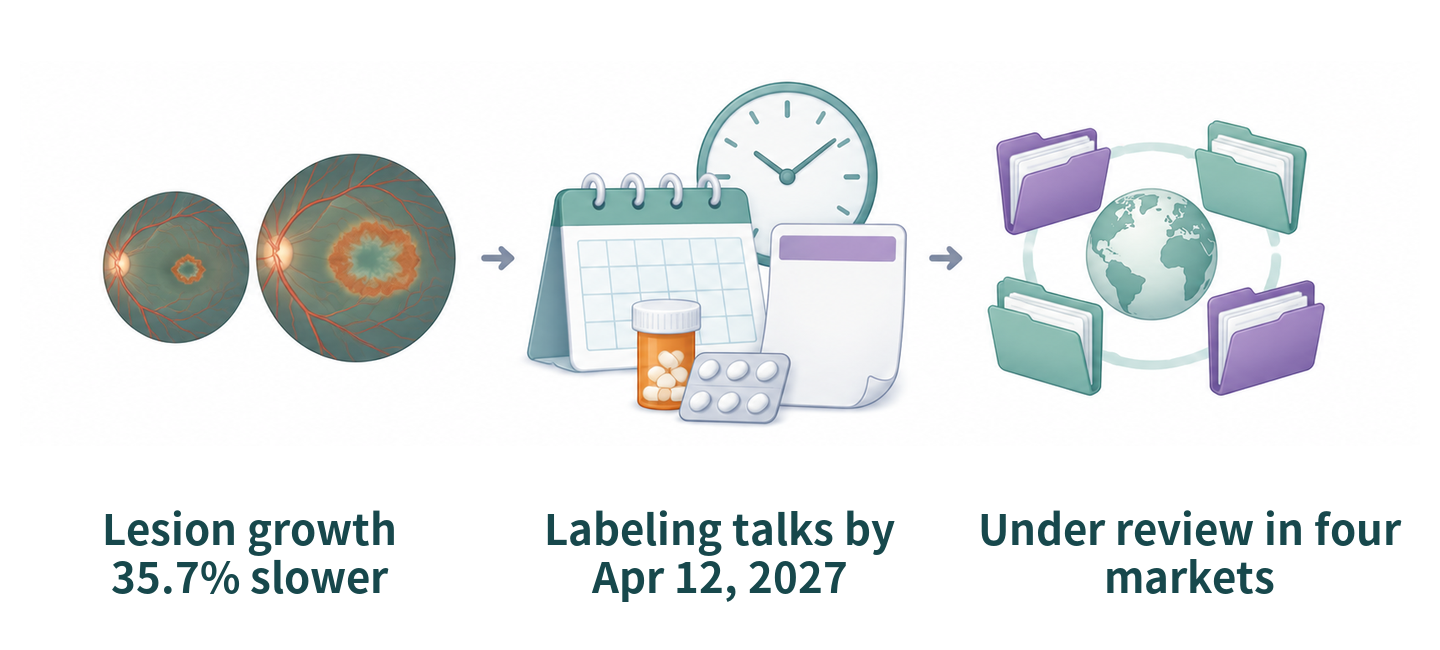
The FDA has moved its decision date for tinlarebant, Belite Bio's oral drug for Stargardt disease, from February 12 to May 12, 2027. Three extra months sounds like trouble.
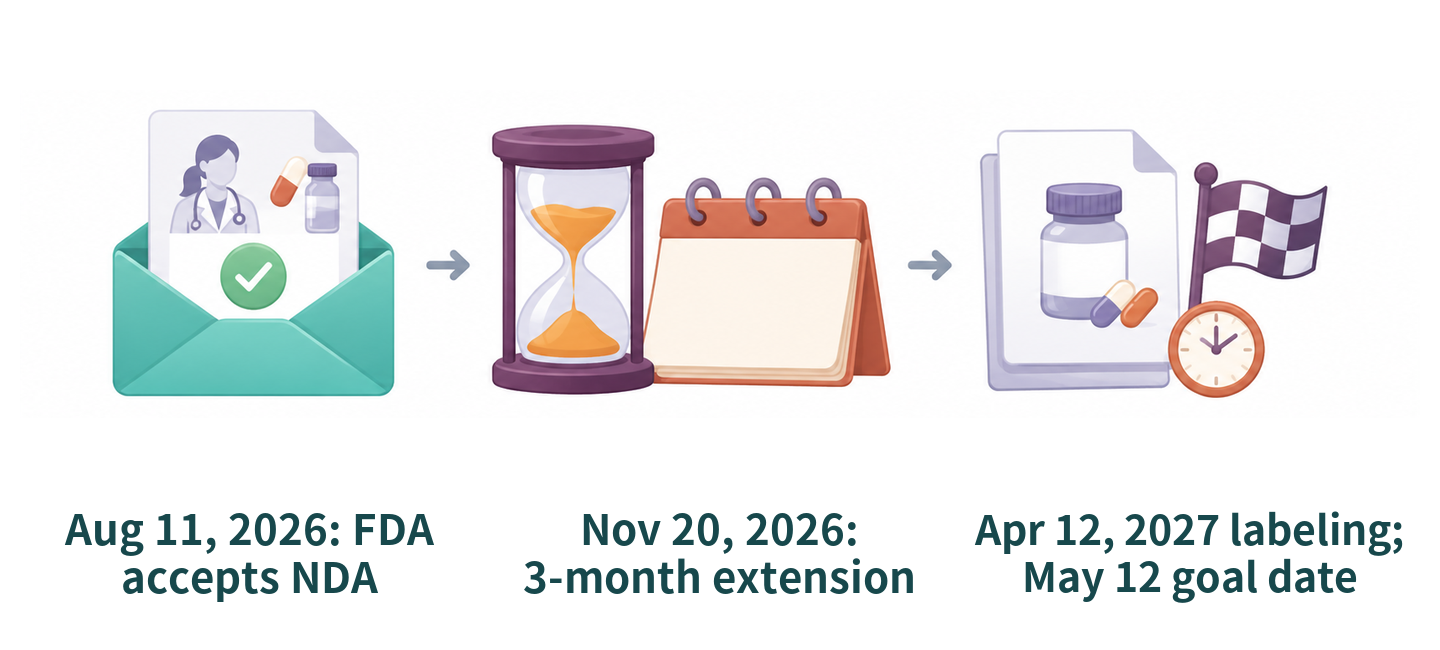
The stated reason is narrower: the agency needs more time to review data the company has already submitted. Belite Bio also said that, if the review finds no major deficiencies, the FDA expects to begin labeling discussions by April 12, 2027.
01 | A childhood eye disease with no approved treatment
Stargardt disease is an inherited form of macular degeneration. According to the US National Eye Institute, fatty waste builds up in the macula, vision loss usually begins in childhood, and central vision in both eyes slowly worsens.

Most cases trace back to the ABCA4 gene, which is involved in how the eye handles vitamin A.
The NEI is blunt: there is no treatment. Patients rely on vision rehabilitation and low-vision aids. Belite Bio's third-quarter report likewise says there is no approved therapy for Stargardt disease type 1 (STGD1).
That gap is why tinlarebant holds Breakthrough Therapy, Fast Track and Rare Pediatric Disease designations in the US, and Sakigake designation in Japan.
02 | A daily pill that slows the build-up
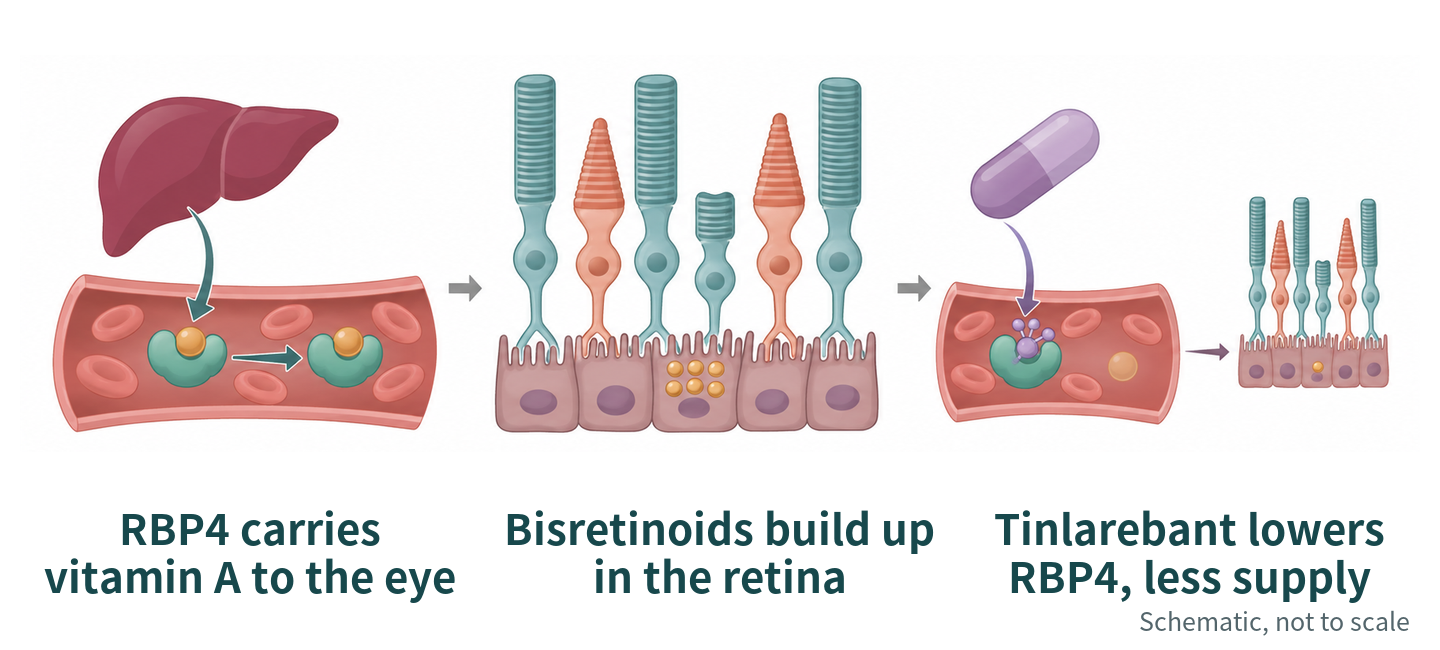
Tinlarebant is taken once a day by mouth. It lowers and holds down blood levels of retinol-binding protein 4 (RBP4), the carrier that delivers vitamin A to the eye. Less vitamin A coming in means fewer toxic bisretinoids piling up in the retina.
Think of it as cutting deliveries to a warehouse that cannot clear its waste. The gene defect stays; the waste just accumulates more slowly.
03 | Lesions grew 35.7% more slowly, and rivals are further back
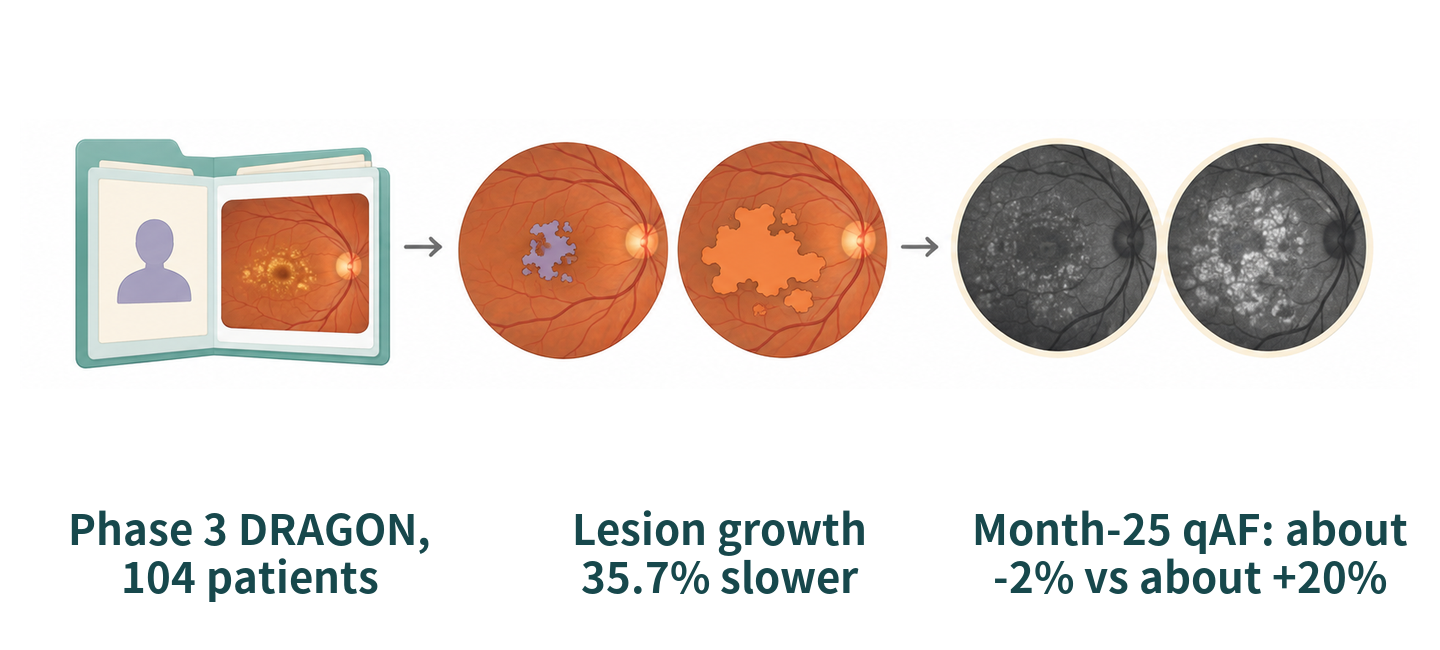
The Phase 3 DRAGON trial enrolled 104 patients, randomized 2:1 to tinlarebant or placebo. The primary endpoint was the growth rate of atrophic retinal lesions.
Lesions grew 35.7% more slowly on tinlarebant than on placebo, a statistically significant result.
The drug slows damage. It does not restore vision already lost. For a disease with no approved therapy, slowing lesion growth by about a third is the basis of the filing.
A second measure points the same way. At month 25, quantitative autofluorescence, which tracks bisretinoid build-up, was roughly flat (about -2%) on tinlarebant and up about 20% on placebo. The company says the drug was well tolerated throughout the trial.
The rest of the field puts that number in context. Kubota Vision's emixustat, another oral drug aimed at the visual cycle, enrolled 194 patients for 24 months; topline results in 2022 missed both the primary and secondary endpoints.
Two rivals are still in trials. Alkeus's oral gildeuretinol (ALK-001), a deuterated form of vitamin A designed to resist forming toxic dimers, dosed the first patient in its Phase 3 NORTHSTAR study in June 2026, with about 230 patients planned over 24 months.
Ocugen's OCU410ST is a one-time gene therapy injected under the retina. Its Phase 2/3 trial finished dosing 63 patients in April 2026, and the company plans to file in mid-2027.
| Drug | Company | Approach | Status (November 2026) |
|---|---|---|---|
| Tinlarebant | Belite Bio (Lin BioScience group) | Oral, lowers blood RBP4 | Under FDA review, goal date 2027-05-12 |
| Emixustat | Kubota Vision | Oral, visual cycle modulator | Phase 3 (194 patients) missed primary endpoint in 2022 |
| Gildeuretinol (ALK-001) | Alkeus | Oral, deuterated vitamin A | Phase 3 NORTHSTAR dosing since June 2026 |
| OCU410ST | Ocugen | Subretinal gene therapy | Phase 2/3 (63 patients) dosed by April 2026; filing planned mid-2027 |
Of the four, only tinlarebant is under FDA review.

04 | The delay changes the clock, not the evidence
Line up the three announcements and only the dates move.
- August 11: the FDA accepts the application with Priority Review, setting a goal date of February 12, 2027.
- November 12: in its third-quarter report, Belite says the FDA does not plan an advisory committee meeting.
- November 20: the goal date moves to May 12, 2027, to allow more time to review submitted data.
The three months has a legal basis. Under 21 CFR 314.60(b)(1), a major amendment submitted within the last three months of the review period counts as agreement to extend it by three months. Both the length and the timing of this extension fit that rule.
The DRAGON data have not changed.
With no advisory committee, there is no public panel of outside experts. The April 12 line works as a midpoint check. Labeling talks cover what doctors will read about the indication, dosing and warnings, and starting them signals a review in its late stage.
05 | Four markets in parallel, and $774 million in the bank
Outside the US, Belite filed in Japan under the Sakigake system in September, and in October applied in the UK, Switzerland and Singapore through the Access Consortium.
| Market | Filed | Pathway | Status |
|---|---|---|---|
| United States | Accepted August 2026 | Priority Review, no advisory committee | Goal date moved to 2027-05-12 |
| Japan | September 2026 | Sakigake (priority review) | Under review |
| UK, Switzerland, Singapore | October 2026 | Access Consortium | Under review |
Japan has a supporting study. The Phase 2/3 DRAGON II trial is fully enrolled at 73 patients, 15 of them Japanese, to supply the pharmacokinetic data Japan requires.

A three-month slip in the US does not stall the whole launch plan.
The balance sheet can carry the wait. At September 30, Belite held $271.3 million in cash and $502.7 million in US Treasury bills, about $774 million combined, against a third-quarter net loss of $30.3 million. Its shares moved to the Nasdaq Global Select Market on October 19.
Spending is rising. Third-quarter R&D expense was $15.5 million, up from $10.3 million a year earlier, as the company runs a Phase 3 in geographic atrophy alongside the Japan study.
For Lin BioScience (6696), Belite's Taiwanese parent group, tinlarebant is the closest drug to market. Next in line is PHOENIX, a 530-patient Phase 3 in geographic atrophy that is fully enrolled; the company plans an interim analysis and has not given a date.
Whether the FDA opens labeling talks by April 12 will be the first answer to whether Stargardt patients get their first approved drug.
This article is industry and company analysis, not investment or medical advice.
References
- Belite Bio Announces Extension of FDA Review Timeline for Tinlarebant NDA | Belite Bio (SEC Form 6-K exhibit) | 2026-11-20 | https://www.sec.gov/Archives/edgar/data/1889109/000110465926130425/tm2630348d1_ex99-1.htm
- Belite Bio Reports Unaudited Third Quarter 2026 Financial Results and Provides a Corporate Update | Belite Bio (SEC Form 6-K exhibit) | 2026-11-12 | https://www.sec.gov/Archives/edgar/data/1889109/000110465926125573/tm2629321d1_ex99-1.htm
- Belite Bio Announces FDA Acceptance and Priority Review of NDA for Tinlarebant for STGD1 | Belite Bio | 2026-08-11 | https://finviz.com/news/380763/belite-bio-announces-us-food-and-drug-administration-acceptance-and-priority-review-of-new-drug-application-for-tinlarebant-for-the-treatment-of-stargardt-disease-type-1
- Belite Bio Announces Submission of NDA to MHLW in Japan under Sakigake for Tinlarebant | Belite Bio | 2026-09 | https://finviz.com/news/389317/belite-bio-announces-submission-of-new-drug-application-to-the-ministry-of-health-labour-and-welfare-in-japan-under-the-sakigake-designation-system-for-tinlarebant-for-the-treatment-of-stargardt-disease-type-1
- Stargardt Disease | National Eye Institute | checked 2026-11-22 | https://www.nei.nih.gov/learn-about-eye-health/eye-conditions-and-diseases/stargardt-disease
- 21 CFR 314.60 Amendments to an unapproved NDA | US Code of Federal Regulations | checked 2026-11-22 | https://www.law.cornell.edu/cfr/text/21/314.60
- LBS-008 (Tinlarebant) pipeline | Lin BioScience | checked 2026-11-22 | https://www.linbioscience.com/Pipeline/LBS008/
- Kubota Vision Announces Positive Post Hoc Analysis from Phase 3 Clinical Trial of Emixustat in Patients with Stargardt Disease | Eyewire+ | 2022-10-03 | https://eyewire.news/news/kubota-vision-announces-positive-post-hoc-analysis-from-phase-3-clinical-trial-of-emixustat-in-patients-with-stargardt-disease
- Alkeus Pharmaceuticals Announces First Patient Dosed in Pivotal Global Phase 3 NORTHSTAR Study of Oral Gildeuretinol in Stargardt Disease | Alkeus | 2026-06-08 | https://www.biospace.com/press-releases/alkeus-pharmaceuticals-announces-first-patient-dosed-in-pivotal-global-phase-3-northstar-study-of-oral-gildeuretinol-in-stargardt-disease
- Ocugen Announces Early Completion of Dosing in Phase 2/3 Pivotal Confirmatory Trial of OCU410ST for Stargardt Disease | Ocugen | 2026-04-01 | https://www.biospace.com/press-releases/ocugen-announces-early-completion-of-dosing-in-phase-2-3-pivotal-confirmatory-trial-of-ocu410st-for-stargardt-disease
Share this analysis
Send this article to readers who follow biotech, company strategy, and capital-market signals.
Cite this article
For decks, research notes, or media references, cite Drugnews with the canonical article URL.
Drugnews Editorial Team. "Belite Bio's Stargardt drug gets three more months at the FDA: the date to watch is April 12, 2027." Drugnews, Nov 24, 2026. https://drugnews.com.tw/articles/2026-11-24-lin-bioscience-belite-tinlarebant-fda-extension-stargardt-en.html