
The pain is under control. Reducing steroids is still difficult.
Cosentyx's new polymyalgia rheumatica indication adds an option for reducing steroid use. Competition with existing treatment turns on sustained remission, the tapering pathway and safety together.
On November 17, Taipei time, Novartis announced US approval of Cosentyx, or secukinumab, for adults with polymyalgia rheumatica (PMR) who have an inadequate response to corticosteroids or difficulty tolerating a taper.[1][11] The news concerns more than pain relief: long-term disease control and reduced steroid exposure must advance together.[1][2]
01 · Control pain and complete the taper
A new PMR treatment must address inflammation and the burden of prolonged medication. That calls for follow-up extending beyond a single pain assessment.
PMR mainly affects older adults, with typical pain and stiffness around the shoulders, neck and hips. These areas matter for getting up, dressing and raising the arms, bringing the disease into everyday activity.[1]
Steroids suppress inflammation, making subsequent tapering part of treatment. Once symptoms stabilize, clinicians assess disease activity and the overall medication picture. Recurrence after a dose reduction shapes the next step.[2][3]
Initial improvement is the first step. Continued steroid dependence and sustained remission after a planned taper are the next fork in the road. For patients seeking a lower long-term medication burden, they mean different things.
A sustained-remission endpoint puts time into the result. Improvement must persist over a defined period, placing symptoms on assessment day within a longer clinical picture. Tapering, rescue treatment and follow-up rules also affect that outcome.[3]
REPLENISH compared Cosentyx with placebo, with both groups following a 24-week steroid taper and sustained remission assessed at week 52.[1][3] The design asks whether adding the drug helps under that specified process. The 24-week taper and week 52 assessment define the result's conditions; an individual patient's tapering pace is arranged by the medical team.
The registered sustained-remission definition requires remission at week 12 and maintenance through week 52. Conditions include avoiding escape or rescue treatment for PMR relapse symptoms or newly diagnosed giant cell arteritis.[3]
The study separately lists complete sustained remission, which adds inflammatory-marker conditions.[3] A few extra words change the question. Identifying the endpoint is the first step in comparing product data.
Study names and assessment times make effectiveness traceable. Symptoms, rescue treatment, inflammatory markers and the way these conditions combine define what a result means.
Targeted treatment helps the clinical team manage this process. Long-term follow-up, drug effects and safe tapering belong within the same care plan.
For families, that makes effectiveness more concrete. Follow-up covers current pain, whether the existing plan remains workable, recovery of daily activity and who interprets changes.

The shoulder and pelvic regions illustrate PMR conceptually; the indication's value is read alongside disease control after tapering.
02 · Another inflammatory pathway adds a choice
Cosentyx introduces another way to block an inflammatory signal. Clinical results establish the value of that mechanistic difference.
Secukinumab binds the extracellular signaling molecule IL-17A, reducing the signal transmitted when it binds its receptor. The antibody in the figure intercepts IL-17A outside the cell; that signal is its point of action.[2][6]
In plain language, the drug aims to prevent part of an inflammatory message from getting through. Clinical data then show which pathways matter for patients and how they respond.
Mechanism defines the development direction, while trials establish outcomes. Connecting the two creates a treatment choice whose value can be discussed. The patient benefit needs to appear in actual results.
Existing treatment competes for the same clinical task. Sanofi and Regeneron's Kevzara, or sarilumab, blocks the IL-6 receptor. Its US FDA label already includes adult PMR after inadequate steroid response or difficulty tolerating tapering, so Cosentyx enters a field that already has a biologic.[4][5]
Cosentyx inhibits IL-17A and Kevzara inhibits the IL-6 receptor. Both seek to help eligible adults control PMR and address difficulty reducing steroids.[1][4]
The next comparison is study design. Each product has its own population, tapering regimen and endpoint rules, with differences assessed against its respective control. Both trials used placebo; a direct comparison would answer the question of product superiority.
Care burden is another measure. Disease activity, comorbidities, infection risk and feasible monitoring enter treatment selection through the full label and the patient's condition.[4][6] Mechanism is the start of the comparison.
For Novartis, adding a disease use extends experience with an established medicine. Adoption in PMR will depend on this population's eligibility and care needs.
Existing Kevzara users have another pathway to discuss with their clinicians. Actual selection follows the label, evidence and disease control.
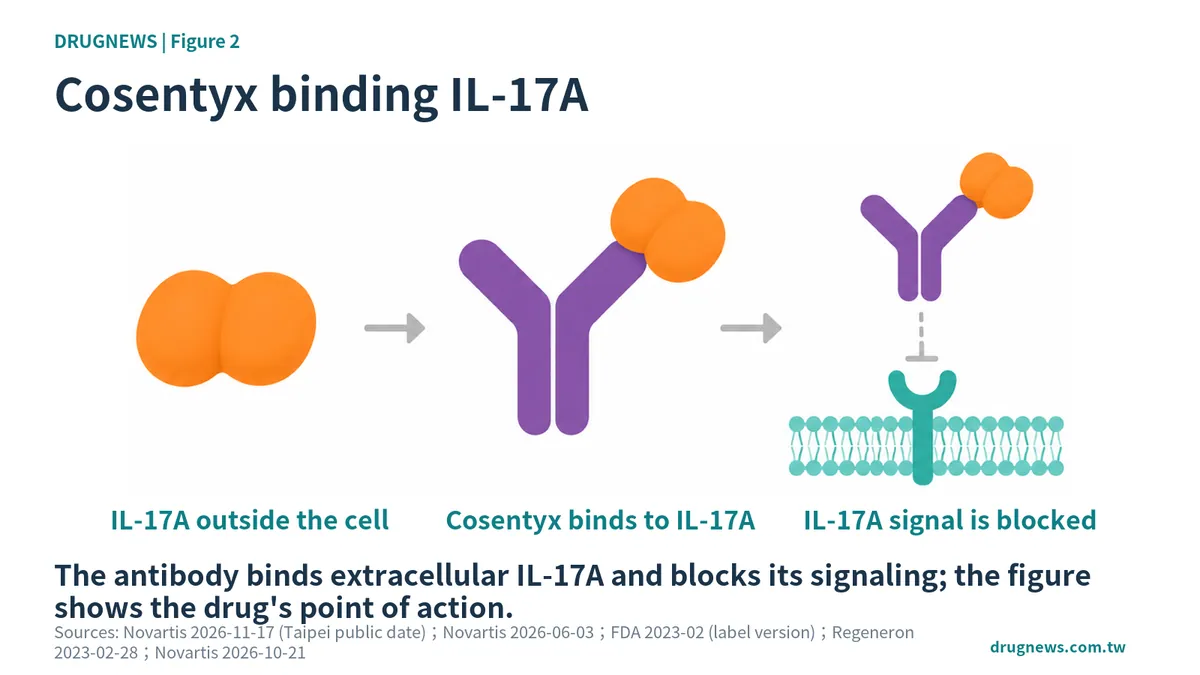
The antibody binds extracellular IL-17A and blocks its signaling; the figure shows the drug's point of action.
03 · A twenty-point remission difference, with safety still in view
The REPLENISH group difference supports added benefit. It also leaves many patients with further care needs.
The approval announcement reports sustained remission at week 52 in 40.5% of the Cosentyx 150 mg group and 20.5% of the placebo group. Subtraction gives an absolute difference of 20 percentage points.[1]
Dividing 1 by 0.20 gives five people. Under that trial's population, tapering pathway and assessment time, treating about five people produces one additional sustained remission compared with control. No separate confidence interval was estimated for this calculation, which belongs to the study's baseline risk, eligibility and remission definition; individual prescribing follows clinical assessment.
At 40.5%, fewer than half achieved sustained remission. Most participants therefore had further disease-control work ahead.[1]
Mean cumulative steroid exposure supplies another important result. It measures the total taken during the study; use at the final visit is a separate measure. Together, they show more of the medication burden.[2][3]
With Kevzara already available, Cosentyx must establish value under its own tapering and endpoint framework. Additional immune-modulating treatment also adds monitoring work. The announcement reports serious adverse events in 15.9% versus 14.2% and a case of fatal cryptococcal meningitis in a Cosentyx recipient.[1] The new treatment's own risks remain central after steroid burden falls.
A full benefit-risk dataset therefore determines treatment value. Infection, comorbidities and subsequent monitoring enter the decision alongside the added trial benefit.
For the industry, claims of suitability for particular patients need corresponding studies or labeling. Those sources provide the basis for differentiation.
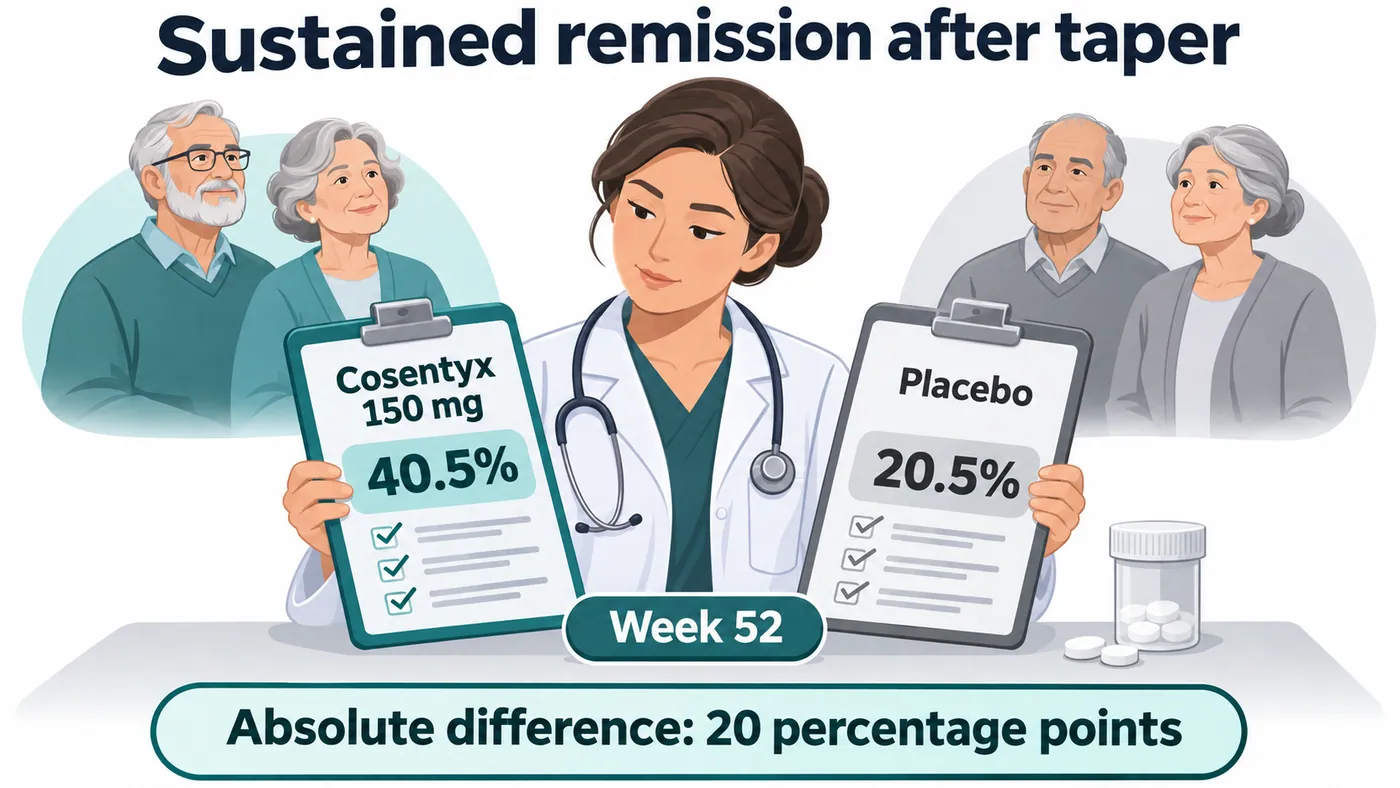
The approval announcement gives 40.5% and 20.5%, a 20-percentage-point difference; the comparator was placebo.
04 · Taiwan: separate a new use from access
For Taiwan readers, an existing medicine's domestic history and a new US PMR indication are separate facts. The local product name and earlier information for Cosentyx appear in historical National Health Insurance meeting documents.[10] PMR authorization and payment need their corresponding Taiwan records.
Local authorization governs domestic sale and use, while reimbursement follows coverage and payment standards.[8][9] Access depends on the actual progress of both processes.
The European Union has also approved PMR use. Each market has its own regulatory decision.[7]
Taiwan PMR reimbursement arrangements were undisclosed in the US announcement. Patient costs need verification against current payment conditions for the new use.
Clinics face the work of complete care. That includes checking eligibility, arranging monitoring, following disease activity and adjusting existing medication.
For patients, successful tapering means more than swallowing fewer tablets. The plan must maintain disease stability, identify abnormal changes and provide records to discuss at follow-up. These tasks connect a new targeted drug to continuing care.
For the industry, value lies in a deliverable difference. A pathway that clinicians can explain, clinics can monitor and patients can complete is closer to real adoption than multiplying an overseas patient count by an assumed price.
Overseas approval is established. Taiwan revenue and launch timing need local pricing, reimbursement and actual-use evidence to develop.
Service providers can begin by checking current authorization and payment conditions, then plan how clinics would provide care. That keeps verifiable facts and business assumptions distinct and gives patients a clearer understanding of international news.
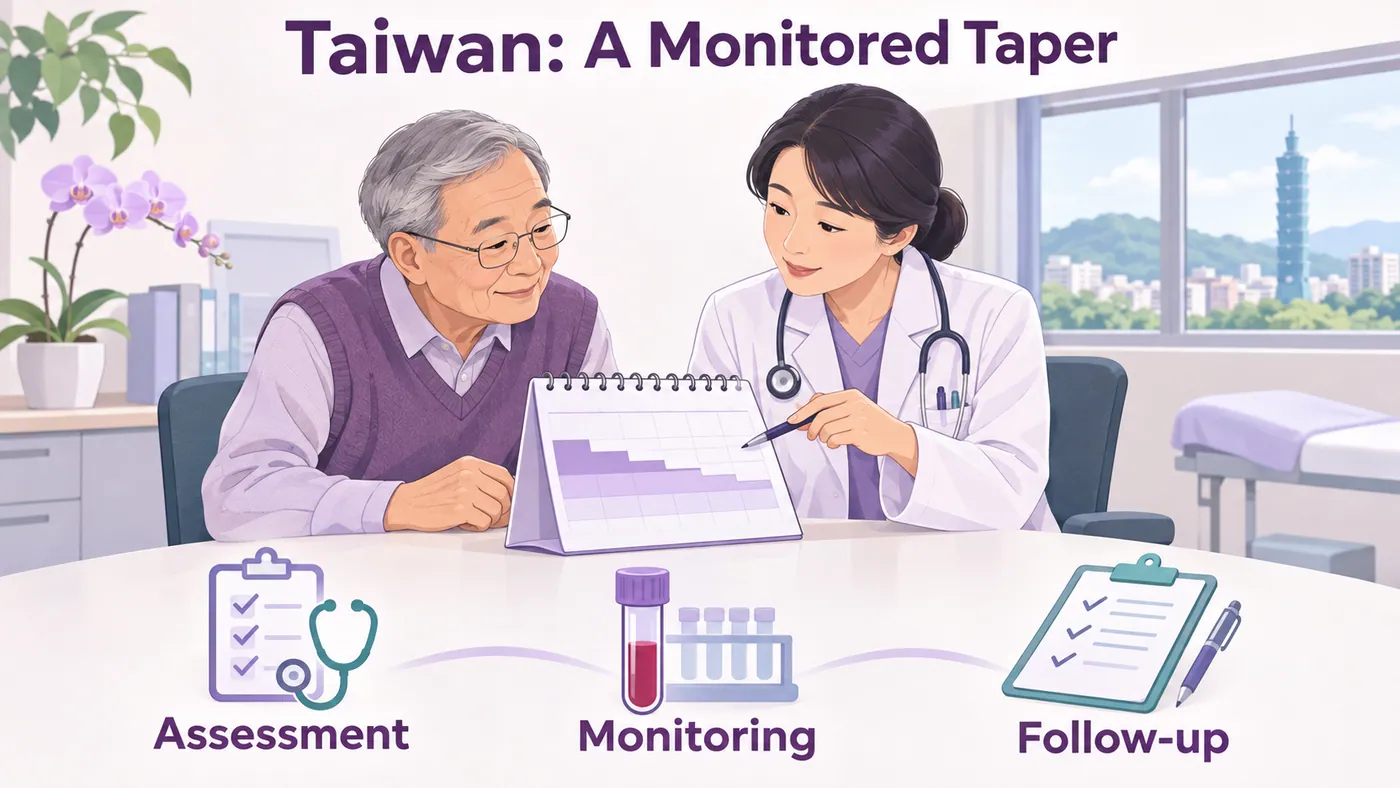
The figure illustrates care in Taiwan; the medical team arranges tapering.
Cosentyx adds a trial-supported option for PMR patients who struggle to reduce steroids. Patients ultimately need disease control that lasts after tapering and care they can complete. Product differences should be assessed against those outcomes.
This article is industry and company analysis, not investment or medical advice.
References
- Cosentyx PMR FDA approval announcement · Novartis · 2026-11-17 (Taipei public date) · https://via.ritzau.dk/files/90446/15292906/612691/en
- REPLENISH full-data announcement · Novartis · 2026-06-03 · https://www.novartis.com/news/media-releases/novartis-cosentyx-pmr-data-new-england-journal-medicine-showed-sustained-remission-vs-placebo-twice-many-patients
- REPLENISH NCT05767034 · ClinicalTrials.gov · 2026-11-17 (accessed) · https://clinicaltrials.gov/study/NCT05767034
- KEVZARA prescribing information · FDA · 2023-02 (label version) · https://www.accessdata.fda.gov/drugsatfda_docs/label/2023/761037s013lbl.pdf
- Kevzara PMR approval announcement · Regeneron · 2023-02-28 · https://investor.regeneron.com/news-releases/news-release-details/kevzarar-sarilumab-approved-fda-first-and-only-biologic
- Cosentyx product information · EMA · 2026-11-17 (accessed) · https://www.ema.europa.eu/en/documents/product-information/cosentyx-epar-product-information_en.pdf
- Cosentyx European Commission PMR approval · Novartis · 2026-10-21 · https://www.novartis.com/news/media-releases/novartis-receives-european-commission-approval-cosentyx-polymyalgia-rheumatica-pmr
- Medication safety · Taiwan Ministry of Health and Welfare · 2026-11-17 (accessed) · https://www.mohw.gov.tw/cp-88-216-1.html
- National Health Insurance pharmaceutical inclusion and payment rules · Taiwan Laws and Regulations Database · 2026-08-24 (amended) · https://law.moj.gov.tw/LawClass/LawAll.aspx?pcode=L0060035
- Cosentyx name in historical meeting materials · Taiwan NHI · 2016-06-23 (meeting date) · https://www.nhi.gov.tw/ch/dl-13689-6b9cfb7d29f6449c9056f62c834aef5b-1.pdf
- Company distribution timestamp · Novartis via GlobeNewswire · 2026-11-16 21:43 ET (2026-11-17 Taipei) · https://www.globenewswire.com/news-release/2026/11/17/3404251/0/en/novartis-cosentyx-becomes-first-and-only-fda-approved-anti-il-17-biologic-for-people-with-polymyalgia-rheumatica-pmr.html
Share this analysis
Send this article to readers who follow biotech, company strategy, and capital-market signals.
Cite this article
For decks, research notes, or media references, cite Drugnews with the canonical article URL.
Drugnews Editorial Team. "Cosentyx: Beyond Steroids." Drugnews, Nov 22, 2026. https://drugnews.com.tw/articles/2026-11-22-cosentyx-pmr-steroid-taper-en.html