
Nippon Shinyaku (TSE: 4516) has signed an exclusive agreement to commercialize Nanoscope Therapeutics' MCO-010 (sonpiretigene isteparvovec, brand name MOGENRY) in Japan. The one-time intravitreal gene therapy is meant to restore some vision in inherited retinal dystrophies whatever mutation the patient carries. The number that matters most is 27: that is how many patients were enrolled in RESTORE, the randomized trial behind both the Japanese and US filings. Western BD teams and investors should look at this deal because Japan, not the US, may be the first market to rule on a mutation-agnostic retinal gene therapy, and a Kyoto mid-cap has bought the launch.

What was signed, and what was not disclosed
The companies announced the deal this week. Nanoscope filed its Japanese marketing application in September 2026. MCO-010 has held SAKIGAKE and Orphan Regenerative Medical Product designations from Japan's Ministry of Health, Labour and Welfare (MHLW) since January 2026. In the US, the FDA accepted the BLA for retinitis pigmentosa (RP) in September 2026.

| Term | What is public |
|---|---|
| Licensee | Nippon Shinyaku (TSE: 4516), Kyoto |
| Licensor | Nanoscope Therapeutics (private, Dallas) |
| Rights | Exclusive commercialization, Japan only |
| Upfront payment | Not disclosed |
| Milestones (cap) | Not disclosed |
| Royalties or supply price | Not disclosed |
| Paid so far vs. contingent | Not disclosed |
| Japan regulatory status | Application filed September 2026; SAKIGAKE + orphan regenerative product designations (January 2026) |
| Proposed Japan label | Inherited retinal dystrophies with severe vision loss |
| US status | BLA accepted for RP (September 2026) |
The financial terms are blank. The scope is the point: this is a commercialization deal for an asset that is already under review, not a development partnership. Nippon Shinyaku is buying a Japanese launch rather than co-developing the asset.

Japan's label request is broader than the US one
The US BLA covers RP. The Japanese application asks for "inherited retinal dystrophies with severe vision loss," a group that, per the companies, includes RP, Stargardt disease, cone-rod dystrophy and Leber congenital amaurosis. That fits how the product works. MCO-010 uses a viral vector to deliver a light-sensitive opsin to surviving bipolar cells, so in principle it does not depend on which gene killed the photoreceptors and needs no genetic test before dosing.
The trial evidence is narrower than that request. RESTORE (NCT04945772) enrolled RP patients only. If MHLW grants the wider wording, it will be extending RESTORE's RP data to other dystrophies on the strength of the mechanism. Japan's conditional, time-limited approval pathway for regenerative medical products was built for exactly this kind of call. It still means the first label anywhere may rest on fewer patients than most Western reviewers would want.
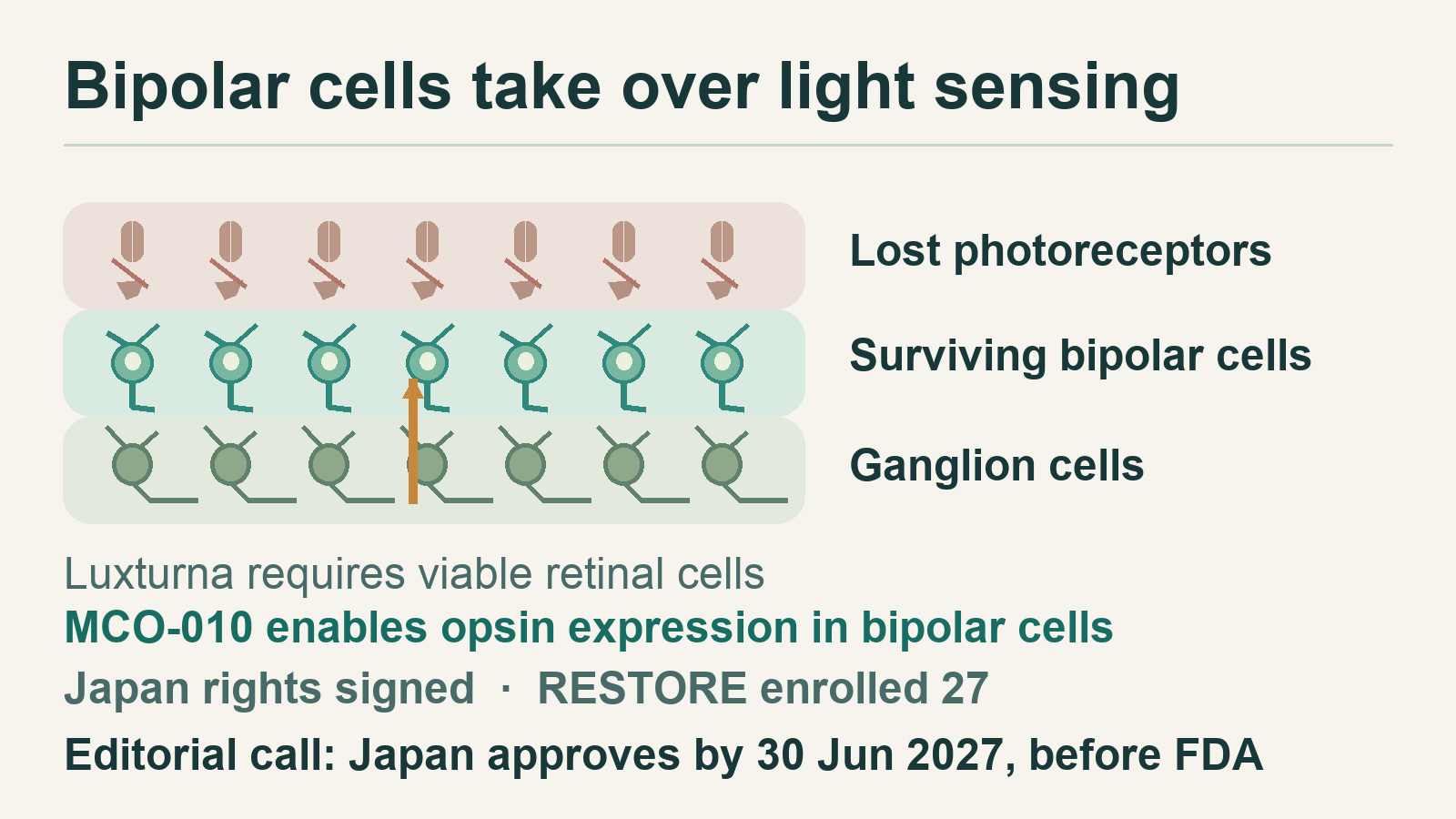
Nippon Shinyaku secured exclusive Japan rights, RESTORE enrolled 27 patients, and the editorial call is that Japan approves by 30 June 2027 ahead of the FDA.
The data behind the filings
| RESTORE (Phase 2b/3, sham-controlled) | Value |
|---|---|
| Enrolled | 27 (ClinicalTrials.gov, actual) |
| Arms | High dose 1.2E11 gc/eye; low dose 0.9E11 gc/eye; sham injection |
| Primary endpoint | Change in BCVA (Freiburg, LogMAR) at week 52 |
| High dose, change from baseline, week 52 | 0.337 LogMAR improvement (sham 0.050); p=0.021 vs sham |
| Low dose, change from baseline, week 52 | 0.382 LogMAR; p=0.029 vs sham |
| High dose, change from baseline, week 76 (key secondary) | 0.539 LogMAR (sham 0.078); p=0.001 vs sham |
| Low dose, week 76 | 0.374 LogMAR, p=0.065 (not significant) |
| Patients with ≥0.3 LogMAR gain | 7 of 18 treated at week 52; 10 of 18 at week 76 |
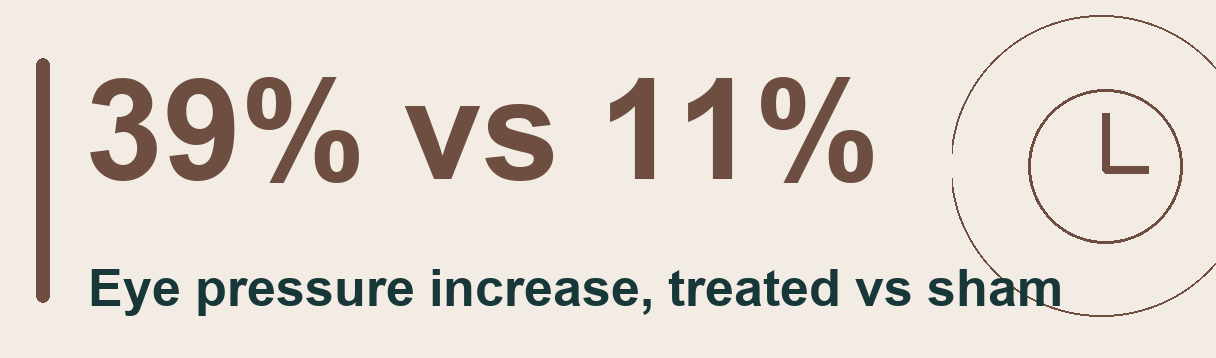
| Most common AEs (treated vs sham) | Anterior chamber cell 44% vs 22%; ocular hypertension 39% vs 11% |

A 0.3 LogMAR gain is about three lines on a chart. That is a real effect for legally blind patients, and it is consistent across the time points Nanoscope has reported. The weakness is size: 18 treated eyes and a sham arm of about nine.
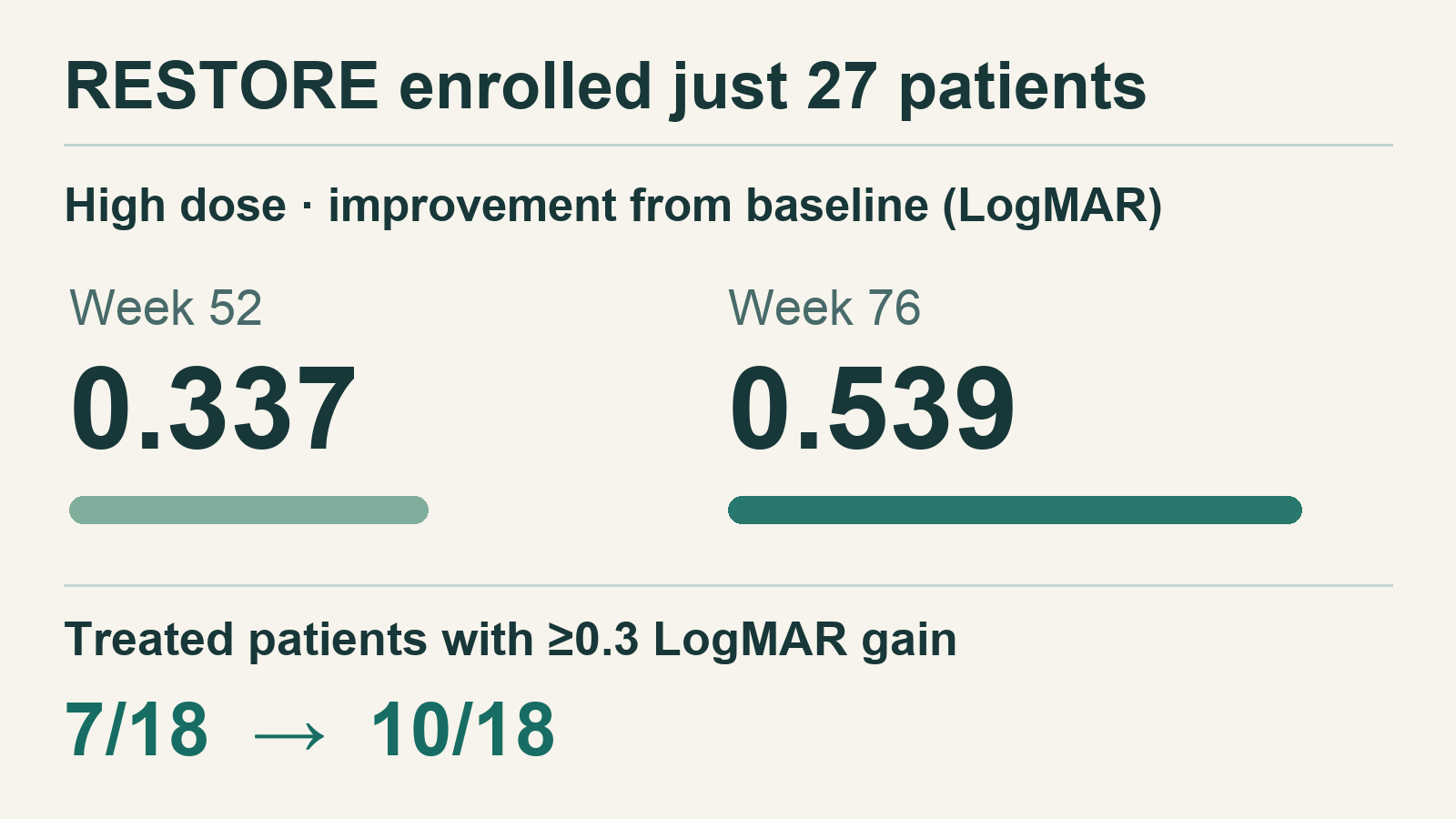
High-dose patients improved 0.337 and 0.539 LogMAR from baseline, and the share of treated patients gaining at least 0.3 LogMAR rose from 7/18 to 10/18.
Same ruler: Luxturna
The closest approved comparator is Luxturna (voretigene neparvovec), the RPE65 gene-replacement therapy the FDA approved in December 2017 and that Novartis sells outside the US.
| Luxturna Phase 3 | MCO-010 RESTORE | |
|---|---|---|
| Randomized patients | 31 (21 treated, 10 control) | 27 (18 treated, sham control) |
| Who is eligible | Biallelic RPE65 mutations only | Severe vision loss regardless of mutation |
| Delivery | Subretinal surgery | Intravitreal injection, in-office |
| Primary endpoint | Multi-luminance mobility test (MLMT), 1 year | BCVA (LogMAR), week 52 |
| Primary result | Mean MLMT change 1.8 vs 0.2 light levels | 0.337 LogMAR from baseline, high dose (sham 0.050) |
The two trials are similar in size, so regulators have approved a retinal gene therapy on a randomized trial of about 30 patients before.
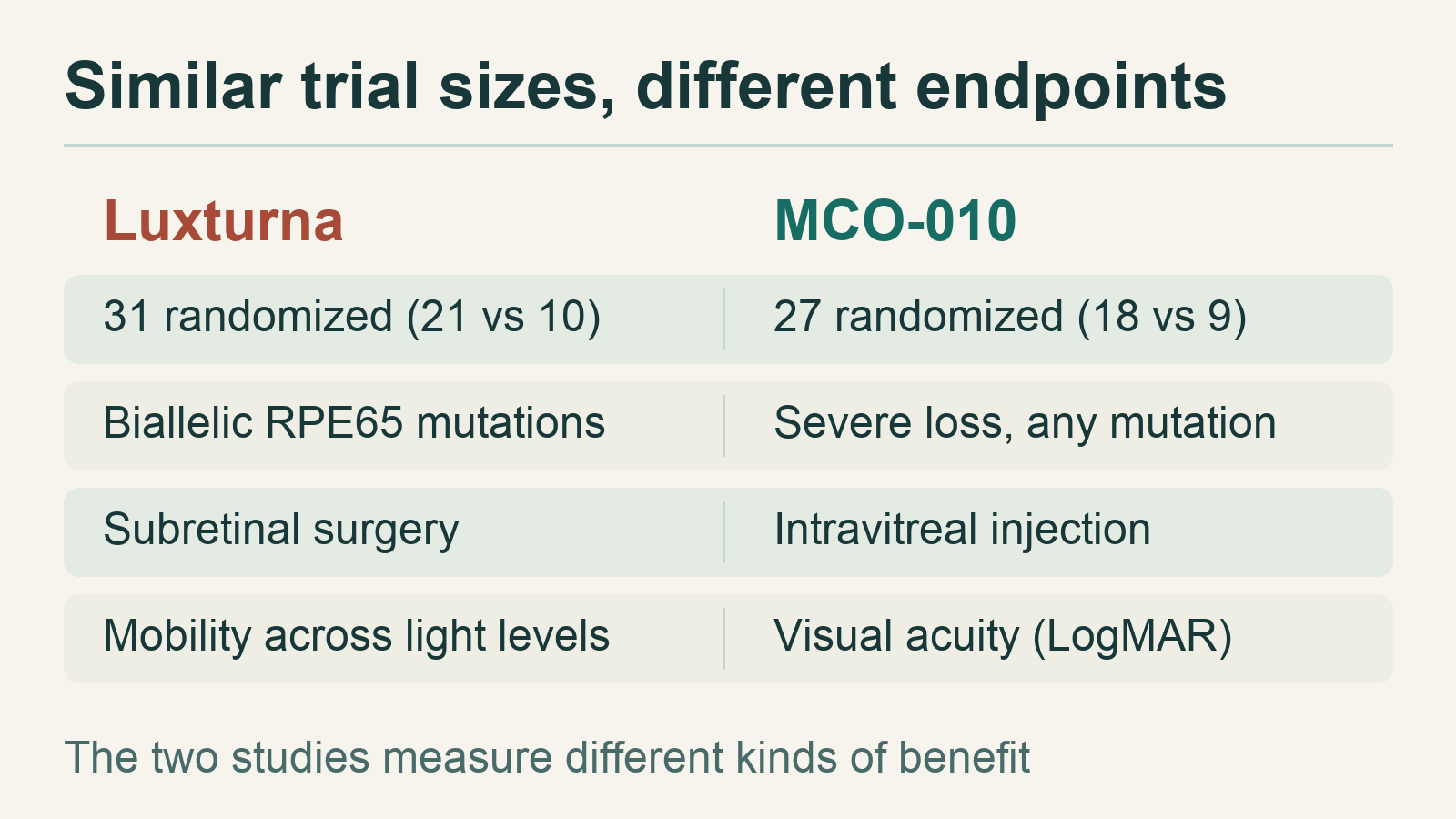
Luxturna and RESTORE randomized 31 and 27 patients respectively, assessed different populations, and measured mobility under different light levels and visual acuity respectively.
The comparison stops there. The endpoints differ (mobility under varying light vs. visual acuity), the populations differ (an earlier-stage, genetically defined group vs. late-stage patients with almost no vision), and MCO-010 adds light sensitivity to cells that never had it instead of replacing a broken gene. Neither effect size can be converted into the other. What does carry over is market size: Luxturna is limited to one gene, while MCO-010's proposed label covers patients with any of hundreds of causal genes.
Why Nippon Shinyaku
Nippon Shinyaku built its rare-disease business partly by bringing Western assets into Japan and, increasingly, into the US through its subsidiary NS Pharma. MCO-010 fits a company with an orphan-drug sales force that wants late-stage, near-approval products rather than early science. For Nanoscope, a private company heading into a US launch, a Japanese partner means it does not have to build a second commercial organization.
What evidence is still missing
- Breadth. No randomized data outside RP. Stargardt and cone-rod dystrophy patients are in the requested Japanese label but not in RESTORE.
- Durability past two years. The randomized readout runs to about week 100. For a one-time therapy priced as one, payers will want five-year data.
- Japanese patients. The public trial data does not show how many Japanese patients RESTORE included. MHLW may ask for post-marketing data in Japan as a condition of approval.
- Inflammation and pressure. Ocular hypertension in 39% of treated patients was controlled with drops in the trial. It needs watching in routine practice, where follow-up is less tight.
- Economics. Without the upfront, milestones and royalty rate, nobody outside the two companies can value Japan's share of MCO-010.
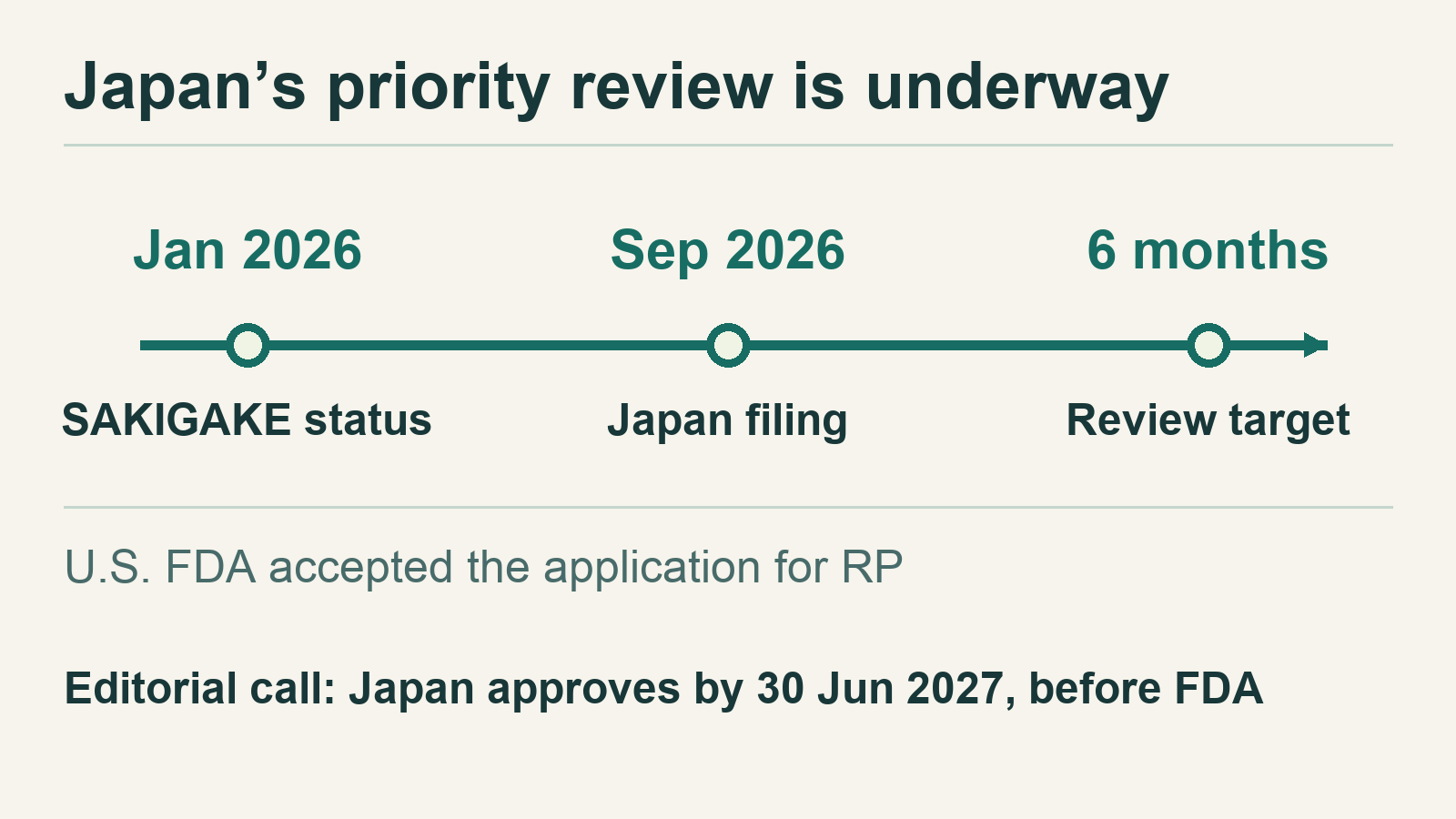
Japan granted SAKIGAKE status in January 2026 and received the filing in September, the review target is six months, and the FDA has accepted the US filing for retinitis pigmentosa.
Our call
MHLW will approve MCO-010 in Japan (conditional, time-limited or full) by 30 June 2027, before the FDA issues an approval decision on the US BLA. That would make Japan the first market to approve a mutation-agnostic optogenetic gene therapy. This is our judgment, not a company forecast: it rests on SAKIGAKE's six-month review target for a September 2026 filing and on the FDA's review of a BLA accepted in September 2026.
What to watch
- MHLW's Pharmaceutical Affairs Council regenerative-products committee agenda in the first half of 2027.
- Whether the Japanese label covers all inherited retinal dystrophies or only RP.
- The FDA action on the US BLA and any advisory committee.
- Whether Nippon Shinyaku discloses the deal economics in its fiscal results.
Related coverage: Ophthalmology · Rare disease · Gene and nucleic-acid therapies · Belite Bio's Stargardt drug gets three more months at the FDA · Shionogi's $2bn NPC acquisition · Company pages · Nippon Shinyaku
Sources
- Nanoscope Therapeutics and Nippon Shinyaku: exclusive commercialization agreement for MCO-010 in Japan (Business Wire via BioSpace)
- Nanoscope: RESTORE top-line results, March 2024
- Nanoscope: two-year RESTORE results presented at AAO 2024
- ClinicalTrials.gov NCT04945772 (RESTORE)
- Retinal Physician: FDA accepts MCO-010 BLA, PDUFA in 1H 2027
- Russell S, et al. Lancet 2017: voretigene neparvovec Phase 331868-8)
- FDA: LUXTURNA product page
- Nippon Shinyaku: Japan commercialization agreement, 24 November 2026
- PMDA: SAKIGAKE target timeline
- Nanoscope Therapeutics: FDA acceptance of MOGENRY BLA, 9 September 2026
This article is industry and company analysis, not investment or medical advice.
Share this analysis
Send this article to readers who follow biotech, company strategy, and capital-market signals.
Cite this article
For decks, research notes, or media references, cite Drugnews with the canonical article URL.
Drugnews Editorial Team. "Nippon Shinyaku takes Japan rights to a mutation-agnostic eye gene therapy: Tokyo may approve it before the FDA." Drugnews, Nov 26, 2026. https://drugnews.com.tw/articles/2026-11-26-nippon-shinyaku-nanoscope-mco-010-japan-optogenetics-en.html