ADCs Move into First-Line Treatment: Which Differences Are Worth Paying For?
Last updated: 2026-11-15
As of 2026-11-14, the 2026-10-15–2026-11-14 update identifies 11 new agreements: 7 conventional ADC agreements, 2 mixed-modality agreements and 2 non-cytotoxic conjugate trial-supply agreements. Another 2 records track existing deals. The 2 separately disclosed upfronts total USD 430 million; Hansoh’s USD 110 million anniversary payment and SBP’s USD 358 million combined upfront and near-term package are listed separately. These are announced terms, not receipts.
From how antibodies find cancer cells to why drugmakers invest in partnerships: the science, clinical competition and business of ADCs.
An antibody–drug conjugate (ADC) joins three components in one medicine: an antibody recognizes a cell-surface target; a linker connects the antibody and payload and influences stability and release; and a cytotoxic payload disrupts cancer-cell survival after reaching its site of action. This design allows delivery and cell killing to be improved separately, while failure at any step can limit the whole medicine.[2][6]
AntibodyRecognizes a cell-surface target
LinkerConnects; shapes stability and release
PayloadProduces the cytotoxic effect
The important industry shift is that some ADCs have moved from later treatment lines into first-line and early-stage cancer, while annual product sales can now be observed for a representative medicine. The next product faces changing standards of care, prior-treatment patterns and supply requirements. This report asks: Which design improves a specific point of failure, what evidence supports its use, and what must a company deliver for that difference to merit payment?[11][12][13][16][69]
Author: Drugnews editorial · Scientific and clinical baseline: 2026-10-07; transactions updated through 2026-11-14
First published: 2026-10-08 · Scientific and clinical baseline: 2026-10-07; transactions updated through 2026-11-14
Upfront 400; separate first-anniversary payment 110; milestones >15,000; tiered royalties, rates not disclosed. Calculated fixed-plus-conditional consideration >15,510.
Hansoh leads through global Phase 1a; Roche leads subsequent development in its territory. Hansoh may select up to 2 programs for participation outside its retained territory.
Lilly reported Phase 1 sofetabart mipitecan plus bevacizumab data in platinum-sensitive ovarian cancer: 33 women were enrolled and 29 had measurable disease. At the 2026-07-06 cutoff, confirmed responses occurred in 23/29 patients (79.3%). Grade 3 or higher treatment-emergent neutropenia and anemia occurred in 42% and 24%, respectively. This early combination study has no randomized control and cannot isolate each component’s contribution or establish superiority.
The EU approved Enhertu monotherapy for adults with resected HER2-positive breast cancer and residual invasive disease after neoadjuvant taxane-based and HER2-targeted treatment. DESTINY-Breast05 reported a hazard ratio of 0.47 for invasive disease recurrence or death versus T-DM1. The new event is EU approval; the trial results were previously published. It does not establish simultaneous approval or reimbursement in Taiwan.
Upfront 30; individual development, regulatory and commercial milestone amounts not disclosed; total potential value >2,000; additional tiered net-sales royalties, rates not disclosed.
Novartis receives related patent and know-how rights with an option for additional payload classes; OBI evaluates novel linker approaches.
01 How an ADC Works: Every Step Is a Design Question
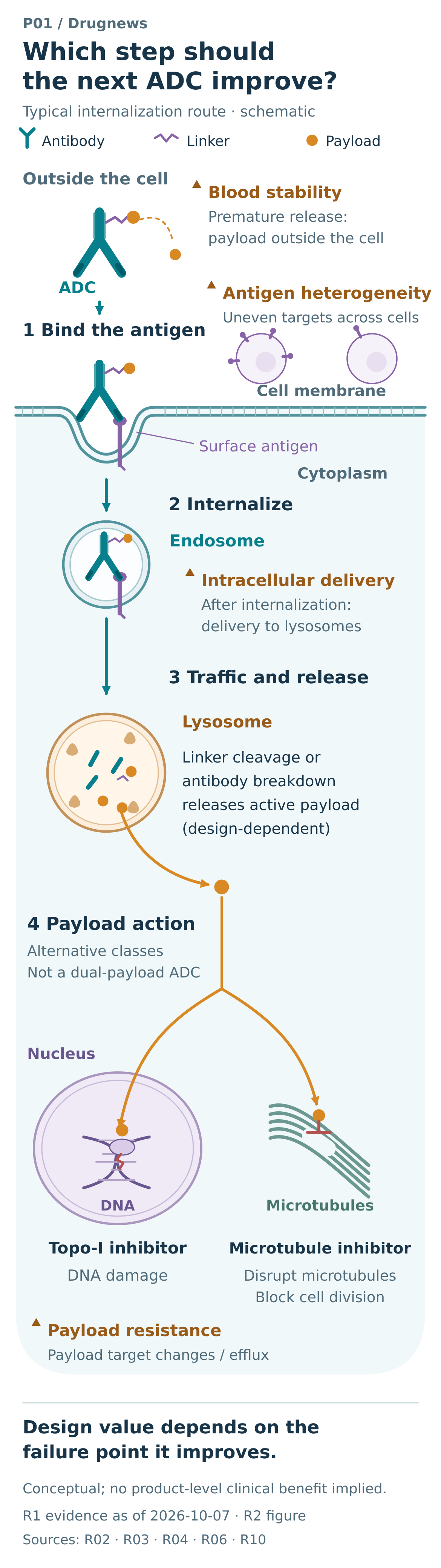
The antibody recognizes a cell-surface target, and the linker connects the antibody to a cytotoxic payload. The typical internalization route shown here proceeds through antigen binding, entry into an endosome, trafficking to a lysosome and design-dependent linker cleavage or antibody breakdown to release an active payload.[2][6]
P01
Which step should the next ADC improve?
Reader question
How does an ADC deliver its payload to its site of action, and which failure point should a new design improve?
Interpretation:A next-generation design is valuable for the failure point it improves.
Four testable points along the typical internalization pathway: stability in blood, antigen heterogeneity, intracellular delivery and payload resistance. The two payload-action branches represent alternative classes.
The site of action depends on the payload class: a Topo-I inhibitor affects DNA processing in the nucleus, while a microtubule inhibitor acts on cytoplasmic microtubules. These are alternative mechanisms. The conceptual diagram does not depict a dual-payload product or establish human benefit for a candidate.[3][6]
The next design should therefore answer four questions: whether recognition is sufficient, whether payload is released prematurely, whether delivery continues after internalization, and whether the payload still works once it arrives. This turns technology labels into hypotheses that can be tested experimentally and then in humans.[2][3][6]
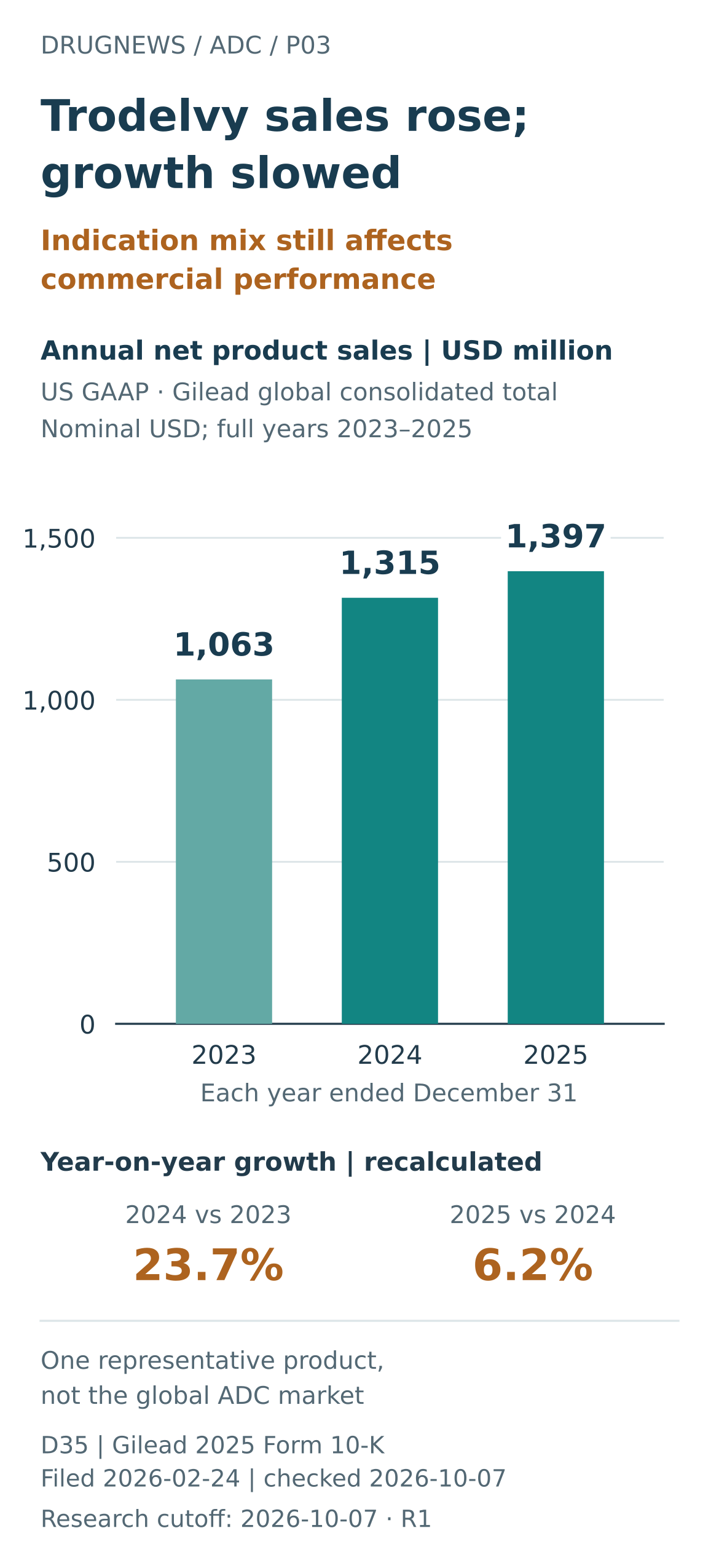
ADC commercialization can already be observed directly in a representative product’s annual sales. Gilead’s 2025 Form 10-K reports that annual net product sales of Trodelvy (sacituzumab govitecan, abbreviated SG) rose from USD 1,063 million in 2023 to USD 1,315 million in 2024 and USD 1,397 million in 2025. Recalculated from these three disclosed values, year-on-year growth was 23.7% and 6.2%, respectively. This is one product’s total in Gilead’s consolidated accounts across the United States, Europe and the rest of the world, in nominal US dollars. It excludes any added collaboration payments or royalties and does not represent the global ADC market. [69]
P03
Trodelvy Sales Rose While Growth Slowed
Reader question
Are actual sales of an established ADC still growing, and how has the pace changed?
Interpretation:One product’s sales continue to rise, but growth must be read with its indication mix.
All three years come from the Trodelvy Total columns in the same table of Gilead’s 2025 Form 10-K. Original values, units and growth calculations are retained in adjacent text and data files. Bars start at zero; percentages are listed separately.
Gilead attributed the 2025 increase primarily to demand in breast cancer treatment and stated that withdrawal of the bladder cancer indication partly offset that growth. This is management’s attribution; the filing does not quantify the contribution of each factor. For developers and buyers, the question is whether differentiation can preserve or expand an evidence-supported treatment position, and whether the same product’s other indications can sustain demand when an indication is lost. [69]
Clinical differentiation and commercial delivery therefore need to be read together: randomized trials in earlier treatment lines can change the patient population a product addresses, while recognized sales also depend on actual product delivery and net price. This chart ends with the full 2025 calendar year; the first-line approvals in 2026 discussed later in the report cannot retrospectively explain 2025 sales. If a new design can establish an advantage that patients can continue to use in a defined population, while supporting reliable supply and clinical adoption, it may translate into product revenue.
Full calendar/fiscal years end December 31. Gilead consolidated product totals across all reported regions; net product sales under US GAAP, in nominal USD. Filed 2026-02-24; checked 2026-10-07.
Earlier Treatment Changes the Patients the Next Medicine Faces
An ADC showing activity in heavily pretreated patients raises a different industry question from an ADC becoming an option in first-line or early-stage cancer. The former initially asks whether the molecule can treat the disease; the latter changes the patients enrolled in subsequent trials. As more patients receive ADCs, efficacy established in populations unexposed to these drugs needs to be reassessed.
Expand the complete comparison table F01
Table F01
Treatment Is Moving Earlier—and Changing the Sequencing Question
Expanded approvals change patients’ prior treatment exposure and the questions the next trial must answer.
US approval date / setting
Specific change
Implication for subsequent development
2025-12-15 First-line HER2+ metastatic breast cancer
T-DXd (trastuzumab deruxtecan; Enhertu) + pertuzumab, supported by DB09.[11]
If DXd has been used first-line, later-line research needs to describe prior ADC exposure.
2026-05-15 HER2+ early-stage breast cancer
Neoadjuvant T-DXd → THP in stage II/III disease; a separate approval covers eligible patients with postoperative residual invasive disease.[12]
The two approvals do not establish a validated sequence of neoadjuvant followed by adjuvant T-DXd.
2026-05-22 / 06-24 Specific first-line TNBC settings
Dato-DXd (datopotamab deruxtecan; Datroway); SG alone or with pembrolizumab.[13][16]
First distinguish immunotherapy suitability, PD-L1 criteria and prior treatment.
2026-07-10 MIBC: candidates for cystectomy and eligible for cisplatin
Perioperative EV (enfortumab vedotin; Padcev) + pembrolizumab expanded to this population.[18]
The full strategy before and after surgery, recurrence and survival must be assessed.
Adjuvant T-DXd applies to residual invasive disease after neoadjuvant trastuzumab (with or without pertuzumab) and taxane therapy. THP = taxane + trastuzumab + pertuzumab; TNBC = triple-negative breast cancer; MIBC = muscle-invasive bladder cancer. A US approval does not imply approval or reimbursement in Taiwan on the same date.
[11][12][13][16][18] · As of 2026-10-07; individual event dates are shown in the table.
Moving earlier has three distinct meanings
First-line treatment of advanced disease emphasizes disease control and survival. Neoadjuvant treatment also asks whether more patients can achieve a pathological response at surgery, while adjuvant treatment asks whether recurrence can be reduced. The endpoints, treatment courses and acceptable risks differ. Pathological complete response (pCR) in DB11 and invasive disease-free survival (iDFS) in DB05 should each answer their own question.[12]
In DB09, for example, median progression-free survival (PFS) was 40.7 months with T-DXd (Enhertu) + pertuzumab versus 26.9 months with THP; the hazard ratio (HR) was 0.56, with a 95% confidence interval (CI) of 0.44–0.71. This supports the first-line combination; overall survival (OS) was immature at the approval analysis. The trial’s third arm remained blinded in the published analysis, so these two groups do not isolate the additional contribution of pertuzumab to T-DXd.[11][25]
As earlier treatment changes, positioning the next product starts with what patients have already received. This changes the population available for study, the standard comparator and the retreatment question. The value of a technical difference must be established from that new starting point.
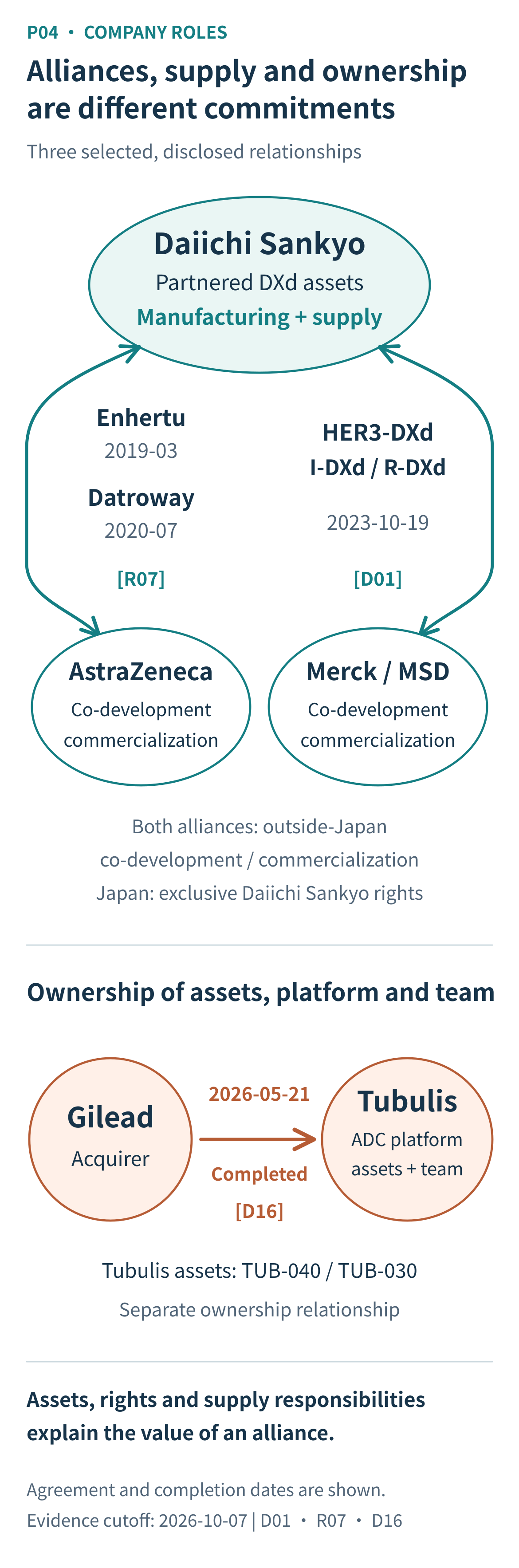
The division of work in ADCs determines whether a scientific distinction can reach patients. Daiichi Sankyo connects different DXd candidates with different partners: its global alliances for Enhertu (T-DXd) and Datroway (Dato-DXd) began in March 2019 and July 2020, respectively; on October 19, 2023, it announced an alliance with Merck for HER3-DXd, I-DXd and R-DXd. The arrangements shown cover co-development and commercialization outside Japan; Daiichi Sankyo retains exclusive Japanese rights and is responsible for manufacturing and supply. This separates asset development, territorial rights and supply responsibilities. A buyer must assess whether the candidate’s clinical question is matched by a division of work that can be sustained through development. [7][35]
P04
Alliances, supply and ownership are different commitments
Reader question
When companies invest in ADCs, what do they obtain and who is responsible for moving each candidate forward?
Interpretation:One DXd platform can connect with different global partners; assets, territorial rights and manufacturing responsibilities explain the value of each alliance.
Daiichi Sankyo connects different DXd assets with AstraZeneca and Merck and is responsible for manufacturing and supply of the listed partnered assets. Gilead acquired Tubulis, including its assets, platform and team. Lines represent only the disclosed relationships shown, not contracts among every company. Original agreement dates appear in the figure; information is current through 2026-10-07.[35][7][50]
Building ADC capability can also extend to owning an organization. Gilead completed its acquisition of Tubulis on May 21, 2026, bringing in TUB-040, TUB-030, its platform and its team; the team remains in Munich as an ADC innovation center. Acquiring a team and platform may support a continuing flow of candidates while bringing integration and development responsibilities into the group. The acquisition case therefore requires assessing both how far the lead asset can progress and whether the platform can deliver another developable candidate. The platform advantages described in the announcement still require product-level evidence. [50]
Research as of / sources reread 2026-10-07. Alliances began 2019-03, 2020-07 and 2023-10-19; acquisition completed 2026-05-21. Arrows encode relationships, not monetary scale.
Drug companies can compete in monotherapy, collaborate on combinations, and use different transactions to strengthen development and supply capabilities.
Collaboration interface
Observed arrangement
Our assessment of the source of value
Platform / candidate ↔ global development
Daiichi Sankyo with AZ and Merck; Duality with BioNTech.[35][46][47][7]
Connect R&D assets to later-stage trials, commercial networks and capital; rights come with cost sharing.
Existing drugs ↔ new combinations
AZ / Daiichi Sankyo and Summit plan to evaluate Dato + ivonescimab.[7]
If complementary effects are established, a new complete regimen could emerge; comparative trials remain necessary.
Collaboration → ownership of the organization
Gilead first collaborated with Tubulis, then completed its acquisition in 2026.[48][49][50]
Expand the commitment after gaining familiarity, acquiring both assets and an R&D organization.
Conjugation technology ↔ process and supply
Lonza integrates Synaffix; WuXi XDC expands services in Singapore.[56][57]
Transferable technology and execution across process stages can shorten the path from candidate to deliverable batch.
Arrows indicate industry interfaces or changes in relationships; they do not imply direct contracts among every company shown. The final column presents the author’s inferences.
The October 2026 Combination Collaboration Extends Competition to the Regimen
On 2026-10-02, AZ and Daiichi Sankyo announced a collaboration with Summit to evaluate Dato-DXd with the PD-1/VEGF bispecific antibody ivonescimab, with plans to begin in first-line TNBC. The parties will supply their respective medicines, share trial costs and retain the development and commercial rights to their own drugs. This is an announced collaboration plan, not evidence of combination efficacy. A planned Phase 3 start should not be described as a completed initiation.[7]
We judge that such partnerships add another consideration for buyers: whether a molecule can form a usable regimen with an established or emerging immunotherapy. The questions include patient selection, overlapping toxicities, the contribution of each component, and benefit relative to the standard of care at the time. The USD 2 billion equity investment completed on 2026-10-05 should be recorded separately, so that the price paid for shares is not treated as an ADC license fee.[8]
Duality’s exercise of its US cost- and profit/loss-sharing option for DB-1311 in May 2026 is another reminder that retaining more downstream value also entails greater funding and execution responsibilities. An industry map that shows only license arrows misses the sharing terms that can materially change the long-term economics of a collaboration.[47]
04 Translate Engineering Labels into Testable Improvements
An ADC's performance reflects the combined effects of its antibody, linker, payload, conjugation distribution and dosing regimen. Improving one measure may alter other properties. A new platform should therefore be assessed by first specifying the constraint it aims to address and then deciding what to measure. Different approaches may complement one another, or move the bottleneck to the next step.[2]
Table F03
Which Point of Failure Does Each Design Address?
A useful comparison links design changes to measurable problems, rather than assigning technology labels to generations.
Design choice
Main problem it seeks to improve
Measurements to examine
Target / bispecific antibody
Uneven antigen distribution; insufficient binding or internalization
Target expression in enrolled patients; relationships among internalization and response; improvement relative to a comparator.
Intracellular delivery design
Inefficient delivery to lysosomes after internalization
Antibody–antigen dissociation, intracellular distribution and lysosomal accumulation; a 2019 preclinical anti-HER2 ADC example.[10]
Conjugation design and DAR
Are product composition and stability controlled, and is exposure adequate?
DAR distribution, free payload, stability and human exposure.
Cleavable linker / permeable payload
Intratumoral release and coverage of neighboring low-expression cells
Bystander effects in tumor models, together with release in blood and tissue toxicity.
Switching payload mechanism
On-target resistance to the existing payload, efflux and related problems
Cross-resistance models, stratification by prior therapy and new limiting toxicities.
Dual payload / combination therapy
Complementary effects across cellular characteristics or disease pathways
Ratios, contribution of each component, sustainable dosing and cumulative toxicity.
The questions and measurements form an analytical framework developed for this report; see F04 for evidence maturity. DAR = the average number of payload molecules attached per antibody; a distribution exists beyond the average.
Delivery to lysosomes after internalization is also measurable. A 2019 preclinical anti-HER2 ADC study reduced antibody affinity for its antigen at acidic endosomal pH to promote dissociation; the study observed greater lysosomal ADC accumulation in cells. This is an antibody-binding and intracellular-delivery design example, not an acid-sensitive linker.[10]
The bystander effect is a useful example. Membrane-permeable payloads can affect neighboring cells in cell and mouse models with mixed HER2 expression, offering a potential way to reach cells missed because of tumor heterogeneity. This provides a mechanistic basis, while also requiring developers to establish where payload release occurs and how much exposure normal tissues receive.[4]
High DAR raises a similar issue. The assessment should focus on the physicochemical properties and in vivo behavior of the whole molecule: DAR distribution, free payload, storage stability and human exposure should be compared, rather than average DAR alone.
Patient selection can itself create a meaningful difference. To assess that difference, consider the timing of target testing, any retesting requirements and trial eligibility criteria together.
05 Beyond “Next Generation”: How Mature Is the Evidence?
Iza-bren has reached Phase 3 comparisons, HDP-101 has early human data, and some dual-payload designs are still supported by animal models. The label “next generation” groups products at very different distances from market. Comparing them requires returning to the patients studied and the comparator used.
Table F04
Evidence Maturity Varies Across New Designs
Bispecific ADCs have reached phase 3; new and dual payloads still require assessment of each product’s human development stage.
Example / design
Evidence available
Next critical gap
Iza-bren EGFR×HER3 / Topo-I
Original phase 3 publication in NPC in China; company-reported phase 3 TNBC/ESCC results.[20][21]
Chemotherapy comparators do not isolate the incremental dual-target contribution; TNBC excluded prior TOPI ADCs.[27]
HDP-101 BCMA / amanitin
53 patients dosed in phase 1; the research poster lists an RP2D of 175 µg/kg; phase 2a expansion has begun.[22]
Early multiple myeloma data; larger studies must validate dosing, efficacy and manageability.
MMAE + MMAF dual payload
Original research observed complementarity in mouse models of breast cancer heterogeneity/resistance.[6]
Both are microtubule inhibitors; animal results do not yet establish benefit in humans.
DUPAC payload with a new mechanism
Genentech / Duality announced a preclinical collaboration and subsequent development handoff.[52]
Overcoming resistance to existing payloads is a design claim awaiting human validation.
2019 original anti-HER2 ADC study in cell and mouse models; engineered antibodies increased lysosomal ADC accumulation in cells.[10]
Preclinical results in that study; they do not establish DCB platform claims or human benefit.
Maturity is assessed for the specific product and sources obtained; another drug’s approval on the same platform is not a substitute. RP2D = recommended phase 2 dose.
In a phase 3 trial in China in recurrent/metastatic nasopharyngeal cancer, iza-bren was studied in patients previously treated with platinum-containing chemotherapy and PD-(L)1 therapy. The objective response rate (ORR) was 54.6% versus 27.0%, and grade ≥3 treatment-related adverse events occurred in 80% versus 62%. In 2026, the company also reported results from PANKU-Breast02 in China: among patients with TNBC who had received 1–2 prior lines of systemic therapy for advanced disease, OS was 15.9 versus 12.5 months, with an HR of 0.60 (95% CI 0.42–0.85). Both trials used chemotherapy comparators; the TNBC trial excluded prior TOPI ADC treatment.[20][21][27]
HDP-101 uses a synthetic amanitin that inhibits RNA polymerase II, a mechanism distinct from Topo-I or microtubule-targeting payloads.[9] Early human data make the development questions for this new mechanism concrete: how to select a dose, manage changes in platelet counts and liver tests, and establish durable efficacy. This multiple myeloma study has not answered whether the drug is effective in solid tumors after Topo-I ADC treatment.[22]
In our assessment, the most persuasive case for an early platform combines a clear hypothesis with trials capable of disproving it. A transaction can demonstrate a buyer's willingness to share development risk; subsequent evidence is needed to turn that willingness into demonstrated clinical differentiation.
Topoisomerase I (TOP1) is the target of several ADC payloads, commonly grouped as Topo-I payloads. If a tumor develops resistance to this mechanism, switching the cell-surface antigen may not be sufficient. If failure instead occurs at the level of the antigen, internalization or payload delivery, a new antibody or conjugation design may help. The essential distinction is where treatment fails.[2][3]
Table F02
Three Evidence Gaps in ADC Sequencing
Check who entered the trial before deciding whether a positive result answers the question of treatment after an ADC.
Question
Verified scope of the evidence
Additional evidence needed
Can a payload from the same class follow?
TROPION-Breast02 and ASCENT-03/04 excluded prior Topo-I treatment / relevant ADCs.[28][29][30]
Study patients whose earlier-line ADC failed, recording payload, interval and reason for progression.
Can a new dual-target ADC overcome failure?
PANKU-Breast02 with iza-bren excluded prior TOPI ADC treatment.[27]
Test in a population with prior ADC exposure, using a meaningful comparator.
Can the drug be used before and after surgery?
DB05 excluded prior T-DXd, T-DM1 or other HER2 ADCs.[31]
Explicitly design an adjuvant comparison after neoadjuvant T-DXd and track recurrence and toxicity.
[27][28][29][30][31] · As of 2026-10-07; individual event dates are shown in the table.
Early-stage breast cancer requires the same precision. pCR was 67.3% versus 56.3% in DB11, and three-year iDFS was 92.4% versus 83.7% in DB05. The former compares neoadjuvant sequences; the latter directly compares postoperative T-DXd with T-DM1. Both findings have value, but the eligibility criteria in DB05 limit the conclusions that can be drawn by joining them together.[12][31]
TOP1 mutations offer a clue that still needs prospective validation
Abelman and colleagues detected TOP1 mutations in 4 of 31 selected patients with metastatic breast cancer who had plasma genomic testing after ADC treatment. A separate cohort of 420 patients who had not received ADCs included 3 such cases. The proportions were 12.9% and 0.7%, respectively, but the cohorts differed in their sources and selection. Functional experiments supported the possibility that some mutations confer cross-resistance to SN38 and DXd payloads.[3]
This study provides a testable biological hypothesis: changing the target may still leave the same payload-related obstacle. It is not yet sufficient to make TOP1 variants a validated clinical exclusion rule. A more useful next step for developers is to collect pretreatment and post-treatment samples prospectively and include prior drugs, time to treatment failure and payload class in the analysis.
The post-ADC population is also heterogeneous. Patients who stopped because of toxicity, those whose disease progressed rapidly and those who progressed after prolonged control may have different needs from the next ADC. A trial that combines them into a single “prior ADC” category may still obscure the differences that matter.
07 First-Line TNBC: Define the Patients before the Competition
Triple-negative breast cancer (TNBC) provides a clear view of competition: suitability for PD-1/PD-L1 therapy, and whether PD-L1 meets a specified threshold, change the relevant treatment options. Defining those patient conditions first makes it possible to understand the use case supported by each randomized trial.[13][16]
P02
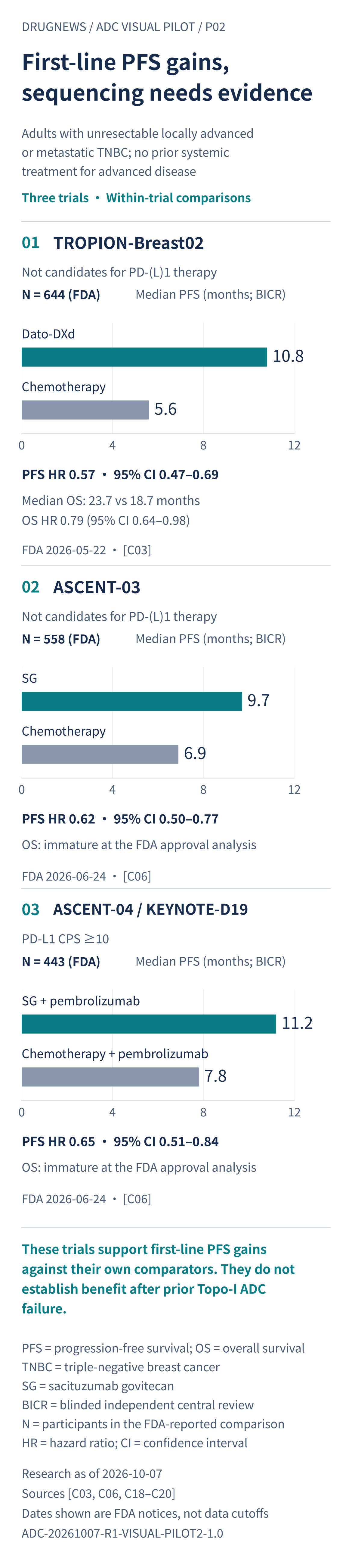
Three Within-Trial Comparisons Answer Separate First-Line Questions
Reader question
For each trial’s patient population, what effect does the ADC show against that trial’s comparator?
Interpretation:The trials support first-line efficacy in their respective populations; they do not establish efficacy after ADC failure.
Three separate panels compare median PFS only within each trial, in months; HR and 95% CI are listed separately. N, population conditions, comparators and FDA announcement dates are retained from the original data. An FDA announcement date is not a trial data cutoff.
Read the Four Statistical Labels First
PFS (progression-free survival) measures time before disease progression or death; its median is expressed in months. HR (hazard ratio) compares relative event rates during follow-up and has no unit of months; the 95% CI is the confidence interval around the HR estimate. N is the number of people in the stated analysis or trial and must be read with its population and source. Each panel’s bars show median PFS only. HR and CI are listed separately, not used as error bars on the medians.[13][16]
TROPION-Breast02 | Not Candidates for PD-(L)1 Therapy
The FDA notice lists N = 644, with 323 participants assigned to Dato-DXd and 321 to chemotherapy. The trial compared Dato-DXd with investigator’s choice chemotherapy in adults with unresectable locally advanced or metastatic TNBC, no prior systemic treatment for advanced disease, and who were not candidates for PD-1/PD-L1 therapy.[13][28]
Median PFS assessed by BICR (blinded independent central review) was 10.8 versus 5.6 months; HR 0.57 (95% CI 0.47–0.69). Median OS (overall survival) was 23.7 versus 18.7 months; OS HR 0.79 (95% CI 0.64–0.98). The FDA announcement date is 2026-05-22, not a trial data cutoff.[13]
ASCENT-03 | Not Candidates for PD-(L)1 Therapy
The FDA notice lists N = 558. The population was likewise adults with unresectable locally advanced or metastatic TNBC, no prior systemic treatment for advanced disease, and who were not candidates for PD-1/PD-L1 therapy. SG was compared with nab-paclitaxel, paclitaxel, or gemcitabine + carboplatin.[16][29]
BICR-assessed median PFS was 9.7 versus 6.9 months; HR 0.62 (95% CI 0.50–0.77). OS was immature at the FDA approval analysis; the announcement date is 2026-06-24. The registry separately lists 623 people as ACTUAL enrollment. This report has not obtained a verifiable explanation of the relationship between the FDA’s 558 and the registry’s 623; the figures are not interchangeable.[16][29]
ASCENT-04 / KEYNOTE-D19 | PD-L1 CPS ≥10
The FDA notice lists N = 443. Participants were adults with PD-L1 CPS ≥10, unresectable locally advanced or metastatic TNBC, and no prior systemic treatment for advanced disease. SG + pembrolizumab was compared with chemotherapy + pembrolizumab; both arms included immunotherapy.[16][30]
BICR-assessed median PFS was 11.2 versus 7.8 months; HR 0.65 (95% CI 0.51–0.84). OS was immature at the FDA approval analysis; the announcement date is 2026-06-24.[16]
The data cutoff for each of the three trials has not been verified; FDA announcement dates and registry-update dates cannot substitute for it.[28][29][30]
Research as of 2026-10-07; FDA announcements 2026-05-22 / 2026-06-24. Trial data cutoffs are unknown. HR is dimensionless, PFS/OS are in months, N counts people; no currency.
First-Line TNBC: Keep Each Trial’s Comparator in View
These three trials support different treatment settings; none directly compares Dato-DXd with SG.
Trial / population
Comparison and N
Within-trial PFS
OS status
TROPION-Breast02 Not candidates for PD-(L)1 therapy
Dato-DXd vs chemotherapy N = 644
10.8 vs 5.6 months HR 0.57 95% CI 0.47–0.69
23.7 vs 18.7 months HR 0.79 95% CI 0.64–0.98
ASCENT-03 Not candidates for PD-(L)1 therapy
SG vs chemotherapy N = 558
9.7 vs 6.9 months HR 0.62 95% CI 0.50–0.77
Still immature in the FDA approval analysis
ASCENT-04 PD-L1 CPS≥10
SG + pembrolizumab vs chemotherapy + pembrolizumab N = 443
11.2 vs 7.8 months HR 0.65 95% CI 0.51–0.84
Still immature in the FDA approval analysis
Trial populations were adults with unresectable locally advanced/metastatic TNBC who had not received systemic therapy for that advanced-disease setting. Immunotherapy criteria and chemotherapy options differed across trials. FDA announcements: 2026-05-22 and 06-24. Values are experimental arm vs control arm; N = number randomized; PFS = progression-free survival; OS = overall survival; CPS = combined positive score.
For companies, clinical differences must become practical reasons for use
The approval analysis for Dato-DXd showed both PFS and OS benefits; OS remained immature at approval in ASCENT-03/04. This makes the evidence profiles different, but does not establish that one product is better than another. A head-to-head randomized trial remains the strongest evidence for comparing the relative benefits of the two drugs. Cross-trial patient-level analyses can add indirect evidence, while retaining the limitations arising from population differences and residual confounding.
Routine care is another area of competition. Managing ocular adverse reactions, oral mucositis and ILD with Dato-DXd differs from managing neutropenia and diarrhea with SG. A hospital's ability to deliver supportive care consistently will affect actual use. Public trial data, however, are insufficient to assign the same care costs across different health systems.[13][16]
08 A Better Therapeutic Window Requires the Full Dosing Picture
A claim of “lower toxicity” needs to specify the toxicity assessed, the follow-up period and how much treatment patients actually received. The antibody, payload-conjugated component and released payload of an ADC can have different pharmacokinetics. FDA clinical pharmacology guidance therefore recommends evaluating the relevant components separately and using exposure–response relationships and the dosing regimen to support dose selection.[2]
Table F06
Four Types of Evidence Behind a Better Therapeutic Window
Sustained dosing as planned can help translate molecular design into a benefit that patients and hospitals can use.
Evidence to examine
Why it changes the assessment
Example in this report
Exposure and dose selection
Exposure to ADC, total antibody and free payload may change in different directions.
FDA recommends separate analysis of relevant components and exposure–response relationships.[2]
Organ-specific and severe toxicity
Similar overall grade ≥3 rates may conceal different fatal or difficult-to-manage risks.
Overall grade ≥3 AE rates were similar in DB09; ILD occurrence differed.[25]
Dosing delivered and supportive care
Dose reductions, delays, discontinuations and prophylaxis change sustainable exposure.
HDP-101 uses a split first dose and prophylactic measures to manage early toxicity.[22]
Disease endpoints and patient burden
Tumor shrinkage, delayed progression, survival and outpatient care burden answer different questions.
Read TNBC trials alongside OS maturity and known management requirements.[13][16]
This table is a framework for reading evidence, not a cross-trial safety ranking. AE = adverse event; ILD = interstitial lung disease/pneumonitis.
[2][25][22][13][16] · FDA guidance: 2024-03; clinical evidence: 2025–2026 versions, as specified in the source index.
In DB09, grade ≥3 adverse events occurred in 63.5% versus 62.3%, which appears similar. Yet adjudicated drug-related ILD/pneumonitis occurred in 12.1% versus 1.0%, with two grade 5 events in the T-DXd + pertuzumab arm. A single overall percentage can conceal different kinds of risk.[25]
HDP-101 illustrates another point: the dosing schedule itself is part of product development. Splitting the first dose and using prophylactic measures aim to manage early changes in platelet counts and liver tests. If these adjustments allow patients to maintain meaningful exposure, they may broaden usability; the phase 1 findings still require confirmation in further expansion.[22]
For industry readers, the next actionable research question is how planned treatment connects with treatment actually delivered: how many patients reduce, delay or stop dosing; how much exposure accumulates before discontinuation; and whether responding patients face the same care burden. These data can test a platform's practical product value and identify where dosing and supportive care still need improvement.
09 A Mature Platform Still Faces Product-Specific Regulatory Tests
I-DXd withdrawal: early activity does not guarantee accelerated approval
On 2026-09-25, Daiichi Sankyo and Merck announced the voluntary withdrawal of the US biologics license application for ifinatamab deruxtecan (I-DXd) in certain previously treated patients with extensive-stage small cell lung cancer. The companies stated that, following discussions with the FDA, the data, including IDeate-Lung01, did not meet the requirements for the accelerated approval pathway. Further phase 3 development continued.[23]
The conclusion this event supports is that a signal of activity can still fall short of the evidence needed for a particular regulatory pathway. The public withdrawal statement did not provide sufficient detail to attribute the decision to ILD, nor did it state that product development had ended. Attributing the withdrawal directly to a particular toxicity would turn an unresolved question into an established conclusion.
HER3-DXd: the same product has faced distinct types of obstacles
When patritumab deruxtecan (HER3-DXd) received a complete response letter (CRL) in June 2024, the companies attributed it to inspection findings at a third-party manufacturing facility and stated that the letter identified no efficacy or safety issues with the submitted data. This report reviewed the companies' public account of the CRL, not the FDA's unpublished full letter.[38]
In May 2025, the BLA was withdrawn after OS in HERTHENA-Lung02 failed to reach statistical significance and after discussions with the FDA. The two events need to remain separate: resolving a manufacturing problem does not automatically meet subsequent clinical evidence requirements, and the later withdrawal does not retrospectively invalidate the 2024 account of the inspection findings.[39]
How do these cases change the assessment of a partnership?
When a large pharmaceutical company acquires access to a mature platform, it can gain accumulated engineering, clinical operations and manufacturing knowledge. That experience does not guarantee results for a new target, population or line of therapy. In our assessment, due diligence should examine three questions individually: does the product offer sustained benefit; can the current trials answer the regulatory questions; and can the commercial manufacturing process reliably deliver the same product?
For sellers, transparency about unfinished comparisons, data maturity and manufacturing dependencies makes partnership terms more concrete. If the buyer needs to redesign trials, re-establish an appropriate dose or repeat a process transfer, each requirement affects downstream resources, timelines and payment arrangements. Separating these risks allows the parties to discuss who is best placed to bear them.
10 Manufacturing: Qualified Batches and Flexible Commitments
CMC (chemistry, manufacturing and controls) determines whether a candidate can be reproduced, scaled up and supplied consistently. ADCs span protein and highly potent chemical processes. Buyers need to understand which quality attributes can change at each handoff, and how the product will be shown to remain fit for use after a change.[2]
Table F07
Four Handoffs Define Value in ADC Manufacturing
Buyers need reproducible, qualified products and evidence supporting transfer; vessel size describes only one equipment parameter.
Handoff
Verifiable deliverables
Risk easily overlooked
Antibody → conjugation
Antibody quality, target binding, available conjugation sites and input consistency
Changes in starting materials may affect downstream reactions and the final product.
Payload/linker → reaction
Purity, impurities, stability and handling of highly potent compounds
Small-molecule and protein-process conditions may not be compatible.
Conjugation → purification and release
DAR distribution, aggregation, free payload, potency and batch comparability
A high yield accompanied by unacceptable impurities cannot become a saleable batch.
Drug substance → drug product / site transfer
Stability during storage, transport and filling; analytical and process transfer
Expansion, a site change or reformulation may require new comparability work.
A buyer review framework developed from FDA guidance and publicly described services. Product specifications and regulatory requirements vary by product. No internal customer manuals were obtained or used.
Daiichi Sankyo’s lesson: supply plans also need to evolve with the evidence
On 2026-05-08, Daiichi Sankyo announced that it had initially reserved capacity against maximum demand without risk adjustment, including minimum purchase obligations and dedicated production lines. Revisions to trial results, eligible patient populations and launch timelines subsequently led it to adopt a risk-adjusted supply plan. The company reported a JPY 75.7 billion provision for compensation to CMOs, and JPY 19.3 billion in impairment of Odawara equipment and estimated contract termination compensation.[40]
These are different accounting charges. They cannot all be described as cash already paid, nor do they establish a technical failure to manufacture at scale. The company also stated that the difference between medium- to long-term purchase obligations and the revised plan had not yet been provided for because of substantial uncertainty. The supply question therefore extends from the amount of capacity available to when commitments are made, how much is committed, and who bears changes in demand.[40]
We judge that capacity arrangements that can expand in stages, support technology transfer and assign clear quality responsibilities could become a partnership advantage. Lonza’s expected 2028 expansion and AZ’s 2029 target for its Singapore facility concern future supply. WuXi XDC’s 2026 GMP release is an operating milestone announced by the company. The three have different availability dates and levels of supporting evidence.[55][57][58]
ADC transactions include research options, asset licenses, co-development, acquisitions and equity investments. Similar headline amounts may cover different numbers of assets, territories, success conditions and subsequent expenditures. Separating the transaction types is the first step in understanding how much risk the buyer has taken on.
Table F08
Five Transaction Types, Five Different Commitments
Identify the nature of the payment and the scope of rights before using a headline value to assess risk allocation.
Transaction / original date
Amount and payment status (USD million)
Rights acquired / obligations assumed
Merck / Daiichi Sankyo 2023-10-19
Original agreement: 4,000 upfront + 1,500 continuation payments + up to 16,500 sales milestones; maximum 22,000. SEC-disclosed gross payments: 5,500.[35][36]
Three DXd ADCs; co-development and commercialization outside Japan; Daiichi Sankyo responsible for manufacturing.
Gilead / Tubulis option 2024-12-03
20 upfront + 30 on exercise + up to 415 milestones; specified fees and milestones total up to 465, with sales royalties additional. Subsequent option-exercise payment not verified.[48]
One research ADC against an undisclosed target; collaborate first, then decide whether to assume development.
Gilead acquisition of Tubulis Completed 2026-05-21
Agreed closing payment of 3,150 + up to 1,850 milestones. SEC reports approximately 3,200 net of acquired cash, a different accounting basis.[49][50][51]
The company and its pipeline; SEC states that TUB-040 represented substantially all of the fair value of the assets acquired.
Genentech / Duality 2026-08-28
45 upfront + over 1,000 contingent milestones; no precise maximum. Actual receipt not verified.[52]
DUPAC ADC; Duality develops through Phase 1a, after which Genentech takes over.
AZ / Summit equity Completed 2026-10-05
2,000 equity investment; recorded separately from the 2026-10-02 clinical collaboration.[7][8]
Equity ownership and a separate combination-trial collaboration; parties retain rights to their own drugs.
All amounts are USD million. Original agreement values, accounting amounts net of acquired cash, gross payments and equity investments are not added into an industry deal total. Merck’s upfront payment includes a 1,000 component that is partly refundable; the 5,500 excludes R&D cost sharing and potential refunds.
[35][36][48][49][50][51][52][7][8] · Transaction dates shown in rows; payment updates from Q2 2026 SEC filings and the 2026-10-05 announcement
The Merck / Daiichi Sankyo collaboration cannot be understood from its original headline maximum alone. The original 2023 agreement had a maximum value of USD 22 billion. The 2026 SEC filing disclosed gross payments totaling USD 5.5 billion: a USD 4 billion upfront payment and two continuation payments of USD 750 million each, alongside conditions including R&D cost sharing and possible refunds. The filing also disclosed a July 2026 amendment to the sharing of certain clinical costs. Repeating only the headline maximum misses how the funding and execution responsibilities actually assumed have changed.[35][36]
The Genentech–Duality agreement places the development handoff after Phase 1a. For the buyer, a meaningful question is whether the novel-mechanism payload can produce sustainable exposure and activity in a clinical candidate. For the seller, the quality of early delivery and a data package that the next team can use will matter to subsequent development. The announced milestone amount of “over USD 1 billion” has no precise ceiling, so an exact upfront share cannot be calculated from it.[52]
Agreements announced 2026-10-15–2026-11-14
Taiwan, Japan, Korea and China have no monetary threshold. India and Singapore are also included. Western-only agreements require a disclosed value above USD 100 million or a material clinical role; the BioNTech–Gilead Phase 3 collaboration meets the clinical criterion. Mixed portfolios and non-cytotoxic payloads remain separate. No aggregate headline deal value is calculated.
11 new agreements; 2 existing-deal updates are separate. Each multi-program agreement counts as 1. The 2 Adlai Nortye counterparties count separately. This is the identified set, not a global market census.
Upfront, milestones and royalties: not disclosed. Lilly supplies cetuximab at no cost.
AN4035 + cetuximab; CEACAM5 / pan-RAS(ON)-inhibitor payload · Phase 1 · US trial sites Adlai Nortye sponsors the trial; the supply agreement does not grant commercial rights to AN4035.
Upfront, milestones and royalties: not disclosed. Merck KGaA supplies cetuximab at no cost.
AN4035 + cetuximab; separate from the Lilly agreement · Phase 1 · Australia and China trial sites The supplier is Germany’s Merck KGaA, distinct from Merck & Co. / MSD.
Upfront 400; separate first-anniversary payment 110; milestones >15,000; tiered royalties, rates not disclosed. Calculated fixed-plus-conditional consideration >15,510.
2 preclinical ADCs and additional ADCs against Roche-nominated targets · Preclinical / discovery · Worldwide excluding mainland China, Hong Kong, Macau and Taiwan Hansoh leads through global Phase 1a; Roche leads subsequent development in its territory. Hansoh may select up to 2 programs for participation outside its retained territory.
Upfront, milestones, royalties and total: not disclosed.
pumitamig + sacituzumab govitecan; ROSETTA Breast-01 · Phase 3 amendment planned, subject to regulatory approval · Global trial BioNTech remains sponsor; Gilead supplies SG. The planned population is PD-L1-low or negative locally advanced or metastatic TNBC; benefit of the new combination is unestablished.
Upfront, milestones, royalties and total: not disclosed. Signed 10/22; announced 10/29.
loncastuximab tesirine-lpyl (MT-2111 / Zynlonta) sublicense · Japanese marketing application submitted · Commercialization in Japan Nippon Shinyaku obtains exclusive commercialization rights; Tanabe retains development and approval responsibilities. Separate from the original 2022 ADCT / Tanabe license.
Upfront, milestones, royalties and total: not disclosed. Prior seed financing is separate.
2 MUTTA ADCs; India territorial licenses · Not specified for each licensed molecule · India; Aarvik retains rights outside India Laurus receives Indian development and commercialization licenses for 2 ADCs; ARR-002 is not assumed to be one of the 2 licensed molecules.
Upfront, milestones, royalties and total: not disclosed. Fee-for-service for selected candidates.
Options for up to 37 biosimilars, including a polatuzumab vedotin biosimilar · Development portfolio · Fresenius retains global commercialization rights for selected products Mixed-modality services agreement; 37 candidates are not 37 ADCs and not all options have been exercised.
Combined upfront and near-term payments 358, split not disclosed; additional option and milestone payments up to 7,000; royalties up to double digits. Combined ceiling 7,358.
6 preclinical ADC / TcE programs; 5 from LaNova and 1 from Beijing Tide · Preclinical · 4 programs exclude mainland China, Hong Kong and Macau; 2 are worldwide SBP leads early development; options follow agreed clinical milestones. ADC / TcE financial allocation is undisclosed; the package is excluded from ADC-only monetary totals.
Upfront to ProBio, development and commercial milestones, and future sales royalties; amounts and rates not disclosed.
Antibody asset against an undisclosed oncology target for ADC development · Discovery · Exclusive worldwide rights AbTis obtains asset development and commercialization rights, applying its AbClick site-specific conjugation technology.
Upfront 30; individual development, regulatory and commercial milestone amounts not disclosed; total potential value >2,000; additional tiered net-sales royalties, rates not disclosed.
ADC platform technologies / novel payload classes · Platform collaboration; no candidate stage specified · Exclusive worldwide rights for selected undisclosed Novartis payload classes Novartis receives related patent and know-how rights with an option for additional payload classes; OBI evaluates novel linker approaches.
Upfront, milestones, royalties and total: not disclosed.
ADC R&D services-platform collaboration · Antibody discovery through preclinical and process development · Not disclosed SMOC covers antibody development, efficacy evaluation and preclinical support; Huateng covers conjugation, purification, analysis and process development.
Closing of the 9/03 license: upfront 110; additional milestones up to 1,185; tiered royalties. Original ceiling 1,295; not a new license in this period.
Formal commercialization cooperation announced; upfront, milestones, royalties and total not disclosed. Strategic cooperation with the same partner was announced on 8/10; conservatively treated as follow-up, not another new license.
sac-TMT commercialization cooperation in Hong Kong and Macau · ·
12 Innovation in Taiwan: Conjugation, Tumor Targets and Biosimilars
OBI Pharma changes where the payload attaches to the antibody; GlycoNex targets a glycan antigen on the tumor surface; and TSY-110, developed by Formosa Pharmaceuticals and EirGenix, references an existing ADC as a biosimilar candidate. All involve ADCs, but the development questions differ. The first two must establish what their respective designs achieve in humans; the third must first demonstrate similarity. Listing status, tickers and sources appear in Appendix B.
OBI Pharma and GlycoNex: Both Work with Glycans, at Different Points in the ADC
OBI Pharma's GlycOBI uses antibody glycan sites for conjugation, primarily addressing where the payload is attached and how consistent the product is. OBI-902 is a TROP2 ADC using this approach, with a registry record showing human development. OBI-992 uses a different conjugation design; the two should remain distinct products. If human PK, sustainable dosing and activity support the engineering rationale, improved consistency may translate into product differentiation.[70][71][72]
OBI Pharma's previously announced TegMine license illustrates one possible collaboration interface: a partner supplies a glycan-targeting antibody, combined with OBI Pharma's conjugation and linker technologies. The verifiable company-issued public release is dated January 12, 2026. Detailed financial terms were not disclosed, and the release does not confirm cash received; it cannot establish a realized order amount.[73]
GlycoNex's GNX1021 instead recognizes the tumor-associated bLeB/Y glycan antigen, addressing what the ADC recognizes. On 2026-08-03, the company announced that the first patient had been dosed in Japan in its Phase 1 trial, an important transition from models to humans. Safety, dose and activity are the next evidence to track. Clinical data from other molecules cannot replace human evidence for the GNX1021 ADC itself.[74]
DCB: A Technology Lead Awaiting Verification
Verifiable content from the Development Center for Biotechnology’s LYSward technology page is currently unavailable. Its pH design, intracellular trafficking and platform maturity therefore remain unconfirmed and are not used to support this report’s mechanistic conclusions.[83] The 2019 anti-HER2 ADC study discussed earlier is a separate preclinical design and cannot substitute for data on LYSward itself.[10]
Formosa Pharmaceuticals / EirGenix: Similarity Offers a Different Kind of Product Value
TSY-110 (EG12043), jointly developed by Formosa Pharmaceuticals and EirGenix, references T-DM1 / Kadcyla. On 2026-08-28, Formosa Pharmaceuticals announced the submission of a clinical trial application in Europe; submission does not establish authorization or patient dosing. The core work concerns analytical similarity, PK, safety and immunogenicity. The separate EGFR × ROR1 asset TSY-310 was represented by preclinical data in the May 2026 announcement and requires its own assessment.[75][76]
DB05 has directly compared T-DXd with T-DM1, so commercial research on a biosimilar also needs to update the reference product's future treatment position. If treatment choices shift, today's originator market cannot simply be treated as the market available to a future biosimilar. Access may create value, but pricing, reimbursement, remaining indications and actual uptake require region-specific assessment.[12]
13 Manufacturing in Taiwan: Connecting Antibodies and Conjugation across Sites
Publicly identifiable capabilities in Taiwan span antibodies and analytics, highly potent small molecules, linkers, conjugation, purification and formulation. For international customers, value depends both on the technology and on whether data and responsibilities can be transferred effectively across companies, sites and development stages.[78][79][81][82]
Table F10
Taiwan's Manufacturing Capabilities: What Can a Buyer Verify?
Turning service lists into delivery evidence may help build sustained collaboration.
Public capability / entity
Evidence available
The next most persuasive evidence
EirGenix × Formosa Laboratories
Publicly described integration of antibody, analytical, highly potent chemistry and conjugation services.[78][79]
Named or verifiable transfers across stages, batch release and records of supply under regulatory requirements.
Formosa Laboratories facilities
The company lists 30–200 L conjugation reactors, TFF, chromatography and related equipment.[80]
Product-specific batch yield, acceptance rate, cycle time and demand alignment are needed to estimate deliverable output.
Mycenax / collaboration network
VLK license for CDMO use; the company lists GMP conjugation at 50 L scale.[81][82]
ADC-specific analytical, release, technology-transfer and clinical-supply evidence, kept separate from unconjugated-antibody cases.
Shared commercial conditions
Work across companies involves materials, methods, quality responsibilities and scheduling.
Staged capacity reservations, changes in demand and technology-transfer responsibilities: criteria proposed by the author for assessing partnerships.
Company-disclosed facility and service capabilities; product-specific batch and commercialization evidence require separate verification.
Public materials from EirGenix and Formosa Laboratories describe integration of the antibody and chemistry / conjugation components. Mycenax extends its services through a VLK technology license and a collaboration network. Published service and equipment information can define the scope of capability a company offers. The ability to supply a particular medicine over time still requires supporting batch and quality data.[78][79][80][81][82]
Equipment volume and manufacturing scale are particularly easy to overinterpret. Protein concentration, reaction conditions, purification recovery and release specifications all affect qualified output. This report therefore preserves the distinction between Formosa Laboratories' 30–200 L reactor volumes and the 50 L GMP conjugation scale listed on Mycenax's service page. Neither figure is used to estimate qualified finished-product quantities, annual sales volume or revenue.[80][82]
We judge that Taiwanese companies seeking greater visibility with potential partners would benefit most from publicly verifiable delivery cases: which stage of technology transfer has been completed, how analytical methods carry forward, where clinical supply or batch-release experience has been gained, and what evidence is needed for the next expansion of a collaboration. These details help buyers understand a company's responsibilities across the chain and allow researchers to track whether its capabilities are advancing.
14 The Next Twelve Months: Lung Cancer Readouts, Combination Benefits and Human Studies in Taiwan
The upcoming events center on a few questions: whether Dato can expand its role in lung cancer, whether further DB09 data can clarify the contribution of the combination, and whether Taiwanese candidates advance toward human dose selection and similarity testing. The table separates company guidance, registry estimates and items with no announced date, so an estimated schedule is not mistaken for a confirmed results release.
Table F11
The Next Twelve Months: Which Events Could Change the Assessment?
An event matters because of the assessment it may change; registry completion dates and company guidance are not guaranteed release dates.
Whether specific combinations and patient selection are supported in first-line lung cancer.
H2 2027 Partly outside this window
TROPION-Breast03; registry estimates primary completion on 2027-09-20.[26][34]
Whether a subsequent strategy can reduce events in TNBC with residual disease after neoadjuvant treatment.
Conditional watch throughout the year No confirmed announcement date
OBI-902/992 data, GNX1021, and TSY-110 regulatory and trial progress.[71][72][74][75]
Whether the Taiwan cases advance toward evidence of sustainable dosing in humans, similarity, or delivery.
Watch window: 2026-10-08 to 2027-10-07. The latest guidance does not confirm that results remain unpublished; announcements must be checked at each update. I-DXd’s BLA was withdrawn, so the former 2026-10-10 PDUFA date has been removed from the event list.
Changes in timing are themselves informative. The latest AZ guidance located places Lung07/08 in H1 2027. Following the withdrawal of the I-DXd application in September, its former 2026-10-10 PDUFA date is no longer a valid upcoming review milestone. The latest Lung02 registry entry estimates primary completion in January 2028, which also falls outside this twelve-month watchlist.[26][23][33]
The conditions for changing an assessment should be specified before each readout. If a positive trial still excludes patients previously treated with the same ADC class, it may change the view of frontline competition while leaving the sequencing gap unresolved. If the main advance is the start of dosing, the update should reflect development maturity while efficacy remains unknown. Frontline efficacy, efficacy after prior treatment and the start of dosing are different kinds of progress.
15 Where to Invest Next: Sequencing, Care Burden and Flexible Supply
As ADCs move earlier in treatment, the next investment need not be another similar drug. Where options after ADC failure are lacking, sequencing trials deserve attention. Where comparable efficacy is difficult to sustain in practice, dosing and supportive care may influence uptake. Where indication expectations or launch dates fall back, supply commitments need room to adjust. These three scenarios make different demands on R&D, transactions and manufacturing.
Table F12
Three Scenarios That Could Change R&D and Partnership Priorities
Identify the gap in treatment or supply before choosing the trial, payment terms and capacity commitments.
Scenario assumption
Priority evidence questions
Potential partnership adjustment
A Frontline Topo-I ADC use increases while sequencing data remain limited
Clearly defined prior-exposure cohorts; mechanism of action and time to failure; a meaningful comparator
Prioritize sequencing trials and approaches with new mechanisms; link contingent payments to verifiable milestones.
B Treatment and supportive care become more sustainable at similar efficacy
Comparative discontinuation, dose reduction, patient-reported outcomes and care burden on hospitals
If the evidence is consistent, positioning could extend to usability; reimbursement and costs still require market-specific validation.
C Indication expectations are reduced or launch timelines are revised
Updated treatable population, trial and regulatory timelines, and existing capacity obligations
Revise demand scenarios and staged capacity commitments; redefine technology-transfer and supply responsibilities.
These are author-developed scenarios without assigned probabilities, not market-size or valuation forecasts. Topo-I denotes the topoisomerase I payload class.
For a specific asset, the buyer still needs to ask: which next result would justify investing more, and which findings should bring that investment to a stop? Without that threshold, even an ambitious platform story offers little guidance for the next expenditure.
Further reading and enterprise research
This free report provides the complete argument, company maps and data for recalculation. The additional value of membership research should come from continuing updates, company tracking and scenario tools: which assumptions new evidence supports, which should be withdrawn, and which evidence to follow next. The Drugnews in-depth research page describes the existing subscription content and subsequent research.[90]
The additional value of an annual enterprise engagement is to extend the same research into tailored questions, competitive positioning and execution throughout the year—for example, mapping a company’s evidence gaps, developing its milestone narrative and establishing an update cadence. The Drugnews enterprise collaboration page provides an entry point to discuss an appropriate scope. Engagement terms and the actual services are confirmed through the existing process.[91]
Understanding the roles an organization already holds helps explain what it needs to acquire, access through partnership, or build internally.
Entity
Substantive ADC position / relationship
Focus for tracking
Daiichi Sankyo / AZ
DXd candidates, marketed products and co-development; AZ also pursues manufacturing investment.[35][58][7]
Frontline and combination data; supply commitments.
Merck
Co-development of I-DXd, HER3-DXd and R-DXd; traceable payments and contract amendments.[35][36][39]
Comparative evidence required for regulatory review.
Pfizer / Seagen
Pfizer completed its acquisition of all outstanding Seagen common stock in December 2023.[41]
Extension of the existing portfolio into earlier treatment lines.
Astellas / Pfizer
Perioperative EV in MIBC: expanded US approval; positive CHMP opinion in Europe.[61][18]
The overall perioperative treatment strategy.
AbbVie / ImmunoGen
Acquisition completed in February 2024; ELAHERE and the ADC pipeline became part of the group.[44]
The marketed product entry point and subsequent pipeline.
Gilead / Tubulis
SG commercial portfolio; acquired Tubulis and assets including TUB-040 in May 2026.[16][50][51]
Human data for new assets and their integration.
BioNTech / Duality
Co-development of BNT323 and BNT324; US profit/loss-sharing option exercised.[46][47][60]
Later-stage data and actual funding commitments.
Roche / Genentech
Genentech signed a DUPAC collaboration involving a novel-mechanism payload.[52]
De-risking evidence before the Phase 1a handoff.
BMS / SystImmune
Joint development of Iza-bren outside China; Biokin sponsors PANKU-Breast02 and PANKU-Esophagus01 in China.[21]
Applicability of the patient populations and comparators.
Lonza / Synaffix
Integration of conjugation platforms, prototyping, analytics and manufacturing.[55][56]
Capacity entering service and processes ready for transfer.
WuXi XDC
Company-announced GMP release at its Singapore site and further expansion.[57]
Supply capabilities and product-specific validation.
Summit
Ivonescimab combination collaboration; separate equity investment from AZ.[7][8]
Combination-trial initiation and design.
Entries represent selected groups or partnerships. Row counts do not indicate the number of independent companies, overall market rankings or every scope of rights. Global securities identifiers are retained in the master data; this figure focuses on roles.
Inclusion criteria: a direct connection to this report’s questions about frontline or sequential treatment, payloads and conjugation, representative transactions, or manufacturing delivery. The master data also retain the original transaction types and securities identifiers. Acquired companies are not treated as independently listed entities. The map does not enumerate every target, early-stage startup or regional license.
Rights to use VLK linker technology for CDMO services; company lists GMP conjugation at 50 L scale.[81][82]
ADC clinical-supply / batch evidence, kept separate from unconjugated-antibody cases.
Development Center for Biotechnology (DCB) Research organization; no ticker
Verifiable content from the LYSward technology-transfer page is currently unavailable; technical claims and platform maturity await verification.[83]
Obtain normally accessible direct public support before assessing the technology and candidates; R10 does not validate DCB.
Securities-status sources are separate from capability sources. EirGenix transferred to the TWSE on 2025-07-21. The TWSE company-profile PDFs available for this check were generated on 2026-10-07. For company pages with no update date, only the access date is recorded; it is not treated as the date on which capability or capacity was updated.
This map should change as evidence changes. The threshold for adding a company is a verifiable, named ADC, trial, transaction, technology license or delivery capability. For companies already included, update their status and sources before deciding whether their role has changed. A collaboration announcement does not automatically turn a service provider into an innovative drug company with demonstrated clinical advantages.
Appendix C Formulas, Source Scope and Update Method
Year-on-year growth is (current-year sales / prior-year sales − 1) × 100%. Trodelvy inputs are USD 1,063 million, USD 1,315 million and USD 1,397 million; the 2024 and 2025 results are 23.7% and 6.2%. These are recalculated from reported whole-million values and rounded to one decimal place. A preceding-year value for 2023 was not obtained in this increment, so no zero or estimate is inserted.[69]
Expand the complete comparison table F15
Table F15
Reproducible Data: Retaining Both Formulas and Units
Within-trial numerical differences can be recalculated; they do not establish individual benefit or rankings across trials.
2024: 23.7%; 2025: 6.2%. Original inputs are USD million; recalculated from reported whole-million values.
Percentage points, months, ratios and monetary values are kept distinct. Amounts remain in their original currency; unknown values are left blank.
[11][12][3][36][48][69] · Data versions follow the individual sources; recalculated 2026-10-07
Sources and interpretation
This report uses publicly available regulatory notices, trial registrations, original studies, company announcements and formal financial filings. See the named sources and their publication and data dates below.
Common abbreviations: T-DXd = trastuzumab deruxtecan (Enhertu); Dato-DXd = datopotamab deruxtecan (Datroway); SG = sacituzumab govitecan (Trodelvy); EV = enfortumab vedotin (Padcev). HR denotes hazard ratio, reflecting the relative event rate during follow-up; 95% CI denotes the 95% confidence interval. An HR is not an absolute risk difference at a particular time point.[11][13][16][18]
Primary publications, regulatory notices, trial registrations, company announcements and financial filings. Publication dates and data periods are shown separately.