
On November 4, Boehringer Ingelheim licensed six preclinical cancer programs from China's Sino Biopharm.
Sino Biopharm, now branded SBP Group, could receive up to about $7.36 billion.
In the same year, Taiwan's listed biotech companies announced nine out-licensing deals.
The three with disclosed values add up to about $828 million, 11% of this one deal.
The gap has two layers. The first is what is being sold: China is selling next-generation molecules with global rights, while most of what Taiwan sold this year were reformulated drugs, biosimilars and single-country rights. The second is the scale of clinical data: Korea also has next-generation platforms, yet its upfront payments run about one-ninth of comparable Chinese deals. Taiwan has cleared neither layer.
01 | Unpacking $7.36 billion: $358 million comes first
According to Boehringer, SBP Group receives $358 million in upfront and near-term payments.
Up to $7 billion more depends on option-exercise, development, regulatory and commercial milestones, plus tiered royalties of up to double digits.
The $358 million is 4.9% of the headline. The other 95% arrives only if the drugs keep moving toward market.
All six programs are antibody-drug conjugates (ADCs) or T-cell engagers.
Five come from SBP's subsidiary LaNova Medicines and one from Beijing Tide Pharmaceutical.
SBP runs early development. Once agreed clinical milestones are reached, Boehringer decides whether to exercise its options.
Four programs cover rights outside mainland China, Hong Kong and Macau. Two are worldwide.
One way to weigh the upfront: in July 2025, SBP paid up to about $951 million for the remaining 95.09% of LaNova.
A little over a year later, with five of the six programs coming from LaNova, this upfront alone equals about 38% of that purchase price.
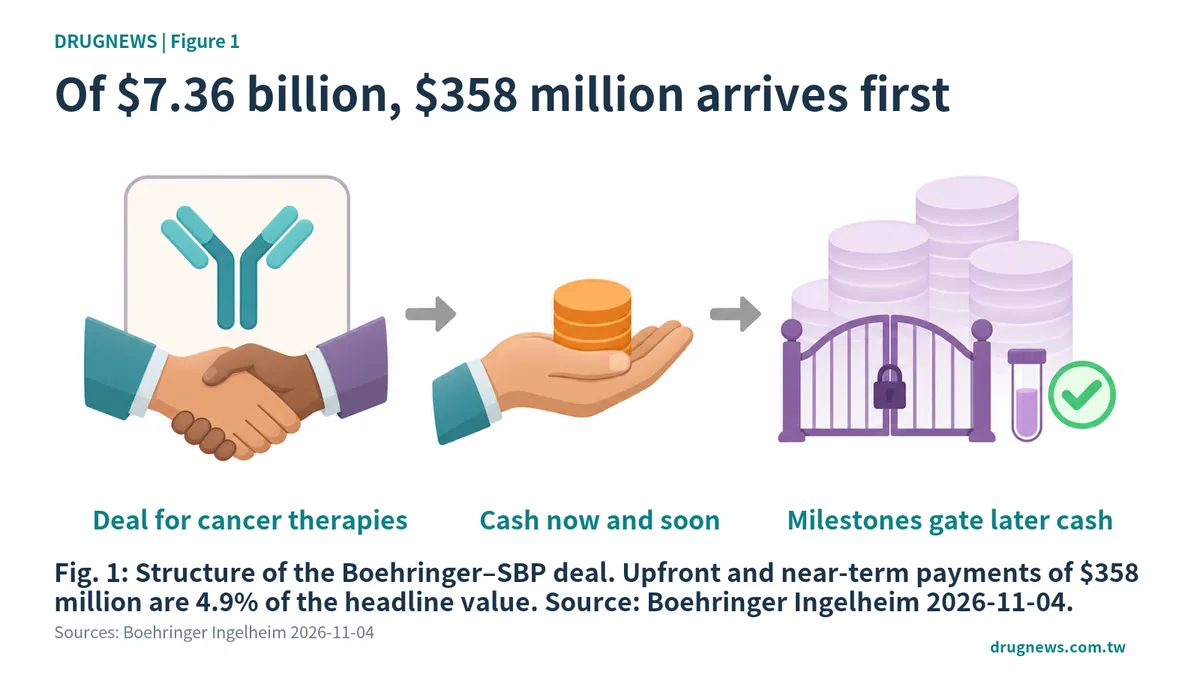
Fig. 1: Structure of the Boehringer–SBP deal. Upfront and near-term payments of $358 million are 4.9% of the headline value. Source: Boehringer Ingelheim 2026-11-04.
02 | One yardstick: upfront cash in China, Korea and Taiwan
Most milestones are never paid. To compare licensing power, look at what the buyer pays on signing.
Evaluate data show the average upfront paid for Chinese assets rose from $52 million in 2022 to about $170 million in early 2026, more than tripling.
Korea is the closer comparison for Taiwan.
The Asia Business Daily, citing the same data, reported that all eight Korean technology-export deals in the first half of 2026 carried upfronts below $50 million.
Taiwan's numbers are thinner.
Drugnews reviewed material announcements on Taiwan's Market Observation Post System (MOPS) from January 5 to October 15, 2026.
Of nine out-licensing deals, only one disclosed an upfront:
$10 million to Foresee Pharmaceuticals from Primevera Therapeutics, a related party in which Foresee also took a 19% stake.
| Comparison | Period | Upfront |
|---|---|---|
| China out-licensing average (Evaluate) | 2022 | ~$52M |
| China out-licensing average (Evaluate) | Early 2026 | ~$170M |
| Boehringer–SBP | 2026-11-04 | $358M |
| Korea technology exports (8 deals) | 1H 2026 | Each below $50M |
| Taiwan out-licensing (9 deals, 1 disclosed) | Jan–Oct 2026 | $10M (related party) |
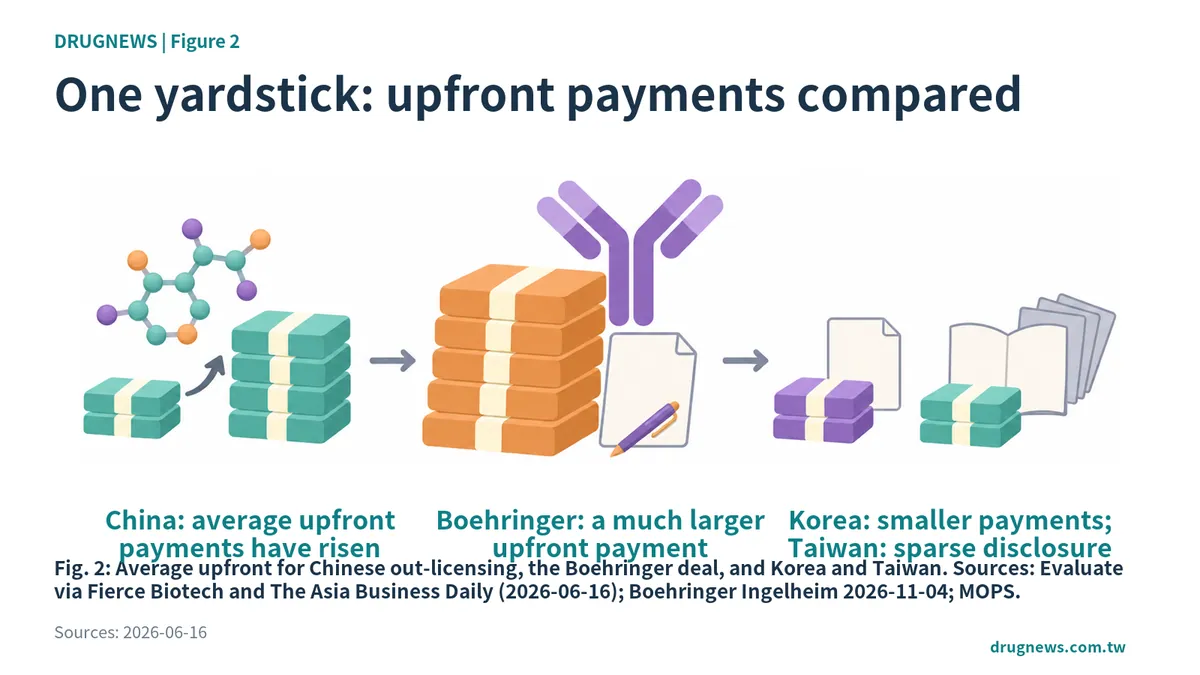
Fig. 2: Average upfront for Chinese out-licensing, the Boehringer deal, and Korea and Taiwan. Sources: Evaluate via Fierce Biotech and The Asia Business Daily (2026-06-16); Boehringer Ingelheim 2026-11-04; MOPS.
03 | What Taiwan actually sold this year
- TLC (Taiwan Liposome Company), TLC599: a sustained-release liposomal dexamethasone (reformulated drug), licensed for Japan, up to $203 million in total.
- Formosa Pharmaceuticals, APP13007: a clobetasol ophthalmic suspension (reformulated drug), in three deals for Korea, Australia and New Zealand, and Vietnam; terms undisclosed.
- Lumosa Therapeutics, LT1001: a long-acting injectable nalbuphine prodrug for pain (reformulated drug), expanded to six Gulf countries.
- EirGenix, EG1206A: a pertuzumab biosimilar, licensed for Japan, NT$1.32 billion in total, about $40.2 million.
- TaiGen Biotechnology, TG-1000: a new-molecule influenza drug, licensed for Korea.
- Intech Biopharm: an acute asthma inhaled product, licensed for the U.S.
- Foresee Pharmaceuticals, FP-025: a new-molecule MMP-12 inhibitor, global rights, to a related party.
Six of the nine are reformulated drugs or biosimilars.
Only Foresee's deal is global; the other eight each cover one country or region.
What a buyer pays upfront depends on how large a market it gets and how likely the drug is to succeed.
A biosimilar for Japan alone cannot support a $100 million upfront.
A next-generation ADC with U.S., European and Japanese rights can.
EirGenix's deal, at about $40.2 million in total value, is 11% of Boehringer's upfront.
Asset structure is the first ceiling on Taiwan's licensing values.
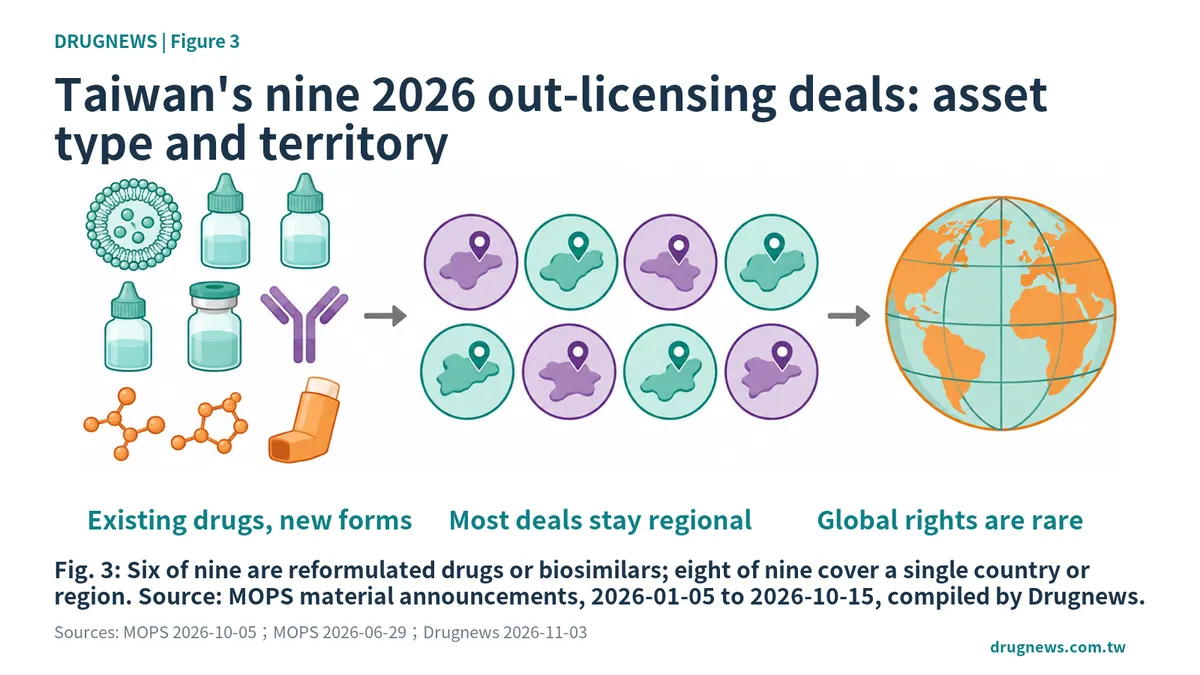
Fig. 3: Six of nine are reformulated drugs or biosimilars; eight of nine cover a single country or region. Source: MOPS material announcements, 2026-01-05 to 2026-10-15, compiled by Drugnews.
04 | The second layer: Korea has new platforms and still trails ninefold
The Asia Business Daily set two Eli Lilly deals side by side.
In 2025, Lilly paid Korea's ABL Bio $40 million upfront for a brain-delivery platform.
In February 2026, it paid China's Innovent Biologics $350 million upfront.
Same buyer, both next-generation technology, an 8.75-fold difference.
The extra money buys scale of clinical data.
Evaluate counts that 51% of ADC clinical trials worldwide include a product from a China-based company, and 48% of CAR-T trials involve assets that originated in China.
Drugmakers restocking pipelines find most of the available human data in China.
Boehringer's structure points the same way. SBP does early development itself;
Boehringer waits for agreed clinical milestones and human data before deciding on its options.
The $358 million buys first call on human data that is coming soon.
For Taiwan, switching to new molecules is only the first gate. The second is producing the human data buyers want, fast enough and in enough patients.
05 | Same drug, two sales: who captured the multiple
The price of that second gate is clearest in one drug that changed hands twice.
On November 13, 2024, BioNTech agreed to buy China's Biotheus for $800 million upfront and up to $150 million in milestones.
The core asset was the PD-L1×VEGF bispecific pumitamig (BNT327).
Less than seven months later, on June 2, 2025, Bristol Myers Squibb agreed to share the drug's global rights with BioNTech:
$1.5 billion upfront, $2 billion in non-contingent payments through 2028, and up to $7.6 billion in milestones.
Biotheus sold the whole company for at most $950 million.
BioNTech's guaranteed money from BMS alone is $3.5 billion, 3.7 times as much, and BioNTech kept half the rights.
BioNTech's third-quarter report on November 3, 2026 lists seven pivotal trials for pumitamig.
Between the two sales, one thing changed: the drug entered global clinical development and human data began to accumulate.
The original developer sold early and took certain cash. It gave up the multiple that came after.
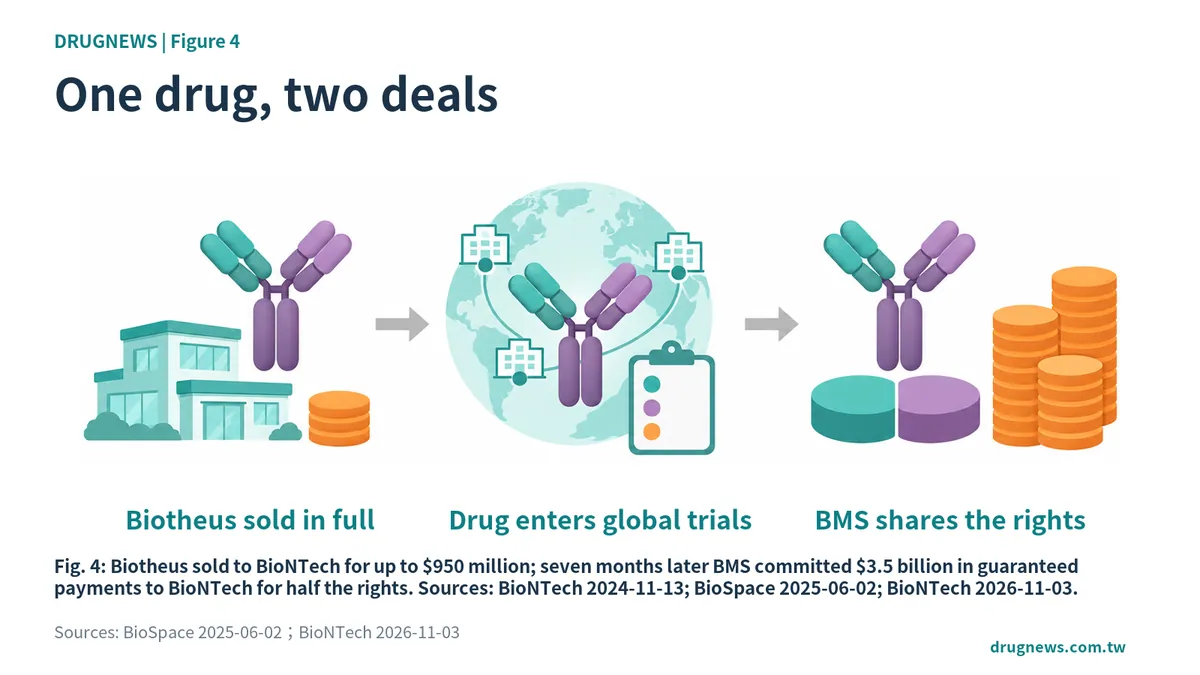
Fig. 4: Biotheus sold to BioNTech for up to $950 million; seven months later BMS committed $3.5 billion in guaranteed payments to BioNTech for half the rights. Sources: BioNTech 2024-11-13; BioSpace 2025-06-02; BioNTech 2026-11-03.
06 | The counterargument: most of China's numbers will never be paid
The strongest objection:
95% of the $7.36 billion is milestones, new drugs fail often, most of it will never be paid, and Taiwan has nothing to envy.
That is half right, which is why this piece compares upfronts only.
Drugnews reviewed 10 Taiwanese licensing deals since 2021 (details in our Taiwan biotech licensing tracker).
None shows the headline value fully paid. Taiwan's headline numbers also mostly stay on paper.
Strip out every milestone and the gap is still an order of magnitude:
Boehringer's $358 million upfront is 35.8 times Taiwan's only disclosed upfront this year.
07 | Two gates between Taiwan and a comparable upfront
This year's list shows Taiwan's strengths plainly: reformulated drugs, biosimilars and regional sales rights.
These deals cost less to develop and reach market sooner. The price is that each one sells only one market.
To earn an upfront above $100 million, the first gate is the asset: a next-generation molecule with global or ex-Greater China rights.
The second is data: human data the buyer can see at signing, or soon after.
Several Taiwanese companies already have ADCs in the clinic; their progress and gaps are in our Taiwan ADC landscape.
Two outcomes would overturn this view.
If a Taiwanese reformulated drug or biosimilar deal earns an upfront above $50 million, asset type is not the first ceiling.
If a Taiwanese or Korean new molecule with Phase 1 data earns an upfront above $100 million, data scale is not the second gate.
Until then, when Taiwanese biotechs negotiate with global drugmakers, the ceiling on the upfront is set before anyone sits down: how many countries the asset can be sold in, and when the human data will be ready.
This article is industry and company analysis, not investment or medical advice.
References
- Boehringer Ingelheim and SBP Group enter partnership to advance next-generation cancer therapies · Boehringer Ingelheim · 2026-11-04 · https://www.boehringer-ingelheim.com/human-health/boehringer-announces-new-oncology-partnership-sbp-group
- Boehringer Ingelheim Licenses Six Preclinical ADC and T-Cell Engager Programs From SBP Group in Deal Worth Up to $7 Billion · BioPharm International · 2026-11-04 · https://www.biopharminternational.com/view/boehringer-ingelheim-licenses-six-preclinical-adc-and-t-cell-engager-programs-from-sbp-group-in-deal-worth-up-to-7-billion
- [KR-China Bio Contrast] Despite Similar Promising Technologies, Upfront Payments Are Only One-Third of China's · The Asia Business Daily · 2026-06-16 · https://view.asiae.co.kr/en/article/2026060908060639753
- After 230% deal size explosion, China is no longer the 'bargain basement' for biopharma licensing: analyst (Evaluate's Mark Lansdell) · Fierce Biotech · Accessed 2026-11-05 · https://www.fiercebiotech.com/biotech/analyst-china-no-longer-bargain-basement-biotech-acquisitions
- BioNTech to Acquire Biotheus · BioNTech (SEC Form 6-K) · 2024-11-13 · https://www.sec.gov/Archives/edgar/data/1776985/000177698524000094/a99_1biontechtoacquirebiot.htm
- BMS Commits up to $11B+ To Work With BioNTech on Solid Tumor Bispecific · BioSpace · 2025-06-02 · https://www.biospace.com/deals/bms-commits-up-to-11b-to-work-with-biontech-on-solid-tumor-bispecific
- BioNTech Announces Third Quarter 2026 Financial Results and Corporate Update · BioNTech · 2026-11-03 · https://www.biontech.com/int/en/home/mediaroom/news/press-releases/2026/11/BioNTech-Announces-Third-Quarter-2026-Financial-Results-and-Corporate-Update.html
- Foresee Pharmaceuticals Announces Global Licensing Agreement for MMP-12 Inhibitors with Primevera Therapeutics · PR Newswire · 2026-01-08 · https://www.prnewswire.co.uk/news-releases/foresee-pharmaceuticals-announces-global-licensing-agreement-for-mmp-12-inhibitors-with-primevera-therapeutics-llc-302656280.html
- TLC TLC599 Japan licensing material announcement · MOPS · 2026-10-05 · https://mops.twse.com.tw/mops/#/web/t05st01?companyId=7924&marketKind=rotc&enterDate=1151005&serialNumber=1
- EirGenix EG1206A Japan licensing material announcement · MOPS · 2026-06-29 · https://mops.twse.com.tw/mops/#/web/t05st01?companyId=6589&marketKind=sii&enterDate=1150629&serialNumber=2
- Taiwan biotech licensing tracker · Drugnews · 2026-11-03 · https://drugnews.com.tw/en/taiwan-licensing-deals.html
Share this analysis
Send this article to readers who follow biotech, company strategy, and capital-market signals.
Cite this article
For decks, research notes, or media references, cite Drugnews with the canonical article URL.
Drugnews Editorial Team. "Boehringer Paid China $358M, Taiwan Got $10M." Drugnews, Nov 09, 2026. https://drugnews.com.tw/articles/2026-11-09-boehringer-sino-biopharm-china-licensing-taiwan-gap-en.html